GuardDuty quarantine: Block infected backup restores fast
A significant price reduction for S3 scanning reported by cloudburn.io fundamentally shifts the economics of continuous backup validation. The math now favors event-driven quarantine workflows over periodic checks. Static schedules leave gaps that modern threats exploit with increasing frequency.
This guide architects a recovery point quarantine system isolating infected data the moment detection occurs. We leverage automated malware containment using native cloud event sources, avoiding the latency of external polling. The goal: deploy scalable workflows across complex AWS Organizations structures without manual intervention.
We implement strict tag-based enforcement to block restore operations on compromised assets. A dedicated forensics account becomes mandatory for deep-dive analysis, preserving production integrity. By anchoring security to specific cloud events, teams ensure no infected recovery point ever returns to the primary environment. This transforms backup storage from a passive target into an active security layer.
The Critical Role of Recovery Point Quarantine in Modern Backup Security
GuardDuty Malware Protection Mechanics for AWS Backup
GuardDuty Malware Protection scans AWS Backup recovery points to detect threats before restoration occurs. Ransomware often lies dormant for weeks, spreading across production systems while nightly backup jobs faithfully preserve it alongside valid data. Amazon GuardDuty Malware Protection for AWS Backup interrupts this cycle by scanning recovery points as part of the backup lifecycle.
The mechanism relies on automated tagging. When the scanner detects a threat, it applies specific metadata labels to the recovery point rather than deleting the file. This separation of detection and prevention preserves forensic integrity. Detection identifies the threat signature within the archived object; prevention relies on downstream policies to block the actual restore operation based on those tags. Without this separation, organizations risk losing evidence or triggering false positives that halt legitimate recovery.
Effective security demands this layered approach, integrating scanning results with immutable storage policies found in Amazon S3 configurations. Merely knowing a backup is infected provides zero protection unless the system actively prevents its use. Detection events must feed directly into enforcement mechanisms. Only then does the backup environment transition from a passive data store to an active defense layer against propagation.
Event-Driven Tagging Workflow Using EventBridge and Lambda
Threat detection triggers an immediate chain reaction. When GuardDuty Malware Protection completes a scan and finds threats, an Amazon EventBridge rule matches the finding event and invokes an AWS Lambda function. This trigger initiates the containment protocol. The function tags the infected recovery point, effectively labeling the data object for downstream enforcement policies. This automated workflow ensures malicious code remains isolated within the backup vault.
Without strict SCP enforcement, a privileged user could restore a tagged object, re-introducing the threat to production. The architecture balances preserving forensic evidence against preventing accidental exposure during the investigation window. While backup data persists for analysis, tag-based enforcement logic prevents standard restore operations on flagged items.
Automated response via EventBridge triggers ensures consistent security posture across all accounts. However, this approach depends entirely on correct Lambda error handling. If the tagging function fails, the recovery point remains unmarked and potentially restorable. Organizations must monitor the success rate of these tagging invocations to maintain a valid security boundary. Failure rates in automation create gaps that attackers exploit.
Manual Restore Blocking Versus Automated SCP Enforcement
Human intervention cannot match the speed required during active ransomware incidents. Manual identification of clean recovery points is impractical at scale given distributed security teams and shrinking detection-to-restore windows. Relying on human operators to inspect every archived object creates an unsustainable bottleneck.
A service control policy (SCP) at the organizations level denies `backup:StartRestoreJob` on recovery points carrying specific tags, effectively removing human error from the containment chain. This automated enforcement contrasts sharply with manual workflows where a single missed Infected tag allows ransomware propagation.
| Feature | Manual Review | Automated SCP |
|---|---|---|
| Response Speed | Dependent on operator availability | Immediate upon event trigger |
| Consistency | Variable | Absolute |
| Scalability | Low | High |
| Human Error | High Risk | Eliminated |
This rigidity ensures compromised data remains isolated regardless of credential compromise levels. Operators using AWS Backup for S3 workloads must recognize that tagging alone provides visibility but offers zero protection without the accompanying SCP layer. Forensic access requires a separate, exempted account path to analyze quarantined data safely. Access paths for forensics differ from standard operational procedures.
Integrating these controls democratizes enterprise-grade object storage security for AI/ML training data and media streaming archives. Skipping automation forces a reliance on speed that human teams cannot match against machine-speed threats. Delays in enforcement allow malware to spread unchecked through restored systems.
Malware Protection for S3 underwent a significant price reduction in February 2025. This economic shift drives adoption of the THREATS_FOUND event, which initiates containment by publishing a JSON finding where the `service.eventType` field explicitly equals "FINDING". The payload carries the resourceId of the scanned object alongside the severity score needed for downstream classification. Operators parse the `detail.type` string to identify specific malware signatures because generic error codes fail to trigger the quarantine workflow. EventBridge filters match this structure using precise JSON path operators and fail silently if the schema nesting differs from the GuardDuty specification. Engineering teams at Rabata.io observe that missing metadata fields often cause Lambda functions to skip tagging, leaving infected recovery points accessible. The architecture relies on this strict contract to enforce isolation before any restore operation occurs. Without accurate payload parsing, the subsequent Service Control Policy cannot evaluate the threat status of the backup target.
Schema versioning presents a tangible constraint; updates to the finding structure can break existing filters if not monitored closely. Teams should validate the JSON structure against the latest documentation during every platform upgrade cycle.
Lambda Tagging Logic for Infected Recovery Points
Invocation begins when EventBridge routes a THREATS_FOUND finding to the tagging function. Logic parses the `detail.type` string to confirm the malware signature before applying the ScanStatus: INFECTED label. Service Control Policies cannot enforce necessary restore blocks without this precise metadata injection.
A common failure mode involves missing `resourceId` fields in the payload, causing the function to exit without tagging the object. Operators must validate that the Lambda execution role possesses explicit `backup:UpdateRecoveryPoint` permissions to avoid silent failures. This shift makes continuous scanning viable for large datasets where manual review was previously cost-prohibitive. Relying solely on automated tags introduces a single point of failure if the tagging function lags behind scan completion. The recovery point remains technically restorable until tag propagation completes, creating a narrow but critical window of exposure. Teams should design workflows to assume tags may arrive seconds after the initial threat detection.
Rabata.io solutions integrate these tagging patterns directly into managed storage frameworks to ensure immediate isolation.
SCP Enforcement Steps to Block Restore Jobs
GuardDuty and AWS Security Hub findings are aggregated in a delegated administrator account to provide centralized visibility across all member accounts. This architecture ensures malware detection events trigger immediate policy enforcement without manual intervention. Operators must configure the Service Control Policy (SCP) to explicitly deny `backup:StartRestoreJob` actions when specific tags appear on recovery points. The enforcement mechanism relies on matching the ScanStatus tag value against a known bad state, effectively freezing the data.
A tangible limitation exists where missing metadata fields in the event payload cause the tagging function to exit silently. If the resource remains untagged, the SCP condition never evaluates to true, leaving the corrupted data accessible for restoration. This gap highlights why relying solely on event triggers without verification logic creates a false sense of security.rabata.io advises implementing retry logic with exponential backoff to handle transient API throttling during high-volume scans. The cost of this architecture is measurable in compute cycles, yet the alternative involves paying ransom or losing data entirely. Centralized aggregation allows security teams to monitor compliance posture across the entire enterprise from a single dashboard. Ransomware actors simply restore encrypted volumes from previous snapshots before defenders detect the breach without this layered.
Deploying Scalable Quarantine Workflows Across AWS Organizations
Prerequisites for AWS Organizations Quarantine Foundation
Administrators enable Service Control Policies (SCPs) in the management account to establish the necessary enforcement boundary for cross-account security operations. This core step allows downstream automation to block malicious restore attempts across the enterprise. Central activation of AWS Backup policies guarantees consistent protection rules apply to all member accounts within the organization. Such centralized configuration prevents gaps where ransomware could otherwise exploit unmanaged recovery points. Specific IAM roles configured in each member account permit GuardDuty scanning and Lambda execution for automated response workflows. These roles act as the secure identity layer allowing quarantine logic to function without exposing long-term credentials.
Deploying these controls creates a rigid perimeter where only verified clean data can be restored. Properly configured, this foundation supports the high-volume event processing required for modern threat landscapes.
Phased Rollout Strategy from Tier 0 Pilot to Full Scale
Operators initiate deployment by establishing the foundation with Service Control Policies enabled in the management account to create an enforcement boundary. This centralized control enables downstream automation to block malicious restore attempts across the enterprise. Teams must also activate AWS Backup policies centrally, ensuring consistent protection rules apply to every member account within the organization. Each account requires specific IAM roles permitting GuardDuty scanning and Lambda execution for these automated response workflows.
A tag-based denial strategy triggered by GuardDuty findings drives the enforcement mechanism. This phased approach mitigates the risk of false positives halting legitimate recovery efforts during initial tuning. Rapid containment conflicts with operational continuity; aggressive scanning thresholds may flag benign anomalies, requiring a period of observation before full enforcement. Extending from critical tiers allows teams to refine exclusion lists and verify that recovery point tagging logic functions correctly before broader application. Iterative scaling helps balance security posture with business availability requirements.
EventBridge Rule Configuration for THREATS_FOUND Events
This specific pattern ensures the automation engine reacts only when a scan job completes with a detected threat, ignoring benign state changes.
- Define the event pattern filtering for `detail-type` "Scan Job State Change" and `detail.state` "COMPLETED".
- Add a condition requiring `detail.scanResultStatus` to equal "THREATS_FOUND" to avoid false positives on clean runs.
Apply Service Control Policies at the Organizational Unit level for targeted testing before enforcing them at the root. A phased approach allows security teams to verify that IAM roles correctly execute the tagging logic without disrupting production workflows.
| Deployment Scope | Risk Profile | Operational Impact |
|---|---|---|
| Root Organization | High | Blocks all accounts instantly |
| Specific OU | Low | Isolates impact to test group |
Validating the entire pipeline using test files helps simulate infection safely. The limitation of this architecture is latency; scanning large datasets exceeds the threshold where immediate processing becomes costly. Engineers should anticipate delays between backup completion and finding generation, meaning fresh recovery points remain vulnerable until the scan cycle finishes.
Optimizing Scan Costs and Forensic Isolation Strategies
Tiered Scanning Frequency by Workload Criticality
Frequent scanning of recovery points guarantees integrity before restoration attempts commence. Lower tiers often accept reduced frequency to balance cost against risk exposure. Aggressive scanning on critical workloads may introduce latency during peak transaction windows if throttling mechanisms fail. Operators must shift from uniform policies to granular scanning schedules. This tiered approach optimizes storage spend while maintaining forensic isolation. Organizations waste resources scanning benign development assets without such differentiation. Critical data remains under-protected when scanning lacks strategic alignment. A single breached asset costs far more than the compute expense of frequent scanning. High-value targets stay exposed to undetected propagation when scan cadence ignores business criticality. Strategic frequency matching ensures recovery point availability aligns with actual threat levels.
Calculating GuardDuty S3 Scanning Costs Post-Reduction
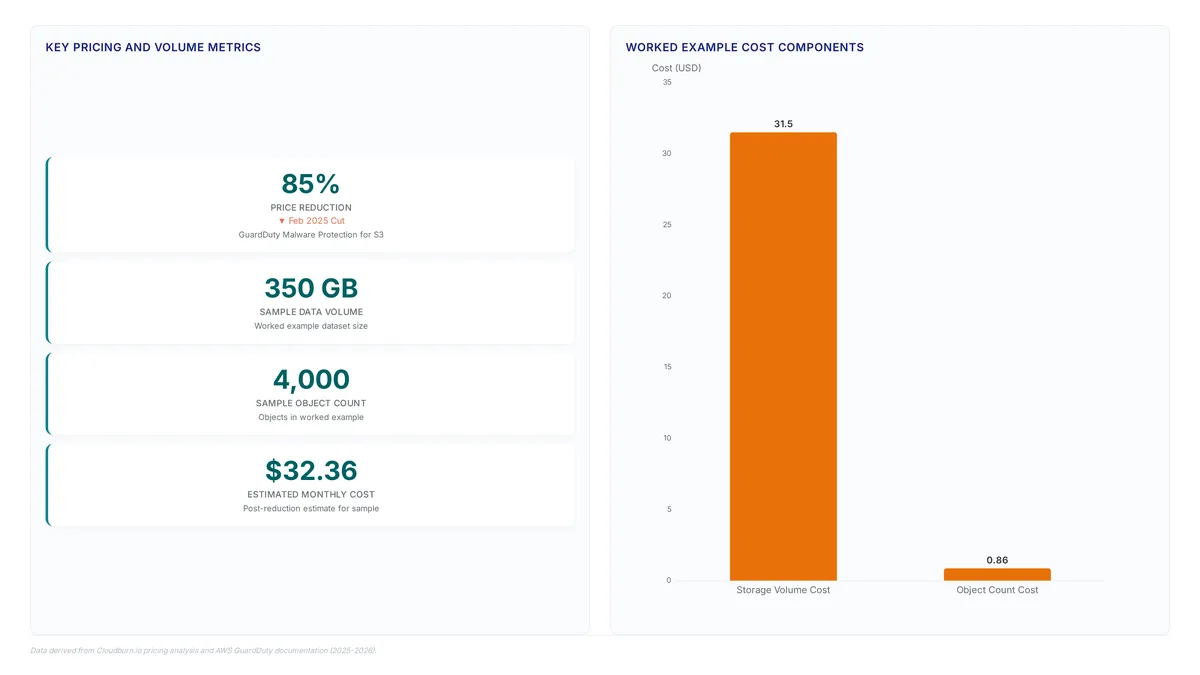
Specific object counts and data volumes alter the business case for continuous scanning of large datasets. Enterprises now move from sampling to thorough coverage without prohibitive expense. Operators justify scanning entire S3 buckets rather than relying on probabilistic spot checks that miss latent threats. Deep inspection across terabytes of object storage sustains predictable operational expenditures. Security architects face a reduced need to architect complex, selective scanning policies based solely on cost constraints. Increased scan frequency generates higher event volumes in Security Hub, requiring adjusted alert thresholds. Storage scanning may be cheaper, yet downstream processing of findings often demands additional automation for efficiency. Data integrity takes precedence over budgetary friction for critical recovery points under this economic shift.
| Scenario | Objects | Data Volume | Estimated Monthly Cost |
|---|---|---|---|
| Legacy Pricing Model | Variable | Variable | High / Prohibitive |
| Post-Reduction Model | Variable | Variable | Reduced |
Resource Cleanup Steps to Prevent Ongoing Charges
Isolated environments accumulate charges if automation artifacts persist post-exercise. Lingering event triggers invoke compute resources even without active malware findings, creating cost leakage. AWS documentation confirms that S3 backups rely on these event dependencies, meaning orphaned rules continue consuming capacity. Forgetting a single scheduled function can inflate monthly operational expenditures unexpectedly. Manual deletion risks missing hidden dependencies in complex organizational structures. Teams must treat cleanup as a mandatory validation step equal to the initial deployment. Removing these components prevents an open financial loop that contradicts cost-optimization goals.
| Component | Action Required | Risk if Skipped |
|---|---|---|
| EventBridge Rule | Delete | Continuous event triggering |
| Lambda Function | Delete | Compute billing accrual |
| SNS Topic | Delete | Notification delivery fees |
About
Alex Kumar is a Senior Platform Engineer and Infrastructure Architect at Rabata.io, specializing in Kubernetes storage architecture and disaster recovery strategies. His daily work designing resilient, S3-compatible storage solutions for enterprise clients directly informs this analysis of AWS GuardDuty quarantine logic. Having architected backup systems where preventing the restoration of infected recovery points is critical, Alex understands the complexities of event-driven security responses and tag-based enforcement. At Rabata.io, a provider of high-performance object storage for AI/ML startups and enterprises, he ensures data integrity across multi-cloud environments. This expertise allows him to dissect how automated malware detection can inadvertently block legitimate ransomware recovery efforts. When inspection scales from sampling to full-bucket coverage, the downstream automation required to process findings becomes the primary cost driver rather than the storage scan itself. Organizations must recognize that cheap scanning does not equate to free operations if orphaned EventBridge rules and Lambda functions continue invoking compute resources after an exercise concludes. Relying on manual deletion for these dependencies is a strategic error that guarantees financial leakage in complex environments.
Teams should mandate an automated validation step for resource teardown before any scanning workflow reaches production, ensuring no scheduled functions persist without active governance. This discipline prevents the very cost spikes that undermine the value of deep inspection. Start by auditing your current EventBridge rules this week to identify and remove any triggers associated with completed or abandoned malware scanning projects. Only by securing the lifecycle of your automation can you ensure that data integrity takes precedence over budgetary friction without creating new financial liabilities.
This gap leaves the environment exposed because prevention policies rely entirely on those specific tags to block restore operations.
Q: Why is manual restore blocking insufficient for modern ransomware threats?
A: Manual identification creates an unsustainable bottleneck during active incidents due to shrinking windows. Automated service control policies are required to deny restore jobs on tagged items quicker than any human operator could react.
Q: How does the architecture separate detection from prevention mechanisms?
A: Detection identifies threat signatures while prevention relies on downstream policies to block restores. This separation preserves forensic integrity by keeping infected data available for analysis while strictly preventing its return to production.
Q: What role does a dedicated forensics account play in this workflow?
A: A dedicated forensics account enables deep-dive analysis without risking production integrity. It allows security teams to investigate compromised recovery points safely while tag-based enforcement prevents accidental exposure during the investigation window.
Frequently Asked Questions
This shift allows teams to replace risky periodic checks with constant event-driven quarantine workflows without exceeding budget constraints.
If the tagging function fails, the recovery point remains unmarked and potentially restorable. This gap leaves the environment exposed because prevention policies rely entirely on those specific tags to block restore operations.
Manual identification creates an unsustainable bottleneck during active incidents due to shrinking windows. Automated service control policies are required to deny restore jobs on tagged items faster than any human operator could react.
Detection identifies threat signatures while prevention relies on downstream policies to block restores. This separation preserves forensic integrity by keeping infected data available for analysis while strictly preventing its return to production.
A dedicated forensics account enables deep-dive analysis without risking production integrity. It allows security teams to investigate compromised recovery points safely while tag-based enforcement prevents accidental exposure during the investigation window.
References