Sovereign backup cuts hidden cloud fees fast
Managed backup services cost roughly $30 per month per agent. Commodity hosts hide the real bill behind egress fees and noisy neighbors. Sovereign cloud infrastructure paired with immutable backups is the only exit strategy for SMEs stuck in the "tenant trap" of throttled performance and unpredictable costs. Isolated architectures stop multi-tenant interference dead. Proxmox grants actual control over data location and encryption keys. Automated data protection removes the human error that breaks recovery workflows.
Commodity platforms look cheap until IOPS charges and snapshot growth explode the budget. ReadySpace Singapore notes that these hidden fees destroy the stability modern business continuity demands. Sovereign solutions let organizations host workloads on infrastructure they fully manage, locking down access policies and compliance. This isn't optional for firms needing strict data sovereignty; it's the only way to avoid third-party throttling during peak demand.
Measurable stability requires ditching shared resources that expose sensitive workloads to performance degradation. Deploying secure AI workload environments on private networks cuts latency and shields intellectual property. Data governance must support production continuity, not hinder it with opaque pricing and limited SLAs.
The Role of Sovereign Cloud and Automated Data Protection in Modern SME Infrastructure
Defining Automated Data Protection and Immutable Backups
Automated data protection runs scheduled snapshots and validation routines to kill manual backup errors. Recovery points stay current without an administrator needing to trigger jobs. Managed services apply intelligent oversight, flagging issues before they become data loss events. The mechanism relies on strict policies enforcing retention windows and verifying data integrity immediately after creation.
Immutable backups add a defense layer where stored data cannot be modified or deleted for a fixed duration. This architecture physically blocks ransomware from encrypting existing restore points or removing recovery paths. Unlike standard writable volumes, these objects reject any change request until the retention period expires.
Sovereign Cloud vs Commodity Hosting for SME Control
Sovereign cloud infrastructure delivers total control over encryption keys and data location, directly addressing strict residency mandates. Isolated architectures prevent noisy neighbors from impacting recovery speeds, a sharp contrast to multi-tenant environments where shared resources cause performance variance. 2026 regulations increasingly demand verifiable data sovereignty, making isolated deployment indispensable for compliance rather than optional.
Commodity hosting often appears cheaper initially but incurs hidden expenses through complex pricing structures. Providers like AWS charge a headline rate of approximately $0.05 per GB-month for backup storage, yet this figure frequently excludes critical add-on costs such as cross-region data transfer and audit evaluations.
The Tenant Trap and RTO Risks in Multi-Tenant Platforms
The tenant trap happens when multi-tenant platforms throttle performance during peak demand, slowing recovery. Shared resources create noise that degrades throughput exactly when speed matters most for restoration. Critical transactional systems require recovery time objectives measured in minutes rather than hours to maintain continuity. Less critical workloads tolerate longer windows, but core databases cannot wait for neighbor traffic to subside.
Basic support tiers often cost €1,080 per year yet provide only a 1-day response time, which fails minute-level requirements. Recovery point objectives define maximum data loss while RTO dictates the speed of restoration. Relying on commodity hosting introduces latency risks that violate strict service level agreements during outages. Data durability for modern cloud backup often reaches 99.999999999% through intelligent tiering without compromising integrity. High durability does not guarantee fast access if the underlying storage cluster is congested by other tenants. This limitation forces a choice between cost savings and predictable performance during disaster scenarios. Isolated sovereign infrastructure mitigates this risk by guaranteeing resource availability. Backup streams maintain consistent throughput regardless of external market activity or neighbor behavior with this architecture.
Inside the Architecture of Immutable Backups and Secure AI Workload Environments
How Immutable Storage Blocks Ransomware Encryption Cycles
Storage systems using object lock capabilities compatible with S3 standards enforce write-once-read-many (WORM) compliance to halt ransomware encryption cycles. This technical mechanism prevents modification or deletion for a set period, effectively stopping attackers from encrypting restore points. The storage layer rejects any delete or overwrite commands during the retention window, ensuring backup lineage remains intact. Even compromised administrative credentials cannot purge recovery data when modern implementations apply these object lock features correctly.
Organizations adopting these controls treat attacks as manageable events rather than existential crises by preserving a safe path to recovery. Security and backup convergence creates an inherent defense where data copying becomes an active protection strategy. Strict segregation stops the encryption cycle before all redundant data is corrupted.
Sovereign GPU allocation isolates training clusters to dedicated hardware, eliminating noisy neighbor latency spikes common in shared commodity environments. This architectural choice secures AI workloads by enforcing strict network segmentation around high-value intellectual property. Running AI workloads on a sovereign platform reduces latency, gives full control over training data, and protects IP with private networks and encryption. Infrastructure optimization for AI workloads includes GPU allocation, fast storage, and low-latency networking.
Encryption standards mandate AES-256 for all data in transit and at rest states. 256-bit encryption strength provides the mathematical foundation for data confidentiality. Managing keys within this sovereign boundary ensures that only authorized personnel can decrypt sensitive training sets, satisfying rigorous compliance audits. Many regulations require demonstrable controls, so audited key lifecycle processes and separation of duties are implemented. Optimizing infrastructure requires precise GPU allocation paired with fast storage tiers to prevent bottlenecks during massive parallel processing tasks. Initial configuration complexity balances against long-term expenditure stability. Organizations ignoring this architectural shift risk exposing proprietary models to third-party risks inherent in public multi-tenant zones. Sovereign infrastructure delivers the foundation necessary for secure, high-performance artificial intelligence development.
Validating Backup Health Through Continuous Monitoring and Audited Key Lifecycles
Operational stability requires continuous monitoring that alerts on failed jobs before capacity trends breach recovery thresholds. Implementing this visibility layer helps detect silent corruption and ensures every scheduled snapshot completes successfully. Automated data protection uses scheduled snapshots, replication, and validation routines to ensure backups are up to date and recoverable. Automation removes human error, enforces retention policies, and supports rapid recovery when incidents occur.
Secure environments demand rigorous key lifecycle management where creation, rotation, and destruction follow audited procedures. Compliance frameworks often mandate separation of duties, ensuring no single administrator controls both the encryption keys and the backup data. The market now treats data protection as a continuous service relationship necessary for operational survival rather than a one-time purchase. Centralized consoles enable providers to track health metrics across customer environments efficiently. Automated validation ensures backups are recoverable and supports rapid recovery when incidents occur, whereas relying on manual checks introduces the risk of human error. The cost of undetected backup failures far exceeds the investment in automated, sovereign monitoring infrastructure.
Measurable Stability Gains from Adopting Managed Backup Over Self-Managed Solutions
Defining Total Cost of Ownership in Backup Architectures
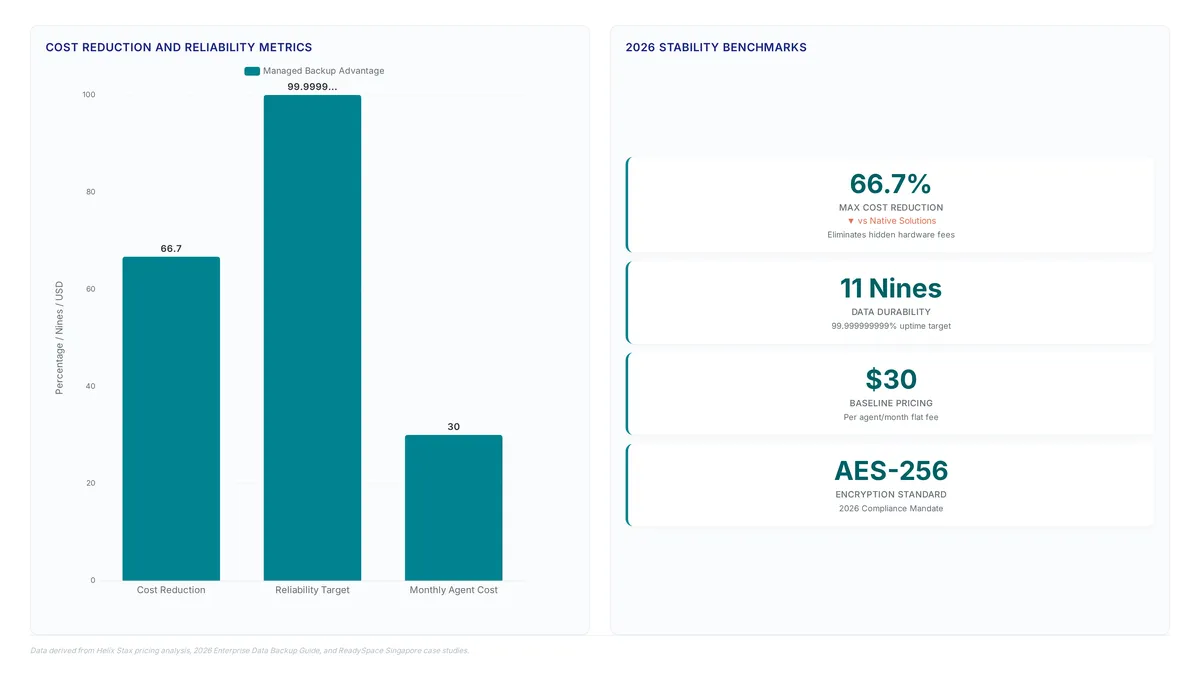
Defining total cost of ownership requires analyzing hidden expenses beyond headline storage rates. Commodity hosting often appears cheaper initially but shifts costs through egress fees, increased IOPS charges, and snapshot storage growth. Research indicates that the total cost of "free" solutions includes mandatory hardware purchases, complex setup time, and skilled IT staff salaries, which frequently exceeds the cost of a managed subscription for small enterprises. Managed backup services operate on a predictable model, often charging a flat fee per agent rather than penalizing data retrieval. This approach converts unpredictable outage recovery costs into a fixed operational expenditure. Organizations favor managed services because they eliminate surprise fees associated with noisy neighbors and performance degradation. ReadySpace Singapore designs solutions that limit these hidden costs while improving performance predictability for AI training data and media streaming workloads. Adopting a managed model ensures that budget allocations reflect actual business value rather than architectural penalties.
Deploying Tiered Storage for Hybrid Cloud Recovery
Policies move cold data to economical storage while keeping hot data on high-performance tiers to maintain recovery speed. ReadySpace Singapore implements tiered storage architectures that automatically shift infrequent backups to lower-cost layers without manual intervention. This approach ensures that active recovery points remain instantly accessible on fast disks while archived data resides on economical storage.
SMEs using a hybrid approach report improved system stability when integrating local speed with cloud replication for durability. The operational tension lies between minimizing monthly spend and guaranteeing that cold data retrieval does not violate recovery time objectives during an incident. Unlike commodity hosts that charge per retrieval operation, ReadySpace supports on-prem, sovereign cloud, and public cloud hybrids with unified policies. This unified management eliminates the complexity of maintaining separate rule sets for each environment.
| Storage Tier | Data Type | Access Latency | Cost Profile |
|---|---|---|---|
| High-Performance | Hot backups | Milliseconds | Premium |
| Economical | Cold archives | Minutes | Low |
The cost of ignoring tiered architectures is measurable: organizations often pay premium rates for data that rarely requires access. Advanced managed services are introducing Instant Restore capabilities allowing VMs to boot directly from backup storage. This feature reduces downtime significantly compared to traditional restoration methods that require full data retrieval before booting.
The Hidden Labor Costs of Open-Source Support Models
"Free" open-source backup platforms like Proxmox Backup Server often mandate annual support contracts ranging from €1,080 to €2,160 to guarantee business continuity. These fixed fees represent only the entry price for a strong solution, as the true operational burden lies in the unquantified labor hours required for ongoing maintenance. Necessary tasks such as patching, capacity planning, and periodic recovery drills consume significant engineering bandwidth that could otherwise drive innovation. Without dedicated staff, organizations risk missing critical security audits or failing to verify backup integrity until a disaster strikes.
| Cost Factor | Self-Managed open-source | Managed Service |
|---|---|---|
| Support Access | Paid tiers required | Included 24/7 |
| Maintenance Labor | High internal overhead | Zero operational lift |
| Recovery Verification | Manual execution | Automated workflows |
| Total Cost Predictability | Variable and hidden | Fixed monthly rate |
The financial risk escalates when internal teams lack specific expertise, leading to configuration errors that compromise data sovereignty. While the software license cost is zero, the requirement for specialized certification and constant vigilance creates a hidden deficit in productivity. ReadySpace eliminates this uncertainty by bundling expert management with sovereign cloud isolation, ensuring that recovery drills and security updates occur without distracting core engineering teams.
Executing a Resilient Disaster Recovery Strategy to Prevent Data Loss and Fix Slow Recovery
Mapping Service Tiers to Business Impact for RTO Targets
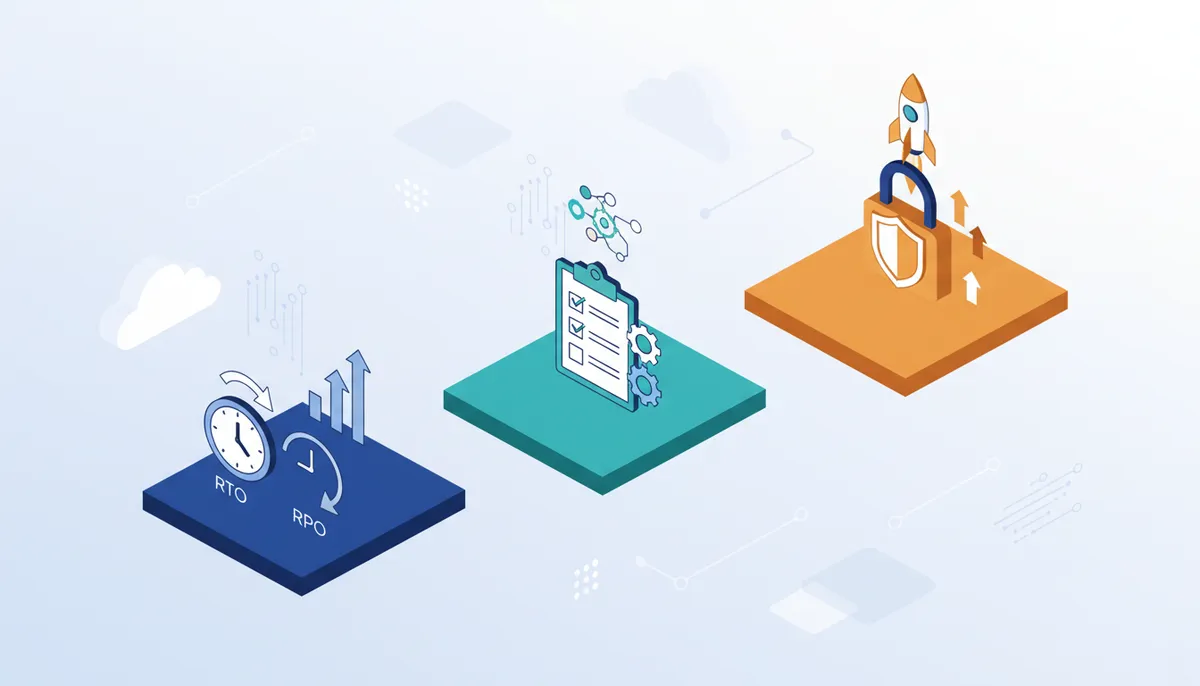
Critical transactional systems require recovery time objectives measured in minutes, whereas less critical workloads tolerate longer restoration windows.
- Conduct a business-impact analysis to classify assets by revenue dependency and operational necessity.
- Define RTO/RPO targets that align technical capabilities with specific business continuity requirements.
- Map recovery workflows to assign appropriate storage tiers and replication frequencies for each category.
| System Tier | Impact Level | Target RTO | Protection Mechanism |
|---|---|---|---|
| Tier 1 | Critical | Minutes | Synchronous Replication |
| Tier 2 | Necessary | Hours | Hourly Snapshots |
| Tier 3 | General | Days | Daily Backups |
Industry analysis highlights that treating backup as a non-optional entry point requires automation to manage these distinct tiers effectively. Advanced services now offer Instant Restore capabilities, allowing virtual machines to boot directly from backup storage rather than waiting for full data restoration. This architectural shift changes the cost-benefit analysis of tiering, as the penalty for misclassifying a Tier 2 system drops significantly when boot times approach zero. Solutions are designed to limit hidden costs and improve performance predictability by mapping service tiers to business priorities. Misalignment between business impact and technical tiering creates unnecessary expense or unacceptable risk exposure.
Preventing Data Loss During Upgrades with Staged Replication
Effective strategies apply staged replication workflows that synchronize data incrementally rather than in single massive bursts. This approach validates checksums at every step, ensuring data integrity before the next segment moves. Pre-migration testing and incremental synchronization ensure data integrity and allow rapid rollback if issues arise. If an upgrade fails, validated snapshots provide a path to restore the system to its pre-upgrade state.
- Create an immutable backup copy that prevents modification or deletion for a set retention period.
- Run incremental synchronization jobs to mirror only changed blocks to the staging environment.
- Perform "dress rehearsal" tests to confirm the staged data supports actual recovery, not storage.
The operational tension lies between upgrade speed and verification depth; rigorous validation is necessary to prevent data loss. Unlike commodity hosts that may charge hidden fees for these restore operations, sovereign infrastructure ensures that routine file recovery or full incident VM restoration incur no incremental egress fees. This financial predictability allows teams to prioritize rigorous testing schedules over cost-cutting measures that compromise safety. Rapid rollback capabilities change potential outages into minor, manageable delays.
Runbook Requirements for Redundant Storage and Recovery Drills
Recovery speed depends on RTOs, data size, and architecture, where well-architected replication allows businesses to restore critical services in minutes. A resilient disaster recovery strategy includes implementing redundant storage, regular recovery drills, immutable copies, and clear runbooks to ensure quick, tested recovery.
- Schedule regular recovery drills to validate that backup data remains viable and uncorrupted over time.
- Create clear recovery runbooks that detail exact steps for failover, eliminating confusion during high-stress incidents.
- Verify immutable copies frequently to ensure ransomware cannot encrypt or delete restore points before an attack occurs.
Managed services employ automated checksum controls and dress rehearsal tests to confirm successful recovery during actual disasters. Advanced technical features now include Instant Restore, enabling virtual machines to boot directly from backup storage targets. This capability significantly reduces Recovery Time Objectives by bypassing the traditional data transfer phase entirely. European providers increasingly eliminate egress fees, ensuring that restore operations incur no incremental cost beyond storage.
| Feature | Basic Tier | Advanced Managed Service |
|---|---|---|
| Restore Method | Full Download | Instant Boot |
| Data Verification | Manual Spot-Check | Automated Checksums |
| Egress Cost | Variable Fees | Zero Fee Policy |
| Drill Frequency | Annual | Quarterly |
Structured testing reveals configuration drift before it causes permanent data loss.
About
Marcus Chen serves as a Cloud Solutions Architect and Developer Advocate at Rabata.io, where he specializes in S3-compatible object storage and AI/ML data infrastructure. His daily work designing scalable, cost-effective cloud architectures directly informs this analysis of managed backup capabilities for SMEs. Having benchmarked storage performance across various providers, Chen understands the critical impact of hidden egress fees and unpredictable IOPS charges on business stability. At Rabata.io, a provider dedicated to transparent, high-performance object storage, he helps organizations eliminate vendor lock-in while securing their data assets. This article connects his hands-on experience with Rabata.io's mission to deliver enterprise-grade backup solutions without the complexity of traditional commodity hosts. By using Rabata.io's GDPR-compliant infrastructure and straightforward pricing models, Chen guides technical leaders toward resilient storage strategies that protect against data loss while optimizing total cost of ownership for expanding enterprises.
Conclusion
Scaling backup operations reveals that low headline storage rates often mask prohibitive recovery costs and sluggish response times. The real operational burden emerges not during data ingestion but when minute-level restoration is required without incurring massive egress penalties. Organizations relying on basic tiers face a critical gap where annual costs exceed €1,080 yet deliver only day-long response windows, rendering them ineffective against modern ransomware velocity. You must transition to a model where sovereign infrastructure guarantees zero-fee restores and immutable copies are verified through automated checksums rather than manual spot-checks.
Adopt a managed service architecture that mandates quarterly recovery drills and instant boot capabilities before your next compliance audit. This approach ensures that Recovery Time Objectives reflect actual business continuity needs rather than theoretical maximums. The data durability offered by rigorous testing schedules directly supports production continuity after substantial IT incidents. Do not wait for a failed restore to expose configuration drift in your current strategy.
Start this week by auditing your existing backup runbooks to verify they include steps for instant restore procedures and confirm that your provider charges nothing for data egress during a disaster scenario. If your current documentation relies on full downloads or lacks immutable copy verification, you must upgrade your protocol immediately.rabata.io provides the sovereign cloud framework necessary to execute these high-frequency drills without financial penalty, ensuring your recovery posture remains reliable and cost-predictable.
Frequently Asked Questions
Managed backup services often cite a baseline of $30 per month per agent. This predictable pricing model helps SMEs avoid the hidden egress fees and noisy neighbor issues found in commodity hosting environments.
Providers may charge a headline rate of approximately $0.05 per GB-month for storage. However, this figure frequently excludes critical add-on costs like cross-region transfers that significantly increase the total budget.
Multi-tenant platforms often create a tenant trap where shared resources cause throttling. This leads to unpredictable recovery speeds during peak demand, unlike sovereign infrastructure that ensures consistent performance through isolation.
These backups prevent data modification or deletion for a fixed duration. This architecture physically blocks ransomware from encrypting restore points, ensuring a valid recovery path remains available without paying attackers.
Proxmox allows organizations to fully manage their own infrastructure and encryption keys. This provides total control over data location, which is essential for meeting strict residency mandates and compliance requirements.
References