Prefix caching cuts LLM latency by 70%
Machine learning-driven routing cuts time-to-first-token latency by over 70% according to Google Cloud data. Readers will examine the mechanics of prefix caching and model-aware routing that enable these gains, alongside a direct comparison of managed Kubernetes services versus third-party alternatives for running real-time inference pipelines.
The analysis dissects how KV cache optimization prevents redundant computation during repetitive prompt sequences, a critical factor for AI inference acceleration. By using static prefix routing, organizations can avoid the "cache tax" inherent in generic orchestration tools. The discussion extends to how these architectural choices impact inter-token latency and overall system throughput in large-scale deployments.
Infrastructure teams must evaluate whether their current ai/ml cluster configurations support these advanced scheduling policies or if they remain stuck paying for inefficient resource usage. The following sections provide a technical breakdown of these capabilities without relying on vendor hype, focusing strictly on the operational realities of deploying LLM performance optimization strategies in production environments.
The Role of GKE Inference Gateway in Modern AI Infrastructure
GKE Inference Gateway Definition and KV Cache Mechanics
Acting as a native extension, the GKE Inference Gateway uses prefix caching and model-aware routing to optimize Large Language Model workloads. An AI model generates key and value vectors for every token when processing input like conversation history. Storing these vectors prevents the system from reprocessing prior tokens during subsequent steps, dramatically accelerating inference speeds. This stored state is known as the KV cache, residing in high-bandwidth memory that remains finite relative to expanding context windows. As agentic workflows chain longer interaction sequences together, demand for this cache frequently exceeds available GPU capacity without intelligent management.
Reducing Inter-Token Latency with Model-Aware Routing
Model-aware routing directs requests to accelerators holding active KV cache states. Standard round-robin schedulers ignore these memory locations, forcing expensive recomputation of prompt tokens. High inter-token latency emerges as GPUs re-process identical context windows due to this inefficiency. Analyzing real-time server metrics before dispatch eliminates such waste. These gains directly address the need to fix high inter-token latency in LLMs by ensuring requests hit primed hardware. Cache affinity creates tension with cluster-wide load balancing. Tuning affinity thresholds prevents single-point saturation while still reducing time to first token in gen AI apps. Intelligently routing workloads based on real-time model server metrics minimizes accelerator idle time, yet requires careful monitoring of queue depths. Configuring appropriate cache-eviction policies alongside these routing rules helps prevent memory fragmentation. Long-running static prefixes may consume disproportionate high-bandwidth memory without such guardrails, blocking new sessions from entering the cache entirely.
GKE Inference Gateway Throughput vs Traditional Round-Robin Load Balancing
Standard round-robin schedulers ignore active memory states, forcing GPUs to recompute tokens unnecessarily. The GKE Inference Gateway resolves this bottleneck by directing traffic to pods holding the KV cache entries. Intelligent dispatch yields substantial throughput advantages over traditional scheduling methods. Operators observing these gains often overlook the direct correlation between cache affinity and capital efficiency. Maximizing cache hits requires accepting uneven load distribution across the cluster. A purely throughput-optimized scheduler might overload specific nodes while others sit idle, creating hot spots that threaten stability. Engineers tune routing weights to balance memory locality against raw compute availability. This tension defines the operational ceiling for large language model deployments. Enterprises seeking to fix high inter-token latency in LLMs should evaluate storage backends that support such granular data access patterns. Strong object storage foundations are necessary to feed these high-throughput inference pipelines without introducing upstream bottlenecks.
Inside Prefix Caching and Model-Aware Routing Mechanics
How KV Cache Storage Enables Prefix Caching in LLMs
Generating key and value vectors for every token allows a model to retain conversational context without reprocessing prior inputs. This storage mechanism accelerates inference by skipping redundant computation steps during subsequent interactions. Context windows in agentic AI workloads frequently expand beyond the limits of GPU high-bandwidth memory (HBM), creating a bottleneck for large-scale deployment. Persisting this data in a dedicated storage tier outside the GPU resolves capacity issues while preserving microsecond-level access speeds. The GKE Inference Gateway inspects incoming request prefixes and routes them to specific pods where that data already resides in memory, effectively bypassing unnecessary processing on GPUs and TPUs.
Cache effectiveness relies heavily on consistent request patterns rather than random prompts. Highly variable inputs yield minimal performance gains compared to repetitive system instructions found in structured applications. Clusters lacking proper alignment to cache locality often require horizontal scaling to handle cache misses, which inflates operational costs without improving throughput. Memory locality dictates speed in these scenarios far more than raw compute power does.
Pinning Static API Documentation for RAG Workloads
Retrieval-augmented generation pipelines accelerate codebase Q&A by pinning entire documentation sets as static cached prefixes. A single prompt might include a static prefix of 10,000+ words of API reference documentation while the user question changes per request. This architecture isolates immutable context from flexible queries, allowing the inference gateway to route traffic directly to pods holding the specific KV cache in memory. Operators adopt this pattern when token generation latency dominates total response time in production environments. The mechanism stores activation states for the documentation block once, eliminating redundant GPU processing for every subsequent developer query. Increased memory pressure on nodes hosting large context windows presents a tangible constraint. High-metadata-concurrency workloads often require high-performance storage solutions to sustain the throughput needed for rapid cache population. Static routing requires cache invalidation and warm-up cycles if the underlying documentation changes frequently. This configuration works best for internal developer tools where API specs remain stable across sprints. The performance gain justifies the memory overhead only when the same documentation context serves thousands of unique questions.
Validating Model-Aware Routing Against Round-Robin Baselines
Engineers validate model-aware routing by measuring token generation latency against standard round-robin distribution. Unlike round-robin, which blindly cycles through available pods, this approach directs requests to nodes holding the specific KV cache in memory. Multi-turn chat benefits notably because caching permanent system personas optimizes consecutive request handling without re-computation. The performance delta is quantifiable; Rapid Cache provides up to 114% accelerated model load, resulting in 47% TCO savings. GKE nodes now start up to 4x faster, and pod startup times have been reduced significantly as of 2026. Metric RoundRobin ModelAwar data highlights these disparities clearly.
Quicker node startup times and reduced pod initialization latencies can reduce the penalty for cache misses during scaling events. This flexible forces operators to weigh the complexity of stateful routing against the raw speed of cache hits. The architecture delivers maximum value for workloads where context reuse represents a significant portion of total tokens. Increased scheduler logic introduces a constraint, yet the latency reduction justifies the overhead for production AI systems.
GKE Versus Third-Party Kubernetes for AI Workloads
Comparison: GKE Inference Gateway vs Third-Party Round-Robin Load Balancing
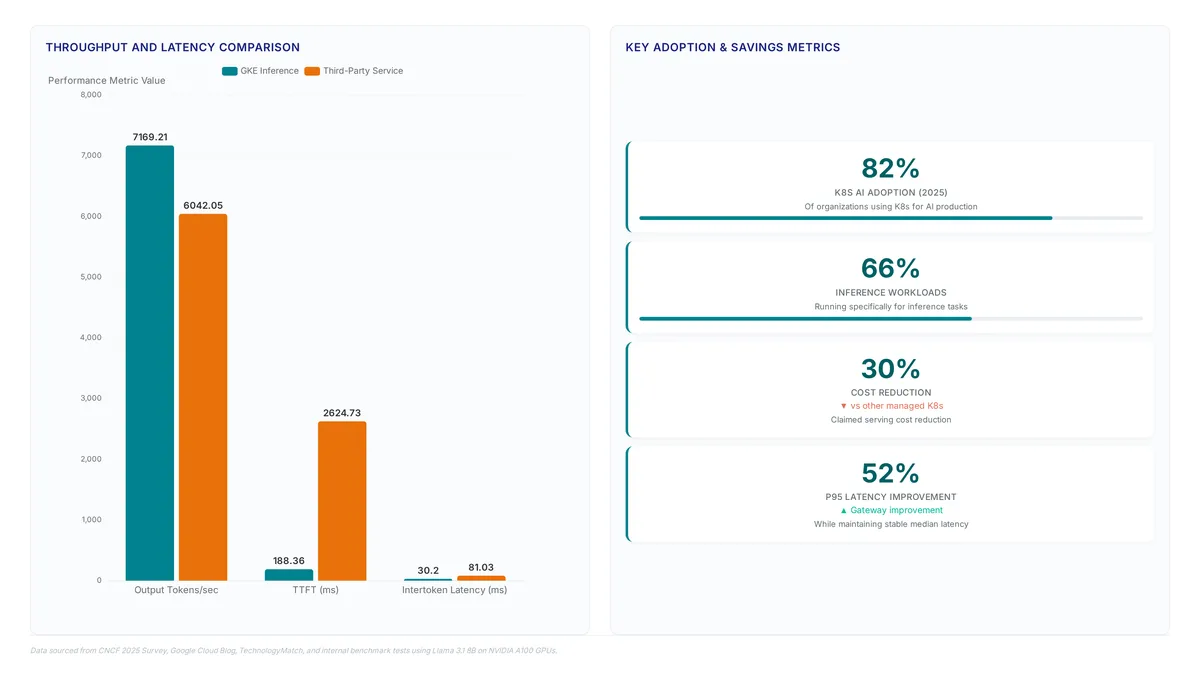
Model-aware routing in GKE directs requests to pods holding the KV cache states, whereas standard round-robin balancers distribute traffic blindly across available nodes. This architectural divergence fundamentally alters latency profiles for large language model workloads. By keeping data close to accelerators, systems notably reduce latency compared to approaches requiring re-processing of prior tokens. Throughput metrics similarly favor the gateway approach by avoiding redundant computation of key and value vectors. In tests using a Llama 3.1 8B Instruct shared prefix workload on identical hardware consisting of eight NVIDIA A100 GPUs, GKE achieved 7,169.21 output tokens per second compared to 6,042.05 for the third-party service, representing a modest increase in throughput. Feature GKE Inference or the third-party service, representing a notable increase in throughput. Maintaining stateful pod affinity enables these gains yet introduces complexity. Without careful capacity planning, reliance on local cache state creates challenges if specific nodes become overwhelmed. KV cache is extremely memory-intensive and GPU high-bandwidth memory (HBM) is finite. The decision hinges on whether an organization prioritizes raw inference speed or simplified horizontal scalability.
Optimizing Llama 3.1 8B Instruct Shared Prefix Workloads on GKE
Operators optimize Llama 3.1 8B Instruct workloads by configuring static prefix routing to map identical system prompts to specific GPU pods. Mean throughput and TTFT metrics show clear advantages for gateway architectures. Inter-token latency variance remains the differentiator for streaming applications. Standard Kubernetes deployments often suffer from cache misses when requests hit different nodes, forcing the model to re-compute KV cache vectors unnecessarily. GKE mitigates this by ensuring subsequent tokens in a conversation chain access cached activation states directly from memory. During evaluation, GKE recorded a mean time to first token (TTFT) of 188.36 ms compared to 2624.73 ms for the third-party service, representing a significant reduction in TTFT.
Total Cost of Ownership: GKE Inference Savings vs Hidden EKS Fees
Efficiency gains reduce serving costs for high-volume AI deployments. Figures highlight the impact of optimizing storage tiers to support high-performance AI pipelines. An architectural gap leads to higher hardware requirements to maintain acceptable latency levels. The hidden cost manifests in electricity and idle GPU time rather than explicit line items. A platform without native prefix caching taxes every request with redundant computation. Enterprises weigh the lower sticker price of generic clusters against the operational drag of wasted cycles.
Implementing Model-Aware Routing and Caching in Kubernetes
GKE Inference Gateway Architecture for Prefix Caching
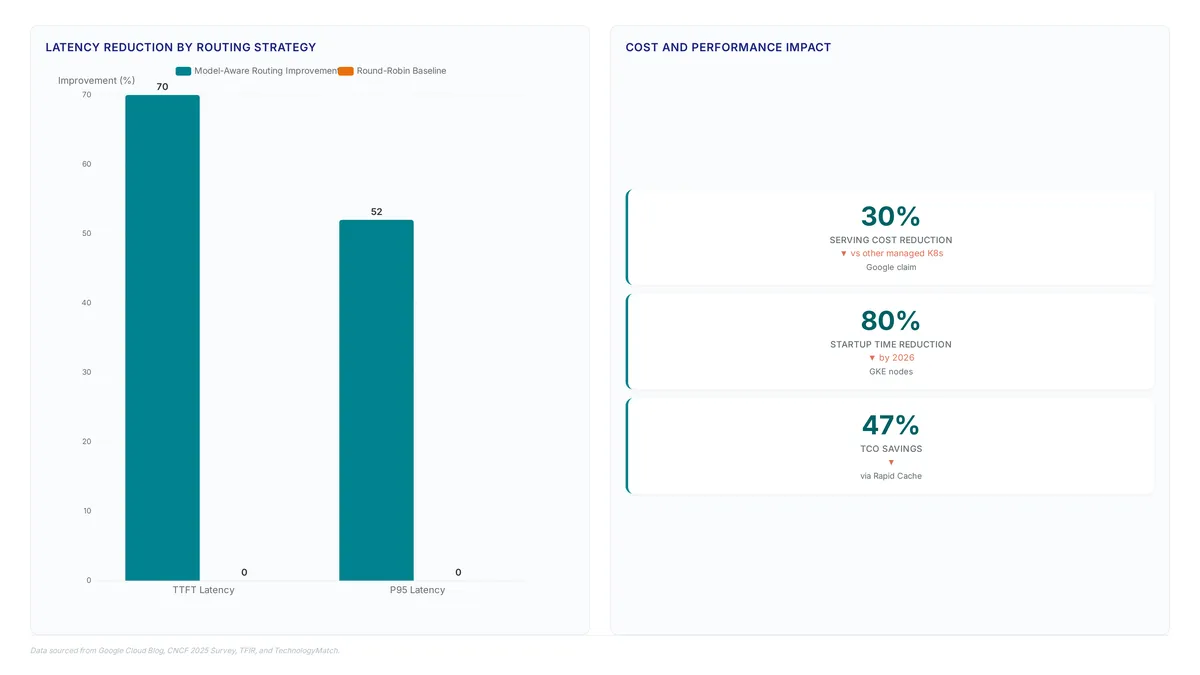
Routing traffic based on content signatures eliminates redundant GPU reprocessing that plagues simple round-robin distribution.
- Identify the static portion of your prompt, such as system instructions or RAG context. 2.
This architecture is particularly effective for RAG applications where context windows constitute a significant portion of the total token count. This constraint ensures low latency but requires careful capacity planning to prevent hotspots on specific nodes.
Integrating llm-d with Envoy Service Mesh
Prefix-cache-aware routing directs requests using content signatures instead of basic load balancing algorithms. The open-source nature of llm-d enables smooth integration with existing Envoy configurations without requiring proprietary gateways. Operators can replicate this architecture by following these implementation steps:
The open-source community maintains llm-d as a critical component for this topology. A critical tension exists between maximizing cache affinity and maintaining even load distribution across the cluster. Operators must tune the routing weighting to balance hit rates against overall cluster utilization.
Implementation: Validating Model-Aware Routing Against Round-Robin Baselines
Measure output token throughput against a standard round-robin baseline to validate the deployment. Configure a test use to send identical prompt sequences to both routing strategies while recording latency metrics. This performance gap confirms that static prefix routing successfully keeps KV states warm on specific pods.
| Metric | Model-Aware Routing | Round-Robin Baseline |
|---|---|---|
| Throughput | Significantly Higher | Baseline |
| Cache Strategy | Content-Based | Blind Distribution |
| GPU Efficiency | Optimized | Wasted Cycles |
Ignoring this validation forces payment for GPU cycles that reprocess known context. Teams lack the ability to quantify AI infrastructure efficiency without reproducible benchmarks.
About
Marcus Chen is a Cloud Solutions Architect and Developer Advocate at Rabata.io, where he specializes in optimizing data infrastructure for AI/ML workloads on Kubernetes. His daily work involves architecting high-performance storage solutions that directly impact the efficiency of generative AI applications, making him uniquely qualified to analyze GKE Inference Gateway and prefix caching strategies. As AI teams strive to reduce time-to-first-token and manage KV cache overhead, Chen's expertise in bridging persistent storage with compute layers provides critical insights into minimizing latency. At Rabata.io, a provider of fast, S3-compatible object storage, he helps enterprises deploy scalable backends for model assets and datasets. This practical experience allows him to evaluate how model-aware routing and static prefix caching interact with underlying storage performance. By connecting storage throughput realities with inference optimization techniques, Chen offers an authoritative perspective on avoiding the "cache tax" while maximizing GKE Inference Gateway benefits for production LLM deployments.
Conclusion
Scaling AI inference reveals that blind distribution strategies collapse under the weight of redundant context processing. The operational cost of ignoring cache affinity is not merely latency; it is the continuous waste of expensive GPU cycles on static data. As cloud-native adoption reaches saturation, the competitive edge shifts from basic deployment to ai-ready cloud optimization where every token counts. Organizations must recognize that standard load balancing is insufficient for modern workloads requiring real-time inference.
Deploy content-signature routing immediately if your current setup reprocesses identical system prompts across multiple nodes. This transition is critical before scaling cluster size, as adding hardware to an inefficient architecture only compounds waste. You should start by configuring a benchmark test this week that compares your current round-robin throughput against a model-aware baseline using identical prompt sequences. This specific action quantifies the exact efficiency gap in your environment and validates the need for prefix-caching mechanisms. Do not assume your current gateway configuration handles context intelligently without empirical proof. The goal is to ensure your infrastructure supports high-density workloads without proportional cost increases.
This inefficiency causes high inter-token latency and wastes valuable compute resources during repetitive prompt sequences.
Q: What operational benefit does prefix caching provide for LLMs?
A: Storing key and value vectors prevents the system from reprocessing prior tokens during subsequent steps. This approach dramatically accelerates inference speeds by keeping data close to accelerators for longer interaction sequences.
Q: How does cache affinity impact cluster load distribution?
A: Maximizing cache hits requires accepting uneven load distribution across the cluster to maintain efficiency. Engineers must tune routing weights carefully to prevent single-point saturation while still reducing overall latency metrics.
Q: What memory constraint must operators plan for with KV cache?
A: KV cache remains extremely memory-intensive, requiring careful capacity planning as workloads scale. Operators must balance static prefix memory footprints against flexible request variability to avoid eviction storms on GPUs.
Frequently Asked Questions
Machine learning-driven routing cuts time-to-first-token latency by over 70%. This drastic reduction means users experience significantly faster response times when initiating new conversation sequences with large language models.
Standard round-robin schedulers ignore active memory states, forcing GPUs to recompute tokens unnecessarily. This inefficiency causes high inter-token latency and wastes valuable compute resources during repetitive prompt sequences.
Storing key and value vectors prevents the system from reprocessing prior tokens during subsequent steps. This approach dramatically accelerates inference speeds by keeping data close to accelerators for longer interaction sequences.
Maximizing cache hits requires accepting uneven load distribution across the cluster to maintain efficiency. Engineers must tune routing weights carefully to prevent single-point saturation while still reducing overall latency metrics.
KV cache remains extremely memory-intensive, requiring careful capacity planning as workloads scale. Operators must balance static prefix memory footprints against dynamic request variability to avoid eviction storms on GPUs.
References