Diskless Kafka latency: hitting sub10ms targets
Diskless Kafka architectures claim cost reductions of 80% to 90% versus traditional disk-based systems according to AutoMQ data. Zero-disk architecture fundamentally alters data nodes by stripping away reliance on local NVMe SSD disks, enabling true cloud distribution.
This isn't just about swapping hardware. It is about replacing ephemeral local drives with shared file storage to achieve low latency messaging. Separating compute from persistent storage lets organizations optimize kafka cost savings without throttling throughput. This transforms deployment strategies, treating storage as a scalable, independent layer rather than a fixed hardware constraint.
You gain specific advantages by leveraging fsx for ontap performance characteristics to hit sub-10ms latency targets in multi-zone setups. We must weigh s3 backed kafka models against high-speed file protocols for active log retention. Understanding these wal storage options allows architects to design resilient multi-az kafka clusters that prioritize network efficiency over local disk IOPS.
The Role of Diskless Kafka in Modern Cloud-Native Messaging
Diskless Kafka Architecture and Write-Ahead Log Constraints
Diskless Kafka rests entirely on object storage, creating a queue system divorced from local disks. This structure clashes violently with the sub-millisecond demands of a traditional Write-Ahead Log (WAL). Object stores favor cheap, durable WORM patterns, not rapid write cycles. Standard interfaces introduce latency that synchronous writes cannot tolerate without architectural surgery.
Messaging systems hit a hard wall here. A standard WAL needs immediate acknowledgment to keep ordering guarantees intact. The architecture must split compute from persistent state so brokers and storage scale independently. Relying only on standard object interfaces causes delays local disks simply do not.
Shared file systems sit between the compute layer and raw object storage to fix this bottleneck. This method keeps the cost benefits of decoupled storage while hitting strict timing SLAs. Managing an extra networked file layer replaces direct writes to disks or buckets. Operators get multi-AZ durability without manual data replication across zones. Pure object storage paths remain less fit for active log segments than optimized file interfaces. Only archived segments gain the full durability and cost perks of the underlying object tier.
Hybrid WAL Strategy for S3 Latency Mitigation
Hybrid architectures put a low-latency write-ahead log ahead of object storage to skip direct latency bottlenecks. AutoMQ adopted this approach in 2023 by placing a low-latency WAL in front of object storage, where writes hit the WAL first and flush to S3 asynchronously in batches. This shift fixes the mismatch between sub-millisecond messaging needs and the latency typical for standard object storage I/O.
Traditional disk-based Kafka architectures depend on synchronous replication across availability zones, which incurs significant cross-AZ data transfer fees. The diskless design uses a shared storage layer that removes redundant data copies while keeping ordering guarantees. AutoMQ claims to reduce total Kafka infrastructure costs by 80% to 90% compared to traditional disk-based architectures through its diskless design.
Asynchronous flush mechanics require management since temporary local failures could theoretically hurt data durability before batch commits happen. Enterprise-grade S3-compatible storage engineered specifically for AI/ML training data and media streaming workloads solves this tension. These platforms deliver the consistent low-latency performance required for hybrid WAL strategies without the vendor lock-in or egress penalties associated with hyperscale providers. Deploying such solutions ensures that the asynchronous flush window remains minimal, preserving the strict ordering guarantees necessary for financial modeling and real-time ad placement systems.
EBS Zonal Failure Risks and Cross-AZ Transfer Costs
Amazon EBS volumes function as zonal resources, creating a strict Availability Zone dependency that regional S3 services do not share. This architectural mismatch forces traditional Kafka clusters to replicate data synchronously across zones to survive an AZ outage. Traditional Kafka replication traffic generates at least a significant amount of cross-zone network traffic for every unit of data produced. The financial impact is severe, as reducing data transfer costs is a primary strategy for optimizing cloud spending in multi-AZ setups.
Diskless architectures eliminate these zonal constraints by decoupling compute from storage entirely. These solutions use a shared regional write-ahead log, removing the need for synchronous block-level replication between zones. This approach prevents the explosion of cross-AZ data transfer fees inherent in disk-based designs. Operators avoid the risk of a single zonal outage cascading into a full cluster failure due to EBS unavailability. The result is a resilient messaging layer that maintains low latency without the penalty of zonal data shuffling. Cost-conscious enterprises deploying AI/ML training pipelines benefit immediately from this regional durability model. Traditional architectures remain vulnerable to zonal partition events that spike latency and billing simultaneously. Modern abstractions provide the necessary framework to treat storage as a regional commodity rather than a zonal liability.
Inside AutoMQ Architecture and FSx for ONTAP Data Flow
AutoMQ Storage Layers: Network, Compute, and FSx for ONTAP WAL
AutoMQ retains standard network and compute layers while swapping local disks for a shared engine built on S3 and a low-latency WAL. A zone-routing interceptor sits atop the network layer to optimize traffic flow. The shared write-ahead log acts as a unified storage mechanism, using cloud infrastructure for data persistence.
| Component | Traditional Kafka | AutoMQ Architecture |
|---|---|---|
| Storage Medium | Local EBS Blocks | Shared S3 + FSx WAL |
| Replication | In-band (Broker-to-Broker) | Out-of-band (Storage Layer) |
| Latency Driver | Disk I/O Wait | Network Throughput |
Produce requests route efficiently while consumers read from the unified log state. This design creates a strict dependency on network stability between the compute fleet and the FSx file system. Cost efficiency and read scalability become the primary benefits. Eliminating local state simplifies broker scaling yet demands strong underlying network infrastructure to maintain service levels.
FSx for ONTAP Multi-AZ Deployment and Sub-10ms Write Latency
Deploying a high-availability pair within a single region creates a unified file system that minimizes synchronous cross-zone replication during the write path. This architecture directly addresses the root cause of high Kafka write latency: the network round-trip penalty inherent in replicating local disk commits between zones. Benchmark results using high-performance instances demonstrate the efficacy of this shared storage approach. Read throughput scaled efficiently, indicating that the ONTAP file system handles fan-out effectively without blocking producers.
| Metric | Result | Significance |
|---|---|---|
| Avg Write Latency | 5.98 ms | Validates sub-10ms SLA feasibility |
| P99 Latency | 12.87 ms | Confirms tail latency stability |
| Write Throughput | High throughput | Sustains high-volume ingestion |
This specific multi-AZ topology delivers enterprise-grade object storage that maintains consistent performance profiles for AI/ML training data and media streaming. A dependency on the underlying managed file service availability exists, making the choice of storage backend vital for overall cluster durability. Operators must prioritize storage engines offering similar multi-AZ synchronization to avoid reintroducing the very latency penalties this architecture seeks to remove.
Single Replica Durability vs Traditional Kafka Triplicate Replication
The shared write-ahead log on FSx for ONTAP provides necessary durability without the network penalty of synchronous disk-to-disk replication across zones.
Reducing the operational overhead associated with maintaining quorum during zone failures becomes possible. Availability of the shared storage layer dictates write acknowledgment. Solutions maximize this storage efficiency for AI/ML training data where volume outweighs local redundancy needs. The architectural change fundamentally alters the failure domain from network partitions to storage service availability.
Measurable ROI from Diskless Kafka Deployments in AWS
Application: FSx for ONTAP WAL and S3 Storage Cost Structure
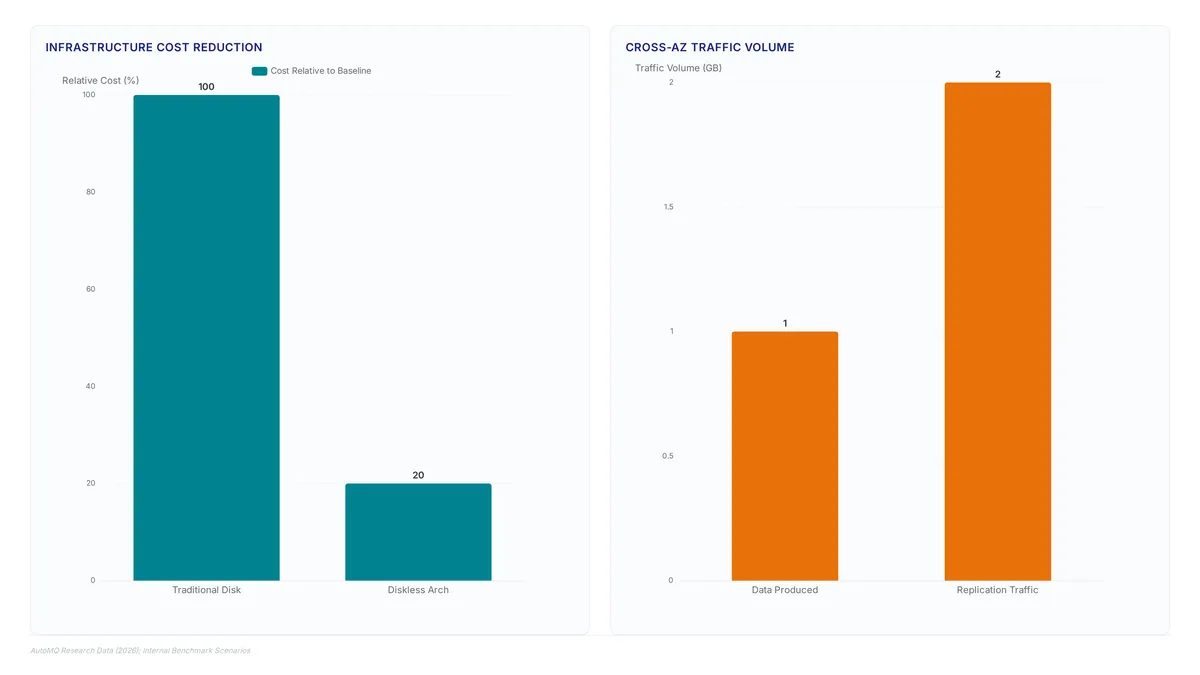
Archiving historical data to object storage while keeping recent log entries on high-performance file systems changes event streaming pricing. This diskless architecture separates compute from storage, lowering total cost of ownership for large-scale workloads compared to monolithic disk-based deployments. Operators pay premium rates only for the active data path, creating a distinct economic advantage. Decoupling compute from storage reduces infrastructure expenses notably. Managing a multi-tiered storage backend adds operational complexity, yet savings on data transfer often justify the architectural shift.ai/ML instruction data pipelines benefit most because throughput volatility makes fixed block storage inefficient. The cost structure shifts from capacity-bound to throughput-optimized, aligning expenses directly with actual data velocity rather than provisioned volume.
Quantifying Monthly Savings for High-Throughput Kafka Workloads
High-volume ingestion drives substantial monthly costs for traditional disk-based Kafka clusters due to block storage and cross-AZ replication. Switching to a diskless architecture with shared file storage reduces this expenditure notably, delivering lower costs for cloud resources. Eliminating inter-broker data duplication and minimizing high-performance storage to only the active write-ahead log causes this dramatic reduction. AutoMQ avoids inter-broker replication, reducing storage and cross-AZ traffic costs.
Deploying this model typically requires fewer instances and just two file systems. The storage-first approach decouples compute from persistent layers, allowing historical data to tier automatically to object storage where costs are notably lower. Capital expense drops precipitously, shifting the operational focus toward network throughput validation. Organizations must verify that their VPC configuration supports the concentrated I/O bursts characteristic of shared file systems. This shift transforms a fixed, high-cost infrastructure problem into a variable, optimization-driven engineering challenge.
Decision Checklist for Diskless Kafka Adoption
Strict ordering across availability zones without massive data transfer fees makes this model a viable path for demanding applications. Ingestion rates must justify the complexity of managing external file systems before adoption proceeds. Decoupling compute from storage offers immediate financial relief for teams struggling with unpredictable cloud bills.ai/ML training pipelines see one effectiveness because data velocity outpaces local disk provisioning capabilities. The final decision hinges on whether your team can manage the operational shift from node-centric to storage-centric monitoring. Success depends on validating network capacity first. Engineers should audit current cross-AZ traffic patterns. Storage latency thresholds require clear definition upfront. Monitoring tools must adapt to the new architecture quickly.
Migrating to Diskless Kafka with AutoMQ and FSx in Five Steps
AutoMQ BYOC Deployment and Three-Zone Selection
Operators initiate the AutoMQ BYOC subscription directly within the AWS Marketplace to deploy into a personal virtual private cloud. The installation workflow requires selecting "Three Zones" to establish a resilient multi-AZ deployment topology across distinct failure domains. This geographic distribution ensures that a single data center outage does not compromise cluster availability or data integrity. Administrators must then choose between S3 WAL and FSx for ONTAP WAL configurations based on latency budgets. While object storage offers durability, the shared file system approach eliminates cross-zone replication traffic for the write-ahead log. This architectural choice directly impacts the sub-10ms latency targets necessary for high-frequency trading or real-time analytics workloads.
- Subscribe to the Bring Your Own Cloud offering in the marketplace.
- Select the "Three Zones" option during the initial VPC configuration.
- Configure the storage backend to use FSx for ONTAP for the WAL.
- Initialize the cluster to begin replicating metadata across zones.
Deploying without local disks shifts the failure domain from individual instances to the shared storage layer.
Configuring FSx for ONTAP Specifications Using AKU Metrics
Mapping AutoMQ Kafka Units (AKU) to storage throughput prevents under-provisioning during high-velocity ingestion phases. Capacity planning relies on the AKU metric, where a baseline of 3 AKU delivers write throughput, read throughput, 2,400 RPS, and supports at least 3,375 partitions. Operators targeting higher performance tiers must scale storage specifications accordingly to match these compute units. For instance, selecting an FSx for ONTAP configuration with modest capacity enables a sustained Kafka write throughput of 150 MiBps. This specification aligns with the diskless architecture goal of eliminating local disk bottlenecks while maintaining sub-10ms latency targets.
The following table outlines the relationship between AKU scaling and required storage performance:
| Target Write Throughput | Required Storage Spec | Supported Partitions |
|---|---|---|
| Moderate throughput | Base Configuration | 3,375+ |
| 150 MiBps | Elevated storage spec | Scaled Horizonally |
| 300 MiBps | High-Performance Tier | Extended Range |
Implementing multi-AZ Kafka on AWS requires careful attention to these thresholds to avoid cross-zone latency spikes.
- Calculate total required AKU based on expected producer load.
- Select the corresponding FSx for ONTAP instance type matching the throughput tier.
- Deploy the configuration across three availability zones for redundancy.
A common oversight involves neglecting read throughput constraints; while write paths often drive provisioning decisions, consumer lag can accumulate if read bandwidth does not scale linearly with AKU count.
Confirming the FSx for ONTAP mount point as the active WAL device prevents accidental fallback to local disk storage. Operators must verify that brokers exclusively apply the shared file system for write-ahead logging to maintain architecture integrity.
- Inspect the broker configuration to ensure the WAL directory points to the mounted NFS path.
- Execute a write test across all three availability zones to measure round-trip network latency.
- Compare observed p99 latency against the sub-10ms target required for real-time messaging workloads.
Persistent deviations above 10 milliseconds often indicate network contention rather than storage throttling. The shared file system eliminates cross-AZ replication overhead, yet physical distance between zones introduces inherent propagation delay. Achieving consistent low latency requires that the underlying network fabric supports high throughput without queuing packets. While cloud storage latency benchmarks provide a baseline, actual performance depends on instance placement within the VPC. Rabata.io recommends validating that the EC2 instances reside in the same placement group as the storage endpoints. This proximity minimizes the number of network hops required for each write operation. Failure to align compute and storage networking results in variable jitter that disrupts producer acknowledgments.
About
Marcus Chen is a Cloud Solutions Architect and Developer Advocate at Rabata.io, specializing in S3-compatible object storage and AI/ML data infrastructure. His daily work involves designing high-performance, cost-effective storage architectures for enterprises seeking alternatives to traditional cloud providers. This direct experience makes him uniquely qualified to analyze diskless Kafka configurations, where minimizing latency and storage costs is critical. At Rabata.io, Chen uses the company's high-speed, S3-compatible storage to optimize Write-Ahead Log (WAL) performance, directly addressing the challenges of achieving sub-10ms targets without relying on expensive proprietary file systems. His insights stem from helping organizations implement multi-AZ Kafka clusters that apply efficient object storage backends to reduce cross-AZ data transfer fees. By focusing on true S3 API compatibility and transparent pricing, Rabata.io enables engineers to build scalable, low-latency messaging systems that avoid vendor lock-in while maintaining rigorous performance standards required by modern data-intensive applications.
Conclusion
Scaling diskless Kafka exposes a critical fragility: the architecture trades local disk failure domains for strict network dependency. If network jitter exceeds the narrow window between average and tail latency, the entire cluster stalls because the zero-disk architecture cannot buffer writes locally. This creates a scenario where storage savings are instantly erased by compute idle time during network hiccups.
Organizations should adopt this model only when their workloads demand the specific throughput tiers that shared file systems provide, and only after validating that their VPC networking can sustain sub-10ms p99 latency consistently. Do not migrate legacy producers that tolerate high jitter; this pattern suits greenfield deployments with controlled client behavior. The industry move toward protocol-centric designs means the broker is no longer the bottleneck, but the network becomes the single point of failure.
Start by running a dedicated latency stress test between your compute data nodes and storage endpoints this week. Measure p99 latency under load rather than average throughput to ensure your infrastructure meets the rigorous stability required for deployment.
Frequently Asked Questions
Diskless designs claim to cut total infrastructure costs by 80% to 90%. This massive reduction allows organizations to reallocate budget from storage hardware toward enhanced compute resources or expanded data retention policies.
This inefficiency drives up operational expenses significantly, making cost reduction a primary strategy for optimizing cloud spending in multi-AZ setups.
Decoupling compute removes strict Availability Zone dependencies found in local disk systems.
Yes, hybrid strategies use a low-latency write-ahead log to achieve 80% cost savings. This approach fixes mismatches between messaging needs and object storage latency by flushing writes asynchronously in batches.
Operators replace direct disk writes with a networked file layer to enable independent scaling. This shift supports true cloud distribution by removing reliance on local NVMe SSD disks for persistent state management.
References