S3-compatible storage: Escape vendor lock-in traps
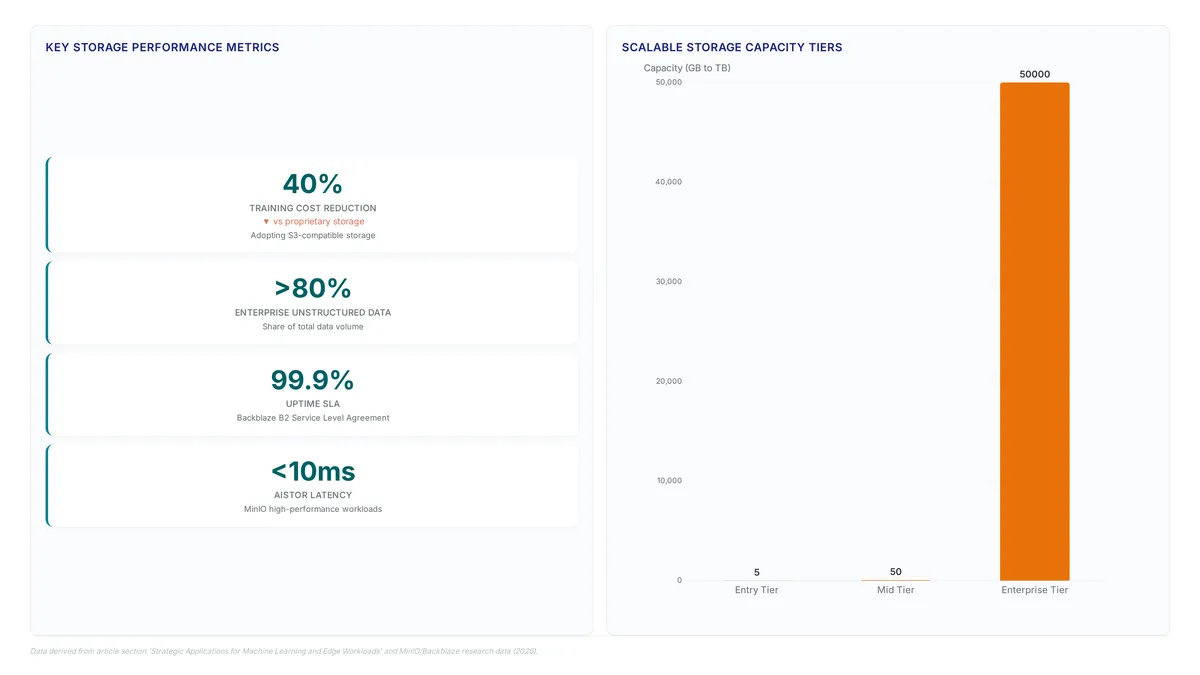
Over 80% of enterprise unstructured data now relies on S3-compatible object storage interfaces as of 2026. This isn't a trend; it's a structural shift. The industry has moved past proprietary silos, favoring open, API-driven architectures that value portability over brand loyalty. S3 API compatibility is no longer a technical convenience. It is a strict financial imperative for surviving modern data economics.
We need to talk about how zero egress fees fundamentally alter the total cost of ownership for massive datasets. This discussion moves beyond simple billing to show how these models enable viable strategies for machine learning data storage where data gravity often traps capital.
Finally, we must address practical methods to avoid vendor lock-in when managing unstructured data storage at scale. You will learn specific approaches to object storage migration that preserve operational continuity while breaking dependence on single-provider ecosystems. By using S3-compatible object storage, enterprises can repatriate control over their data backup solutions and archives without reengineering their entire application stack.
The Role of S3-Compatible Interfaces in Modern Data Architecture
Defining S3-Compatible Object Storage for Unstructured Data
Object storage handles massive unstructured datasets cheaply by pairing data with rich metadata inside a flat namespace. This design bypasses the hierarchical rigidities found in traditional file systems while managing media files and logs efficiently. S3-compatible object storage replicates the Amazon S3 API so engineers direct existing tools and SDKs to non-AWS endpoints without code changes. Applications written for AWS S3 function identically when pointed at alternative backends. Any platform implementing the S3 API qualifies as S3-compatible, enabling teams to use existing applications and tools without modification. This interoperability breaks proprietary silos while preserving operational workflows. Operators gain control over data location and compliance posture without sacrificing the convenience of established ecosystems. The strategic value lies in portable infrastructure; however, "S3 compatible" is a spectrum where implementations vary by provider. Some solutions are purpose-built for specific feature sets like archival and backup while omitting others such as website hosting or analytics. Enterprises must validate that their specific usage patterns behave consistently across platforms. The ability to switch providers hinges on this strict adherence to interface standards. Unstructured data growth demands this scalable, API-driven approach to avoid costly vendor lock-in.
Real-World Use Cases for S3-Compatible Storage in AI and Backups
Flat namespaces using unique identifiers rather than hierarchical paths organize unstructured data within S3-compatible systems. This architecture supports AI training datasets and backup repositories by allowing direct API access without code modification. More than 80% of enterprise unstructured data, including AI training datasets, backups, media archives, and logs, is managed through S3-compatible storage. Common deployments involve feeding high-throughput machine learning pipelines or retaining immutable system logs for compliance audits. The primary advantage lies in API compatibility, which lets organizations swap backend providers while keeping front-end applications unchanged. Some implementations focus on cost-effective archival with features like Object Lock and Versioning. Others prioritize high-performance ingestion for active applications. This approach prevents vendor lock-in while maintaining the toolchain familiarity engineers require for production stability.
Amazon S3 vs S3-Compatible Platforms: Capacity Limits and Egress Costs
Implementation details can vary even when many S3-compatible providers match this capacity, potentially affecting workflows that rely on large single-object uploads. This fragmentation complicates data integrity checks and increases metadata overhead for storage administrators if limits differ. Object size limits directly determine whether high-resolution media workflows remain efficient or require complex preprocessing pipelines before ingestion. Egress costs represent fees charged for retrieving data from a storage environment, creating financial friction for data-heavy operations. Platforms offering zero egress fees eliminate this barrier, allowing unrestricted data movement for backup recovery or machine learning training cycles. The economic impact becomes pronounced when moving terabytes of logs or model weights between compute clusters and storage tiers. Data portability suffers when retrieval penalties discourage necessary traffic flows across hybrid cloud boundaries. Smooth migration requires verifying both capacity ceilings and retrieval pricing before committing to a new vendor. A platform might support the API yet fail to handle the scale required for modern AI workloads without artificial constraints. Operators must test these boundaries explicitly rather than assuming full compatibility based on API claims alone. The cost is clear: lower storage rates mean little if operational friction or retrieval costs cripple overall system performance.
| Feature | Native Amazon S3 | S3-Compatible Alternatives |
|---|---|---|
| Max Object Size | Large maximum size | Varies by Provider |
| Egress Model | Per-GB Fee | Often Zero or Reduced |
| API Surface | Complete | Partial or Extended |
| Lock-in Risk | High | Low |
| Compliance Tools | Native Integration | Dependent on Vendor |
The table above highlights key differentiators. Engineers should note that tive S3Compatible : : : Max Object Size Varies by Provider Egress Model PerGB F serves as a shorthand reminder for these critical specifications during evaluation.
Economic Mechanics of Zero-Egress Storage Models
How Egress Fees Create Hidden Retention Penalties
Providers frequently promote low headline rates while enforcing strict exit charges that inflate the true Total Cost of Ownership. This flexible generates a minimum retention penalty where moving data becomes economically prohibitive regardless of technical compatibility. The mechanism depends on reasonable-use policies capping monthly outbound traffic at the volume of stored data. Standard per-gigabyte charges activate once an organization exceeds this threshold, effectively locking datasets in place. Competitive Data Transfer High perGB cost $0 within network Retention Constraint Non escape costs, minimum retention penalties, and reasonable-use policies now define market differentiators where monthly egress is capped at the volume of stored data.
Some vendors claiming free egress enforce caps where monthly transfer cannot exceed the total stored volume, creating a hidden trap for active workloads like AI training that require frequent data access. Network operators must calculate escape costs before signing any contract because true cost control requires eliminating these exit barriers entirely. Scrutinizing fine print regarding unstructured data storage prevents organizations from paying more for movement than for residence. Balancing nominal storage savings against the long-term liability of data immobility represents the core strategic choice.
Using S3 Compatibility to Eliminate Migration Friction
Direct API alignment enables teams to address high egress fees without re-engineering operational tooling. Vendor lock-in shifts from the cost of egress to the cost of re-engineering operational tooling if the storage target lacks S3 compatibility. Organizations using S3-compatible object storage bypass this friction entirely by maintaining existing application configurations while switching backend providers. Flexibility emerges as the primary advantage since teams retain all existing S3 tools and code without becoming locked into one vendor pricing or data center locations. This approach directly addresses queries about cloud providers with zero egress fees by enabling a transition to such models without code changes.
The mechanism allows organizations to democratize access to enterprise-grade storage for AI/ML startups. Verifying API parity before deployment avoids hidden integration costs. Strategic selection of storage backends ensures that data portability remains a functional reality rather than a theoretical benefit. This architectural choice transforms storage from a static cost center into a flexible, optimizable resource layer.
The Economic Trap of Single-Platform Storage Reliance
Financial friction transforms standard data retrieval into a costly operation, effectively trapping unstructured assets within one provider's boundary. Charging per gigabyte for outbound traffic enforces vendor lock-in through cumulative transfer costs rather than technical incompatibility. Strategic risk extends beyond immediate billing shocks to long-term architectural rigidity. Operators facing this constraint cannot easily redistribute workloads or use specialized compute resources elsewhere without triggering prohibitive transfer charges. Migrating to a zero-egress model eliminates this specific barrier by removing outbound fees entirely. Shifting providers introduces a different friction point if the new target lacks full API alignment. Vendor lock-in is not eliminated but rather shifted from the cost of egress to the cost of re-engineering operational tooling if the destination does not support standard interfaces. Evaluating both the financial exit costs and the technical effort required to reconfigure applications remains necessary before committing to a storage architecture.
Strategic Applications for Machine Learning and Edge Workloads
Machine Learning Training Sets as Searchable S3 Environments
Massive machine learning datasets shift from static archives into efficient, searchable environments when hosted on S3-compatible object storage. Models devour data, yet proprietary file formats frequently create performance bottlenecks during iterative development phases. Teams use S3 API compatibility to mount petabytes of unstructured data directly to compute clusters, bypassing complex data movement pipelines. Object storage expands almost infinitely at low-cost, making it ideal for backing up and managing the vast, expanding datasets modern AI development demands. Engineers treat this storage as a queryable layer instead of a passive dump site. Decoupling compute from storage while maintaining high-throughput access provides the real strategic advantage. Organizations adopt S3-compatible storage to use pricing structures that eliminate or reduce egress fees, which typically penalize frequent data access during hyperparameter tuning. This method enables high-performance, cost-effective storage that scales with dataset growth. Data gravity becomes a strategic asset rather than a liability.
Edge Storage Deployment for Audiovisual Archives and Logs
Security cameras and edge devices generate continuous streams of unstructured data requiring immediate, low-cost retention at the source. Implementing S3-compatible object storage at the edge allows organizations to archive high-volume audiovisual content and system logs locally without incurring the prohibitive egress fees typical of proprietary cloud vendors. Activities generating massive data volumes, such as perimeter surveillance, benefit from storing archives long-term using standard APIs rather than expensive block storage. Avoiding egress fees on these continuous streams can notably reduce the total cost of ownership for edge storage projects. Physical security risks emerge when deploying storage at the edge, challenges that central data centers mitigate through controlled access. Centralization offers convenience, yet modern video resolution creates bandwidth realities that complicate the equation.
Ransomware Recovery Risks When Object Storage Lacks Infinite Scale
Organizations lacking elastic scaling may struggle to retain sufficient historical versions, failing to find a clean recovery point before the attack vector closes. Failure occurs when storage quotas hit while attempting to restore terabytes of encrypted files alongside their clean predecessors. Operators implementing a backup strategy with object storage must verify that the system scales elastically rather than enforcing static thresholds. Those asking should I adopt S3-compatible storage for disaster recovery need to prioritize platforms offering truly unlimited zero egress to avoid being taxed on their own survival. Cost-effective recovery depends on architectures where storing massive versions incurs no penalty during the crisis window. Upfront storage rates compete against the existential risk of being unable to afford the data pull when it matters most.
Migration Pathways from Proprietary S3 Implementations
S3-Compatible API Mechanics for Zero-Friction Tooling

Changing the endpoint URL configuration allows existing S3 tools to function immediately against alternative backends. This compatibility layer permits operators to apply standard libraries for unstructured data without rewriting application code. Any platform implementing the S3 API qualifies as S3-compatible, enabling applications written for Amazon S3 to read, write, and manage data without modification.
- Identify the endpoint URL provided by your chosen storage provider.
- Update your application configuration file to point to the new address.
- Replace access credentials with the specific keys for the target bucket.
Data portability remains high while eliminating the friction often associated with migrating away from proprietary implementations. Object storage uses a flat namespace ideal for files and media archives, unlike block storage which requires low-latency access protocols. Operators scale storage automatically as needed and optimize costs with lifecycle policies. Non-standard extensions or proprietary metadata features may not translate perfectly across different vendors. Organizations implement these architectures to avoid lock-in by keeping existing S3 tools and code while avoiding being locked into one vendor's pricing or data center locations.
Migrating Data to Edge Storage Without Vendor Lock-In
Switching the endpoint URL in your configuration file instantly redirects S3 tools to a new storage backend. This change allows teams to switch providers, run hybrid setups, or migrate between cloud and on-premises without rearchitecting their entire stack. Operators avoid re-engineering application logic because the API surface remains identical across vendors.
- Retrieve the specific endpoint URL and access keys from your target provider.
- Update the `AWS_ENDPOINT_URL` environment variable or SDK configuration to match the new address.
- Execute data transfer using standard sync commands that preserve metadata and versioning history.
Storing massive datasets directly at the edge reduces latency by placing data closer to compute resources. The strategy shifts focus from raw transfer speed to architectural flexibility. Vendor lock-in is not eliminated but rather shifted from the cost of egress to the cost of re-engineering operational tooling if custom features were previously exploited. Teams relying on proprietary extensions like specific analytics engines must refactor those components before migration. Adopting S3-compatible storage gives organizations a choice of vendors and provides greater control over costs such as egress fees. Alternatives often offer lower costs, different pricing structures, no egress fees, or self-hosted deployment options depending on the provider. Validating multipart upload behavior during the pilot phase ensures large model training sets transfer without corruption, as "S3 compatible" is a spectrum and implementations vary.
Validating Predictable Pricing and Regional Data Placement
Confirming zero egress fees eliminates a primary financial penalty associated with large-scale data retrieval. Apparent savings on storage costs may vanish during the first substantial model training cycle or disaster recovery test without this validation, as some providers enforce reasonable-use policies or retain minimum periods. Regional placement logic requires equal scrutiny to ensure latency constraints are met.
This checklist maintains the performance profile required for production AI pipelines while securing predictable pricing.
About
Marcus Chen serves as a Cloud Solutions Architect and Developer Advocate at Rabata.io, where he specializes in designing scalable S3-compatible object storage infrastructures for AI/ML workloads. His daily work involves rigorous performance benchmarking and implementing cloud cost optimization strategies, directly informing this analysis on escaping vendor lock-in traps. At Rabata.io, Chen helps enterprises and startups migrate from complex, expensive legacy systems to simplified, S3 API-compatible solutions that eliminate hidden egress fees. His hands-on experience with Kubernetes persistent storage and data migration allows him to identify exactly where traditional providers create dependency. By using Rabata.io's GDPR-compliant infrastructure, Chen demonstrates how organizations can achieve true interoperability without sacrificing speed or security. This article reflects his practical expertise in deploying zero lock-in architectures that empower teams to control their unstructured data costs while maintaining the flexibility to switch tools or providers smoothly.
Conclusion
The S3 API has evolved from a simple storage interface into a reliable data management standard, meaning compatibility gaps now pose a greater risk than raw transfer speeds. While the interface remains consistent, the underlying implementation of multipart uploads and metadata handling varies significantly across providers, creating hidden friction for large-scale AI workloads. Organizations must recognize that shifting vendors does not eliminate lock-in but rather transfers it from egress costs to the complexity of re-engineering operational tooling around proprietary extensions. Teams relying on specific analytics engines or custom retention policies face immediate disruption if they assume uniform behavior across all endpoints.
Migrate only after validating multipart upload integrity and confirming that reasonable-use policies do not reintroduce hidden financial penalties during disaster recovery scenarios. Do not assume that an identical API surface guarantees identical performance characteristics under load. Start by running a parallel pilot transfer of a non-critical dataset larger than a substantial size this week to test metadata preservation and throughput consistency against your specific latency requirements. This targeted verification prevents costly corruption issues in production model training cycles. By treating compatibility as a spectrum rather than a binary state, operators secure genuine architectural flexibility while maintaining the performance profile required for modern data pipelines.
Frequently Asked Questions
Over 80% of enterprise unstructured data currently uses these interfaces. This dominance means organizations must prioritize API portability to manage the vast majority of their backups, logs, and AI datasets effectively without vendor lock-in.
Most platforms support objects up to a large number, enabling massive single-file storage. If a provider enforces lower limits, teams must split files, which complicates workflows for high-resolution video or seismic data and increases metadata overhead significantly.
S3-compatible storage replicates the Amazon S3 API so tools function without changes. This allows engineers to redirect existing applications to new backends instantly, preserving operational continuity while breaking dependence on single-provider ecosystems for unstructured data.
Zero egress fees eliminate financial friction when retrieving data for analysis. This economic shift allows unrestricted movement of terabytes of logs or model weights between compute clusters, fundamentally altering cost control strategies for machine learning workloads.
Flat namespaces organize data with unique identifiers rather than rigid paths. This structure supports direct API access for AI training datasets, allowing high-throughput pipelines to ingest data efficiently while maintaining the toolchain familiarity engineers require.
References