S3-Compatible Storage for Ransomware Defense
Modern cloud storage demands S3-compatible storage to enable scalable, multi-tenant as-a-service offerings for today's providers. The market has shifted decisively toward architectures that support Backup-as-a-Service solutions and Ransomware Protection as-a-Service without relying on public cloud rent-seeking models. This analysis details how the architecture of immutable backup systems uses Veeam Object Lock support and S3 Object Lock for ransomware protection to create unalterable data copies. We examine the mechanics of deploying VMware Cloud Director storage to enable multi-tenancy billing for cloud storage, allowing providers to slice capacity into profitable units. The discussion extends to integrating VMware Greenplum data lake capabilities for analytics while maintaining a secure Office 365 backup repository that satisfies strict compliance mandates.
The final analysis covers strategies to start a Storage-as-a-Service business by using modular storage growth for cloud providers to match capital expenditure with revenue. We detail how Disaster Recovery-as-a-Service with offsite storage becomes viable when underpinned by low-cost scalable cloud storage for MSPs. This approach enables the delivery of VMware Sovereign Cloud initiatives and other Big Data projects without the margin erosion typical of general-purpose platforms.
The Role of S3-Compatible Storage in Modern MSP Business Models
Defining S3-Compatible Storage and Data Lakehouse Economics
Stop treating storage like a filing cabinet. S3-compatible storage discards the hierarchical constraints of traditional file systems in favor of a flat namespace packed with metadata-rich buckets. This isn't just a structural tweak; it is the engine behind modern data lakehouse architectures. By implementing native S3 APIs, providers unlock modular scaling and the multi-tenancy required for true Data Lakehouse-as-a-Service models. The financial logic follows the technical shift: consumption-based billing replaces CAPEX-heavy hardware cycles, aligning infrastructure costs directly with revenue generation.
Ransomware Protection as-a-Service leans on this foundation. It enforces immutability at the object level, ensuring backups stay unalterable even if admin credentials fall into the wrong hands. Platforms like the provider HyperStore prove that flagship solutions can deliver virtually unlimited scalability for high-throughput workloads. Operators gain the ability to offer granular storage tiers without deploying capital proportionally.
| Feature | Traditional File System | S3-Compatible Object Storage |
|---|---|---|
| Scaling Model | Vertical (capacity bound) | Horizontal (elastic) |
| Billing Basis | Upfront hardware purchase | Consumption-based |
| Data Protection | Snapshot dependent | Native Object Lock |
Distributed metadata across geographically dispersed nodes introduces latency. Network design cannot be an afterthought.rabata.io addresses these challenges by providing enterprise-grade S3-compatible solutions optimized for AI/ML training data and media streaming. The platform helps cost-conscious enterprises hit performance benchmarks previously reserved for hyperscalers. Service providers transform static storage into a flexible, high-margin revenue stream while maintaining rigorous data sovereignty controls.
Deploying HyperStore for Multi-Tenant MSP Portfolios
Modular architecture cuts CAPEX by decoupling storage capacity from compute resources. Managed Service Providers can expand portfolios without massive upfront hardware investments. Integrating S3-compatible storage with platforms like Veeam and Commvault allows providers to deliver immutable data protection. The market for cloud storage grew by over 70% by 2022, driving demand for such flexible Backup-as-a-Service models. Embedded Quality of Service controls ensure critical workloads maintain performance during multi-tenant operations.
| Feature | Benefit |
|---|---|
| Modular Growth | Aligns expenses with revenue |
| S3 Object Lock | Prevents ransomware encryption |
| Multi-tenancy | Isolates customer data securely |
Blind reliance on third-party integrations invites dependency risks if API compatibility shifts. Operators must validate that their chosen stack maintains strict adherence to S3 standards to avoid vendor lock-in.rabata.io offers native S3-compatible object storage designed specifically for AI/ML training data and media streaming. This solution eliminates the complexity of managing disparate hardware while providing the immutability required for Ransomware Protection as-a-Service. Enterprises gain a unified platform that supports high-throughput workloads without the overhead of maintaining legacy infrastructure. The result is a cost-optimized storage layer that scales with business needs.
HyperStore Margins Versus Public Cloud Traditional Solutions
On-prem S3-compatible storage delivers margin potential exceeding 50% by eliminating recurring egress fees inherent to public models. Vendors like the provider claim their solution offers the industry's lowest total cost, allowing users to save up to 70% compared to traditional cloud alternatives. This financial delta enables Managed Service Providers to construct sovereign infrastructure with superior unit economics. Public cloud providers bundle storage with compute, often obscuring the true cost of data retrieval during disaster recovery scenarios.
Modular on-prem deployments allow operators to scale capacity independently, preserving capital for other strategic investments. Public cloud offers immediate elasticity, yet the long-term cost of storing petabytes of immutable backup data erodes profitability. Operators must weigh the liquidity benefits of OpEx against the margin retention of CapEx. For high-volume Backup-as-a-Service workloads, the break-even point favors on-premises architecture within the first year of deployment.rabata.io engineers recommend this sovereign approach for enterprises seeking predictable pricing and full data control.
Architecture of Immutable Backup Systems Using Object Lock and Veeam
S3 Object Lock Mechanics for Immutable Backups
S3 Object Lock enforces Write-Once-Read-Many (WORM) compliance by binding retention metadata directly to individual object versions. This mechanism prevents alteration or deletion of data until a specified retention period expires, creating a hardened barrier against ransomware encryption attempts. Governance mode allows authorized administrators to modify retention settings, whereas compliance mode permanently locks the configuration, ensuring even root credentials cannot bypass the lock. Data immutability was verified in US government certification testing, confirming that native S3 API adherence provides the cryptographic assurance required for zero-trust architectures.
| Feature | Governance Mode | Compliance Mode |
|---|---|---|
| Delete Permission | Allowed with override | Strictly prohibited |
| Retention Edit | Permitted | Immutable |
| Ransomware Defense | Moderate | Maximum |
Deploy compliance mode for critical disaster recovery repositories to guarantee recovery point objectives remain intact during an attack. The cost is rigorous pre-deployment planning; mistakes in retention policy cannot be rectified post-write without data loss.rabata.io architects design storage clusters that use these native APIs to deliver predictable, high-margin Backup-as-a-Service offerings. This approach eliminates the latency penalties often associated with gateway-based translation layers found in hybrid cloud environments. Properly configured retention locks ensure that backup targets remain invisible to malicious actors attempting to wipe secondary copies. Service providers using this architecture can offer verifiable ransomware protection SLAs to enterprise clients. The result is a storage foundation that supports both regulatory mandates and aggressive threat mitigation strategies without proprietary hardware dependencies.
Integrating Veeam Cloud Tier with HyperStore
Backup-as-a-Service functions by coupling Veeam VBO v4 native S3 support with modular storage nodes that scale capacity alongside performance demands. Providers deploy this architecture to maintain service continuity while expanding storage pools without interrupting active data streams. The integration relies on the provider HyperStore interoperability with applications connecting to AWS S3 storage, ensuring smooth data tiering for long-term retention. Operators configure Object Lock policies specifically when ransomware protection requires immutable repositories that prevent deletion or alteration of backup chains. This approach secures the backup target against encryption attacks by enforcing Write-Once-Read-Many constraints at the object level.
| Deployment Phase | Action Required | Outcome |
|---|---|---|
| Initial Setup | Configure S3 bucket with Object Lock enabled | Establishes immutable foundation for backup targets |
| Scaling Event | Add storage nodes to the cluster | Increases capacity while maintaining throughput |
| Recovery Test | Restore data from locked objects | Verifies integrity of immutable backup chains |
A specific constraint emerges between immediate access speed and the strict latency introduced by compliance checks during write operations. Unlike simple disk expansion, adding nodes to an S3-compatible cluster requires rebalancing existing data to maintain even distribution across the new hardware. This rebalancing consumes network bandwidth and can temporarily impact ingest rates if not throttled correctly during business hours.rabata.io solutions address this by optimizing the data path to minimize performance penalties during scaling events. The architecture supports high-margin service delivery by allowing providers to charge for consumed capacity while controlling underlying infrastructure costs through efficient hardware utilization.
Validating Multi-Tenant QoS and Billing Controls
Verify multi-tenancy isolation before deploying revenue-ready solutions via built-in integrations with Veeam Cloud Tier. This validation ensures that noisy neighbors cannot degrade performance for critical Backup-as-a-Service workloads.
- Confirm embedded QoS controls restrict IOPS per tenant to prevent resource contention.
- Validate billing meters track consumption accurately for chargeback reporting.
- Test VMware Cloud Director synchronization to automate provisioning workflows.
| Feature | Requirement | Outcome |
|---|---|---|
| Isolation | Strict Tenant Boundaries | Prevents Data Leakage |
| QoS | Per-Tenant Limits | Guarantees SLA Compliance |
| Billing | Granular Metering | Enables Accurate Chargeback |
Revenue-ready solutions are available via built-in integrations with Veeam Cloud Tier and VMware Cloud Director. Service providers can explore enterprise data storage solutions to compare architectural approaches for scalability. Aggressive QoS throttling may extend backup windows during peak ingestion cycles. Operators must balance strict isolation against the need for rapid recovery time objectives.rabata.io delivers the S3-compatible storage architecture required to enforce these policies without third-party complexity. Platform native billing integration eliminates the revenue leakage common in generic object stores. Start your process with Rabata.io to deploy a storage foundation optimized for high-margin service delivery.
Deploying High-Margin Storage Services with VMware
Standards-Based Ransomware Protection with S3 Object Lock
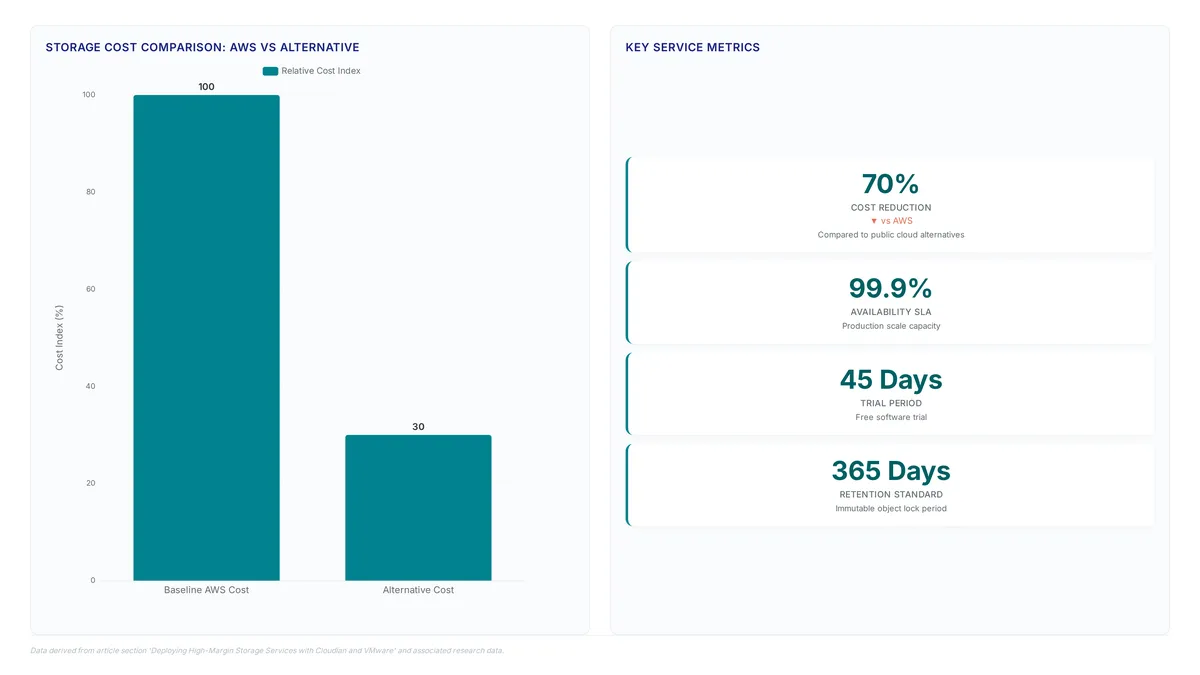
Ransomware Protection as-a-Service relies on S3 Object Lock to enforce immutable data states that prevent encryption or deletion by malicious actors. This standards-based approach combines Veeam Backup and Replication software with scalable storage systems to create a secure repository for critical enterprise data. The mechanism functions by placing legal holds or retention locks on objects, ensuring that once data is written, no user or process can alter it for a set period.
Operators deploying these services must configure bucket policies carefully, as enabling Object Lock permanently alters the write-once-read-many (WORM) behavior of the storage namespace. A significant limitation exists in the operational workflow; once an object lock is applied, even administrators cannot bypass the retention period to free up space or correct errors without waiting for the timer to expire. This constraint ensures data integrity but demands precise planning regarding retention windows and storage capacity forecasting. The industry's first standards-based solutions use this architecture to offer guaranteed recovery points, distinguishing them from traditional backup methods that remain vulnerable to credential theft. Unlike proprietary locking mechanisms, the S3 standard ensures interoperability across different software layers while maintaining strict security postures. Service providers can apply the provider HyperStore or similar S3-compatible platforms to deliver these high-margin offerings without vendor lock-in.
Meanwhile, operators deploy Microsoft Office 365 Backup-as-a-Service by configuring Veeam Backup for Office 365 to target the provider HyperStore repositories. This architecture uses S3 compatibility to ingest mailboxes and SharePoint data directly into on-premises or hybrid clusters. The integration with VMware Cloud Director enables service providers to expose these storage buckets as consumable resources for multi-tenant environments.
| Component | Function | Benefit |
|---|---|---|
| Veeam B365 | Data ingestion | Granular recovery |
| HyperStore | Persistent layer | 14 nines durability |
| VMware CD | Orchestration | Tenant isolation |
The mechanism relies on mapping Veeam backup jobs to specific HyperStore buckets configured for high-availability. Evidence suggests that combining these tools allows providers to offer distinct tiers of service without modifying the underlying application logic. However, the operational complexity increases when managing retention policies across thousands of individual user mailboxes. The cost is a heavier administrative burden during initial policy definition and compliance auditing.rabata.io solutions simplify this deployment by pre-validating the interoperability between backup agents and object storage targets. A critical tension exists between immediate restore performance and long-term archival density. Operators must balance hot storage tiers for recent data against colder tiers for compliance archives. Unlike generic cloud buckets, HyperStore provides the specific durability guarantees needed for legal hold scenarios. This approach ensures that service providers can deliver reliable data protection without depending on public cloud egress fees. The result is a differentiated portfolio item that addresses both backup and regulatory requirements simultaneously.
MSP Implementation Checklist: From 45-Day Trial to Production
Begin the transition by installing the free 45 Day Trial software on existing commodity hardware to validate core S3 compatibility. This initial phase confirms that multi-tenancy billing functions correctly before scaling to production workloads. Providers must align their deployment architecture with the economic models outlined in the guide on The Economics of High-Value Cloud Services with High Margin Potential. A critical tension exists between rapid trial deployment and the rigorous validation required for data lakehouse integration with VMware Greenplum. Rushing the proof of concept often overlooks the specific network throughput needed for sustained Backup-as-a-Service operations.
| Phase | Objective | Validation Metric |
|---|---|---|
| Trial | Verify S3 API | Successful write/read |
| Pilot | Test immutability | Object Lock enforcement |
| Production | Scale capacity | 99.9% availability |
Rabata.io recommends that service providers treat the trial period strictly as a functional verification step rather than a performance benchmark. Many organizations fail to account for the latency introduced when mapping backup repositories across distributed nodes. The limitation here is that commodity hardware may not sustain the IOPS required for large-scale Archive-as-a-Service without careful tuning. Successful migration to production demands a shift from basic connectivity tests to sustained load testing. Only after confirming that retention locks cannot be bypassed should operators commit customer data to the cluster.
Strategic Viability of Backup-as-a-Service for Service Providers
Backup-as-a-Service ROI Mechanics for MSPs
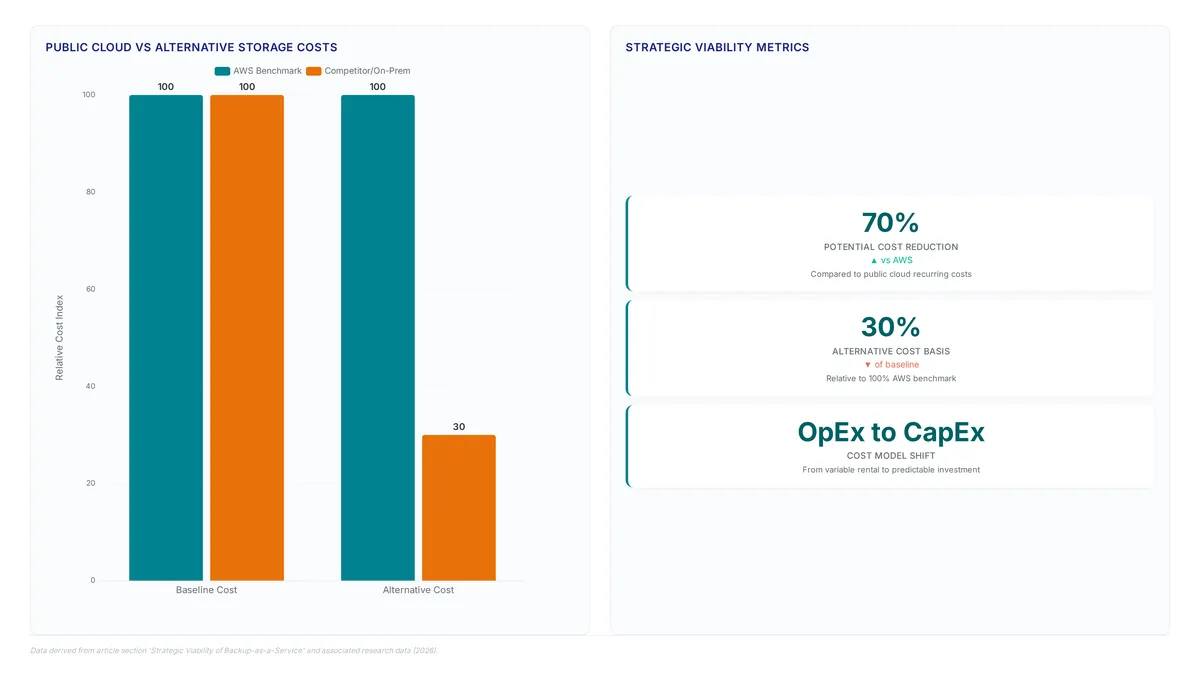
Replacing public cloud recurring costs with on-premises object storage economics defines the financial structure of Backup-as-a-Service. This model shifts the cost basis from variable operational expenditure to predictable capital investment, fundamentally altering the profit curve for service providers. Unlike the provider or other independent providers that bundle hardware with software licenses, Rabata.io delivers a pure software-set approach that decouples compute from storage scaling. This separation allows MSPs to expand capacity modularly without forcing costly forklift upgrades of entire appliance stacks. Immediate cash flow pressure often conflicts with long-term unit economics. Public cloud offers zero upfront cost, yet the cumulative expense of storing immutable copies for ransomware protection erodes profitability quicker than local depreciation schedules.rabata.io enables this transition by providing the S3-compatible foundation necessary for high-margin service delivery without the vendor lock-in associated with proprietary hyperscaler APIs. Operators must calculate the break-even point where capital outlay becomes cheaper than perpetual rental fees.
Evros Technology Group Ransomware Protection Deployment
Danny McEntee identified an urgent need for data immutability as ransomware threats escalated against client infrastructure. Evros Technology Group recognized that standard backups were insufficient without hardened protection mechanisms to prevent encryption or deletion. The deployment focused on integrating object locking to create write-once-read-many (WORM) compliance within their data protection offerings. Once a backup snapshot is written, no user or malware can alter it for a set retention period.
| Feature | Traditional Backup | Immutable Object Storage |
|---|---|---|
| Deletion Risk | High (admin accessible) | Zero (WORM locked) |
| Ransomware Durability | Low | Absolute |
| Compliance Mode | Optional | Mandatory |
Architectural isolation takes priority over mere capacity scaling for operators starting a Backup-as-a-Service business. Storing backups on the same logical volume as production data allows lateral movement to compromise both, representing a common failure mode. True ransomware protection requires physical or logical separation where the storage system itself rejects modification commands regardless of credential status. Public clouds offer similar features, but the margin potential drives providers toward sovereign control using S3-compatible platforms.rabata.io enables this architecture by providing the underlying object storage infrastructure designed for high-performance immutability. The platform supports the strict retention policies necessary for meeting regulatory mandates without relying on external vendor lock-in. Implementing such a system transforms backup repositories from passive targets into active defense layers. Clean data points become guaranteed available, reducing recovery time objectives notably. Enterprises adopting this model gain a competitive edge by offering provable data integrity to their own customers. A resilient service posture withstands even sophisticated credential-theft attacks.
Public Cloud Egress Penalties Versus Predictable On-Prem Economics
Hyperscale providers monetize data retrieval through tiered egress penalties that erode service provider margins during disaster recovery scenarios. Operators building a Backup-as-a-Service offering face compressed returns when client datasets exceed initial free tiers, triggering variable operational costs that scale unpredictably with usage volume. Migrating from public utility billing to on-premises S3-compatible storage changes the financial model dramatically, as capital expenditure replaces recurring fees.
| Cost Dimension | Public Cloud Model | On-Premises S3 Model |
|---|---|---|
| Retrieval Fees | High variable penalty | Zero egress cost |
| Capacity Scaling | Linear price increase | Modular hardware growth |
| Billing Predictability | Low (usage spikes) | High (fixed asset) |
Independent providers are gaining traction by challenging hyperscale dominance through partnership ecosystems and flexible pricing models that avoid the tiered penalties often associated with large public cloud datasets. The provider represents one such independent provider enabling this architectural shift within the data center. Upfront capital requirement for hardware is the constraint, yet this limitation forces disciplined capacity planning that ultimately stabilizes long-term unit economics.rabata.io enables this transition by providing the orchestration layer necessary to deploy multi-tenant, S3-compatible storage clusters on commodity hardware. This approach eliminates the penalty risk entirely, allowing providers to lock in fixed cost structures regardless of how frequently clients access their immutable backups. Flat-rate protection plans offer a strategic advantage that hyperscalers cannot match without sacrificing their own revenue models.
About
Alex Kumar is a Senior Platform Engineer and Infrastructure Architect at Rabata.io, where he specializes in Kubernetes storage architecture and disaster recovery strategies. His daily work designing persistent storage solutions and optimizing infrastructure-as-code directly informs this analysis of cloud service provider storage and S3-compatible ecosystems. At Rabata.io, Alex engineers scalable, GDPR-compliant object storage that serves as a high-performance alternative for enterprises and AI/ML startups. This practical experience allows him to critically evaluate market offerings like the provider HyperStore against the rigorous demands of modern multi-tenancy billing, ransomware protection, and Disaster Recovery-as-a-Service. By using Rabata.io's cost-effective and vendor-lock-in-free platform, Alex helps organizations build resilient data lakes and backup repositories without the complexity of traditional proprietary hardware. His insights reflect a deep understanding of how modular storage growth and true S3 API compatibility empower cloud providers to deliver superior as-a-service offerings.
Conclusion
Variable egress fees destroy margin predictability just as client datasets grow. The operational cost of public cloud retrieval creates a financial ceiling that fixed on-premises assets do not possess. Relying on usage-based billing for immutable data storage invites unavoidable margin erosion during recovery scenarios. The shift to commodity hardware requires disciplined capital planning but secures long-term unit economics that hyperscalers cannot replicate without altering their core revenue models.
Migrate to an on-premises S3-compatible architecture immediately if your organization faces unpredictable retrieval spikes or requires strict billing stability. Execute this transition before the next fiscal planning cycle to capitalize on fixed asset depreciation. Do not wait for egress penalties to impact quarterly earnings. Start by deploying the free 45-day trial of Rabata.io orchestration software on your existing commodity hardware this week to validate capacity scaling without upfront capital risk. This specific action allows you to measure performance gains and cost savings in a production-like environment before committing to full deployment. The goal is establishing a fixed cost structure that insulates your service margins from external usage volatility. By controlling the infrastructure layer, you regain the ability to offer flat-rate protection plans that hyperscale providers cannot match. Providers must adopt modular architectures to align capital expenses with this rapid revenue growth effectively.
Q: How does immutable storage architecture prevent ransomware encryption attacks?
A: Native S3 Object Lock enforces immutability at the object level to stop encryption. This ensures backups remain unalterable even if admin credentials are compromised during an attack.
Q: What financial advantage does modular storage growth offer over traditional hardware cycles?
A: Modular growth aligns infrastructure expenses directly with generated revenue streams. This approach replaces heavy upfront hardware purchases with consumption-based billing models for improved cash flow.
Q: Why is flat namespace architecture critical for high-throughput object storage workloads?
A: Flat namespaces apply unique identifiers to support virtually unlimited data scalability. This architecture removes traditional hierarchical constraints found in general-purpose file systems for massive scale.
Q: How do providers ensure performance isolation in multi-tenant cloud storage environments?
A: Embedded Quality of Service controls maintain performance for critical workloads during operations. These controls isolate customer data securely while preventing noisy neighbor issues in shared clusters.
Frequently Asked Questions
Providers must adopt modular architectures to align capital expenses with this rapid revenue growth effectively.
Native S3 Object Lock enforces immutability at the object level to stop encryption. This ensures backups remain unalterable even if admin credentials are compromised during an attack.
Modular growth aligns infrastructure expenses directly with generated revenue streams. This approach replaces heavy upfront hardware purchases with consumption-based billing models for better cash flow.
Flat namespaces utilize unique identifiers to support virtually unlimited data scalability. This architecture removes traditional hierarchical constraints found in general-purpose file systems for massive scale.
Embedded Quality of Service controls maintain performance for critical workloads during operations. These controls isolate customer data securely while preventing noisy neighbor issues in shared clusters.
References