k8scsis3 Driver: Real Tradeoffs for S3 Mounts
The yandex-cloud project hosting this k8s-csi-s3 driver records exactly 260 commits alongside 872 stars. This FUSE-based CSI implementation remains a functional, if niche, method for mounting S3 compatible storage as filesystems within Kubernetes 1.17+ clusters. While vendors like AWS push optimized alternatives such as their Mountpoint S3 CSI Driver, the open-source approach persists for environments requiring flexible bucket allocation without proprietary lock-in.
We need to talk about the specific architectural trade-offs of using fuse mount mechanisms versus native protocols. You will need privileged containers and shared mounts in the Docker daemon configuration. There is no way around it. System administrators must enable the MountFlags=shared systemd flag. Skip this, and mount propagation fails during pod scheduling.
Deployment happens via the published Helm chart or through manual kubectl application of provisioner.yaml and driver.yaml manifests. You must define a csi-s3-secret in the kube-system namespace to handle accessKeyID credentials securely. This process ensures that flexible volume provisioning functions correctly across the cluster without relying on external orchestration layers.
The Role of FUSE-Based CSI Drivers in Kubernetes Object Storage
Yandex k8s-csi-s3 Driver and GeeseFS Architecture
The k8s-csi-s3 driver presents S3 buckets as mountable volumes using the Container Storage Interface. Authored by yandex-cloud, this open-source project uses the GeeseFS file system engine to translate object storage operations into POSIX-compliant file calls via FUSE. This architectural choice distinguishes it from alternatives relying on different translation layers, as the GeeseFS backend is designed to handle file system translations for S3-compatible storage. The repository reflects active community engagement, recording 872 stars, 165 forks, and 20 watchers since its inception. Operators must deploy the driver within privileged containers to enable the necessary mount propagation required for FUSE operations inside pods.
Mounting Pre-existing Buckets via Static Provisioning
Static provisioning mounts a pre-existing bucket without triggering automatic deletion upon volume removal. This FUSE mount in Kubernetes approach preserves external data lifecycles independent of cluster state. Operators must omit the `storageClassName` field within the PersistentVolumeClaim definition to bypass flexible provisioning logic. Instead, a PersistentVolume requires manual creation featuring a matching `claimRef` to bind correctly. This configuration prevents the driver from assuming ownership of the underlying storage namespace. Unlike flexible allocation, this method ensures that deleting a PV leaves the remote bucket intact. The cost is increased operational overhead, as administrators must manually synchronize volume metadata with existing cloud resources. Misalignment in the `claimRef` configuration can prevent the PersistentVolume from binding correctly. Static workflows suit AI training pipelines requiring stable data roots across cluster upgrades. The k8s-csi-s3 driver explicitly supports this mode to prevent unintended cleanup of shared assets. Properly configured, the system presents object storage as a local directory while respecting external retention policies.
AWS Mountpoint S3 CSI Driver v2 vs Yandex GeeseFS
Architectural divergence defines performance profiles. The AWS driver employs Mountpoint Pod sharing while Yandex relies on GeeseFS. The AWS Mountpoint S3 CSI Driver reached version v2.7.0, introducing specific resource optimization through shared daemon processes across pods. This design reduces memory overhead and is optimized for integration within EKS environments. Both systems support static provisioning, allowing operators to mount pre-existing buckets without automatic deletion policies interfering with data retention.
| Feature | AWS Mountpoint v2 | Yandex k8s-csi-s3 |
|---|---|---|
| Underlying Engine | Mountpoint for Amazon S3 | GeeseFS |
| Pod Architecture | Shared Mountpoint Pods | Independent FUSE mounts |
| Primary Target | Amazon EKS | Generic Kubernetes |
| Provisioning | Flexible and Static | Flexible and Static |
Operators selecting between these drivers face a choice between managed service integration and engine flexibility. The AWS approach uses specific identity management features like IRSA and EKS Pod Identity. The Yandex implementation allows configuration of memory limits via storage class parameters, such as `--memory-limit 1000`. The choice ultimately depends on whether the priority is native cloud vendor alignment or portable, high-performance object access.
Architecture and Mounter Selection for S3 CSI Integration
GeeseFS Mounter Mechanics and Systemd Isolation
GeeseFS functions as the default mounter for the csi-s3 driver. The repository confirms the driver uses GeeseFS to mount S3-compatible storage via FUSE into containers. The architecture supports running the FUSE process with systemd isolation to prevent crashes during driver upgrades or restarts, a common consideration for FUSE deployments. Administrators can modify this behavior by adding `--no-systemd` to the storage class parameters if specific deployment constraints require it.
| Feature | GeeseFS Default | s3fs Backend | rclone Backend |
|---|---|---|---|
| POSIX Compatibility | Supported | Supported | Supported |
| Small File Perf | Optimized | Variable | Variable |
| Large File Perf | Optimized | Variable | Variable |
| Crash Durability | High (Systemd) | Standard | Standard |
The reliance on systemd creates a dependency on host-level configuration that cluster operators must verify before deployment. Specifically, the Docker daemon requires shared mounts via the `MountFlags=shared` flag to propagate the file system correctly into pods. This mounting strategy ensures AI/ML workloads maintain throughput by using the stability of user-space FUSE drivers configured with proper isolation. GeeseFS offers almost full POSIX compatibility and provides good performance for both small and big files.
Configuring Storage Class Parameters for Mounter Selection
Select the mounter via `parameters` in the storage class to control POSIX behavior. The csi-s3 driver exposes GeeseFS, s3fs, and rclone as distinct backends, each suiting different workload profiles. GeeseFS is the default engine, while s3fs and rclone offer alternative compatibility layers.
| Mounter | POSIX Level | Small File Perf | Directory Speed |
|---|---|---|---|
| GeeseFS | High | Good | Fast |
| s3fs | High | Variable | Variable |
| rclone | Low | Variable | N/A |
For workloads requiring strict isolation from pod restarts, the default configuration runs the FUSE process outside the container using systemd. You can disable this external isolation by adding `--no-systemd` to `parameters.options`. Static provisioning allows mounting pre-existing buckets without lifecycle management by omitting the `storageClassName` in the.
Kubernetes Privilege Requirements and Shared Mount Validation
Clusters must run Kubernetes 1.17+ to support the privileged operations required by FUSE-based CSI drivers. This version floor ensures the API server can handle the specific volume lifecycle hooks needed for object storage integration.
Privileged container permissions are mandatory because the csi-s3 driver requires host-level access to establish FUSE mounts. The Docker daemon configuration critically depends on the `MountFlags=shared` systemd flag to propagate these mount points across pod boundaries. Omitting this flag isolates the mount namespace, causing pods to see empty directories despite successful driver initialization.
| Requirement | Purpose | Failure Symptom |
|---|---|---|
| Kubernetes 1.17+ | API compatibility | Driver deployment fails |
| Privileged mode | FUSE access | Permission denied errors |
| MountFlags=shared | Mount propagation | Empty mount points |
Validating the systemd configuration on every node helps prevent intermittent mount failures during scale-out events.
Deploying and Configuring the S3 CSI Driver via Helm
Defining the CSI-S3 Secret and Endpoint Requirements

Provisioning fails immediately if the csi-s3-secret lacks the correct endpoint format for the target object store. Administrators must create this credential object in the kube-system namespace before deploying the driver components. The YAML structure requires three specific string data keys: `accessKeyID`, `secretAccessKey`, and `endpoint`. AWS deployments demand a region-specific URL pattern like `s3.eu-central-1.amazonaws.com`, whereas other S3-compatible providers apply a fixed domain. For instance, Yandex Cloud documentation specifies `storage.yandexcloud.net` as the static entry point for its managed service. The region field remains empty for non-AWS backends to prevent signature mismatches during authentication handshakes. Misaligned endpoint strings cause silent connection timeouts rather than clear authentication errors, delaying troubleshooting efforts. The GeeseFS engine relies on this precise configuration to establish valid FUSE mounts within the pod network namespace. Static provisioning strategies depend entirely on this initial secret accuracy to mount pre-existing buckets without creating new prefixes. Correctly defining these parameters allows the storage class to dynamically allocate volumes or bind to static resources.
Executing Helm Repository Addition and Driver Installation
Operators begin installation by adding the Yandex Cloud Helm repository at `yandex-cloud.github.io to the local client environment. This step registers the chart index, enabling the package manager to resolve dependencies for the csi-s3 driver without manual file handling. The process relies on the standard `helm repo add` command followed by an immediate installation directive targeting the `yandex-s3` namespace alias. The installation command triggers the creation of pods that apply the GeeseFS engine, a FUSE-based file system layer distinct from the Mountpoint architecture found in AWS native implementations. This architectural choice means the driver handles POSIX translation differently, prioritizing specific compatibility matrices over raw throughput optimization for large sequential writes.
A critical operational tension exists here: while Helm simplifies deployment, it abstracts the underlying privileged container requirements necessary for FUSE operation. If the cluster policy restricts privileged pods, the installation completes but the daemonset fails to mount volumes, leaving the storage class non-functional. Enterprises must verify node-level security policies allow shared mount propagation before relying on this automation.
Implementation: Configuring Storage Class Mounter Options and Bucket Prefixes
Defining the mounter parameter as `geesefs` within the StorageClass ensures optimal POSIX compatibility for file-system interactions. Administrators must explicitly configure this option alongside memory constraints to prevent unbounded resource consumption during heavy I/O operations. The configuration below demonstrates setting a strict memory-limit while designating a pre-existing bucket for data persistence:
When a specific bucket is declared, the driver does not delete the underlying object store container upon volume removal. Instead, the system isolates data by assigning a unique prefix matching the volume ID to every provisioned claim. This architectural choice means deleting a PersistentVolume only removes the specific prefix path, preserving the parent bucket structure for other workloads. Static provisioning offers an alternative where the driver mounts a pre-existing bucket or prefix without managing its lifecycle at all. Operators using static provisioning avoid automatic deletion entirely, ensuring critical datasets remain intact regardless of Kubernetes resource state changes. Relying on prefix-based isolation introduces a limitation where global bucket policies apply to all volumes within that container. This prefix strategy works well for multi-tenant AI/ML training environments where dataset segregation is required without the overhead of managing thousands of individual buckets. The cost is reduced granular control over bucket-level encryption or versioning settings compared to flexible bucket creation.
Operational Maintenance and Troubleshooting Common Mount Failures
Diagnosing Transport Endpoint Failures via CSI Provisioner Logs
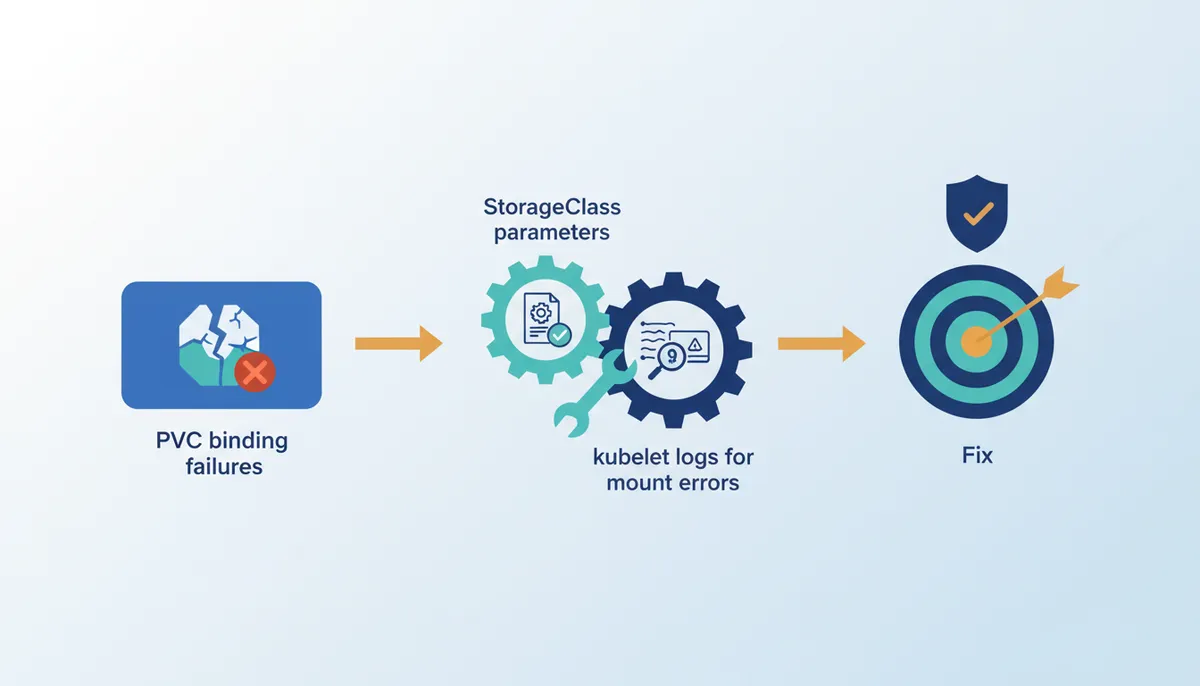
Transport endpoint disconnection often indicates that the FUSE mount process has terminated or become unreachable. Operators should inspect the pod logs using `kubectl logs` to isolate failure timestamps and determine if the csi-s3 container lost communication with the underlying FUSE daemon. A common root cause involves the MountPropagation feature gate being disabled or the Docker daemon not allowing shared mounts, which prevents the container from seeing the shared mount namespace required for persistent connectivity. For issues creating containers, users must ensure the feature gate MountPropagation is not set to false. Without the systemd flag `MountFlags=shared` configured on the Docker daemon, any restart of the CSI pod may sever the link between the application and storage, resulting in connectivity errors.
When upgrading the driver, administrators must delete legacy resources from previous versions to prevent conflicting configurations. Specifically, if upgrading from version `<= 0.35.5`, all resources from `attacher.yaml` must be deleted. If upgrading from `<= 0.40.6`, resources from the old `provisioner.yaml` must be removed. After cleaning up these legacy resources, re-applying the updated `provisioner.yaml`, `driver.yaml`, and `csi-s3.yaml` manifests restores the control loop. Ensuring the Docker daemon allows shared mounts via the `MountFlags=shared` systemd flag is a strict requirement for the driver to function, as this configuration ensures the kernel propagates mount events correctly across the container boundary.
Validating GeeseFS Mounts and Writing Test Files in Pods
Executables inside the pod must confirm the fuse.geesefs type appears in the system mount table immediately after startup. Running `mount | grep fuse` reveals the active translation layer, displaying critical parameters like `user_id=65534`, `group_id=0`, and `default_permissions` that govern file access contexts. The output includes parameters such as user_id=65534, group_id=0, and permissions default_permissions,allow_other. This output verifies that the engine successfully negotiated the shared mount namespace with the host node. Without this specific string in the mount list, the container lacks the necessary POSIX interface to interact with the remote bucket.
Operators should validate write permissions by executing a touch command against a target path such as `/usr/share/nginx/html/s3/hello_world`. Successfully creating this file proves end-to-end connectivity beyond simple directory listing. The standard testing procedure involves creating a test pod using `examples/pod.yaml` and verifying that the pod can start and write to the mounted volume. If the file creation fails despite a successful mount check, the issue likely lies in bucket policy restrictions or credential configuration rather than driver installation.
CSI Sanity Tester Execution and Docker-Based End-to-End Validation
The project repository includes a `test` directory and a `Makefile`, which are typically used to run validation workflows and ensure driver stability. While the source code is available on GitHub, the standard installation method relies on applying Kubernetes manifests via `kubectl` or using the provided Helm chart. End-to-end tests demand accessible S3 storage and a functional mounter like geesefs, ideally isolated within a container environment. Operators frequently encounter PVC binding failures when the underlying mount process lacks the necessary POSIX compatibility or shared namespace visibility. Running tests inside the containerized environment exposes these latent configuration errors before production deployment. Unlike manual checks, automated suites consistently stress flexible provisioning logic under varying load conditions. The limitation remains that network latency between the test container and storage backend can skew performance metrics, requiring careful interpretation of timeout values. Upgrading the driver requires careful adherence to the upgrade steps, such as deleting specific legacy resources, to ensure new binaries maintain compatibility with existing persistent volume claims. Embedding validation steps into CI/CD pipelines helps catch regressions early. This approach guarantees that only verified, stable driver versions reach production clusters, minimizing downtime risks associated with storage connectivity loss.
About
Marcus Chen is a Cloud Solutions Architect and Developer Advocate at Rabata.io, where he specializes in Kubernetes persistent storage and S3-compatible infrastructure. His daily work involves designing scalable data architectures for AI/ML startups, making him uniquely qualified to analyze the k8s-csi-s3 driver. At Rabata.io, Chen directly supports enterprises migrating from legacy cloud providers by using true S3 API compatibility to eliminate vendor lock-in. His expertise bridges the gap between complex CSI driver configurations and practical, high-performance storage solutions. Because Rabata.io offers GDPR-compliant object storage with significantly lower egress fees than substantial competitors, Chen understands the critical need for efficient bucket mounting in containerized environments. He evaluates tools like the k8s-csi-s3 driver not just as code, but as essential components for building cost-effective, high-throughput data pipelines that power modern generative AI applications without the burden of hidden costs.
Conclusion
Scaling the `k8s-csi-s3` driver reveals that static resource allocation often fails under flexible load, specifically when the default memory limit constrains high-throughput AI/ML workflows. As clusters expand, the operational cost shifts from initial setup to managing intermittent mount failures caused by insufficient buffer space during peak data ingestion. The recent update to the AWS Mountpoint S3 CSI Driver image v2.7.0 signals that relying on legacy configurations without rigorous validation invites instability. Teams must move beyond basic sanity checks and implement continuous, containerized end-to-end testing that mimics production network latency and file size variance.
Organizations running stateful workloads on Kubernetes should immediately adopt a policy of automated regression testing within their CI/CD pipelines before applying any driver upgrades. This approach ensures that changes to `MountPropagation` or binary compatibility do not silently degrade storage availability. Do not wait for a production outage to validate your storage layer; the window for preventing transport endpoint disconnections is narrowing as data velocity increases. Start this week by configuring your test suite to enforce strict memory limits against a staging bucket, verifying that your specific workload patterns remain stable under these constrained conditions before rolling out changes to production.
Frequently Asked Questions
You must enable the MountFlags=shared flag on your systemd daemon. This setting allows the driver to propagate FUSE mounts correctly across 1.17+ clusters.
Administrators must create the csi-s3-secret within the kube-system namespace. This step ensures secure credential handling for the 260 commits worth of driver logic.
Omit the storageClassName field in your PersistentVolumeClaim to use static provisioning. This method protects your 872 starred project data from accidental cleanup.
This driver utilizes the GeeseFS file system engine for POSIX translation. Unlike AWS v2.7.0, it relies on this specific engine for its core operations.
The driver requires privileged containers to execute necessary FUSE mount operations. Without this permission, the 165 forks of the code cannot access host mount namespaces.
References