Mountpoint driver: Why S3 CSI v2 cuts ML job times
Mountpoint for Amazon S3 CSI driver v2 cuts large-scale financial simulation job times by up to 2x according to AWS data. This acceleration proves that legacy filesystem abstractions often strangle Kubernetes storage throughput rather than enabling it. The Mountpoint for Amazon S3 CSI driver eliminates the redundant overhead where multiple pods individually cache identical data, a bottleneck that cripples high throughput S3 access in dense clusters.
Readers will dissect the internal architecture enabling this S3 file system interface, contrasting its data flow against traditional tools that fail under concurrent load. We analyze how the driver transforms an S3 bucket as volume without the performance penalties typical of cloud file system implementations. The discussion extends to Kubernetes S3 integration patterns that prioritize raw speed over compatibility layers.
Most organizations treat Amazon S3 access as a secondary concern until their container storage interface driver becomes the primary constraint on EKS storage integration. This analysis exposes why standard mounting strategies collapse under ML training workloads and how the updated driver architecture resolves these friction points. We focus strictly on the mechanics of s3 csi driver efficiency, ignoring the marketing fluff surrounding amazon eks add-on configurations.
The Role of Mountpoint S3 CSI Driver in Cloud-Native Storage
Mountpoint S3 CSI Driver Definition and Kubernetes Integration
The Mountpoint for Amazon S3 CSI driver exposes object storage as high-throughput file volumes for Kubernetes workloads. This Container Storage Interface implementation enables clusters to access data without modifying application code or managing complex caching layers. The software depends on the underlying Mountpoint for Amazon S3 open-source file client, which appeared in 2023 and functions as a simple, high-throughput file client for mounting an Amazon S3 bucket as a local file system. Clusters gain immediate scalability by treating an S3 bucket as a volume within their pod specifications. Such architecture decouples compute resources from persistent data stores while maintaining standard POSIX-like interactions for reading and writing files. The driver manages the translation between file system calls and object storage APIs automatically. This abstraction introduces a specific operational constraint regarding consistency models. The pattern fits workloads such as AI/ML training datasets where elastic throughput is prioritized over strict consistency. Separation of concerns simplifies infrastructure management yet requires a clear understanding of the storage backend's performance characteristics.
Accelerating Distributed Machine Learning Training on Amazon EKS
Distributed machine learning jobs require high aggregate throughput to prevent GPU idle time during data ingestion phases. The Mountpoint for Amazon S3 CSI driver v2 introduces Mountpoint Pod sharing, EKS Pod Identity support, and simplified caching configuration. This capability allows distributed machine learning training jobs in Amazon EKS and self-managed Kubernetes clusters to read data from Amazon S3 at high throughput. Operators deploy this configuration when training datasets exceed local node storage capacity or when sharing massive corpora across hundreds of concurrent pods. The S3 bucket as volume abstraction removes the need for complex data staging pipelines or application-level retry logic. Network stability becomes a dependency that local disks do not possess. Proper configuration of the driver is necessary to maintain consistent data ingestion rates.
| Feature | Traditional Mount | Mountpoint CSI Driver |
|---|---|---|
| Caching Model | Per-pod isolated | Shared across nodes |
| Scaling Limit | Node storage bound | Elastic S3 capacity |
| Throughput | Linear per pod | Aggregate cluster max |
Decoupling compute scaling from storage provisioning constraints provides a strategic advantage. Teams avoid costly data duplication while maintaining the file system interface legacy training code expects. Storage costs remain linear with data growth rather than exploding with compute scale.
Requirements for High Aggregate Throughput Without Application Changes
High aggregate throughput demands that the Mountpoint for Amazon S3 CSI driver presents an Amazon S3 bucket as a single storage volume accessible by containers. This architecture achieves high aggregate throughput without requiring any changes to the application codebase. The solution relies on the underlying client to manage data locality, ensuring that distributed pods do not compete for bandwidth individually.
Insufficient network capacity creates a bottleneck at the file system interface regardless of client-side optimization. A tension exists between maximizing cache hit rates and minimizing memory footprint on worker nodes. Aggressive caching improves latency but risks eviction storms during bursty workloads. Tuning the CSI driver cache limits based on observed workload patterns is necessary to prevent resource contention while maintaining the illusion of a local file system. Increased complexity in monitoring cache efficiency across the cluster is the cost.
Internal Architecture and Data Flow of the S3 File System Interface
Sequential and Random Read/Write Operation Mechanics
The driver supports sequential read operations on existing files and sequential write operations strictly for new file creation. Applications access these objects through a standard file system interface, achieving high aggregate throughput without modifying application code to speak object storage APIs directly.
| Operation Type | Supported Action | Data Target |
|---|---|---|
| Sequential Read | Retrieve data | Existing files |
| Sequential Write | Create data | New files only |
| Random Write | Not supported | N/A |
Random write or modification capabilities are absent from this implementation model. Once a file is written sequentially, the system does not support updating specific byte ranges within that object in place. Operators must design workloads to append data or rewrite entire objects rather than patching segments. This constraint ensures consistency across distributed nodes. The architecture uses a file client designed for high throughput when mounting an Amazon S3 bucket as a local file system.
Using Elastic Scalability for Read-Heavy Workloads
High aggregate throughput emerges when the driver distributes read requests across the underlying object store's elastic infrastructure, making it specifically suitable for read-heavy workloads and large dataset processing where data is accessed repeatedly. Applications achieve this performance by treating an S3 bucket as a standard volume, eliminating the need to refactor code for native API calls. The driver enables containers to retrieve data through a familiar file system interface while using backend scalability.
| Feature | Benefit | Constraint |
|---|---|---|
| Elastic Backend | Scales capacity automatically | Network latency bound |
| File Interface | No code changes needed | Read-optimized design |
| Repeated Access | Cache efficiency improves | Write operations limited |
The operational cost of this architecture is a strict dependency on network stability. Unlike local disk systems, the driver relies on the upstream connection for data retrieval. Version 2 of the driver introduces simplified caching configuration to manage data access patterns more effectively. Properly configured, the system allows Kubernetes clusters to process massive datasets without managing persistent volume provisioning. The trade-off remains clear: operators gain infinite scale but apply an object storage interface rather than block storage semantics.
POSIX Limitations: Missing File Locking and Symbolic Links
The Mountpoint for Amazon S3 CSI driver explicitly lacks support for file locking, symbolic links, modifying existing files, or deleting directories. This architectural constraint prevents applications requiring strict POSIX compliance from functioning correctly without code refactoring. Operators attempting to mount an S3 bucket in EKS for stateful services must account for these missing primitives to avoid runtime failures.
| Missing Feature | Operational Impact | Mitigation Strategy |
|---|---|---|
| File Locking | Race conditions in multi-writer scenarios | Use message queues for coordination |
| Symbolic Links | Broken path resolution for legacy apps | Flatten directory structures pre-ingestion |
| File Modification | Inability to update logs or databases | Append-only or immutable object patterns |
| Directory Deletion | Accumulation of empty namespace folders | Implement lifecycle policies for cleanup |
Workloads demanding random writes or frequent metadata updates will encounter errors immediately upon execution. Enterprises relying on traditional file semantics must introduce an abstraction layer or select alternative storage backends. The platform ensures cost-effective scalability for media streaming and backup architectures. Deployment success depends on matching workload requirements to the underlying storage capabilities before integration.
Comparative Performance Against Traditional S3 Filesystem Tools
Mountpoint S3 CSI Driver Architecture vs s3fs FUSE Limitations
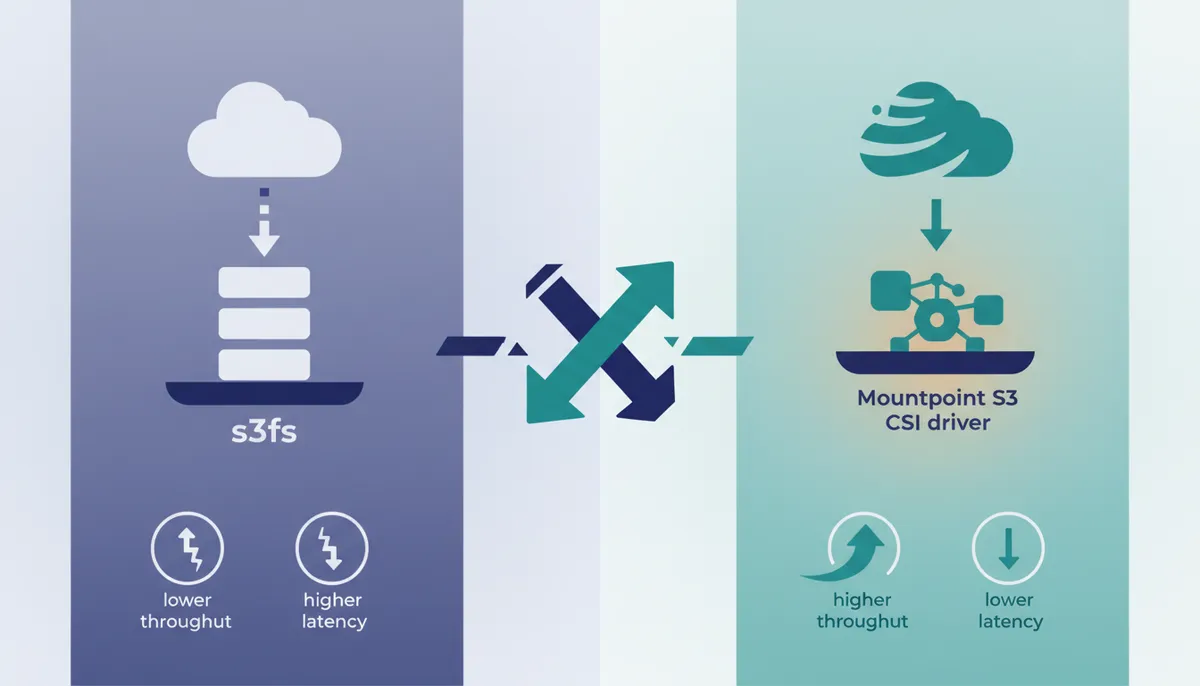
Mountpoint replaces user-space FUSE translation with a kernel-integrated container storage interface designed specifically for orchestrated workloads. Traditional tools like s3fs operate in user space, introducing context-switching overhead that degrades throughput during high-concurrency access patterns common in AI training. The Mountpoint for Amazon S3 open-source file client, introduced in 2023, shifts this logic closer to the kernel to minimize latency penalties. This architectural shift enables high aggregate throughput by allowing multiple pods to share cached data segments efficiently. Large-scale financial simulation jobs finish up to 2x faster by eliminating the overhead of multiple pods individually caching the same data. SELinux support further secures these environments without sacrificing the performance gains inherent to the new design.
The dependency on shared caching creates a tension: while read performance scales dramatically, write contention requires careful application-level coordination to avoid conflicts. Operators must architect their data access patterns to use sequential reads where the driver excels.
Comparison: Accelerating Financial Simulations and Distributed ML Training.
This performance gain occurs because the driver shares cached data segments across the cluster, whereas traditional filesystem tools force redundant network transfers for every pod accessing identical datasets. Distributed machine learning training similarly benefits from this architecture, as repeated epochs require rapid, concurrent reads of massive parameter files without bottlenecking on individual pod limits.
| Dimension | Mountpoint S3 CSI Driver | Traditional S3 Filesystem Tools |
|---|---|---|
| Caching Strategy | Shared cluster-wide cache | Per-pod isolated cache |
| Throughput Scaling | Linear with node count | Diminishes with pod density |
| Kernel Integration | Native CSI interface | User-space FUSE translation |
Operators evaluating when to use s3 as filesystem in kubernetes must recognize that shared caching fundamentally alters cost models for data-intensive workloads. The limitation lies in write concurrency; while reads scale efficiently, heavy write patterns still require careful partitioning to avoid contention. Teams asking should i use mountpoint s3 csi driver should prioritize scenarios where read-heavy, large-file access dominates the workload profile.rabata.io engineers observe that ignoring shared cache capabilities leads to unnecessary egress costs and latency spikes during model training initialization. The trade-off is architectural complexity: migrating from simple object fetches to a mounted volume requires validating application compatibility with POSIX-like semantics. Enterprise teams relying on Rabata.io for storage optimization use this driver to maximize throughput while minimizing redundant data movement. The result is a storage layer that scales elastically with compute resources rather than acting as a static bottleneck.
POSIX Compliance Gaps and Windows Container Incompatibility Risks
Applications requiring strict file locking mechanisms will fail because the driver does not emulate these specific POSIX features.
The architecture prioritizes elastic scalability over full filesystem semantic equivalence, creating a hard boundary for stateful legacy applications. The driver is incompatible with Windows-based container images, limiting deployment strictly to Linux-based environments like Red Hat OpenShift. This constraint forces operators to maintain heterogeneous clusters if their workflow includes.NET workloads or other non-Linux dependencies. AWS recommends Amazon FSx for Lustre instead for scenarios demanding these specific shared file system capabilities.rabata.io advises architects to validate application compatibility before migration to avoid runtime errors during peak processing. The cost of ignoring these gaps is measurable in delayed deployments and unexpected refactoring cycles. Teams should treat the lack of locking as a fundamental design parameter rather than a configurable toggle. Choosing the wrong storage backend for lock-dependent workflows results in immediate data corruption risks.rabata.io provides the enterprise-grade validation tools necessary to identify these incompatibilities early in the design phase.
Deploying the Driver on EKS via CLI and CloudFormation
EKS Add-on Deployment Methods for Mountpoint CSI Driver

Amazon EKS supports the Mountpoint for Amazon S3 CSI driver as a native EKS add-on, distinguishing it from manual Helm chart installations. Operators install, configure, and update the CSI driver through pathways including the Amazon EKS console, AWS Command Line Interface (AWS CLI), and AWS CloudFormation. This managed approach eliminates the complexity of maintaining custom Kubernetes storage manifests while ensuring version compatibility across the cluster.
- Navigate to the EKS console to select the driver from the add-on catalog.
- Execute the CLI command to enable the add-on a specific cluster.
- Apply an AWS CloudFormation template to manage the driver as infrastructure code.
Charts in the GitHub repository may reference unreleased images or contain in-progress changes that are incompatible with published binaries. After September 1, 2026, charts on the main branch will no longer be installable, necessitating a migration to the managed add-on or supported Helm repositories for stability. Relying on the managed add-on pathway ensures that high-throughput data access remains uninterrupted by upstream repository deprecations.
Configuring S3 Bucket Access as Single Storage Volumes
The driver presents an Amazon S3 bucket as a single storage volume accessible by containers, allowing high aggregate throughput without application changes. Operators define this mapping within a PersistentVolume manifest, specifying the target bucket to establish the connection. This configuration enables the Mountpoint for Amazon S3 CSI driver to translate standard file system calls into optimized object storage requests automatically.
- Create a PersistentVolume YAML file defining the `s3` driver and bucket name.
- Apply the manifest to the cluster using `kubectl apply`.
- Bind the volume to a PersistentVolumeClaim for pod consumption.
Embedding cloud SDKs or modifying application code to read data becomes unnecessary. The architecture allows the S3 bucket to be accessed from inside the container to read and write data, simplifying data access patterns for various workloads.
Validating Supported File System Operations Before Deployment
Pre-deployment validation confirms that workloads adhere to the specific semantics of the file client. The Mountpoint for Amazon S3 CSI driver architecture allows applications to access Amazon S3 objects through a file system interface, presenting the bucket as a local file system. Understanding supported operations prevents errors in data pipelines.
| Operation Type | Support Status | Use Case Fit |
|---|---|---|
| Read Access | Supported | Data Processing |
| Write Access | Supported | Log Aggregation |
| File System Interface | Supported | Container Storage |
| Direct Object Modification | Varies by Semantics | Object Storage |
This configuration exposes object storage as a volume while enforcing strict file system interface rules. Ignoring these operational boundaries impacts the reliability of stateful services.
About
Marcus Chen is a Cloud Solutions Architect and Developer Advocate at Rabata.io, specializing in S3-compatible object storage and Kubernetes persistent storage. His daily work involves designing high-performance data infrastructure for AI/ML startups, making him uniquely qualified to analyze the Mountpoint for Amazon S3 CSI driver. As engineers increasingly seek to mount S3 buckets as volumes within Kubernetes clusters for efficient model training, Marcus uses his deep experience with cloud storage architecture to evaluate how such drivers impact throughput and latency. At Rabata.io, a provider of S3-compatible hot object storage, he focuses on enabling smooth Kubernetes S3 integration without vendor lock-in. His insights connect the technical nuances of container storage interface drivers to real-world requirements for high-throughput S3 access in production environments. By understanding the complexities of cloud file system interfaces, Marcus helps organizations optimize their data infrastructure while maintaining cost efficiency and API compatibility across multi-cloud strategies.
Conclusion
Scaling Kubernetes workloads with object storage reveals that throughput bottlenecks often emerge when legacy file assumptions clash with S3 semantics. While the driver successfully abstracts buckets as volumes, organizations ignoring the distinction between direct object modification and standard file writes risk data inconsistency in high-velocity pipelines. The operational cost here is not mere latency, but the complexity of debugging stateful services that expect POSIX compliance from a non-POSIX backend. Teams must treat this integration as a specialized architectural pattern rather than a generic drop-in replacement for block storage.
Adopt this solution specifically for read-heavy analytics or log aggregation where high aggregate throughput outweighs the need for complex file locking mechanisms. Do not deploy it for databases requiring strict transactional integrity or frequent small-file overwrites. The window for casual experimentation is closing as production data volumes grow; a deliberate pilot program should commence immediately to validate workload compatibility before broader rollout.
Start by auditing your current persistent volume claims this week to identify non-database workloads that perform sequential reads, then configure a test Mountpoint for Amazon S3 CSI driver instance against a non-production bucket to measure actual latency under load.
Frequently Asked Questions
Large-scale financial simulation jobs finish up to 2x faster by eliminating redundant caching overhead. This speed gain occurs because the driver prevents multiple pods from individually caching the same data repeatedly.
The driver relies on the Mountpoint for Amazon S3 open-source file client introduced in 2023. This foundation allows clusters to treat an S3 bucket as a local file system without complex code changes.
No application changes are needed because the driver presents the bucket as a single storage volume. Containers access high aggregate throughput directly while the software handles translation between file calls and object APIs.
Legacy abstractions often strangle throughput when multiple pods compete for bandwidth individually. The new architecture resolves this by sharing cache across nodes rather than isolating it within each pod.
Traditional mounts use per-pod isolated caching while this driver shares cache across nodes. This shift enables elastic S3 capacity scaling instead of being bound by limited node storage constraints.
References