High-Performance Storage: Ditching Legacy Ceph Now
In early 2022, OVHcloud tore out aging Ceph infrastructure. In its place, they installed high-performance Storage driven by OpenIO artificial intelligence. This isn't a patch update; it is a hard pivot away from legacy OpenStack Swift APIs toward intelligent, parallelized data handling built for modern throughput.
Calling this "High Throughput Storage" undersells the shift. We are looking at a fundamental re-engineering of concurrency management. The old model relied on static hashing; the new model uses AI-powered architecture to optimize parallel data transfers and rethink multipart downloads. When you contrast these capabilities against traditional Ceph solutions using the rigorous testing scenarios from Cloud Mercato, the gap widens.
The metrics tell the story across distinct operational profiles: large file uploading for backups and small file downloading for website assets. We are talking about video streaming broadcasts and Big Data retrieval patterns that break conventional systems. These concrete use cases prove why legacy architectures cannot match the efficiency of AI-driven platforms in 2026.
The Role of AI-Powered Architecture in Modern Object Storage
Defining high-performance Object Storage via OpenIO AI
OVHcloud launched High Efficiency Storage in early 2022 to retire aging Ceph and OpenStack Swiift systems. The infrastructure now leans on OpenIO technology, an architecture that employs artificial intelligence for management rather than rigid rules. Traditional clusters choke on fixed configurations when demands shift. The new solution optimizes data placement by automatically analyzing specific workload patterns. OpenIO engines scrutinize access frequencies and file sizes to distribute data across physical nodes with precision. Standard object stores falter with heterogeneous workloads. An AI-driven approach maintains consistent throughput regardless of the mix.
Optimizing S3-Compatible Endpoints with AI Data Placement
Static hashing rings are dead in S3-compatible endpoints. Flexible node selection, driven by AI, takes over. The OpenIO engine reads real-time access patterns, routing large file downloads to available physical disks to maximize throughput for big data workloads. This mechanism sustains high concurrency by spreading requests across the cluster, preventing specific drives from choking during peak transfer windows. Operators managing media streaming or backup archives gain automated load balancing, cutting the manual tiering legacy Ceph architectures demand. By dynamically optimizing disk I/O subsystems, the architecture targets read speeds approaching 1,360 MB/s and write performance near 525 MB/s concurrent request performance.
Small file workloads introduce a wrinkle: the overhead of decision logic can impact latency gains compared to simple distribution. Validate your specific file size distributions before migrating heterogeneous datasets. Traditional systems stick to fixed configurations; this approach adapts to shifting data temperatures without service interruption. There is a cost, however. Computational overhead on metadata servers requires strong CPU allocation to keep the control plane responsive. For enterprises prioritizing bulk data throughput over micro-service latency, industry observers see this configuration as the logical choice.
Legacy Ceph Swift API vs AI-Driven Storage Performance
high-performance Object Storage kills static hashing rings. Flexible, AI-driven data placement eliminates the bottlenecks they create.
Traditional architectures relying on Ceph via the OpenStack Swiift API distribute data using fixed algorithms blind to real-time disk congestion. The OpenIO engine analyzes access patterns to route requests to available physical nodes dynamically. This mechanistic shift allows clusters to sustain high concurrency during massive parallel downloads without manual sharding. Benchmarks validating these gains often measure performance across seven popular object storage solutions to ensure comparative validity. The specific OVHcloud/OpenStack Swift Benchmark project illustrates how modern platforms evaluate throughput against main competitors under varied load scenarios.
| Feature | Legacy Ceph + Swift | AI-Driven Storage |
|---|---|---|
| Data Placement | Static Hash Rings | Flexible ML Optimization |
| Congestion Mgmt | Reactive Rebalancing | Predictive Routing |
| Scaling Method | Manual Shard Addition | Automatic Node Selection |
| Latency Profile | Variable under load | Consistent low latency |
Continuous metadata analysis consumes additional CPU cycles compared to simple hashing. That is the trade-off. Network operators must weigh this compute overhead against the gains in throughput consistency for large file transfers. Legacy systems suffice for predictable, low-volume archives. Big data workloads demand the adaptive routing found in newer platforms. Organizations seeking to replicate these rigorous testing methodologies can find guidance through industry resources on reproducible benchmarking. Static simplicity yields to intelligent complexity when scale becomes a variable.
Inside the Mechanics of Parallel Data Transfers and Multipart Downloads
Multipart Download Mechanics and Parallel Connection Logic
Splitting large objects into segments bypasses sequential bottlenecks entirely. This process divides a single file into independent chunks, enabling the client to open multiple parallel connections that fetch data slices concurrently rather than waiting for previous blocks to finish. Traditional sequential throughput measurements miss this capability. Modern evaluations prioritize concurrent request performance because contemporary applications demand efficient handling of multiple simultaneous I/O operations Concurrent request performance.
Sequential downloads saturate a single TCP stream. Multipart logic aggregates bandwidth across several streams to maximize aggregate throughput.
- The client requests object metadata to determine total size.
- The file is logically partitioned into equal-sized segments.
- Parallel threads retrieve distinct ranges simultaneously.
- The client reassembles segments into the original file order.
Complexity arises in error handling and reassembly overhead if network jitter occurs. Unlike simple GET requests, multipart strategies require the client to manage state and coordinate reassembly, increasing CPU usage on the consuming host. Big data workloads downloading massive datasets see substantial latency reductions through parallelization. Performance benchmarks now explicitly measure these concurrency metrics in milliseconds to reflect real-world usage patterns where I/O operations occur in bursts rather than steady streams I/O operations. Organizations optimizing for AI training data or media rendering must configure their clients to exploit these parallel paths effectively.
Optimizing Big Data and Video Streaming Scenarios
Architectural decisions for large file downloads now prioritize mountability and retrieval latency over simple sequential throughput. Benchmarks increasingly categorize providers by these metrics because they directly impact the operational expenditure of high-performance deployments operational expenditure. Systems split massive objects into segments for simultaneous retrieval via parallel connections when handling Big Data Multipart scenarios. This approach bypasses the bottlenecks inherent in single-stream TCP transfers, allowing clients to saturate available bandwidth effectively.
Performance varies notably across workload types, as shown in recent high-configuration tests:
- Big Data Multipart Read Throughput Up to 1,360 MB/s recorded 1,360 MB/s Large File Upload
- e File Upload Write Speed Approximately 525 MB/s measured 525 MB/s Video Broadcasting
- Document AB medium file retrieval rates
- Website AB small file access speeds
Video broadcasting to several clients demands consistent low-latency retrieval rather than peak burst capacity. The ability to mount object storage as a local file system remains a differentiator for legacy high-performance computing applications requiring direct disk access mountability. Enabling aggressive parallelism introduces complexity in error handling and data consistency checks. Operators must balance connection counts against server-side throttling limits to avoid diminishing returns.
Rabata.io recommends validating retrieval time SLAs under load before migrating active AI training datasets. Maximizing concurrency while maintaining data integrity requires careful tuning of client-side chunk sizes. Enterprises should test specific multipart configurations to ensure their network infrastructure supports the required degree of parallelism without packet loss.
Validating S3-Compatible Storage with COSBench
Reliable validation of S3-compatible interfaces requires standardized workload simulation using tools like COSBench. This open-source utility, originally developed by Intel Cloud, replicates complex I/O patterns on OpenStack Swift and S3 endpoints to expose throughput bottlenecks before production deployment. Operators must configure workloads that mirror specific Big Data Multipart scenarios rather than relying on simple sequential read tests.
Benchmarking studies frequently evaluate seven popular self-hosted solutions under identical conditions to ensure comparative validity across different architectures seven popular. The methodology demands strict control over variables such as object size and concurrent connection counts to yield reproducible results.
| Test Scenario | File Size Profile | Connection Strategy |
|---|---|---|
| Backup | Large | Single Stream |
| Big Data | Large | Parallel Segments |
| Website AB | Small | High Concurrency |
Network bandwidth exceeding the storage node's ability to process metadata requests creates a specific limitation. High parallelism can overwhelm the metadata server even when data plane throughput remains unused.rabata.io recommends tuning the worker count in COSBench to match the expected client concurrency of your AI training clusters. Ignoring this alignment leads to false confidence in storage performance during actual model training jobs.
Comparative Performance Analysis of OVHcloud Against Traditional Ceph Solutions
Defining Concurrent Request Output in S3 Benchmarks

Modern performance evaluations have shifted focus from simple sequential throughput to concurrent request throughput as the primary metric for storage validation. Technical assessments now prioritize how systems handle multiple simultaneous I/O operations rather than single-stream speed. Big data workloads rarely read linearly; they demand parallel access patterns that stress coordination layers. Research indicates that benchmarking must measure Time To First Byte latency under load to reflect actual application behavior Concurrency Metrics. Static hashing architectures struggle here, whereas newer solutions like OpenIO apply artificial intelligence to optimize data placement dynamically. High-performance configurations can sustain roughly 1,360 MB/s read speeds and 525 MB/s write speeds even when competing for resources vendor-benchmarked performance. Throughput results vary notably depending on specific test conditions and provider configurations. Raw disk speed means nothing without efficient request scheduling. Validating storage candidates against multipart download scenarios before production deployment is a recommended practice to ensure performance aligns with expectations.
Big Data Multipart Download Scenarios for Parallel Connections
Large file downloads with multiple parallel connections apply the Big Data Multipart scenario to maximize throughput by distributing load across discrete stream segments. This approach helps bypass single-connection bottlenecks often encountered during massive dataset retrieval. Evaluations of self-hosted S3-compatible storage often measure performance across seven popular object storage solutions to ensure comparative validity under identical conditions comparative validity. Operators should verify that their chosen provider maintains low latency even when request concurrency spikes. Efficiency in multipart operations often depends on how files are split into chunks and managed by client-side logic.
OVHcloud High Output Storage Read Write Speeds vs Market Averages
Market baselines for high-performance S3-compatible storage peg read throughput near 1,360 MB and write speeds around 525 MB, setting a rigorous ceiling for architectural comparisons. OVHcloud High Throughput Storage uses OpenIO technology to approach these limits by using flexible data placement driven by artificial intelligence. This mechanism distributes data fragments across physical disks to prevent hotspots during massive parallel downloads. Traditional clusters may experience saturation on specific OSDs when metadata operations spike, causing latency spikes that degrade video streaming or backup restoration times. Achieving these speeds often requires optimized network stacks that many legacy on-premise deployments lack. The cost of migrating from a stable but slower Ceph environment involves re-architecting application logic to apply multipart uploads effectively. Single-stream performance may not reflect the system's true capacity without parallelizing requests. Operators must weigh the throughput gains against the complexity of tuning client-side concurrency settings. Validating storage performance using real-world big data download scenarios rather than relying solely on vendor spec sheets is a prudent strategy for ensuring operational success.
Executing Reliable Object Storage Benchmarks for Big Data Workloads
Application: Defining Concurrent Request Efficiency in Modern S3 Benchmarks
Sequential throughput no longer serves as the primary metric for evaluating modern object storage systems. Applications now demand efficient handling of multiple simultaneous I/O operations rather than raw single-stream speed. This shift reflects how AI training jobs and media streaming services access data in parallel across distributed nodes. Evaluations now prioritize concurrency metrics measured in milliseconds to capture real-world latency under load. Standardized testing tools simulate workloads where hundreds of clients request objects simultaneously, exposing bottlenecks invisible to sequential benchmarks. Storage architectures that excel at large file downloads may falter when faced with thousands of small, concurrent requests typical of document serving or website backends.
A system optimized for backup scenarios involving large sequential uploads may underperform in big data multipart downloads requiring parallel connections. Operators must distinguish between mountability capabilities and pure object store throughput when selecting infrastructure for specific workloads. The provider leads in download latency and Time To First Byte metrics during concurrent tests, outpacing competitors in scenarios demanding rapid response across many simultaneous connections.rabata.io advises clients to replicate these multi-scenario benchmarks before committing to a storage provider. Choosing incorrectly results in either wasted capacity or unacceptable latency during peak demand periods.
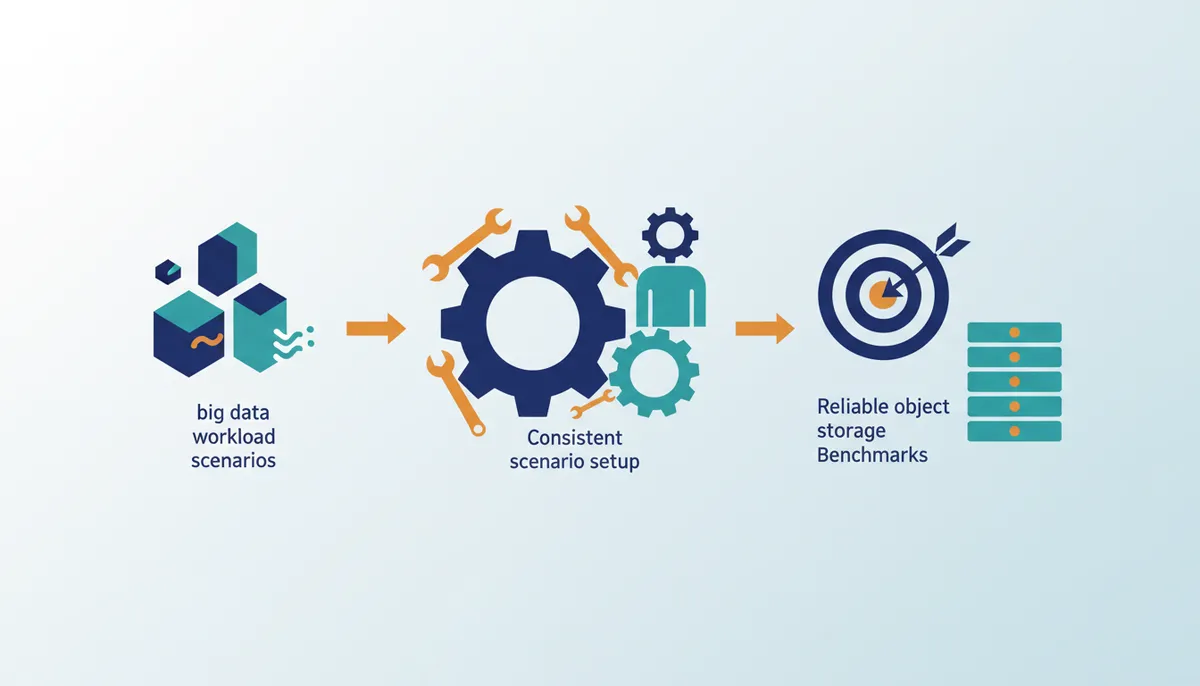
Executing Big Data Multipart and Backup Scenarios with COSBench
Distinct COSBench workloads allow operators to accurately simulate parallel downloads for AI training sets and massive backup ingestion streams. The technical mechanism relies on defining XML workload files that specify operation mixes, distinguishing between single-stream large file uploads for disaster recovery and multi-connection downloads for dataset preparation. Engineers apply this open-source tool from Intel Cloud to generate the necessary concurrency that exposes storage controller bottlenecks under realistic pressure.
Maximizing parallel threads does not guarantee linear throughput gains if the underlying network stack introduces head-of-line blocking or if the storage backend lacks sufficient I/O queues. A common limitation involves client-side resource exhaustion, where the benchmarking host itself becomes the bottleneck before the storage array reaches saturation. High-performance vendor-benchmarked metrics for specific S3-compatible offerings have been recorded at approximately 1,360 MB/s for read operations and around 525 MB/s for write configurations. The cost of ignoring multipart testing is measurable latency spikes during actual model weight retrieval, directly impacting GPU utilization rates in production clusters. Validation of S3-compatible endpoints through these specific scenarios ensures that egress patterns match the aggressive parallelism required by modern frameworks.rabata.io recommends validating these configurations against your specific object count targets before committing to a production migration.
Application: Validating S3-Compatible Storage Across Seven Solution Configurations
Reliable validation requires testing seven popular object storage solutions under identical conditions to ensure comparative validity. Engineers must evaluate mountability and retrieval time distinctions, as these metrics directly dictate operational expenditure for high-performance deployments. Pure object stores often lack the file-system-like access required for legacy workflows, creating a tangible constraint between protocol purity and integration ease. Thorough benchmarks explicitly include pricing as a primary comparison parameter alongside raw throughput data.
The analysis reveals that ignoring retrieval time variances can inflate total cost of ownership despite competitive base pricing. Teams should replicate real upload and download operations rather than relying on theoretical maximums.rabata.io recommends aligning test scenarios with specific workload profiles like video broadcasting or document serving. This targeted approach prevents over-provisioning resources for unused concurrency levels.
About
Marcus Chen serves as a Cloud Solutions Architect and Developer Advocate at Rabata.io, where he specializes in S3-compatible object storage and AI/ML data infrastructure. His deep expertise in cloud storage architecture and performance benchmarking makes him uniquely qualified to analyze OVHcloud's High Efficiency Storage evolution. In his daily work, Chen engineers scalable storage solutions for enterprise clients, directly confronting the same challenges of balancing throughput, latency, and cost that define the OVHcloud and OpenIO transition. This article connects his hands-on experience optimizing Kubernetes persistent storage and managing massive datasets to the broader industry shift toward high-performance, S3-compatible endpoints. By evaluating how OVHcloud uses OpenIO to modernize legacy Ceph systems, Chen provides a technical perspective grounded in Rabata.io's mission to deliver transparent, high-speed storage alternatives. His analysis bridges the gap between theoretical benchmarks and the practical realities faced by DevOps engineers and data architects today.
Conclusion
Scaling beyond initial benchmarks exposes a critical fracture where concurrency degradation undermines theoretical throughput. While single-stream tests highlight peak capabilities, production environments often stall because the architecture cannot sustain parallel I/O queues under load. The operational cost here is not merely storage capacity but the wasted compute cycles when GPUs idle waiting for data retrieval. Teams must prioritize validating S3-compatible endpoints against their specific object count targets rather than trusting vendor marketing materials that ignore client-side bottlenecks.
Organizations should commit to a rigorous validation protocol within the next sprint cycle before migrating any production workloads. This timeline ensures that latency spikes do not derail critical model training or video broadcasting schedules. The market is shifting toward solutions that integrate deeply with Kubernetes and offer strict compliance, making early verification necessary for long-term stability.
Start by replicating your exact upload and download operations this week using a tool that measures retrieval time variances under concurrent load. Compare these results against the documented performance baselines to identify if your current setup will degrade at scale. This immediate test reveals whether your infrastructure can handle real-world parallelism or if it will collapse when multiple users access data simultaneously.
Frequently Asked Questions
Reads sustain approximately 1,360 MB while writes reach 525 MB under optimal conditions. This performance enables efficient handling of big data workloads requiring massive parallel download speeds for job completion.
Dynamic node selection replaces static hashing rings to optimize disk I/O subsystems dynamically. This shift allows the system to target read speeds near 1,360 MB by analyzing real-time access patterns automatically.
The engine distributes requests across the cluster to maximize throughput for big data workloads.
Write performance remains stable near 525 MB, which is critical for latency-sensitive video broadcasting. This consistent speed ensures that uploading large files for backups does not degrade under heavy concurrent load.
Concurrency handling degrades with scale in legacy systems, but AI optimization maintains stability.
References