Digital sovereignty needs local code, not just borders
Global data volume will triple by 2027. Centralized storage models cannot scale to meet this demand while satisfying sovereign infrastructure requirements. The partnership between Cubbit and Commvault offers a functional countermeasure to foreign dependency by anchoring European backup targets within continental borders. This alliance merges Commvault's cyber-durability engines with Cubbit's geo-distributed S3 storage, creating a verifiable chain of custody for strict regulatory mandates.
The DS3 Architecture reconstructs object storage using a swarm of physical nodes. This bypasses mainstream public cloud inefficiencies while maintaining S3 compliance. Mechanics involve the DS3 Composer for on-premises deployments or the fully managed DS3 Cloud. Both options keep cryptographic keys and operations under local control. This technical reality addresses a stark statistic: the EU imports over 80% of its key digital products from non-EU nations.
Organizations can now meet NIS2 and DORA compliance without sacrificing recovery speed. Decoupling storage logic from hardware ownership breaks the hyperscaler monopoly. It forces a reevaluation of where "sovereignty" actually resides in the stack. Digital sovereignty requires deployable code, not just political rhetoric.
Digital Sovereignty and Cyber Durability Set for European Infrastructure
Digital sovereignty means European authority over infrastructure code, not just geographic data placement. The EU depends on non-EU nations for over 80% of necessary digital products. Residency rules alone cannot fix this strategic weakness. Data localization keeps bits inside borders, but digital sovereignty ensures governing legal and technical frameworks stay under European jurisdiction. Global data volume is projected to triple by 2027. This places immense strain on compliant architectures. The upcoming Cloud and AI Development Act targets dependency, not just location. A localized dataset running on non-European software stacks remains vulnerable to extraterritorial legal claims. Sovereign architectures remove this exposure.
Migration presents the primary hurdle. Moving from hyperscaler ecosystems requires replacing the entire management plane, not just storage buckets. Operators must verify their S3 endpoints execute European-controlled code to satisfy GDPR compliance completely. Confusing physical data location with stack control leaves data localization compliance issues unresolved despite apparent adherence to residency laws.
Commvault and Cubbit DS3 Geo-Distributed Backup Architecture
S3-compliant storage acts as the immutable target layer where Commvault deposits encrypted fragments across a peer-to-peer swarm. This geo-distributed topology substitutes centralized racks with a virtual pool of customer nodes. Collectively, they satisfy NIS2 directive residency mandates. General-purpose object stores target web hosting. This architecture specifically addresses unstructured data and backup archives to maximize cost efficiency. Operationalizing hybrid cloud data protection through this model produces measurable economic shifts. Eliminating egress fees, which can reach $0.12/GB on other platforms, fundamentally alters the total cost of ownership for long-term retention.
Complexity defines the architectural constraint. Operators manage node availability rather than relying on provider SLAs. Data becomes inaccessible if the swarm quorum fails. This demands rigorous monitoring of underlying physical infrastructure. The limitation forces a choice between absolute sovereignty and the convenience of managed services. Organizations must weigh the benefit of European digital sovereignty against the operational overhead of maintaining a distributed edge. Code enforces data localization here, not contracts.
Hyperscaler economics depend on tiered structures where internet egress costs 33% more than AWS rates and 38% above Azure fees. Such variability complicates budget forecasting for backup targets holding large datasets. Operators face unpredictable bills when recovering data during incident response. Every transferred gigabyte incurs a fee. The total cost of ownership escalates rapidly when disaster recovery drills require moving terabytes across regions. This model directly addresses GDPR compliance by allowing customers to define exact geographical perimeters for data shards rather than relying on broad region selection. Network topology presents a limitation; distributed swarms require stable connectivity to maintain performance during heavy write operations.
Adoption metrics show Cubbit holding a 0.9% mindshare, rising from 0.4% the previous year, while Google Cloud Storage dropped from 8.5% to 3.9%. This shift indicates operators prioritize predictable operational expenditure over brand familiarity. Architectural complexity serves as the counterbalance. Swarm storage demands different monitoring tools than centralized block stores. Organizations must weigh the certainty of fixed costs against the engineering effort required to integrate non-standard object storage backends into existing Commvault policies.
Inside the DS3 Architecture and Commvault Integration Mechanics
DS3 Composer Swarm Storage and Cryptographic Key Mechanics
DS3 Composer launched in November 2023 to orchestrate a swarm of heterogeneous infrastructure into sovereign networks. This software component enables enterprises to build sovereign cloud storage networks by aggregating disparate physical resources into a single logical pool. The architecture relies on a peer-to-peer model where data is fragmented into shards and distributed across customer nodes rather than centralized racks. Each fragment undergoes AES-256 encryption locally before transmission. The provider never holds the decryption keys. This zero-knowledge approach eliminates single points of failure inherent in traditional data centers. Operators retain full control over cryptographic key management, a requirement often missing in public cloud alternatives.
True sovereignty requires both legal jurisdiction and technical control over encryption assets.
Configuring Commvault Integration with DS3 Cloud and On-Premises Deployments
Deployment begins by selecting DS3 Cloud via partners or installing DS3 Composer on-premises to satisfy local jurisdiction mandates. Operators configuring cryptographic key management must ensure AES-256 keys remain on-premises. The architecture relies on zero-knowledge principles. This constraint prevents vendor lock-in but demands rigorous local key lifecycle procedures.
- Deploy DS3 Composer on heterogeneous hardware to orchestrate a sovereign swarm.
- Configure Commvault storage policies to target the S3-compatible endpoint with object locking enabled.
- Validate that data localization rules are met by restricting node geography to specific EU regions.
A common integration failure occurs when network firewalls block P2P shard distribution. Commvault jobs stall indefinitely in this scenario.
Maximum sovereignty increases operational complexity in maintaining underlying node health. Audit firewall rules specifically for shard fragmentation traffic prior to production cutover.
Validating S3 Compliance and European Infrastructure Requirements
Validation starts by confirming data locality constraints match specific national perimeters rather than broad regional buckets. Operators must distinguish between managed DS3 Cloud services and on-premises DS3 Composer deployments to satisfy strict sovereignty mandates. The choice dictates control depth over physical infrastructure and compliance posture.
| Deployment Model | Infrastructure Control | Compliance Scope |
|---|---|---|
| DS3 Cloud | Partner-managed nodes | GDPR, NIS2 |
| DS3 Composer | Full on-premises swarm | Sovereign data laws |
Configuring cryptographic key management requires keeping AES-256 keys strictly within the organizational boundary to maintain zero-knowledge guarantees. Healthcare providers like ASL CN1 Cuneo demonstrate that defining exact geographical perimeters prevents cross-border data leakage during shard distribution. System integrators such as Eurosystem SpA use this granularity to guarantee GDPR adherence for DACH region clients without relying on hyperscaler abstractions. A critical limitation exists: while software defines the logical perimeter, physical node verification remains the operator's responsibility. Failure to audit underlying hardware ownership invalidates the sovereignty claim regardless of encryption strength. Organizations must document both the logical policy and the physical asset chain to pass regulatory scrutiny.
Deploying Sovereign Backup Solutions with Cubbit and Commvault
DS3 Composer Swarm Orchestration vs Managed DS3 Cloud
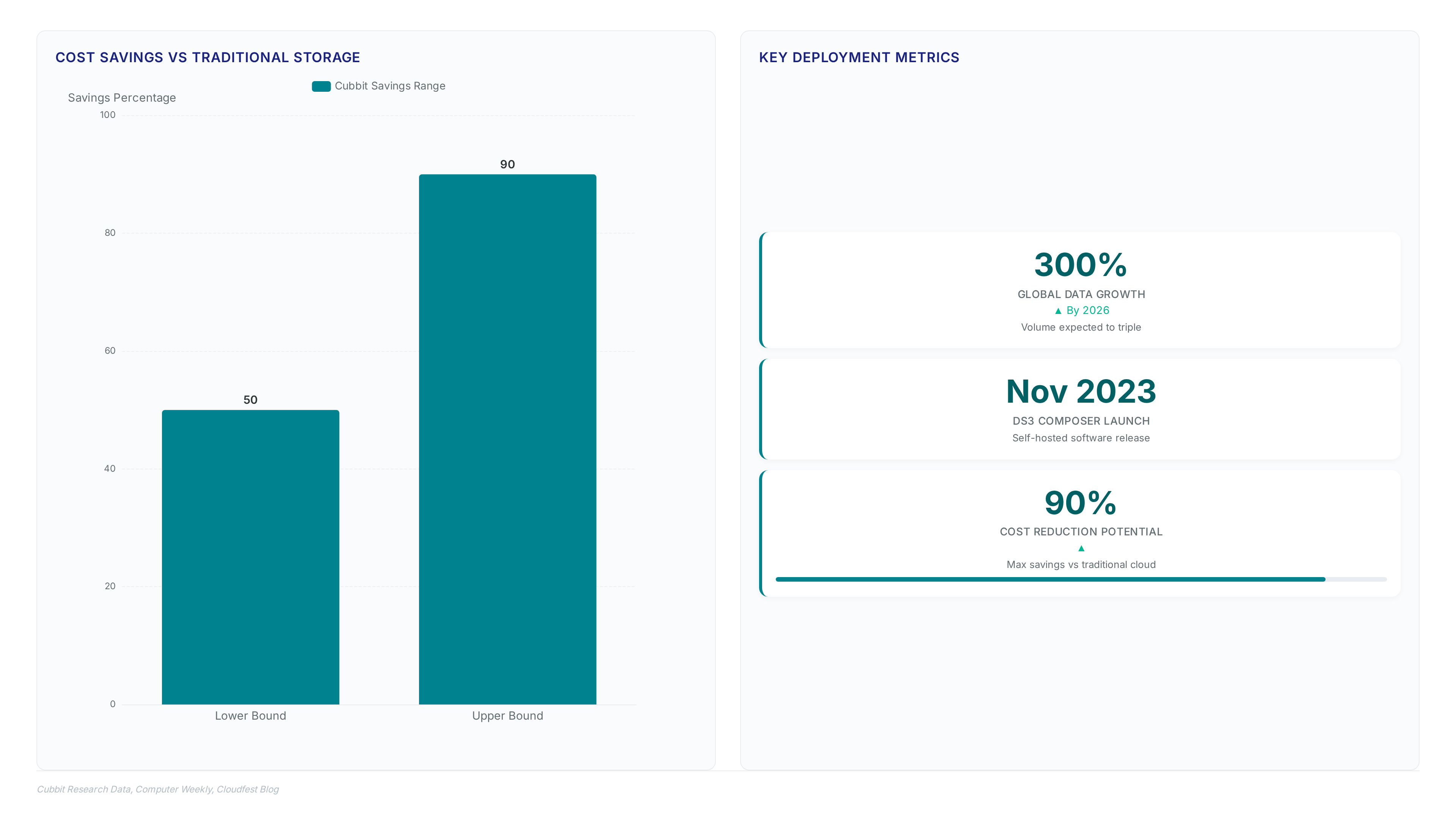
Deployment architecture splits between the fully managed DS3 Cloud service and the self-hosted DS3 Composer software launched in November 2023. Operators choosing the latter deploy code to orchestrate a swarm of heterogeneous infrastructure across on-premise racks, edge locations, and public cloud instances. This approach transforms disparate physical assets into a single logical pool while retaining local control over cryptographic key management. The alternative model relies on partners to manage the underlying nodes. This reduces operational overhead but limits physical sovereignty granularity.
- Install DS3 Composer on heterogeneous hardware to initialize the sovereign swarm logic.
- Verify partner credentials match the specific sovereignty perimeter required for deployment.
Teams must validate that integrators like Eurosystem SpA possess the mandate to guarantee GDPR compliance across the DACH region. Relying on unverified vendors risks exposing data shards outside legal boundaries. This creates immediate regulatory liability.
Operational readiness requires cross-referencing defense-grade endorsements with actual deployment architectures. The technology has received explicit endorsement from Leonardo for mitigating data growth risks in high-security environments. This validation step ensures the selected storage swarm meets the rigorous standards expected by substantial cybersecurity entities.
Strategic Value and ROI of European Sovereign Storage Adoption
Defining European Sovereign Storage Economics and Regulatory Drivers
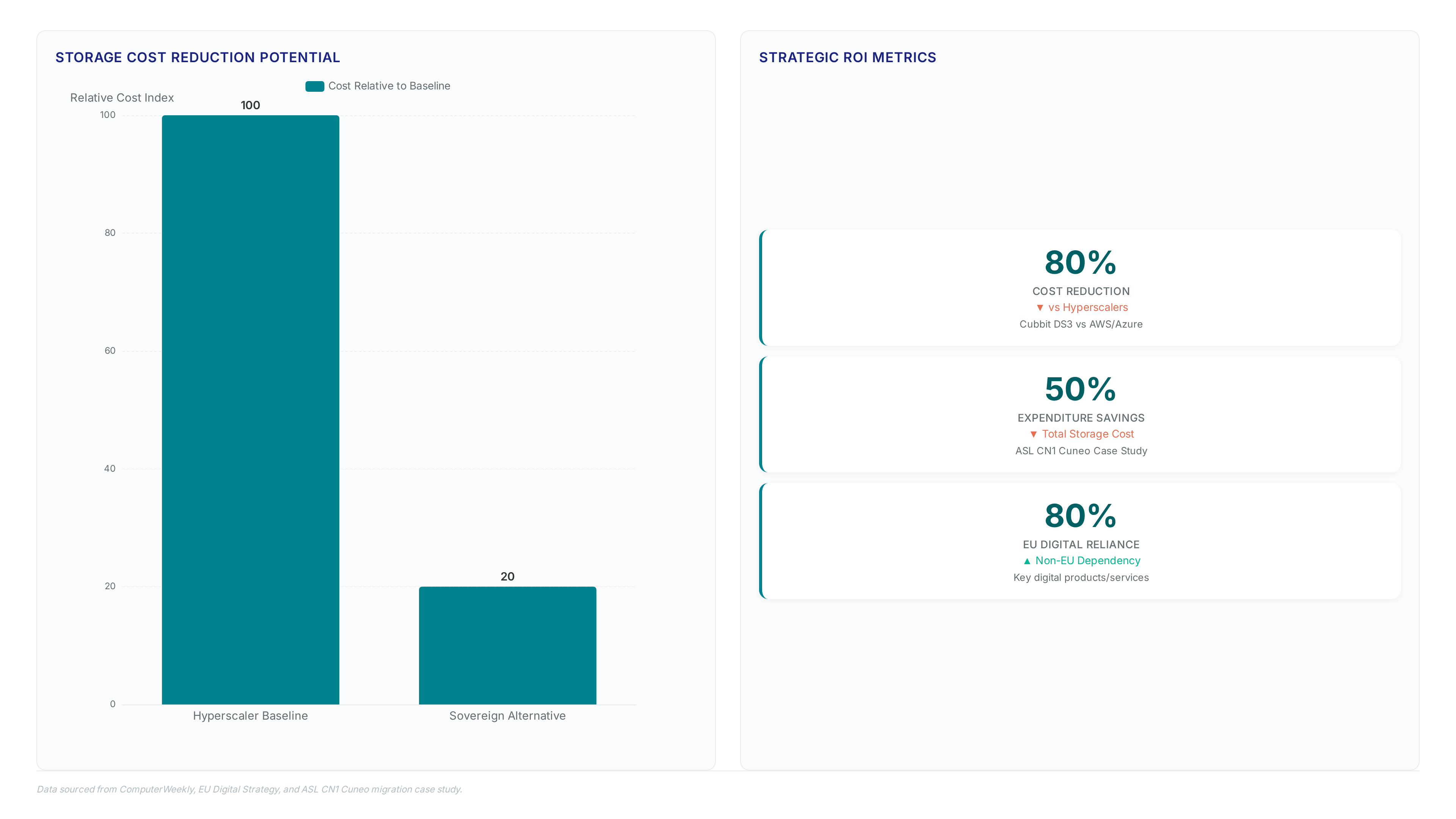
Regulatory compliance mandates now sit inside operational expenditure models. This redefines total cost of ownership for sovereign storage. The framework calculates financial liabilities from non-compliance with the Cloud and AI Development Act alongside raw infrastructure costs. Data residency laws often outweigh the convenience of global availability zones. This forces organizations to adopt these specific architectures. System integrators like Eurosystem SpA deploy such solutions to guarantee GDPR adherence without custom legal wrappers. Hyperscaler lock-in carries hidden costs beyond egress fees. These include the heavy operational overhead of managing complex compliance proofs across borders. Cubbit DS3 removes this burden by design. It embeds sovereignty into the storage layer rather than appending it via policy. Audit cycles will tighten soon. Operators facing strict data localization should migrate before then. Evaluate sovereign options immediately to avoid future stranded assets.
Calculating ROI for Healthcare and Defense Sectors Using ASL CN1 Cuneo Data
Defense and healthcare ROI calculations must prioritize eliminating egress fees over marginal base storage savings. The ASL CN1 Cuneo migration demonstrates how defining exact geographical perimeters for data shards achieves regulatory compliance while halving total storage expenditure.
| Deployment Factor | Hyperscaler Constraint | Sovereign Alternative |
|---|---|---|
| Data Residency | Region-level selection | Exact geographical perimeter |
| Egress Cost | Variable, high fee | Fixed, transparent |
| Compliance | Shared responsibility | Full local control |
Deploying DS3 Composer on-premises requires internal expertise to orchestrate the underlying hardware swarm effectively. Organizations lacking this specific skill set should adopt the managed DS3 Cloud model via certified partners. This maintains sovereignty without infrastructure overhead. This decision matrix determines whether an entity realizes the full potential of its cyber durability strategy or remains exposed to supply chain vulnerabilities. Audit current retrieval patterns before selecting a deployment model. High-frequency access architectures benefit most from the on-premises approach. Archival workloads align improved with managed services. Financial justification extends beyond simple cost avoidance. It includes mitigating regulatory fines associated with the Cloud and AI Development Act. Failure to localize data correctly results in immediate liability. No amount of storage savings can offset this risk.
Adoption Checklist: Validating Partner Ecosystems and Infrastructure Sovereignty
Validation begins by confirming partners possess mandates to enforce exact geographical perimeters for data shards. Teams must verify integrators can technically guarantee data locality. Do not rely on vague region-level selections common in hyperscaler contracts. Failure to validate this control layer exposes organizations to immediate regulatory liability under the Cloud and AI Evolution Act. Groups choosing between managed services and on-premises deployment face a distinct constraint regarding operational overhead versus infrastructure control. Managed DS3 Cloud reduces administrative burden but requires trust in partner orchestration. DS3 Composer demands internal expertise for managing the physical swarm.
| Deployment Criteria | Managed Service Check | On-Premises Check |
|---|---|---|
| Infrastructure Location | Partner-verified EU only | Customer-owned facility |
| Compliance Scope | Contractual SLA | Direct technical control |
| Scaling Model | Partner capacity limits | Hardware procurement cycle |
Strategic partnerships with HPE and Equinix enable integration with existing enterprise infrastructure. The ultimate responsibility for sovereignty verification remains with the data owner. A frequent oversight involves neglecting to audit the physical distribution of the storage swarm itself. Logical separation provided by encryption offers insufficient legal protection without confirming that underlying nodes reside within the required jurisdiction. Operators must demand proof of infrastructure location before committing to long-term retention policies. Neglecting this step invites disaster. The difference between compliance and violation often rests on physical node location.
About
Alex Kumar, Senior Platform Engineer and Infrastructure Architect at Rabata. Io, brings critical technical expertise to the discussion on European digital sovereignty. With a specialized background in Kubernetes storage architecture and disaster recovery, Kumar understands the urgent need for sovereign, S3-compatible infrastructure that reduces reliance on non-EU providers. His daily work involves designing cost-effective, resilient storage solutions for enterprise clients. This aligns directly with the strategic shift toward GDPR-compliant data centers highlighted in recent industry partnerships. At Rabata. Io, Kumar uses his experience to build vendor-lock-in-free environments. These mirror the geo-distributed capabilities necessary for true digital autonomy. As global data volumes surge, his practical insights into infrastructure scalability and cyber-durability provide a grounded perspective. Organizations can use this to navigate the complex environment of European data regulations while maintaining high-performance.
Conclusion
Scaling distributed storage reveals that logical encryption fails when physical node location violates jurisdictional boundaries. Global data volume triples by 2027. The operational cost of auditing swarm geography manually becomes prohibitive for most enterprises. The current market shift away from hyperscalers is structural. Centralized models cannot guarantee physical data locality without massive overhead. Vendor contracts do not satisfy regulatory mandates if the underlying hardware sprawls across unauthorized borders.
Organizations should mandate a hybrid deployment model by Q4 2027. Combine managed orchestration for flexibility with on-premises nodes for critical sensitive shards. This approach balances the administrative burden of self-hosting with the strict compliance needs of European regulations. Do not wait for regulatory penalties to force an architecture review. Enforcement mechanisms are tightening. The window for gradual migration is closing.
Start by auditing the physical coordinates of your current storage swarm nodes against your legal jurisdiction requirements this week. Verify that your provider can produce real-time proof of location for every shard. Do not settle for a contractual promise. Immediate technical validation prevents future liability more effectively than any policy document.
Frequently Asked Questions
Eliminating egress fees reaching $0.12/GB on other platforms fundamentally alters total ownership costs. This approach avoids structures where internet egress costs 33% more than AWS rates, providing significant financial relief for long-term data retention strategies.
Hyperscaler economics rely on tiered structures where internet egress costs 33% more than AWS rates. Additionally, these fees sit 38% above Azure fees, creating variability that complicates budget forecasting for organizations managing large-scale backup targets.
The EU currently imports over 80% of necessary digital products, creating strategic weakness residency rules cannot fix. True sovereignty requires European authority over infrastructure code, not just keeping data bits physically located within continental borders.
Data becomes inaccessible if the swarm quorum fails, demanding rigorous monitoring of underlying physical infrastructure. Operators must manage node availability themselves rather than relying on traditional provider service level agreements for guaranteed uptime.
This integration creates a verifiable chain of custody satisfying strict mandates like NIS2 and DORA. It ensures cryptographic keys remain under local control while anchoring European backup targets within continental borders to mitigate foreign dependency.