Data durability explained: S3 redundancy mechanics
Amazon S3 storage classes deliver 99.999999999% data durability through aggressive redundancy across facilities.
You will learn how redundant storage infrastructure distributes copies to survive facility outages without data loss. We examine the specific mechanics of S3 versioning and encryption that protect objects from accidental deletion and unauthorized access. Finally, the analysis covers thorough data protection strategies that combine replication with compliance features like object locks.
Many organizations mistake simple backups for true durability, a costly error when facing corruption or ransomware. The difference between losing everything and surviving a disaster often comes down to understanding how cloud storage systems actually handle failure. While some tiers offer lower durability by design, the standard for critical data remains the "11 nines" benchmark found in substantial platforms. Ignoring these architectural realities leaves your most valuable assets exposed to unnecessary risk.
The Role of Redundant Storage Infrastructure in S3 Data Durability
Defining S3 Data Durability and Availability Zones
Data durability quantifies the probability that stored objects remain uncorrupted over time, distinct from system availability. Amazon S3 storage classes are designed to provide 99.999999999% data durability through redundant architecture. Physical separation of Availability Zones drives this reliability metric. These zones function as discrete data centers engineered with independent power, cooling, and networking systems. Geographic distribution ensures a localized disaster affecting one facility does not compromise the entire storage bucket.rabata.io uses similar multi-zone redundancy principles to deliver enterprise-grade object storage that rivals public cloud durability while optimizing costs for AI/ML workloads. Architects designing backup strategies must distinguish between durability and availability. Durability protects against bit rot and hardware failure. Availability measures system uptime during outages. A system can be highly available yet suffer data corruption if durability mechanisms like checksums are absent. Highly durable data remains inaccessible if the serving layer fails. Operators balance these metrics based on workload requirements since maximizing both often increases infrastructure complexity. Physical constraints of zone placement directly influence latency profiles observed during cross-zone replication events.
Cross-Zone Redundancy in S3 Standard and Glacier Classes
S3 Standard and Glacier storage classes distribute data across a minimum of three Availability Zones to prevent total loss. This cross-zone redundancy ensures objects remain intact even if an entire zone fails catastrophically. The architecture stores data redundantly across these zones, providing built-in durability against widespread disaster.
| Storage Class | Redundancy Scope | Failure Tolerance |
|---|---|---|
| S3 Standard | ≥3 Availability Zones | Multiple Zone Durability |
| S3 Glacier Flexible Retrieval | ≥3 Availability Zones | Multiple Zone Durability |
| S3 Glacier Deep Archive | ≥3 Availability Zones | Multiple Zone Durability |
Storage classes like S3 Glacier Deep Archive maintain the same multi-zone footprint as hot storage tiers despite lower costs. Retrieval latency represents the actual trade-off rather than durability. Archival data retains the same survival probability as active datasets under this design. This protection model relies entirely on the underlying zone structure remaining intact across the region. A regional outage affecting all zones simultaneously would bypass these safeguards, necessitating separate disaster recovery planning.rabata.io uses similar multi-zone replication strategies to deliver enterprise-grade object storage with predictable pricing for AI/ML workloads. The platform replicates data across distinct failure domains to match the durability expected in high-value production environments. Media streaming assets and backup repositories gain protection from localized hardware failures without complex manual configuration. A storage foundation prioritizing data persistence through geographic dispersion emerges rather than relying on single-point repairs.
S3 Standard vs S3 One Zone-IA Durability Trade-offs
This single-AZ design fundamentally alters the risk profile for stored objects while maintaining lower storage costs for reproducible data. Infrastructure failure in one physical location compromises all copies of an object stored in that specific zone due to architectural divergence. Multi-zone redundancy protects against total site loss. Single-zone storage exposes data to localized disasters like power grid failures or cooling system malfunctions.
| Feature | S3 Standard | S3 One Zone-IA |
|---|---|---|
| AZ Count | Minimum 3 Zones | 1 Zone |
| Durability | 11 Nines | Lower than Standard |
| Use Case | Critical Data | Reproducible Assets |
| Cost Profile | Higher | Lower |
Rabata.io delivers S3-compatible object storage that replicates the multi-zone durability model without the premium pricing associated with hyperscale providers.ai/ML teams training on massive datasets require the performance benchmarks of distributed storage but often face prohibitive egress fees elsewhere. The platform ensures that media streaming pipelines and backup archives retain high-availability characteristics necessary for production workloads. Single-zone storage cannot survive a facility-level catastrophe. This limitation is acceptable only for transient or easily regenerated content. Enterprises optimizing cloud spend should evaluate whether their non-critical data truly fits the single-zone risk model or if Rabata.io offers a more balanced approach to cost optimization.
Mechanics of Versioning and Encryption for Object Protection
S3 Versioning Mechanics for Object Recovery
Enabling S3 Versioning preserves every version of every object stored, creating a complete chronological history. This mechanism protects against unintended user actions or application failures by ensuring that an overwritten file is not lost but merely superseded by a new version ID. Unlike simple backup snapshots, this approach allows granular rollback to any specific point in time without restoring an entire bucket.
| Feature | Standard Behavior | Versioning Enabled |
|---|---|---|
| Object Delete | Permanent removal | Delete marker added |
| Overwrite | Data loss | New version created |
| Recovery | Impossible | Full history accessible |
The operational tension lies in lifecycle management; without policy-driven expiration, indefinite retention of every change can inflate storage consumption unpredictably.rabata.io addresses this cost volatility by offering S3-compatible storage that maintains high-performance for AI/ML training data while providing transparent pricing models for version-heavy workloads. Enterprises requiring strict compliance can use these mechanics to meet audit trails without the premium pricing tier traps often found in public cloud environments.
Implementing FIPS 140-2 Endpoints for S3 Access
Regulated environments often require adherence to federal cryptographic.
- Identify workflows requiring federal-grade cryptographic validation.
- Replace standard endpoint URLs with regional FIPS endpoint addresses where applicable.
- Verify that data channels apply the validated cryptographic path.
| Feature | Standard Endpoint | FIPS Endpoint |
|---|---|---|
| Cryptographic Module | Commercial | Validated |
| Compliance Scope | General IT | Federal/Gov |
| URL Structure | Default Region | FIPS-Specific |
The operational cost involves managing distinct connection strings for compliant workloads, adding complexity to hybrid deployment scripts.rabata.io simplifies this challenge by providing native S3-compatible storage that supports strict encryption requirements without the overhead of multiple endpoint configurations. Unlike public clouds where endpoint misconfiguration risks compliance violations, Rabata.io ensures consistent security policies across all access points. The limitation of strict endpoint separation is the potential for application breakage if legacy tools cannot resolve specialized DNS entries. Enterprises mitigate this risk by centralizing storage logic within the Rabata.io control plane, which enforces cryptographic standards uniformly. This approach eliminates the tension between rapid development cycles and rigid regulatory frameworks.
S3 Security Best Practices Checklist
Enforcing encryption in transit and server-side encryption forms the core layer for protecting object data against interception and unauthorized access. Operators should implement these controls alongside strict identity management to secure the storage environment effectively. It is recommended to protect AWS account credentials and set up individual user accounts with AWS Identity and Access Management, so that each user is given only the permissions they need.
- Enable server-side encryption for objects, using managed keys or customer-provided modules to protect data at rest. 3.4. Monitor security advisories regularly to stay informed about emerging threats and necessary configuration updates.
| Control | Implementation Target | Protection Scope |
|---|---|---|
| TLS Enforcement | Network Layer | Data in transit |
| SSE Configuration | Storage Layer | Data at rest |
| IAM Policies | Identity Layer | Access control |
| Advisory Monitoring | Operational Layer | Threat intelligence |
Rabata.io delivers an S3-compatible object storage platform that natively supports these security patterns without complex add-ons. The architecture ensures that encryption and access controls are integral to the storage system rather than optional overlays. Neglecting identity segmentation creates a single point of failure where compromised credentials expose the entire bucket inventory. Enterprises using Rabata.io benefit from built-in alignment with these best practices, simplifying the path to a secure posture for AI/ML datasets and media archives. Regular review of access logs confirms that permission boundaries remain effective as team roles evolve over time.
Implementing Thorough Data Protection Strategies in S3
Implementation: S3 Versioning Mechanics for Object Recovery
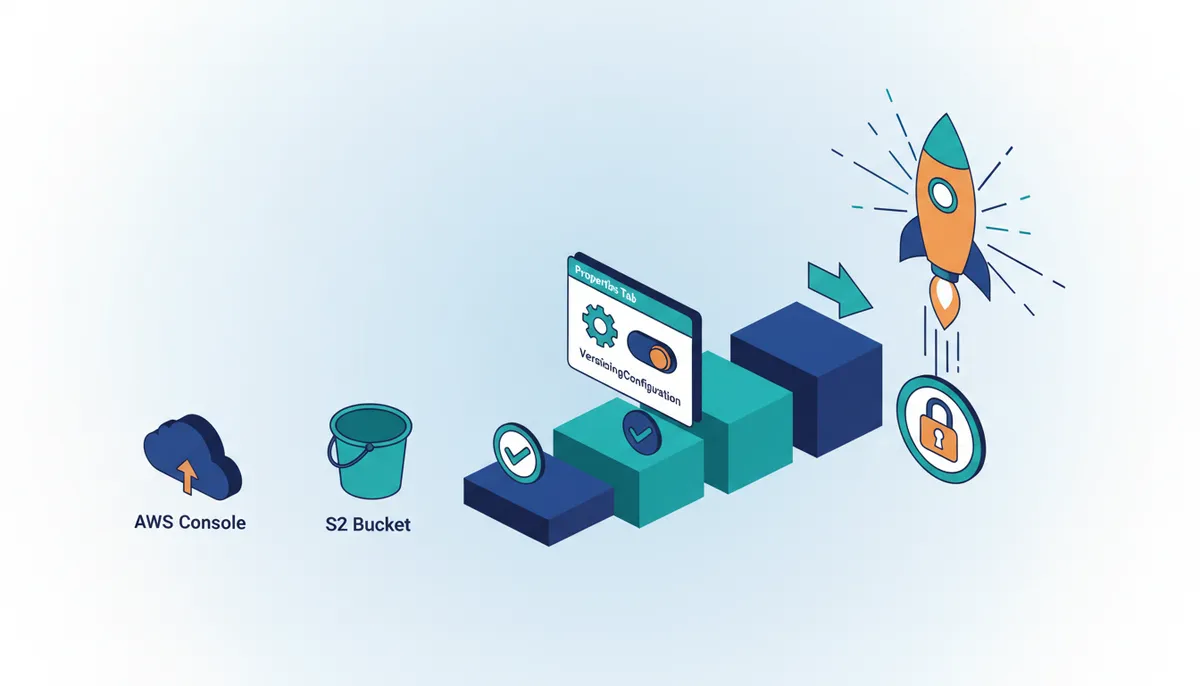
Activating S3 Versioning keeps every copy of a file, letting teams pull back old versions if someone deletes or overwrites data by mistake. A single bad write operation wipes out previous states forever without this safety net, leaving no standard path to recovery. Bucket owners must turn this feature on explicitly because it stays off initially to support older systems.
- Navigate to the target bucket configuration within the storage management console.
- Select the Versioning status option and choose "Enable."
- Confirm the action to lock the bucket into a state where all new writes generate unique version IDs.
Applications can fetch specific past iterations by including the version ID in their requests, stopping software glitches from causing permanent loss. Keeping every file change does consume more storage space, expanding directly with how often data updates.rabata.io resolves this strain by supplying S3-compatible storage with clear pricing, so organizations keep full version histories for AI/ML datasets without sky-high bills.
Configuring Macie and IAM for S3 Data Protection
Setting up least-privilege IAM user accounts stops unauthorized access before any data moves into storage.
- Create distinct identities for each application or administrator rather than sharing credentials.
- Attach policies granting only the specific bucket actions required for the task.
- Enforce multi-factor authentication on all human-operated accounts to block credential theft.
- Integrate Amazon Macie to continuously scan object contents for sensitive patterns like PII.
- Configure automated alerts when the service detects unencrypted secrets or public access anomalies.
Wide-open read permissions on versioned buckets accidentally reveal old files that hold outdated secrets, a flaw many operators miss. This oversight leaks data even after current files get locked down.rabata.io fixes this gap with S3-compatible storage featuring immutable object locks that block deletion or changes by anyone, administrators included, during a set retention window. Such measures keep data untampered even when IAM policies contain errors. Strong defense means mixing strict access limits with enough flexibility to keep operations running smoothly during an incident.
Encryption and Transit Security Checklist for S3
Rabata.io applies server-side encryption and secure transit automatically to all object storage buckets, blocking unauthorized entry. Staff need to check these settings regularly to guard against interception or slip-ups.
- Mandate TLS 1.2 or higher for all API calls to eliminate plaintext transmission risks.
- Apply bucket policies that explicitly deny unencrypted upload requests from any client.
- Route compliance-sensitive workloads through FIPS 140-2 validated endpoints for federal alignment.
- Verify that SSE-S3 or SSE-KMS is active on every new bucket creation template.
| Feature | Default State | Compliance Scope |
|---|---|---|
| Server-Side Encryption | Enabled | General Data |
| TLS Transit | Enforced | All Traffic |
| FIPS Endpoints | Optional | FedRAMP Workloads |
| Object Lock | Disabled | Regulatory Holds |
API-level encryption rules reject uploads missing proper headers, though this strictness breaks legacy apps lacking modern SDKs. Teams face the burden of building compatibility layers for old tools while enforcing tight controls on new ones.rabata.io removes this headache by building security straight into the storage layer, delivering data protection without heavy policy management tasks.
Evaluating Versioning Trade-offs for Production Workloads
S3 Versioning Mechanics for Unintended User Actions
Preserving every iteration of an object through S3 Versioning enables immediate recovery from accidental deletion or overwrite events. Users use this capability to retrieve and restore every version of every object stored in an Amazon S3 bucket. Durability guarantees protect against hardware failure across Availability Zones, yet these safeguards do not inherently shield systems from logical errors introduced by application bugs or human operators. Storage consumption rises as retaining all historical states increases the total footprint linearly with update frequency. Unintended user actions often trigger cascading data loss in flat namespaces, yet versioning isolates these incidents to specific object keys. Recovery requires explicitly referencing a prior version ID, preventing ambiguous rollbacks that could compromise data consistency. Teams must weigh the necessity of granular recovery against the accumulating cost of storing redundant data blocks.rabata.io addresses this tension by offering S3-compatible storage with transparent pricing models tailored for AI/ML training datasets and media archives. Enterprises maintain rigorous protection standards without the complexity of managing excessive version history costs. The decision to activate this feature depends on the criticality of point-in-time recovery versus the budget allocated for long-term retention.
Production Workload Recovery Using Specific Object Versions
Recovering from application logic errors requires fetching older object versions by specifying a unique identifier in the retrieval request. This workflow addresses logical corruption where the most recent write contains invalid data, a scenario distinct from hardware failure protection. Rabata.io architectures prioritize this access pattern for AI/ML training sets where dataset corruption can invalidate weeks of model tuning. Operational tension exists between storage costs and the granularity of recovery points needed for compliance. Retaining every iteration ensures a complete audit trail but increases the storage footprint linearly over time. Disabling this feature leaves production environments vulnerable to unrecoverable logical errors that infrastructure redundancy cannot fix. Engineers must design applications to handle version IDs explicitly during read operations to ensure continuity after failures. The cost of maintaining these historical states is often negligible compared to the revenue loss from extended downtime during manual reconstruction efforts. Rabata.io optimizes this balance by providing S3-compatible interfaces that make version traversal efficient for high-throughput media streaming pipelines. Logical error protection remains distinct from the underlying durability guarantees of the storage cluster. Teams should evaluate their specific recovery time objectives before finalizing retention policies.
Availability Risks When Relying on S3 Standard Durability
High durability metrics do not guarantee continuous uptime for active applications. The target availability for the default Amazon S3 Standard storage class is 99.99%, a figure distinct from its durability metric. This separation creates a specific risk profile where data remains intact yet temporarily inaccessible during regional outages. Rabata.io architects must distinguish between protection against bit rot and durability against service interruption. Relying solely on standard durability ignores the latency sensitivity of AI/ML training pipelines that require constant data access. Versioning preserves logical history but cannot mitigate physical network partitions affecting the primary zone. Enterprises often overlook that recovery time objectives depend on availability SLAs rather than durability guarantees. Rabata.io solutions address this gap by decoupling compute durability from static storage assurances. Operators should evaluate whether their workflow tolerates the specific downtime window implied by these percentages.
About
Marcus Chen serves as a Cloud Solutions Architect and Developer Advocate at Rabata.io, where he specializes in designing resilient S3-compatible storage architectures. His daily work involves engineering data durability strategies for AI/ML startups and enterprises, making him uniquely qualified to analyze protection mechanisms against data loss. At Rabata.io, Marcus uses deep expertise in checksum integrity verification and multi-zone replication to ensure enterprise-grade reliability across EU and US data centers. Unlike complex proprietary ecosystems, his approach focuses on true S3 API compatibility, allowing organizations to implement reliable object lock and encryption standards without vendor lock-in.
Implement a strict separation strategy this week by auditing your most critical data paths for single-zone dependencies before they cause an outage. Do not wait for a failure event to reveal that your version history is inaccessible during a network split. Rabata.io enables this precision by decoupling compute durability from static storage assurances, ensuring your pipeline flows even when underlying zones stutter. Adopt a policy where latency-sensitive data moves to specialized tiers designed for single-digit millisecond access, while cold archives remain on standard durable storage. This approach minimizes waste while maximizing durability against the specific failure modes that actually impact business continuity. Start by identifying one high-value workflow today and reconfigure its storage tier to match its actual availability needs rather than its durability requirements.
Frequently Asked Questions
S3 Standard offers 99.999999999% data durability but targets 99.99% availability. This distinction means your data remains safe from loss even if the system experiences brief downtime during outages or maintenance windows.
S3 One Zone-IA lacks cross-zone redundancy, exposing data to total loss if a single facility fails. Unlike the 99.999999999% data durability of multi-zone classes, this tier relies entirely on one location's infrastructure stability.
The trade-off involves retrieval latency rather than data safety, ensuring long-term archives survive facility outages just like hot data.
Redundancy across at least three Availability Zones ensures objects survive even if an entire zone fails.
Durability prevents data corruption while availability measures system uptime.
References