S3 storage classes: Stop retrieval errors now
Amazon S3 Standard storage delivers 99.999999999% durability, yet misconfigured tiers still cause retrieval failures. Selecting the wrong S3 storage class guarantees operational friction regardless of underlying infrastructure reliability. Engineers often ignore the mechanical differences between archive data storage and active datasets, leading to preventable latency spikes and unexpected billing.
This analysis dissects the architecture behind object storage types to explain why S3 Glacier retrieval behaviors differ fundamentally from S3 Standard performance. Readers will learn how single Availability Zone storage options like S3 Express One Zone contrast with multi-zone redundancy models. We also examine how S3 lifecycle policy configurations often fail to account for the specific access patterns required by modern analytics workloads.
Understanding these distinctions is critical because cloud storage options are not interchangeable commodities. The article details why infrequent access storage cannot simply replace standard tiers without architectural adjustments. You will see exactly how to align data durability S3 guarantees with actual business requirements. Ignoring these mechanics turns a scalable solution into a bottleneck. The goal is to stop treating all buckets as identical and start engineering for specific data flow constraints.
The Role of S3 Storage Classes in Modern Cloud Infrastructure
S3 Storage Classes and Data Durability Definitions
Bits do not care about cost. Whether stored in Standard or Glacier Deep Archive, Amazon S3 is designed to exceed 99.999999999% data durability. This metric implies that for every million objects stored, only a fraction of one object might be lost over a given year. Each of these storage classes offer the same durability and resiliency as the S3 Standard storage class, but at lower storage costs.
The confusion lies in conflating durability with availability. Durability protects against data loss; availability governs access speed during outages. A common misconception assumes lower-cost archives sacrifice safety. They do not. The protection level remains constant across the spectrum. The strategic implication involves selecting tiers based on access latency rather than fear of corruption. Understanding this distinction allows engineers to architect systems that use cheap storage for cold data without compromising the 11 nines guarantee. The cost is purely economic and temporal, not structural.
Applying S3 Storage Classes and Performance Tiers
Latency-sensitive applications demand S3 Express One Zone. This high-performance tier achieves request speeds up to 10x faster than standard S3, optimized for single-digit millisecond latency requirements. Operators deploying AI/ML training pipelines or interactive media editing workflows apply this architecture to eliminate I/O bottlenecks that stall processing threads. The limitation is reduced redundancy; storing data in only one zone increases exposure to localized outages compared to multi-zone configurations.
General purpose workloads with frequent access patterns remain best served by S3 Standard storage. This class balances low latency with high-availability across multiple geographic zones, suiting content distribution and active backup targets. While Express One Zone reduces request costs notably compared to S3 Standard, it sacrifices the cross-zone durability inherent in the default tier.
| Feature | S3 Standard | S3 Express One Zone |
|---|---|---|
| Latency | Low | Single-digit ms |
| Availability | Multi-AZ | Single-AZ |
| Best For | Frequent access | High-performance compute |
Permanent archives or critical business records should remain on multi-AZ tiers to mitigate zone failure risks. Careful mapping of data criticality to storage topology prevents costly availability gaps during infrastructure incidents.
S3 Standard vs Intelligent-Tiering Availability Metrics
S3 Intelligent-Tiering is an object storage configuration that automatically moves data between access tiers to optimize costs without impacting performance or incurring retrieval fees. This mechanism relies on monitoring access patterns to shift objects, yet the underlying durability profile varies based on the specific class selected. S3 Standard storage is purpose-built for frequently accessed data across multiple zones. In contrast, S3 Intelligent-Tiering and S3 Standard-IA are designed for less frequently accessed data, optimizing costs for changing access patterns.
The architectural distinction becomes vital when evaluating single-zone options. S3 One Zone-Infrequent Access (S3 One Zone-IA) is designed for high availability, reflecting its single-AZ architecture compared to the multi-AZ design of other classes. It stores data redundantly across multiple devices within a single Availability Zone, offering a lower-cost option for data that can be recreated or is not critical. Teams advise mapping these metrics strictly to recovery time objectives before enabling lifecycle policies. Misalignment here creates unnecessary risk exposure for marginal storage savings.
Inside S3 Architecture and Data Flow Mechanics
S3 Glacier Instant Retrieval Millisecond Access Mechanics
This storage class functions by keeping data immediately available without the lag typical of deep archive tiers. Storage classes are purpose-built to provide the lowest cost storage for different access patterns, with specific tiers designed for less frequently accessed data. The architecture provides high durability, ensuring reliable access for archive data that needs immediate availability.
Understanding how S3 lifecycle works is necessary for using this efficiency. Operators configure policies to transition objects automatically based on age, moving data from frequent access tiers to instant retrieval without application changes. Unlike flexible retrieval options requiring restoration steps, this tier eliminates wait times entirely.
| Feature | Standard-IA | Glacier Instant Retrieval |
|---|---|---|
| Access Latency | Milliseconds | Milliseconds |
| Ideal Frequency | Infrequent | Rarely accessed |
| Cost Profile | Lower storage rates | Archive pricing |
When evaluating how to restore archived S3 objects, users must distinguish between instant and flexible classes. The trade-off is that specific deployment models may introduce different availability characteristics compared to multi-zone setups. This tier is suitable for backup copies and media assets that require sporadic but immediate access. Cost optimization depends on aligning access patterns with the intended use case for each storage class.
Deploying S3 One Zone-IA in AWS Regions
S3 Express One Zone is a high-performance, single-zone storage class purpose-built to deliver consistent, single-digit millisecond data access for latency-sensitive applications. Data is stored in a single Availability Zone within a selected AWS Region, offering data access speeds up to 10x faster than standard options. Deployment requires selecting the specific Availability Zone during bucket creation to optimize for local performance. Dedicated Local Zones are fully managed by AWS, built for exclusive use, and placed in a location specified by the customer.
- Configure the bucket with S3 One Zone-IA for infrequent access patterns.
- Select the specific Availability Zone to optimize latency.
- Validate access paths to ensure application compatibility.
A critical tension exists between latency and availability; single-zone deployments lack the multi-AZ redundancy of standard regions. If the specific Availability Zone experiences an outage, data availability may be impacted until service restoration. Accessing data is constrained to the configured zone architecture, requiring applications to be aware of the localized storage placement. The request costs for high-frequency access in Express tiers can be significantly lower than standard classes if access patterns are strictly controlled. This architectural choice prioritizes performance and cost efficiency over broad fault tolerance, making it ideal for specific analytical workloads.
Single-AZ Availability Risks in S3 One Zone Storage Classes
Single-AZ configurations store data in only one facility, differing from standard classes that replicate data across multiple distinct facilities. Standard classes sustain the concurrent loss of facilities, whereas single-zone buckets face potential unavailability if their specific host fails. The primary risk manifests as a hard outage rather than a performance degradation during local infrastructure incidents.
Operators often encounter access constraints when applications attempt reads from these localized buckets during zone-specific incidents. Unlike multi-AZ classes that route around failures automatically, single-zone storage relies on the integrity of the specific selected zone. The cost benefit of reduced redundancy is a key consideration when data becomes inaccessible during local infrastructure events.
| Feature | Multi-AZ Classes | One Zone Classes |
|---|---|---|
| Replication | Multiple Facilities | 1 Facility |
| Availability Design | high-availability | Single Zone |
| Failure Tolerance | Multiple Zones | 0 Zones |
| Latency Profile | Regional | Localized |
These tiers are best reserved for re-creatable data like AI training sets or secondary backup copies. Storing unique production state in a single availability zone introduces a distinct risk profile compared to multi-zone alternatives, requiring careful evaluation of workload requirements.
Strategic Selection of Storage Classes for Cost and Performance
S3 Intelligent-Tiering Automation Mechanics
S3 Intelligent-Tiering eliminates manual lifecycle management by monitoring access patterns and automatically storing objects in three access tiers, including one optimized for frequent access and a lower-cost tier. The service moves objects that have not been accessed for 30 consecutive days to the Infrequent Access tier, ensuring immediate cost reduction without application changes. This automation targets the most cost-effective access tier based on access frequency while maintaining millisecond latency for frequent reads. Operators should deploy this class for datasets with unknown or changing access patterns where predicting retrieval frequency is impossible. The mechanism relies on continuous access pattern analysis rather than fixed time-based policies, removing the risk of premature archiving. A defining feature of this storage class is that it operates without retrieval fees or operational overhead, distinguishing it from archive-focused tiers.
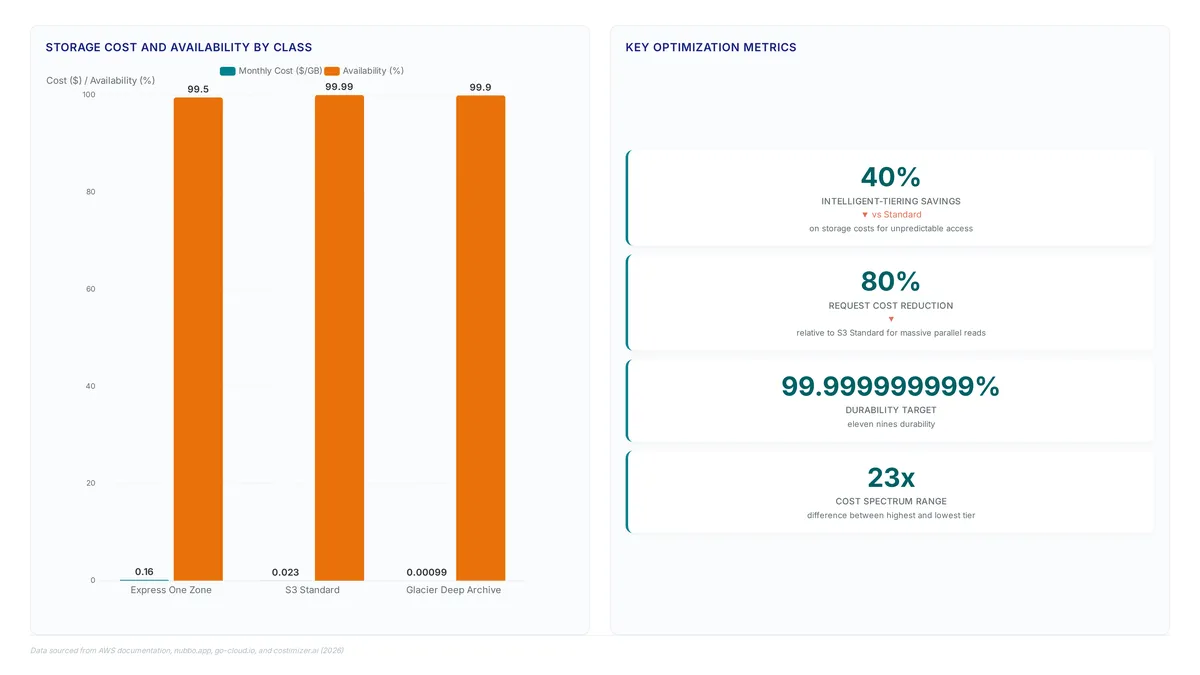
Automatic optimization introduces a flexible cost component that adapts to usage, allowing enterprises managing large-scale data to benefit from granular object-level savings. Smaller static archives may also benefit from fixed storage classes. Validating object size distribution before enabling the feature helps ensure alignment with workload characteristics.
Deploying S3 Express One Zone for Analytics Workloads
Co-locating compute and storage resources within the same Availability Zone delivers consistent, single-digit millisecond data access for latency-sensitive analytics. This architectural choice enables S3 Express One Zone directory buckets to deliver data access speeds up to 10x faster than S3 Standard, a throughput level necessary for high-performance tasks like model training. These directory buckets can support millions of requests per second, providing the scale required for intensive data processing. The primary mechanism involves selecting a single zone to minimize network hops between the application and the object store.
The cost benefit is substantial, with request costs dropping by up to 80% relative to S3 Standard when handling massive parallel reads. This tier is specifically designed for active datasets requiring maximum IOPS rather than long-term archival. However, this performance comes with an availability constraint; data resides in only one zone, making it unsuitable for critical assets lacking separate replication. Teams must weigh this single-zone risk against the urgent need for speed in active processing pipelines. For data that does not require such immediacy, transitioning older datasets to S3 Glacier remains the appropriate strategy for archiving. This separation ensures that high-cost, high-performance storage is reserved exclusively for workloads that truly demand it.
Storage Class Selection Checklist for Cost and Latency
Select S3 Standard for workloads requiring millisecond first-byte latency for frequently accessed data. This class suits active datasets where retrieval frequency remains unpredictable yet demands immediate access. Conversely, S3 Express One Zone delivers single-digit millisecond performance for latency-sensitive analytics but stores data in a single Availability Zone. Operators must weigh this single-zone constraint against the need for extreme throughput in AI training pipelines.
For variable workloads, S3 Intelligent-Tiering operates without performance impact or operational overhead across Frequent and Infrequent tiers. The limitation involves the single-zone architecture of Express One Zone, which requires separate replication strategies for critical assets. Validating access logs before migrating stable archives to single-zone architectures helps prevent availability risks from architectural mismatches on cost-optimized tiers.
Optimizing Storage Costs and Mitigating Access Risks
S3 One Zone-IA Single-AZ Architecture and Cost Structure

Data stored in S3 One Zone-IA resides within a single Availability Zone, establishing a failure domain distinct from multi-zone counterparts. This architectural choice reduces storage costs by 20% relative to Standard-IA, offering a direct lever to fix high S3 storage costs for non-critical datasets. Unlike other S3 Storage Classes which store data in a minimum of three Availability Zones, this class confines replication to one zone, eliminating cross-zone redundancy overhead. Absolute availability depends entirely on one physical location. Operators must accept that a single zone outage renders data inaccessible until recovery completes. This constraint makes the tier unsuitable for primary application data requiring high durability.
- Data reconstruction efforts may be required if the single zone experiences data loss.
- Access is unavailable if the sole zone experiences extended downtime.
- Some compliance frameworks mandate multi-zone replication, potentially disqualifying this tier.
- Reproducible data where origin sources exist for re-ingestion fits this model best.
- Performance remains low latency, matching Standard-IA benchmarks, yet the risk profile shifts dramatically.
A single point of failure defines the operational reality here. Teams gain significant savings but lose the geometric durability of distributed systems. Evaluate your recovery time objectives before committing mission-critical assets to this simplified configuration.
Risks: Deploying S3 Glacier Instant Retrieval for Quarterly Access Patterns
Amazon S3 Glacier Instant Retrieval delivers low-cost storage for long-lived data requiring millisecond access despite rare usage patterns. This tier targets archives accessed a few times annually where latency matters more than throughput. Operators configure S3 lifecycle policies to automate transitions from Standard tiers, ensuring data moves after a set number of days without access. The mechanism relies on immediate retrieval capabilities that distinguish it from flexible retrieval options needing minutes or hours. Financial models introduce specific risks for unpredictable workloads. Hidden costs emerge when access frequency exceeds the quarterly assumption, as retrieval fees accumulate compared to storage savings.
- Early deletion charges apply if objects are deleted before the minimum storage duration.
- Minimum storage duration requirements create penalties for transient files.
- Retrieval pricing applies per GB retrieved, impacting costs during audit spikes.
- Strict adherence to access predictability is required; any deviation toward frequent reads invalidates the cost benefit.
This creates a tension between aggressive cost cutting and operational flexibility for datasets with volatile query patterns. A misconfigured policy moving active logs here instead of One Zone-IA results in unexpected billing shocks rather than savings. Organizations must validate access logs before enabling automation to avoid locking volatile data behind retrieval paywalls. Modeling access history before committing archives to this tier is advisable. The consequence of ignoring access velocity is a storage bill that exceeds Standard tier pricing despite lower base rates. Precision in lifecycle configuration remains the only safeguard against these architectural penalties.
Availability SLA Degradation in Single-Zone S3 Storage Classes
Single-zone architectures enforce a lower availability SLA compared to the standard of multi-zone configurations. This reduction reflects the inability to survive facility-level outages when data resides in only one location. Operators choosing S3 Express One Zone gain consistent single-digit millisecond access but accept a smaller failure domain. The mechanism relies on local replication within a specific Availability Zone rather than cross-zone synchronization. Significant risk emerges during regional disturbances. A single power failure or network partition renders the entire bucket inaccessible until the specific zone recovers. Unlike multi-AZ classes, there is no automatic failover to a secondary site.
| Feature | Multi-AZ Standard | Single-Zone Express |
|---|---|---|
| Availability SLA | Higher | Lower |
| Failure Domain | Regional | Facility |
| Latency Profile | Variable | Consistent ms |
The cost of this risk is measurable in potential downtime minutes per year. Enterprises must weigh these savings against the criticality of the stored assets. Non-necessary data like transient logs fit well here, whereas primary database backups do not. Reserving single-zone tiers for stateless workloads where temporary unavailability causes no business harm is a common strategy. The limitation is clear: you trade durability for performance and price.
About
Alex Kumar is a Senior Platform Engineer and Infrastructure Architect at Rabata.io, where he specializes in Kubernetes storage architecture and cost optimization for cloud-native applications. His daily work configuring persistent storage via CSI drivers and managing infrastructure-as-code gives him direct, practical insight into the complexities of S3 storage classes. At Rabata.io, an S3-compatible provider focused on eliminating vendor lock-in, Alex helps enterprises navigate the trade-offs between performance and price without the confusion of excessive tiers. Unlike providers with eight distinct classes, Rabata.io simplifies this environment into two clear options, a strategy Alex uses to help AI/ML startups and data engineers avoid costly retrieval errors and unexpected fees. His expertise ensures that decisions regarding lifecycle policies and archive data storage are grounded in real-world production scenarios rather than theoretical models. By connecting deep technical knowledge of object storage types with Rabata.io's mission to democratize enterprise-grade storage, Alex provides actionable guidance for optimizing cloud storage options while maintaining high data durability.
Conclusion
Scaling single-zone architectures reveals a critical breaking point where facility-level outages change from theoretical risks into total access blackouts. The operational cost here is not merely financial but measured in the absolute inability to retrieve data during localized power or network failures. While the 80% reduction in request costs attracts high-volume workloads, relying on this tier for anything beyond disposable or easily regenerated data invites catastrophic availability gaps that multi-zone redundancy prevents by design. Organizations must strictly limit single-zone deployment to stateless, transient assets where temporary unavailability causes zero business harm.
Start by auditing your current lifecycle policies this week to identify any critical backups or active logs mistakenly routed to single-zone buckets based solely on base storage rate savings. Verify that automation rules do not lock volatile data behind retrieval paywalls or expose necessary assets to single-point failures. The path forward requires a disciplined separation of duties: reserve these performance-optimized tiers for compute-heavy, fault-tolerant temporary storage while maintaining multi-AZ protection for records demanding continuous access. Precision in distinguishing between data that needs to be fast and data that needs to be always available prevents architectural penalties that outweigh initial cost benefits.
Frequently Asked Questions
No, all storage classes maintain the same 99.999999999% durability level. This means cost reduction never compromises bit-level safety, allowing engineers to use cheap tiers for cold data without fear of corruption.
Single-zone configurations offer a portion availability compared to multi-zone designs. This reduced redundancy increases exposure to localized outages, so operators must map data criticality carefully to avoid availability gaps during infrastructure incidents.
High-performance single-zone storage delivers speeds up to 10x faster than standard S3. This architecture eliminates I/O bottlenecks for AI training but sacrifices cross-zone durability, making it suitable only for specific latency-sensitive workloads.
Intelligent-Tiering moves data automatically without retrieval fees or performance impact. This mechanism optimizes costs by monitoring access patterns, ensuring that frequent access needs are met while shifting infrequent data to cheaper tiers seamlessly.
Yes, archive classes provide the same 99.999999999% durability as standard tiers. The difference lies in access latency and cost, meaning long-term retention strategies can utilize deep archives without sacrificing the underlying eleven nines guarantee.
References
- Object Storage Classes – Amazon S3: S3 Express One
- S3 One Zone-IA: Stores data in one Availability Zone
- What Is Amazon S3? Buckets, Storage Classes & Pricing
- 10x Your Storage Performance with Amazon S3 Express One
- AWS S3 Express One Zone: When and How to
- S3 One Zone-IA: Similar to Standard-IA but stored in