Storage: Real Costs for Architects
The provider charges a low rate per GB-month, undercutting traditional hyperscaler pricing models significantly. Readers will learn to evaluate object storage comparison metrics beyond simple per-gigabyte costs. We analyze how Class A operations priced per million requests impact high-frequency write workflows compared to read-heavy archives. The discussion extends to zero egress storage benefits for CDN origin strategies and media workloads where data retrieval volume dictates total cost of ownership.
Understanding these variables is critical for architects managing backup storage solutions in 2026. We examine specific application scenarios including CI/CD artifact caching and Terraform state backends where latency and API compatibility drive decision making. The analysis relies on verified data points to demonstrate why migrating from legacy systems often yields immediate ROI without sacrificing S3 API compatibility or performance.
Defining Modern Object Storage Architecture and S3 Compatibility
Object Storage Durability and 11-Nines Reality
Object storage durability quantifies the probability that a stored bit remains uncorrupted over a year, distinct from system uptime. Substantial providers claim 99.999999999% annual durability by replicating data across multiple physical locations to prevent loss. This mathematical reality means an operator storing one million objects might wait thousands of years to lose a single file. The mechanism relies on distributing shards across failure domains so that hardware faults do not compound into data loss. However, this extreme durability does not guarantee immediate access during an outage. Availability SLAs operate independently, with S3 Standard offering high availability while R2 and B2 offer 99.9% availability as of 2026. The cost of downtime is measurable, making the distinction between protecting bits from corruption and guaranteeing their instant retrieval necessary for architects. Zero egress refers to data transfer costs, not durability mechanics, yet it influences where teams place active datasets versus cold archives. A common failure mode involves assuming high durability eliminates the need for cross-region replication for disaster recovery. Durability protects against disk rot; it does not protect against regional cloud outages or accidental deletion policies. Architects emphasize that high durability solves the storage problem, while availability SLAs define the operational risk profile.
Configuring AWS SDK for Endpoints
The provider achieves S3 compatibility by mapping the endpoint URL to a specific R2 domain. This configuration allows standard AWS SDKs to bypass AWS infrastructure entirely and route traffic directly to the provider's edge network. Developers must explicitly override the default region logic because the SDK otherwise attempts to validate credentials against an AWS account that does not exist for this bucket. The mechanism relies on the `endpoint_url` parameter in Boto3 or the equivalent `ClientBuilder` configuration in Java to redirect API calls. The provider B2 is S3-compatible via their S3-compatible API endpoint such as s3.us-west-004.backblazeb2.com. The limitation of this approach is that cross-provider tooling often assumes AWS region formats, causing validation errors if the string `auto` is not accepted by older library versions. Operators migrating Terraform state backends must update the provider block to include the custom endpoint, or the client will fail to locate the bucket. This architectural flexibility enables cost-effective data movement without rewriting application logic, though it demands strict attention to credential scoping. Experts recommend validating these configurations against non-production buckets before shifting AI training datasets or media assets. The constraint is increased configuration complexity in exchange for significant reductions in egress spending.
S3 Feature Gaps in R2 Object Lock and Replication
The provider omits native S3 Object Lock and S3 Replication, creating compliance gaps for regulated industries requiring immutable audit trails. The mechanism behind these missing features prevents automatic cross-region data copying and WORM (Write Once Read Many) storage enforcement directly within the bucket configuration. Switching to a provider with zero egress fees can cut storage bills by 60, 80% for media-heavy workloads, this savings often ignores the operational cost of building custom replication logic. Engineers must implement external cron jobs or third-party sync tools to mimic native replication, introducing latency and potential consistency errors during failover events. R2 does not support multi-part upload listing in exactly the S3 way, which breaks some legacy backup agents expecting strict API parity. The limitation is clear: organizations subject to strict regulatory rules cannot rely solely on R2 for immutable records without external governance layers. This architecture forces a choice between egress savings and built-in regulatory compliance controls. Experts recommend hybrid setups where sensitive logs remain on S3 while bulk media assets use R2 for cost efficiency.
Comparative Analysis of Pricing Models and Performance Metrics
Deconstructing Storage, Egress, and Operation Fee Structures
Total cost of ownership calculations demand separation of storage density, egress volume, and operation frequency into distinct financial variables. Data-heavy retrieval patterns found in media streaming or large-scale model training suffer under structures that penalize volume. Removing egress charges changes the economic viability of using cloud object storage as a primary CDN origin.
| t Tier Best Fit Scenario | : | ||
| : | : | : | AWS S3 $0.09/GB 10TB Terraform state, AWSnativ |
| Best Fit Scenario | : | ||
| : | : | : | AWS S3 $0.09/GB 10TB Terraform state, AWSnative apps Cl |
| orm state, AWSnative apps the provider $0 Publicfacing assets, hightraffic med | |||
| te, AWSnative apps the provider $0 Publicfacing assets, hightraffic media | |||
| assets, hightraffic media the provider B2 Free first per day Cold backups, disast | |||
| Scenario | : | ||
| : | : | : | AWS S3 $0.09/GB 10TB Terraform state, AWSnative apps Cloudfl |
| ic media the provider B2 Free first per day Cold backups, disaster recovery arc |
Operation fees for Class A (write) and Class B (read) requests heavily influence total costs in high-churn environments. Systems generating millions of small objects daily face compounding request charges that flat-rate storage models hide. Architects should simulate actual access patterns before locking into a single provider because the cheapest storage per GB frequently becomes the most expensive option under heavy read loads. Low storage rates clash with high retrieval penalties to define the 2026 cost environment. Selecting a tier misaligned with a specific access profile leads to unexpected budget variances regardless of the base storage rate.
Latency Winners for Co-located AWS vs Global Edge Reads
Compute running within AWS regions often achieves lowest read latency by keeping Terraform state and CI/CD artifacts on S3 to avoid cross-cloud hops entirely. S3 wins on latency especially for applications co-located in AWS infrastructure where millisecond differences impact build times and model training iterations. R2 reads via a public Cloudflare URL are served from the nearest Point of Presence (PoP) using the global edge network to optimize delivery for distributed user bases.
Meanwhile, compute affinity competes against user proximity. When media uploads originate from diverse geographic locations, routing through a single AWS region may introduce additional hop counts compared to edge-ingest patterns. The latency penalty of crossing cloud boundaries often outweighs edge benefits for AI/ML training where datasets reside next to GPU clusters. Mapping workload geography before selecting a provider reveals that co-location beats edge speed only when the consumer is inside the same cloud fabric. Operators must distinguish between storage for active processing versus storage for global consumption.
Operational Cost Trade-offs: Class A Writes vs Class B Reads
This differential compounds aggressively in high-ingest scenarios like AI training pipelines where millions of small objects enter the system daily. Operators managing write-heavy workloads must calculate operation density alongside storage rates to avoid hidden cost spikes. The pricing structure forces a strategic choice between native AWS integration and raw throughput economics. Workflow compatibility limits adoption more than pure cost does. S3 remains the default for Terraform state backends due to deep system tooling whereas R2 excels when public distribution eliminates egress penalties. Mapping operation profiles before migration ensures write bursts do not erode storage savings. High-frequency writers gain immediate relief but read-dominant archives might prioritize latency over per-request penny differences.
Strategic Application Scenarios for DevOps and Media Workloads
Why AWS S3 Native Locking Wins for Terraform State
Native DynamoDB locking within the AWS S3 backend stops concurrent state file corruption, a feature missing from S3-compatible alternatives. Simultaneous `terraform apply` commands overwrite infrastructure definitions without this atomic coordination. Irreversible drift or resource loss follows such errors. Moving to cheap object storage like the provider B2 demands manual workarounds that lack these guarantees. Teams often skip credential validation or build fragile external lock scripts to compensate. Non-AWS backends exchange native safety for reduced storage costs. This swap introduces operational complexity requiring rigorous testing. DevOps groups choose between managed locking convenience or custom engineering burdens. Network operators adopting S3-compatible storage for Terraform accept higher failure modes unless they rebuild equivalent locking logic from scratch.
Zero Egress Architecture for CDN Origins and Media Uploads
Public media workloads reach optimal economics through zero egress designs that remove variable download charges. New projects without legacy AWS dependencies find immediate financial justification in starting with R2 when serving content directly to users. Traditional clouds charge egress fees that frequently exceed storage costs for popular content. Complex server-side transformations or specific AWS-native event triggers remain difficult to replace immediately due to system maturity. Architectures built on S3 API compatibility now separate compute from storage location without rewriting application logic. The decision matrix for should I use R2 or S3 shifts entirely based on whether the workload faces the public or stays internal. Internal batch processing might tolerate egress fees for deeper tooling integration. Public media delivery cannot ignore the compounding cost of gigabytes served. Flat-rate storage enables precise forecasting without modeling traffic spikes.
Decision Checklist: Selecting S3, R2, or B2 by Workload
System maturity matters most when deploying Terraform state backends needing atomic locking. AWS S3 stays the safest choice for ecosystem maturity since native integrations prevent concurrent write conflicts without fragile external scripts. Higher operational overhead affects teams not already embedded in the AWS environment. Public-facing media pipelines require providers offering zero egress models to avoid variable cost spikes during traffic surges. New projects often benefit from zero-egress architectures. Established enterprises face complex migration hurdles when moving terabytes of existing data. Cold backup strategies demand the lowest possible unit cost for long-term retention of infrequently accessed logs. Accepting potential latency penalties during rare restoration events compares to hot storage classes.
Rabata.io recommends validating these constraints against specific compliance requirements before finalizing vendor selection. Operators must verify that S3 API compatibility extends to all required metadata operations before committing to a migration path. Choosing the wrong tier initially locks organizations into inefficient spending patterns that are difficult to reverse later.
Implementing Migration and Configuration for Multi-Cloud Storage
Defining the S3 to R2 Migration Command Syntax
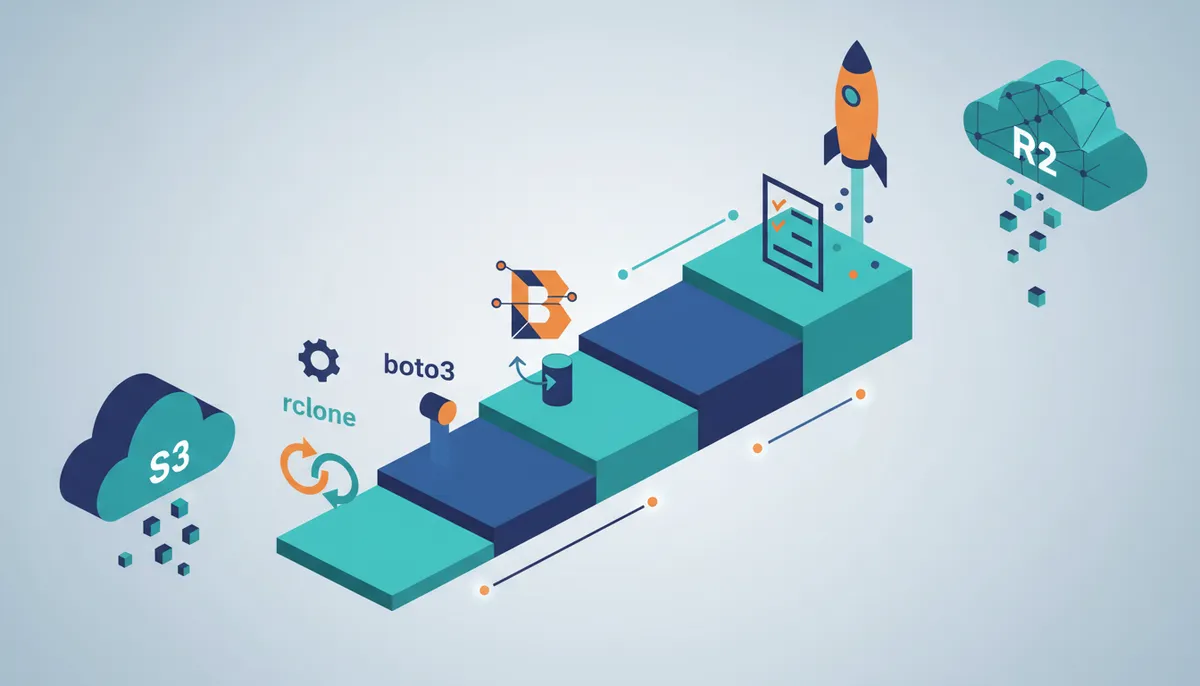
Operators initiate data transfer by executing `rclone sync` with explicit source and destination bucket paths. This command structure ensures metadata preservation while overwriting divergent files in the target container.
- Configure the remote endpoints in the rclone configuration file with valid access keys.
- Validate network connectivity between the source S3 bucket and the destination R2 bucket.
- Execute the synchronization command to begin the one-way data flow.
The syntax demands precise naming to prevent accidental data loss during the synchronization process. Cloud migration incurs egress charges when pulling data from AWS to the public internet. This cost factor often dictates batch sizing for large-scale migrations to manage cash flow. Validating checksums post-transfer is recommended to guarantee integrity before switching application traffic. The operational tension lies between speed and cost; maximizing parallel threads reduces the migration window but increases network utilization. Teams must balance throughput requirements against the variable nature of inter-cloud transfer rates. Successful execution requires strict adherence to path definitions to avoid creating nested directories or orphaned objects.
Configuring boto3 Clients for R2 Endpoints in Python
Developers override the default AWS host to route S3 API calls through Cloudflare's global network. This specific configuration enables Python applications to apply zero egress architectures without rewriting core logic. The process requires instantiating a `boto3` session with an explicit `endpoint_url` parameter pointing to the R2 domain.
- Initialize the boto3 client with the target bucket name and custom region.
- Define the `endpoint_url` string to direct traffic to the correct storage cluster.
- Supply access credentials that match the R2 worker or user permissions.
The `region_name` parameter is typically set to a specific value like `auto` or omitted, as R2 buckets are globally distributed rather than zone-locked.
Migrating data incurs a one-time egress charge based on standard public internet rates. This upfront financial exposure often catches engineering teams off guard when budgeting for cloud migration projects.
- Estimate total volume to determine the baseline egress liability before initiating any transfer jobs.
- Allocate sufficient funds in the project budget to cover this non-recoverable outbound traffic cost.
- Plan the transfer window carefully to manage network load effectively.
Modeling this expense as a mandatory tax on data mobility rather than a variable performance cost is advisable. The architectural decision to move data always carries this specific monetary weight.
About
Marcus Chen is a Cloud Solutions Architect and Developer Advocate at Rabata.io, where he specializes in S3-compatible object storage and AI/ML data infrastructure. His daily work involves rigorous performance benchmarking and cloud cost optimization, making him uniquely qualified to analyze the real cost differences between Rabata.io and AWS S3. As an architect who routinely helps enterprises migrate from legacy systems, Marcus understands the critical importance of zero egress fees and true API compatibility for DevOps teams. At Rabata.io, a provider dedicated to eliminating vendor lock-in, he uses hands-on experience with tools like Terraform and rclone to validate storage claims against production realities. This article reflects his direct engagement with customers seeking 70% cost savings without sacrificing the performance required for generative AI and media workloads. By connecting theoretical pricing models to actual deployment scenarios, Marcus provides a factual breakdown necessary for technical decision-makers evaluating cloud storage strategies.
Conclusion
Durability guarantees alone cannot offset the operational drag of vendor lock-in when data gravity increases. While providers promise nine-nines durability through replication, the real constraint emerges in the economic friction required to move or access that data at scale. The industry shift toward zero-egress models fundamentally alters the total cost of ownership for media-heavy and AI workloads, making legacy pricing structures increasingly difficult to justify for greenfield projects. Organizations must stop treating bandwidth charges as an unavoidable variable and start viewing them as a selectable architectural parameter.
Adopt a strict policy where any new bucket created after this quarter requires a zero-egress justification if it serves public-facing or high-volume read workloads. Retain legacy tiers only for cold archival where access frequency remains negligible. This approach prevents new projects from inheriting the hidden latency and cost penalties of traditional per-gigabyte exit fees. Start by running a query on your current billing dashboard to identify the top three buckets by outbound traffic volume and calculate their potential savings under a flat-rate model. This immediate audit reveals whether your current storage strategy aligns with modern economic realities or merely perpetuates outdated spending habits.
Frequently Asked Questions
Durability prevents data loss while availability ensures immediate access. Providers claim 99.999999999% annual durability, yet S3 Standard offers 99.99% availability while R2 and B2 offer 99.9% availability as of 2026.
Class A operations like writes and deletes incur specific request charges. These Class A operations are priced at $4.50 per million requests, significantly impacting budgets for applications with high-frequency write workflows compared to read-heavy archives.
Removing egress fees drastically reduces total cost of ownership for media. Switching to a provider with zero egress fees can cut storage bills by 60–80% for media-heavy workloads, though this often ignores building custom replication logic.
Some platforms omit native object lock and cross-region replication features. This gap prevents automatic data copying and immutable audit trails, forcing engineers to implement external cron jobs or third-party sync tools to mimic native replication capabilities.
Modern budget-friendly options undercut traditional hyperscaler pricing models significantly. The provider charges $0.015 per GB-month, allowing architects to evaluate object storage comparison metrics beyond simple per-gigabyte costs for modern infrastructure.
References