Zero egress fees: Why CoreWeave's $1M offer matters
CoreWeave covers egress fees to save customers up to $1 million per transfer. This Zero Egress Migration program eliminates the financial gravity trapping AI teams on legacy hyperscalers by removing exit costs entirely. The initiative directly addresses the $0.12 per GB charge that often turns a single petabyte move into a six-figure expense, according to CoreWeave.
Readers will learn how this white-glove service orchestrates secure, petabyte-scale data transfers while maintaining full access to existing environments. We examine the technical architecture of CoreWeave AI Object Storage, which enforces a permanent zero egress fee model for all subsequent data usage. This approach contrasts sharply with competitors that demand account closures or impose hidden trade-offs for data mobility.
The analysis further details specific performance metrics where CoreWeave outperforms traditional cloud providers in both cost efficiency and throughput. By using verified transfer speeds exceeding 1 PB per day, organizations can migrate training datasets without the typical operational friction. This article dissects why the zero egress fee model is becoming the critical differentiator for modern AI infrastructure strategies.
The Role of Zero Egress Migration in Modern Cloud Infrastructure
Defining CoreWeave Zero Egress Migration and AI Object Storage
On November 13, 2025, CoreWeave identified data mobility as a primary constraint for teams scaling AI, citing transfer costs up to $0.12 per GB that trap datasets behind commercial fine print. The Zero Migration ([0]EM) program acts as a secure, white-glove service enabling customers to move large-scale datasets from substantial cloud providers directly to CoreWeave without paying exit fees. By covering egress costs incurred when leaving existing cloud providers, the initiative effectively reduces migration friction for petabyte-scale operations, offering potential savings of up to $1 million for a typical data transfer operation. This approach eliminates the "gravity" keeping AI teams tethered to suboptimal infrastructure by removing the financial penalty of movement.
Complementing this mobility is AI Object Storage, a high-performance foundation delivering up to 7 GB/s per GPU of throughput with 11 nines durability. Unlike legacy systems where throughput per GPU declines at scale, this architecture ensures linear performance gains as clusters expand to hundreds of thousands of GPUs. Removing egress barriers allows organizations to adopt such AI-native storage solutions, facilitating smooth multi-cloud strategies where data thrives rather than merely resides. The combination of covered transfer costs and zero subsequent egress fees creates a unique economic model where data location no longer dictates budget constraints or computational efficiency. Teams can now execute training, fine-tuning, and agentic applications across distributed environments without the traditional tax on data gravity. This structural shift enables enterprises to prioritize workload performance over storage locality, fundamentally altering how AI infrastructure scales.
Applying Zero Egress Migration to Petabyte-Scale AI Training Workloads
AI teams deploy the Zero Migration ([0]EM) program when egress fees threaten to consume capital required for model development. The primary application involves moving massive datasets for training and fine-tuning without incurring prohibitive network charges. Unlike rigid hyperscaler offers, this approach supports multi-cloud flexibility by allowing teams to retain full access to existing environments. Teams can execute petabyte scale transfers while continuing to run agentic applications on legacy infrastructure. The process requires organizations to coordinate read-only credentials to initiate the secure, white-glove transfer process.
Eliminating exit costs fundamentally alters the cloud cost optimization environment for AI startups. By removing the penalty for data movement, enterprises gain the agility to relocate workloads based on performance needs rather than vendor lock-in constraints. This freedom enables flexible resource allocation across diverse cloud providers.
Zero Egress vs Traditional Migration: Avoiding Account Closure Traps
Traditional migration offers frequently mandate full account closure, trapping operators in rigid, one-time switches that alter ongoing business continuity. This binary choice forces a complete infrastructure rip-and-replace rather than enabling strategic multi-cloud expansion. In contrast, the Zero Migration ([0]EM) program preserves access to existing environments while eliminating financial friction for data movement. These fees accumulate rapidly at scale, creating a financial barrier that discourages necessary data portability for AI workloads. This approach prevents the "account closure trap" where businesses lose access to legacy data simply to avoid paying transfer taxes. This capability enables a hybrid architecture where Compute and Storage decouple effectively. By allowing teams to transfer data while retaining full access to their existing environments, the program supports a transition that avoids the disruption of forced cutover scenarios. The account closure trap ultimately serves vendor retention rather than customer innovation, whereas zero-egress frameworks prioritize data sovereignty and architectural agility for modern AI development.
Inside CoreWeave AI Object Storage Architecture and Data Flow
Read-Only Credentials and End-to-End Checksum Validation Mechanics
Operators initiate the workflow by supplying read-only credentials, a constraint that permits CoreWeave to orchestrate full data transfer without requiring write access to source buckets. The system executes end-to-end checksum validation on every object to guarantee integrity and accuracy across the entire dataset. Engineers depend on this cryptographic verification to confirm that bit-for-bit fidelity remains intact from the source cloud to the destination storage tier. Such rigor prevents the silent data corruption that frequently compromises AI training runs. Manual scripts often skip verification steps to save time, yet the automated pipeline enforces zero data loss guarantees at petabyte scale. A real-time dashboard provides visibility into these validation metrics so operators see exactly which objects have passed integrity checks. This method removes egress costs as a variable when planning multi-cloud strategies. Teams design systems based on performance needs rather than cost-avoidance of data movement. Organizations using cross-cloud capabilities benefit from a single dataset supporting models deployed anywhere.
Orchestrating Petabyte-Scale Transfers with Real-Time Dashboard Visibility
Migrations typically exceed 1 PB per day, demanding rigorous orchestration to prevent visibility gaps during massive shifts. Operators manage this volume through a real-time migration dashboard that surfaces granular progress metrics and throughput statistics instantly. This interface eliminates blind spots common in legacy transfers where teams wait days for final checksum reports. Engineers observe live object counts and validate that end-to-end checksum operations complete without manual intervention. The system guarantees zero data loss while maintaining full fidelity across every stage of the movement. Large-scale data transfer often incurs prohibitive costs elsewhere, yet the program covers egress fees for typical enterprise moves. Teams gain immediate confidence that datasets remain secure and intact throughout the entire workflow.
| Feature | Traditional Migration | CoreWeave [0]EM Approach |
|---|---|---|
| Visibility | Post-transfer logs only | Real-time dashboard |
| Scale | Limited by manual steps | Exceeds 1 PB daily |
| Cost | High egress fees | Zero egress charges |
Visibility drives trust, allowing organizations to commit to multi-cloud strategies without fearing data entrapment or silent corruption events during transit.
Linear GPU Throughput Gains Versus Legacy Hyperscaler Decline
Scale-out efficiency collapses on legacy platforms where added GPUs dilute per-unit bandwidth, a bottleneck eliminated by delivering up to 7 GB/s per GPU consistently. This architecture ensures that linear performance gains persist as clusters expand to hundreds of thousands of units, directly countering the throughput decay observed in traditional hyperscaler environments. Removing egress costs as a variable allows engineers to design systems based on performance rather than cost-avoidance of data movement. This model decouples transfer volumes from billing, enabling true multi-cloud mobility without financial penalties.
| Metric | Legacy Hyperscaler Scaling | CoreWeave AI Object Storage |
|---|---|---|
| Throughput Trend | Declines per GPU at scale | Linear gain per added GPU |
| Data Integrity | Standard verification | End-to-end checksum validation |
| Cost Variable | Per-GB transfer fees | Zero egress fees |
| Scalability | Bottlenecked by I/O | Maintains 7 GB/s consistency |
Architectural rigidity of legacy providers often forces a choice between cost containment and performance, whereas modern AI workloads demand both simultaneously. Network architects recognize that storage must no longer be treated as a passive repository but as an active component dictating model convergence speed.
CoreWeave vs Hyperscalers on Cost and Performance Metrics
Comparison: CoreWeave Zero Egress Migration and AI Object Storage Specifications
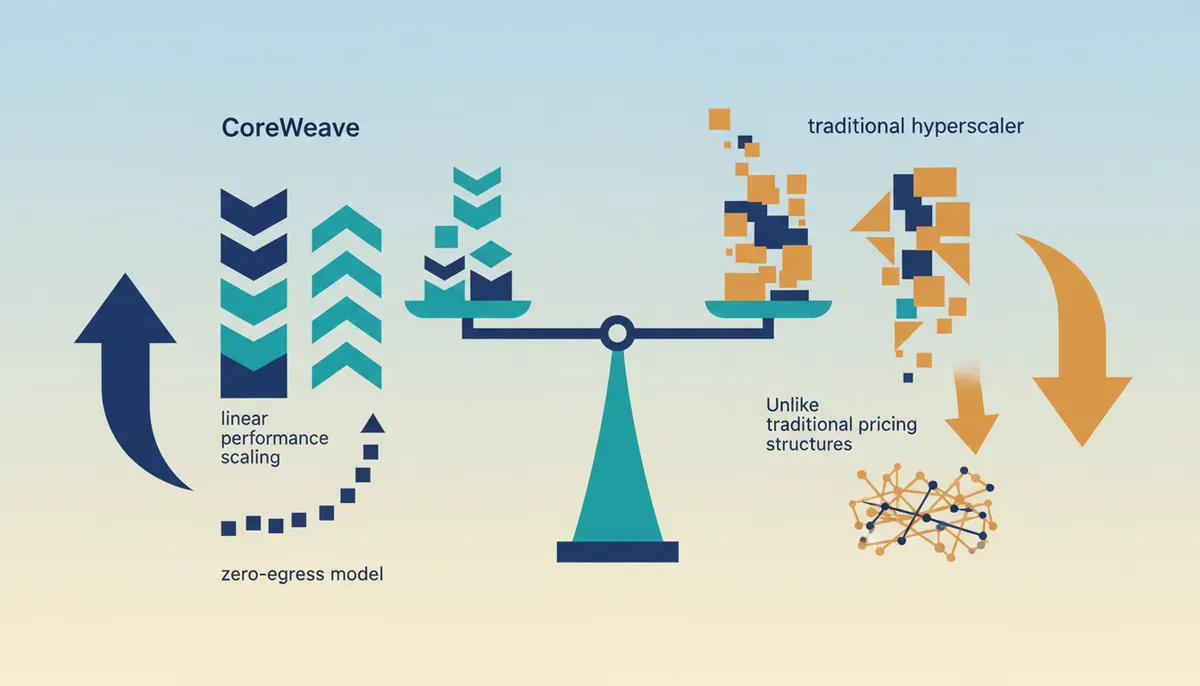
CoreWeave AI Object Storage delivers up to 7 GB/s per GPU of throughput with 11 nines durability and 99.9% uptime, providing a high-performance foundation for AI at scale. Such specs prevent I/O bottlenecks from stalling expensive compute cycles. Removing egress costs from architectural decisions lets engineers focus on latency instead of billing surprises. Linear performance gains occur with every added GPU, a sharp contrast to legacy hyperscalers where throughput per GPU drops as clusters grow. This capability simplifies multi-cloud complexity found in traditional setups. Teams move petabytes of data while keeping full access to current environments. A unified approach helps enterprises maximize GPU use without the hidden latency penalties of scattered data copies.
Comparison: Scaling AI Workloads with Linear Throughput Gains
Proportional throughput increases with each new GPU, avoiding the diminishing returns seen in older systems. Xander Dunn of Periodic Labs notes this setup speeds up experiments while holding costs steady during active phases. Compute and storage expand in tandem, keeping throughput consistent even as workloads reach hundreds of thousands of GPUs. These performance traits solve the GPU bottlenecks that frequently halt model training on conventional infrastructure. Once data is in CoreWeave AI Object Storage, customers will not pay CoreWeave egress fees, no matter where the data is used.
Zero Egress Savings Versus AWS Azure and Google Cloud Fees
Capital preservation happens immediately when outbound transfer charges disappear. Specific numbers show the egress fee savings for AI teams leaving legacy providers. Steep fees and rigid lock-ins create a "gravity" holding advanced AI teams on suboptimal infrastructure. Most "free data transfer" deals waive fees only if customers close entire accounts in a one-time switch, an ultimatum trapping data behind fine print. Engineers optimize for latency and throughput rather than transfer bills once these fees vanish. True hybrid cloud architectures become possible when data sits closest to compute without fiscal restraint. Storage economics must match flexible workload needs.
Executing a Secure Data Transfer to CoreWeave in Five Steps
Defining the [0]EM White-Glove Migration Workflow
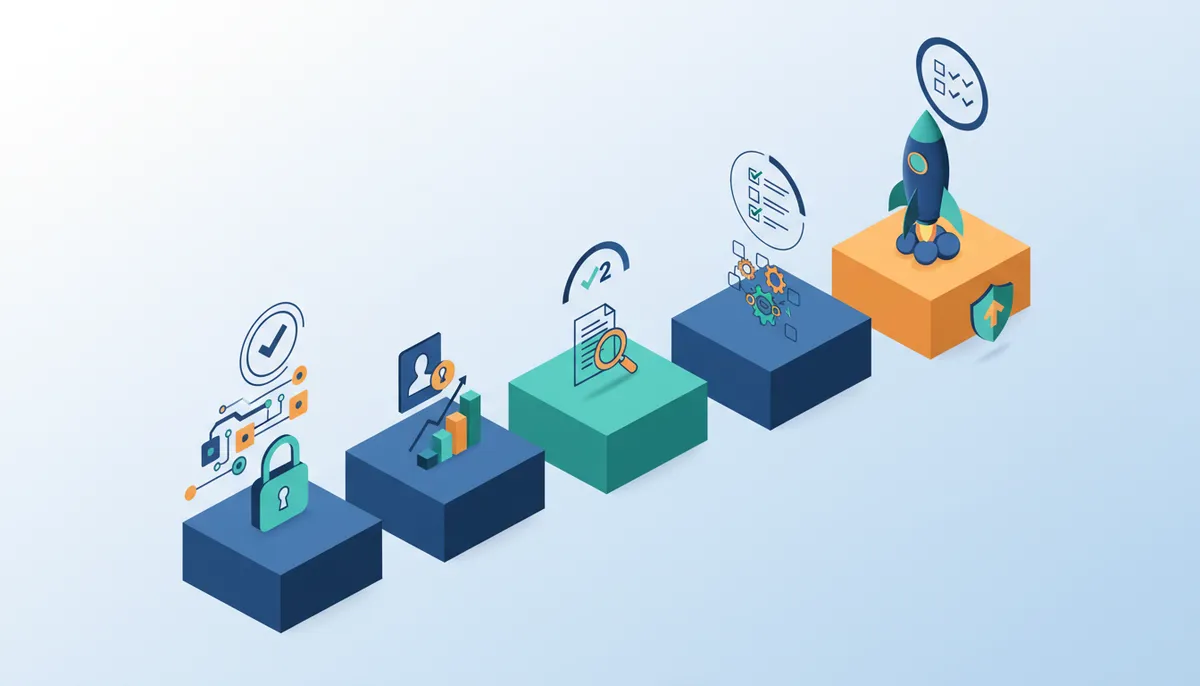
Initiating the Zero Migration (0EM) program requires only read-only credentials, after which CoreWeave orchestrates the entire transfer. This white-glove workflow eliminates manual intervention while executing end-to-end checksum authentication to guarantee data fidelity. The process typically handles volumes exceeding 1 PB per day, ensuring that large-scale moves complete without disrupting active innovation cycles.
- Submit read-only access keys to the dedicated engineering team.
- Allow CoreWeave to execute the petabyte-scale replication job.
- Verify integrity via the real-time migration dashboard.
- Receive confirmation of zero data loss and full fidelity.
- Begin training models on the new unified dataset architecture.
Standard lift-and-shift operations often demand full account closures, yet this approach preserves access to legacy environments until the transition is fully validated. Retaining dual-environment access during migration prevents the single-point-of-failure risks inherent in "big bang" cutover strategies. Teams gain the freedom to test performance characteristics of AI Object Storage against live workloads before committing to a full switchover. Such flexibility ensures that the move to a high-throughput foundation remains a controlled engineering evolution rather than a risky commercial gamble.
Implementation: Applying Petabyte-Scale Transfer Capabilities to AI Workloads
Applying petabyte-scale transfer capabilities to AI workloads begins with the Zero Migration (0EM) program covering egress costs. This financial removal enables teams to move training datasets without the typical six-figure expense barrier. The mechanism relies on CoreWeave orchestrating the migration after receiving read-only credentials, ensuring security during transit. Operators gain real-time visibility through a dedicated dashboard, monitoring progress as data exceeds 1 PB daily throughput rates.
- Provide read-only access credentials to initiate the secure handoff.
- Monitor end-to-end checksum verification via the real-time dashboard.
- Verify data fidelity before switching compute workloads to the new storage.
- Scale AI Object Storage consumption based on active training needs.
Network saturation presents a constraint; moving such vast volumes requires careful bandwidth scheduling to avoid impacting production traffic. Unlike legacy hyperscalers where throughput per GPU declines at scale, this architecture delivers up to 7 GB per GPU, maintaining linear throughput gains. Storage must not become the bottleneck for agentic applications. By eliminating egress fees entirely after migration, the model shifts cost optimization from transfer avoidance to performance maximization.rabata.io recommends using this high-throughput foundation to accelerate model fine-tuning cycles. The cost is the initial coordination effort, yet the result is a unified dataset architecture ready for immediate scaling. This approach transforms data mobility from a capital expenditure problem into an operational efficiency gain.
Validating Unified Dataset Architecture and Egress Fee Elimination
Final validation confirms zero data loss guarantees through end-to-end checksums before traffic shifts. Operators must verify full fidelity across the unified dataset to ensure model training integrity remains uncompromised. This cost structure fundamentally alters budget planning for AI startups scaling beyond initial pilots.
- Execute integrity checks comparing source and destination object hashes.
- Confirm full fidelity via the real-time migration dashboard visibility.
- Validate that no egress fees apply to subsequent data access.
Eliminating transfer costs removes the artificial gravity binding data to legacy providers. Teams gain the freedom to distribute datasets globally without incurring per-gigabyte penalties. The true operational shift lies in decoupling data location from compute economics. Traditional models dictate billing based on access patterns, but this architecture allows unrestricted data movement.rabata.io engineers note that such freedom enables flexible workload placement based purely on latency or GPU availability. The constraint is procedural rather than technical; organizations must update internal governance to reflect that data mobility no longer carries a direct financial penalty. This change empowers architects to design truly hybrid workflows without fear of bill shock.
About
Marcus Chen is a Cloud Solutions Architect and Developer Advocate at Rabata.io, where he specializes in S3-compatible object storage and AI/ML data infrastructure. His daily work involves designing cloud storage architectures that eliminate vendor lock-in, making him uniquely qualified to analyze the impact of egress fees on data mobility. As teams face six-figure costs to move petabytes of data under programs like CoreWeave's, Marcus uses his production experience to highlight how rigid transfer policies hinder scalability. At Rabata.io, he helps enterprises and AI startups achieve true data freedom through zero vendor lock-in and transparent pricing. By focusing on true S3 API compatibility, Marcus ensures that organizations can migrate datasets smoothly without being trapped by commercial fine print. His insights connect the industry's struggle with data gravity to Rabata.io's mission of providing cost-effective, high-performance storage solutions that empower engineers to scale without prohibitive exit barriers.
Conclusion
At scale, the primary friction shifts from transfer fees to orchestration complexity when moving petabytes daily. Organizations often underestimate the coordination required to sustain 7 GB/s per GPU consistently across hybrid boundaries. This bottleneck demands a shift from simple lift-and-shift tactics to rigorous, checksum-verified workflows that guarantee 11 nines durability throughout the transition.
Teams must adopt a zero-egress fee model immediately if their roadmap includes multi-region inference or flexible workload placement. Waiting until legacy contracts renew locks in artificial scarcity that hinders agentic application performance. The window to capture these efficiency gains opens when governance policies explicitly decouple data location from compute economics, allowing architects to prioritize latency over billing zones.
Start this week by executing end-to-end integrity checks on a representative 10 TB slice of your dataset before authorizing full-scale movement. Verify that source and destination object hashes match perfectly to ensure full fidelity prior to shifting production traffic. This concrete validation step prevents data corruption from compounding across the unified dataset architecture as you scale.
Frequently Asked Questions
The program covers exit costs, saving up to $1 million per transfer. This eliminates the financial gravity trapping teams on legacy clouds, allowing capital reallocation to model development instead of penalties.
It removes transfer costs reaching $0.12 per GB that often block data mobility. By erasing this fee, organizations avoid six-figure expenses when moving single petabytes of training data.
Storage delivers up to 7 GB per GPU of consistent throughput. This architecture ensures linear performance gains as clusters expand, preventing the decline seen in legacy hyperscaler systems.
No, teams retain full access to existing environments during the secure transfer. This approach avoids the account closure trap, enabling strategic multi-cloud expansion without disrupting ongoing business continuity.
The system provides 99.9% uptime to support demanding research and training workloads. This reliability ensures that data remains accessible and intact while teams execute large-scale model operations.
References