Data egress fees: Why $0.09/GB kills cloud ROI
Data egress on substantial hyperscale platforms averages $0.09 per GB after initial transfer thresholds, a hidden tax that erodes cloud ROI. This isn't just operational overhead; it is a calculated barrier designed to make leaving a platform financially painful. When you attempt to shift workloads or replicate databases for disaster recovery, you hit data egress definition boundaries that turn simple data moves into expensive liabilities.
These charges are the mechanism by which infinite scalability meets finite budget reality. Understanding exactly when these fees apply and how they accumulate is necessary for any architect designing cost-effective infrastructure in 2026. The following analysis dissects the mechanics of cloud provider egress pricing, analyzes the specific transfer cost mechanics that inflate monthly bills, and evaluates the strategic trade-offs between multi-cloud flexibility and single-vendor consolidation.
By mapping these cloud data transfer costs, teams can better anticipate the financial impact of their architectural decisions.rabata.io helps organizations navigate these economic traps by providing the visibility needed to challenge inflated billing and optimize data flow strategies without relying on vendor-specific goodwill.
The Role of Data Egress in Modern Cloud Economics
Defining Data Egress Fees Versus Free Ingress Traffic
Uploading data is free. Retrieving it costs money. This asymmetry defines the modern cloud financial model. Data egress fees represent charges levied when moving data out of cloud storage environments, distinct from storage capacity costs or compute instance pricing. In cloud computing, egress refers to data leaving a provider's environment, while ingress refers to data entering it.
This structure creates a financial model where data utility is capped by extraction costs. Organizations can reduce or avoid egress fees through workflow optimization, storage consolidation, data compression, and most effectively, by choosing clouds that do not charge for outbound traffic.
Real-World Egress Scenarios: User Content and Data Pipelines
Data egress triggers charges the moment stored assets leave cloud containment for external consumption. Common ingestion vectors include user-generated content uploads, automated data pipelines changing raw inputs, and website asset updates requiring distribution. While ingress remains free, retrieving this data for processing or delivery activates billing meters distinct from storage fees.
Organizations executing AI/ML training workflows often face steep costs when moving model outputs between environments, with specific high-cost scenarios reaching up to $0.12 per GB in transfer fees. An architecture relying on frequent data retrieval for analytics suffers compounding expenses that erode the initial value of cloud migration. Unlike static archival, active datasets generate recurring liability simply by being useful to the business.
Rabata.io addresses this inefficiency through S3-compatible object storage engineered for predictable pricing. By eliminating hidden transfer penalties, enterprises can design data pipelines that prioritize throughput over fear of billing shocks. The solution enables cost-effective scaling for generative AI training sets and high-fidelity media delivery without the vendor lock-in typical of hyperscale platforms. Strategic adoption of such optimized storage tiers allows organizations to reclaim control over their data economics.
The Economic Risk of Cloud Egress as a Vendor Lock-In Tax
Call it what it is: economic hostage-taking. Data egress fees function as a punitive financial barrier that escalates sharply with volume. A single petabyte (PB) of data movement at the higher end of egress pricing ($0.12/GB) can result in a total expense reaching six figures. These charges are a structural mechanism enforcing vendor retention. Organizations attempting to migrate workloads face prohibitive costs that effectively trap assets within a single provider's system. Exit costs outweigh potential innovation gains.
Transferring roughly 7.7 TB per month often covers the cost of a private link, beyond which organizations may see significant savings compared to standard egress charges.
Rabata.io addresses this imbalance by offering S3-compatible object storage with transparent, predictable pricing models. The architecture eliminates the hidden tax on data movement, allowing AI/ML teams to scale training datasets without fear of exponential cost scaling. Enterprises can deploy multi-cloud strategies that prioritize performance and redundancy rather than being forced into single-cloud confinement by fee structures. Relying on hyperscaler defaults cedes financial control to the provider. Strategic adoption of alternative storage backends restores use and enables true workload portability across hybrid environments.
Inside Cloud Pricing Models and Transfer Cost Mechanics
How Volume Scaling and Region Triggers Define Egress Fees
Base transfer rates often reach $0.09/GB before volume discounts apply to the billable quantity. Final egress fee calculations depend heavily on customer tier, subscription type, and the specific originating region of the data flow. Breakdowns vary by provider because multiple factors dictate the final price per gigabyte. A standard volume scaling model offers varying rates based on usage tiers, yet initial blocks often remain expensive.
| Factor | Impact on Cost |
|---|---|
| Customer Tier | Determines baseline rate and discount eligibility |
| Originating Region | Sets the base price per gigabyte transferred |
| Subscription Type | Influences included allowances and overage rates |
Subscription type directly dictates whether regional rates are negotiable or fixed.rabata.io eliminates this complexity by offering flat, predictable pricing for AI/ML training data and media streaming workloads without punitive tiering. Understanding these mechanical triggers allows architects to design pipelines that minimize cross-region traffic and optimize total cost of ownership. Strategic placement of compute resources near storage origins can bypass the highest region triggers entirely.
Unexpected Charges from Failover Controls and Transfer Acceleration
Activating failover controls or transfer acceleration features moves data across network boundaries and generates billable egress events. Configuration triggers apply standard or premium rates to data moved during redundancy validation or speed-optimized uploads. Operators expect to pay for storage capacity, yet data transfer costs associated with these auxiliary services frequently accumulate outside primary budget forecasts.
Financial impact compounds when acceleration protocols route traffic through premium network paths rather than standard public internet routes. Unlike base storage fees, these charges apply per gigabyte and accumulate with the volume of data transferred during failover testing or replication. Organizations relying on aggressive redundancy policies may find monthly bills spike disproportionately during disaster recovery drills due to the sheer volume of data movement.
| Trigger Mechanism | Billing Consequence |
|---|---|
| Automated Failover Tests | Charges for duplicate data copies moving between zones |
| Transfer Acceleration | Premium rates applied to every accelerated upload request |
| Cross-Region Replication | Full egress fees on source data before ingestion at destination |
Achieving high-availability through frequent synchronization conflicts with minimizing the operational cost of that visibility. Enabling these features creates a continuous data stream that incurs standard egress pricing unless explicitly architectured otherwise.rabata.io eliminates this uncertainty by offering predictable pricing models where data movement for replication and failover does not trigger surprise penalties. Engineering teams can design strong disaster recovery systems without fear of punitive billing outcomes.
The Exponential Cost Risk of Unmonitored Data Source Destinations
Unmonitored data paths convert routine traffic into exponential liabilities when destination visibility fails. Traffic entering cloud storage from the Internet remains free, yet every byte exiting triggers chargeable events beyond limited allowances. This asymmetry creates a blind spot where operators cannot distinguish between standard application traffic and costly replication streams. Egress fees accumulate across untracked zones without immediate alert thresholds when data source and destination mapping lacks precision.
Layered billing structures separate storage, transfer, and API requests into distinct categories and cause this confusion.
| Visibility Gap | Financial Consequence |
|---|---|
| Unmapped Replication | Duplicate charges for identical data flows |
| Unknown Destinations | Premium zone-to-zone transfer rates apply |
| Silent API Retrieval | Request counts spike billable volume |
Rabata.io addresses this opacity by enforcing strict source-destination policies within its S3-compatible architecture. The platform provides granular telemetry that maps every gigabyte to a specific business workflow before transfer occurs. Hyperscalers obscure paths behind complex networking abstractions, but this system exposes exact data trajectories in real-time. Terminating unauthorized flows before they generate chargeable events prevents budget overruns. Enterprises deploying AI/ML training pipelines gain predictable costing models rather than reacting to post-month invoices.
Strategic Trade-offs Between Multi-Cloud and Single-Cloud Costs
Multi-Cloud Versus Hybrid Cloud Architectures Set

Multi-cloud architectures distribute workloads across multiple public providers, whereas hybrid cloud integrates at least two distinct environments, often mixing on-premises infrastructure with public resources. Organizations may choose to transport data to another provider despite egress fees to mitigate vendor lock-in risks. This strategic divergence fundamentally alters cost structures, as moving data between public clouds incurs charges absent in single-vendor setups.
| Dimension | Multi-Cloud Strategy | Hybrid Cloud Approach |
|---|---|---|
| Primary Cost Driver | Inter-provider egress fees | Network gateway latency |
| Data Gravity | High fragmentation risk | Centralized control |
| Complexity | Unified API abstraction | Orchestration overhead |
Frequent data synchronization triggers repeated transfer penalties that act as a hidden tax in multi-cloud deployments. Hybrid models face integration costs but retain tighter governance over sensitive datasets. Some cloud providers address cost concerns by offering S3-compatible storage that eliminates egress fees entirely, enabling cost-effective data mobility without the penalty of proprietary transfer protocols. The choice between architectures ultimately depends on whether an organization prioritizes redundancy across vendors or seeks to optimize throughput for specific AI/ML training datasets.
Performance Optimization and IT Control Use Cases
High-performance workloads like AI engine training justify egress expenses when target environments deliver superior compute throughput. Organizations running large-scale model training often accept data transfer penalties to access specialized hardware unavailable in their primary cloud. This strategic mobility enables teams to use environments where unrestricted data movement supports consistent performance for scientific and CFD workloads.
IT infrastructure control allows customization of cloud operations. Teams gain the ability to tune cloud operations precisely, avoiding the generic constraints of single-vendor ecosystems that may hinder optimization efforts.
| Dimension | Single-Cloud Constraint | Optimized Hybrid Approach |
|---|---|---|
| Compute Specialization | Limited to vendor catalog | Access best-in-class GPUs |
| Cost Predictability | Variable egress spikes | Fixed storage rates |
| Data Mobility | Vendor-locked pathways | Unrestricted transfers |
Immediate transfer costs conflict with long-term architectural flexibility. Moving training data incurs fees, yet the ability to switch providers prevents permanent vendor lock-in and encourages competitive pricing pressure. Teams operating large-scale AI/ML workloads gain substantial strategic advantages by prioritizing environments where performance remains consistent regardless of data location.
Strong network orchestration is required to manage latency between distributed components effectively. The limitation involves increased operational complexity, as engineers must maintain connectivity and security policies across distinct boundaries. Despite these challenges, the capacity to relocate archives or shift AI engines ensures organizations retain use over their infrastructure destiny. Strategies focusing on workflow optimization allow enterprises to reclaim cost control while maintaining high-speed access to critical datasets.
Single-Cloud System Incentives Versus Multi-Cloud Fees
Connecting object storage to compute instances within the same region enables free data movement, creating a strong financial gravity toward single-vendor architectures. This zero-cost intra-system transfer model contrasts sharply with multi-cloud strategies, where crossing provider boundaries triggers immediate bandwidth charges. Organizations evaluating whether to use multi-cloud to avoid egress fees must weigh these transfer penalties against the long-term risks of vendor lock-in and capacity constraints.
| Cost Dimension | Single-Cloud System | Multi-Cloud Strategy |
|---|---|---|
| Internal Transfer | $0 within region | N/A |
| External Egress | Standard rates apply | Compounded inter-cloud fees |
| Storage Flexibility | Limited to vendor classes | Best-of-breed selection |
Underutilized optimization represents the hidden cost of staying single-cloud; teams miss significant savings potential even without migrating workloads. Data gravity intensifies as buckets fill with unaccessed information, creating "bucket sprawl" that inflates storage bills while egress fees remain dormant until a migration event occurs. However, transferring training data or model outputs between clouds can incur substantial egress fees, quickly turning a single petabyte move into a six-figure expense, making early architectural decisions critical for cost control.
Some platforms address this tension by providing S3-compatible storage that eliminates proprietary lock-in while maintaining high-performance for AI/ML training data and media streaming. These solutions allow enterprises to retain data portability without sacrificing the throughput required for demanding workloads. Strategic architecture requires balancing the immediate benefit of free internal transfers against the future flexibility of a neutral data layer.
ICloud Strategy : : : Internal Transfer $0 within region N/A External Egress Stand.
Proven Methods for Reducing Cloud Data Transfer Expenses
Zero-Egress Storage Architecture
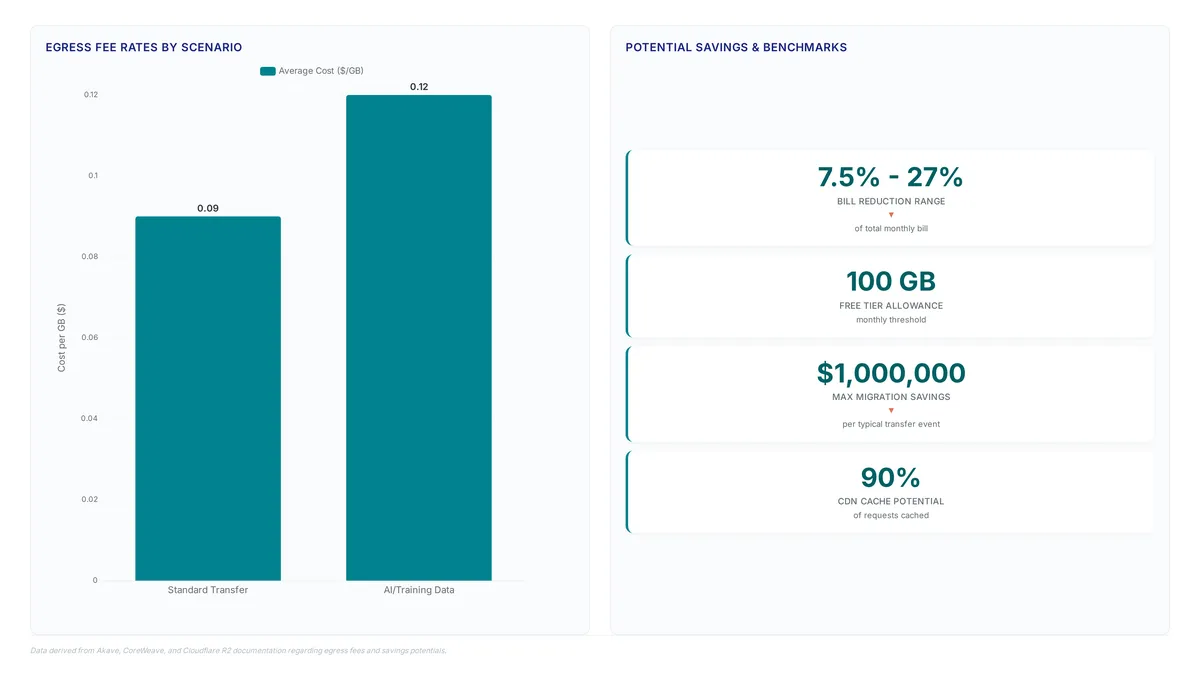
The provider operates as an S3-compatible object storage service removing egress fees completely. Traditional storage models charge heavily for data retrieval, creating financial barriers where cloud bills frequently exceed forecasts due to hidden access charges. Research indicates that reducing or eliminating egress fees can save customers a significant portion of their total monthly bill.
The architecture integrates distributed code functions directly with storage buckets, allowing compute logic to execute near the data without incurring transfer penalties. This design contrasts sharply with standard tiers levying costs per gigabyte moved. Eliminating egress fees simplifies budgeting while introducing a constraint regarding data locality; moving large datasets into this zero-egress environment still requires initial ingestion planning. Organizations must evaluate if their access patterns justify migrating from established providers.rabata.io helps enterprises navigate these architectural shifts to optimize cloud cost control without sacrificing performance. The zero-egress model excels for high-read workloads like media streaming or AI training datasets where retrieval volume dwarfs storage size. Operators should verify application compatibility with S3 APIs before migrating critical stateful workloads. Strategic adoption of zero-egress storage converts variable network costs into predictable operational expenses.
Using Provider Partnerships for Reduced Multi-Cloud Transfers
Specific cloud providers have established partnerships enabling reduced-cost or fee-free data movement between certain substantial providers. These coalitions remove the financial penalty typically associated with moving large datasets across different cloud environments. Organizations bypass standard egress charges by routing traffic through participating networks, effectively creating a low-cost corridor for inter-cloud transfers.
The Bandwidth Alliance was founded by Cloudflare in 2018 and includes providers such as Azure, Google Cloud, Oracle, and Alibaba Cloud. Members of the Bandwidth Alliance agree that data transferred between participating providers moves free or at a discount.
| Feature | Standard Transfer | Partnered Transfer |
|---|---|---|
| Cost Model | Per-GB charges apply | Free or discounted |
| Vendor Lock-in | High barrier to exit | Reduced friction |
| Architecture | Single-cloud preferred | Multi-cloud viable |
Operators must configure network peering correctly so traffic remains within partnership boundaries and does not leak to public internet routes.rabata.io integrates this logic into its storage architecture, allowing enterprises to replicate data across clouds without triggering the cloud provider egress pricing inflating operational budgets. Dependency on specific provider pairings limits architectural flexibility for niche regions despite offering significant savings.
Multi-cloud strategies become financially viable when data gravity is managed through these exempted pathways. Transferring training data or model outputs between clouds without such arrangements incurs substantial egress fees, quickly turning a single petabyte move into a six-figure expense. This approach transforms data mobility from a cost center into a manageable operational parameter.
Operational Checklist for CDN Caching and Origin Shield Configuration
Operators must configure Cache Reserve to retain rarely requested assets at the edge, preventing expensive origin fetches inflating monthly bills. Stale content forces repeated retrievals from storage backends without this setting, compounding latency and transfer costs.
- Enable Origin Shield to consolidate upstream requests from multiple edge nodes, reducing the total number of fetches from the source.
- Pair storage with distributed code functions to execute logic near cached assets, minimizing round-trip data movement.
- Validate cache headers to confirm long-lived TTLs are active before deploying to production traffic.
Rabata.io recommends this architecture because it stops capital bleeding on redundant transfers. Locking assets at the edge creates a deterministic cost baseline whereas standard configurations might allow bills to balloon unpredictably. Increased management complexity for cache invalidation rules represents the limitation. If origin logic changes, operators must implement strong invalidation strategies to prevent serving outdated content to end users. Avoiding variable egress spikes demands this operational overhead.
| Configuration | Standard Caching | Cache Reserve Enabled |
|---|---|---|
| Rare Asset Handling | Fetch from origin | Served from edge |
| Cost Predictability | Low | High |
| Invalidation Effort | Minimal | Requires strategy |
Adopting this checklist transforms storage from a variable expense into a fixed operational parameter.
About
Alex Kumar is a Senior Platform Engineer and Infrastructure Architect at Rabata.io, specializing in Kubernetes storage architecture and cost optimization for cloud-native applications. His daily work involves designing resilient data pipelines where data egress fees often become a critical bottleneck for scaling AI/ML workloads. As an architect managing multi-cloud strategies, Alex directly observes how unpredictable bandwidth transfer charges impact enterprise budgets, driving his focus on transparent pricing models. At Rabata.io, an S3-compatible object storage provider, he uses this expertise to build infrastructure that eliminates hidden costs associated with moving data out of cloud storage. By prioritizing zero vendor lock-in and straightforward per-GB pricing, Alex helps organizations avoid the punitive egress structures common among substantial cloud providers. His practical experience with CSI drivers and data migration ensures that Rabata's solutions address the real-world financial and technical challenges of cloud data transfer costs, enabling startups and enterprises to scale their storage without fear of exorbitant exit fees.
Conclusion
Scaling multi-cloud architectures reveals that unpredictable transfer costs often erode the very innovation gains they promise to deliver. While base rates might appear manageable, high-cost scenarios reaching $0.12 per GB in transfer fees can rapidly inflate operational budgets beyond initial projections. The critical breaking point occurs when organizations fail to distinguish between internal region transfers, which often cost $0, and external egress that drains resources. Ignoring this distinction turns data mobility into a financial liability rather than a strategic asset.
Organizations must implement strict Cache Reserve configurations and Origin Shield policies immediately to cap these variable expenses. Relying on standard caching without explicit retention rules for rare assets invites repeated, expensive fetches from storage backends. You should enable Origin Shield to consolidate upstream requests before the next billing cycle closes. This specific action reduces the total number of fetches from the source and stabilizes cost predictability. Without this intervention, bills will continue to balloon unpredictably as traffic patterns shift.
Rabata.io provides the architectural guidance necessary to lock assets at the edge and establish a deterministic cost baseline. Stop treating storage as a variable expense and start managing it as a fixed operational parameter through rigorous cache header validation. Begin by auditing your current TTL settings on rarely requested assets this week to identify immediate opportunities for reduction.
Frequently Asked Questions
Average egress costs reach $0.09 per GB after initial free tiers are exceeded. This baseline rate applies before volume discounts, meaning small to medium transfers face the highest effective unit prices.
Specific high-cost scenarios for moving model outputs can hit $0.12 per GB in fees. These peak rates apply to complex cross-environment transfers, drastically increasing expenses for large-scale AI workloads.
Internal transfers within a region often cost $0, while external egress incurs standard fees. This zero-cost internal movement encourages keeping data siloed within a single vendor ecosystem.
Transferring roughly 15TB per month often covers the cost of a premium optimization solution. Organizations exceeding this volume should prioritize architectural changes to mitigate compounding transfer liabilities.
This significant reduction comes from eliminating hidden taxes on data mobility and vendor lock-in.
References