Synology ActiveProtect stops ransomware
Cyberattacks are up 71%. Synology ActiveProtect Appliances now ship with native Wasabi integration to enforce immutable cloud storage. This pairing kills the architectural friction and unpredictable egress fees that have long plagued hybrid backup frameworks.
Ransomware severity is surging. The solution embeds S3-compatible destinations directly inside the ActiveProtect Manager interface. No more disparate consoles. IT teams orchestrate local and cloud backups through a single pane of glass, meeting compliance without adding operational overhead. This matters because storage footprints are expanding faster than regulatory teams can adapt.
This native architecture supports the rigorous 3-2-1-1-0 backup standard by guaranteeing air-gapped recovery points. It also mitigates data loss scenarios ahead of the scheduled Q3 2026 rollout of AI-driven threat detection.
The Role of Immutable Cloud Storage in Modern 3-2-1-1-0 Backup Frameworks
Defining the 3-2-1-1-0 Backup Framework Components
Three data copies. Two media types. One off-site location. One immutable copy. Zero verification errors. That is the 3-2-1-1-0 standard. On February 10, 2026, Synology and Wasabi Technologies formalized this architecture by mapping specific partnership components to each digit. Local volumes, secondary appliances, and Wasabi Hot Cloud Storage tiers hold the three required copies. Disk-based performance separates from object storage durability across the two media types. A single off-site copy resides in the cloud, eliminating physical transport risks for the 71% of firms facing increased attack frequency. Wasabi provides WORM (Write Once, Read Many) protection as the fourth digit, preventing ransomware encryption or malicious deletion of backup sets. Automated validation handles the zero errors requirement through the built-in hypervisor within ActiveProtect, enabling instant recovery testing without production impact.
Immutability fails if the initial backup contains corrupted data before reaching the vault. The 0 errors constraint forces continuous integrity checks rather than periodic audits. The ActiveProtect Manager coordinates these checks to prevent the immutable copy from permanently preserving a corrupted state. This integration ensures the final copy remains both untampered and usable.
Deploying Immutable Vaults Against 93 Million Exposed Records
Ransomware risks persist after 93 million healthcare records faced exposure in 2023, driving the need for immutable vaults. Synology ActiveProtect enforces the 3-2-1-1-0 methodology across PCs, Macs, VMs, and SaaS data to guarantee recoverability. The solution creates WORM vaults that lock backups immediately upon arrival, ensuring file security against encryption attacks. Native off-site replication sends copies to Wasabi Hot Cloud Storage for redundancy without requiring separate management consoles. This architecture eliminates egress fees, allowing frequent integrity checks that would otherwise incur prohibitive costs on traditional cloud platforms.
Retention depth conflicts with storage budgets when immutability periods extend indefinitely. Network bandwidth limits the initial seeding of large datasets to the cloud tier, requiring careful scheduling to avoid impacting production traffic. Microsoft 365 environments with 400 million active users demand specific cloud-to-cloud protection capabilities that standard agents often miss. Failure to configure these SaaS connectors leaves a significant gap in the enterprise data protection posture. Validate restore procedures quarterly to ensure the zero-error verification standard holds under pressure.
Adversaries encrypt both primary data and mutable backups simultaneously, causing standard retention policies to fail. The Synology and Wasabi Technologies partnership addresses this gap by embedding WORM compliance directly into the backup workflow. Organizations adopting the 3-2-1-1-0 framework gain a distinct advantage against AI-driven threats scheduled for detection in Q3 2026. This architecture isolates the immutable copy from the production network, preventing lateral movement during a breach.
Verification remains necessary because immutability alone does not guarantee recovery. The centralized backup management interface reduces monitoring overhead while maintaining strict separation between administrative access and data modification rights. A communication agency realized a 60% time saving on backup monitoring after implementing similar native integrations. Financial planning improves notably when egress fees are eliminated from the retention strategy. Defining retention locks that satisfy both regulatory mandates and operational recovery time objectives introduces initial configuration complexity. Validate lock durations against specific compliance statutes before deployment.
Native Integration Architecture Between ActiveProtect Manager and S3-Compatible Destinations
ActiveProtect Manager as the Unified S3-Compatible Console
ActiveProtect Manager (APM) functions as the singular on-premises interface coordinating local appliances and Wasabi Hot Cloud Storage targets without external orchestration layers. This architecture eliminates the operational friction of managing disparate consoles for on-site and off-site repositories. Administrators configure protection plans once, directing global source-side deduplication to reduce network load by 99% while maintaining a unified view of recovery operations. The system treats cloud buckets as native extension tiers rather than foreign endpoints, allowing smooth policy inheritance across the hybrid environment.
| Management Scope | Traditional Approach | APM Unified Console |
|---|---|---|
| Interface Count | Two or more separate tools | Single dashboard |
| Policy Propagation | Manual replication required | Automatic synchronization |
| Visibility | Siloed per environment | Complete across site and cloud |
| Recovery Initiation | Context switching needed | Direct from console |
Future roadmap items indicate ActiveProtect Manager 2.0 will broaden destination support to include Azure Blob Storage alongside existing S3-compatible options. This consolidation reduces the attack surface by removing the need for third-party gateways that often introduce configuration errors. However, centralizing control creates a single point of administrative failure; loss of the APM console interrupts the ability to modify retention policies or initiate manual failovers until service restoration. Operators must therefore secure the manager appliance with the same rigor applied to the backup data itself. Treat the manager console as a critical control plane component requiring redundant power and network paths.
Establishing Off-Site Replication with Built-In Wasabi Destinations
Configuring Wasabi Hot Cloud Storage as a native S3 target within ActiveProtect Manager creates an immediate off-site copy without external gateways. Administrators define the remote bucket directly in the console, using global source-side deduplication to minimize WAN consumption during initial seeding. This process eliminates the need for third-party agents, allowing IT teams to manage local and cloud backups from a single interface. The architecture treats the cloud bucket as a logical extension of the on-premises site rather than a disparate endpoint.
| Configuration Element | Traditional S3 Gateway | Native APM Integration |
|---|---|---|
| Management Plane | Dual Console | Unified Dashboard |
| Data Path | Proxy Server Required | Direct Appliance Stream |
| Deduplication Scope | Post-Process | Source-Side |
| Operational Overhead | High | Reduced |
Future roadmap updates indicate ActiveProtect Manager 2.0 will expand support to include Azure Blob Storage alongside existing Amazon S3 compatibility. This evolution signals a shift toward multi-cloud agility, though current deployments remain optimized for the Wasabi partnership. A specific operational constraint exists: network latency dictates the feasible frequency of incremental replication cycles. High-latency links force longer intervals between off-site copies, potentially widening the recovery point objective window despite the 50% storage reduction capability. Validate WAN capacity before enabling continuous replication policies. Operators must balance the desire for near-zero RPO against the available bandwidth headroom. The direct integration removes middleware costs but introduces a dependency on the underlying internet circuit stability.
Validating Data Integrity and Deduplication in Hybrid Workflows
ActiveProtect Manager executes hash-based verification immediately after replicating data to Wasabi Hot Cloud Storage to detect silent corruption before indexing completes. Operators must confirm that global source-side deduplication reduces WAN traffic significantly, though the exact savings depend on dataset redundancy rather than fixed percentages.
| Verification Method | Network Overhead | Recovery Confidence |
|---|---|---|
| Post-Transfer Hash Check | Low | High |
| Full Image Mount | High | Absolute |
| Metadata Only Scan | None | Minimal |
The system avoids the fragmented licensing costs often seen when combining separate software with third-party deduplication appliances, integrating these functions into a single unit. Administrators facing replication errors should inspect the protection plan logs for S3 authentication timeouts rather than assuming bandwidth saturation. Future updates expanding support to Azure Blob Storage will require similar hash-validation workflows to maintain consistency across diverse cloud tiers. Relying solely on metadata scans leaves organizations vulnerable to bit-rot that only full content verification exposes. Enable automated video recording of backup verification processes to create an auditable trail for compliance audits. This approach ensures that data integrity checks remain non-negotiable even as storage targets diversify.
Step-by-Step Configuration of Hybrid Backup Environments Using ActiveProtect and Wasabi
Configuring Native Wasabi S3 Destinations in ActiveProtect Manager

Operators establish Wasabi Hot Cloud Storage as a built-in S3 destination directly within the ActiveProtect Manager console interface.
- Navigate to the storage repository settings in ActiveProtect Manager version 1.2, released on May 6, 2026.2.
- Select the cloud tier option and input the specific bucket credentials for the immutable off-site target.
- Apply the protection plan to enforce WORM compliance without deploying external gateways or additional management layers.
The cloud bucket functions as a logical extension of the on-premises site instead of a disparate endpoint. Administrators avoid fragmented licensing costs tied to per-instance models because each site supports up to three backup servers by default. Managing separate consoles for on-site and off-site repositories creates unnecessary operational friction that this architecture removes. Future updates will expand support to include Azure Blob Storage alongside existing Amazon S3 and Wasabi targets. A single misconfigured API key during setup can invalidate the entire immutability chain. Such an error leaves the secondary copy vulnerable to encryption attacks. Operators must verify that the selected bucket policy explicitly denies delete operations from all identities except the backup service account. Audit these permissions quarterly to maintain strict adherence to the 3-2-1-1-0 framework.
- Select the global source-side deduplication policy to minimize WAN consumption during initial cloud seeding.
- Designate Wasabi Hot Cloud Storage as the immutable off-site target to satisfy the single unalterable copy requirement.
- Enable automated verification recordings to guarantee zero errors in backup integrity checks.
- Apply the configuration to all endpoints, including PCs, Macs, and virtual machines, from the central console.
This workflow eliminates the need for disparate agents. Per-instance licensing models charge for every protected node, creating a sharp contrast with the current approach. Treating cloud buckets as logical extensions rather than foreign endpoints simplifies long-term retention planning. Automated policies alone risk missing context-specific recovery time objectives for critical SaaS datasets. Teams must manually adjust retention windows for regulated data classes where statutory holds exceed default settings. Enterprises seeking to secure diverse data sources against escalating threats now view adoption of this strategy as a standard requirement.
Validation Checklist for Immutable Write-Once-Read-Many Bucket Policies
Confirm WORM vault activation prevents deletion before the retention timer expires per software specifications.
- Verify the bucket policy explicitly denies `DeleteObject` API calls for the set retention window.
- Test recovery by attempting to overwrite a sample file; the system must reject the write operation.
- Ensure ActiveProtect Manager logs show successful immutability handshakes with the cloud partner.
- Validate that ransomware simulation tools cannot encrypt the off-site copy despite local compromise.
| Check Type | Expected Result | Failure Signal |
|---|---|---|
| Delete Attempt | Rejected 403 Error | Object Missing |
| Overwrite Try | Access Denied | File Modified |
| Log Audit | Immutable Flag Set | Warning Event |
Enabling immutability locks the configuration object itself, a detail operators often miss. This rigid design choice prevents early expiration even during legitimate crises. Administrative flexibility is sacrificed for absolute data integrity against insider threats. Future roadmap items indicate Azure Blob Storage support will arrive in ActiveProtect Manager 2.0. Diversifying vendor lock-in risks becomes possible with this addition. Test failover scenarios quarterly. These tests confirm the immutable copy remains accessible when primary sites go dark. The global enterprise backup market growth toward a substantial valuation by 2032 reflects this industry-wide shift toward rigid, unalterable storage tiers.
Strategic Advantages of Purpose-Built Appliances Over Traditional Legacy Backup Solutions
One-Time Hardware Purchase vs Per-Workload Licensing Models
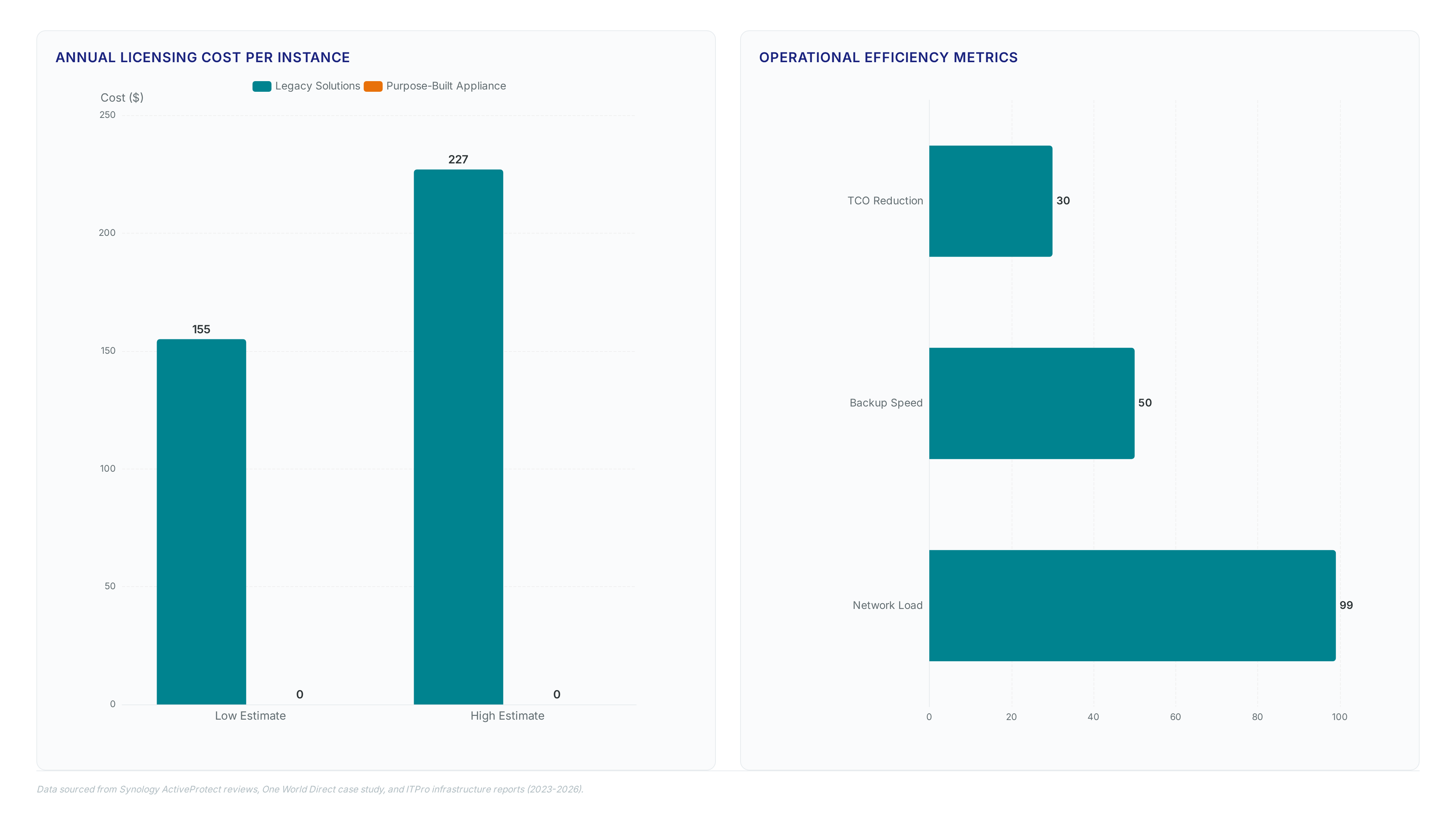
Synology ActiveProtect replaces recurring software fees with a single one-time hardware purchase to enable full platform capabilities. Legacy competitors like Veeam Backup & Replication charge between $155 and $227 per instance annually, creating compounding operational expenses as data volumes expand. This licensing structure forces operators to budget for perpetual software renewals alongside separate storage hardware costs. In contrast, the ActiveProtect model bundles global source-side deduplication and management tools into the initial appliance price, effectively reducing marginal costs for additional workloads to zero. Organizations with stable growth trajectories benefit most from the hardware-centric approach, avoiding the penalty of per-workload scaling. Environments requiring rapid, temporary expansion might find the rigid hardware cap less flexible than modular software licensing. Evaluate five-year horizon costs rather than initial sticker price to capture the true financial impact of this architectural shift.
Eliminating Egress and API Request Charges for Predictable Budgeting
Wasabi removes egress fees and API request charges, enabling predictable disaster recovery drills without financial penalties. Traditional cloud providers levy costs on data retrieval and management operations, creating budget variance during restore testing. The absence of these line items allows IT leaders to execute long-term retention strategies with fixed operational expenses. A 30-fold reduction in Total Cost of Ownership emerges when combining this storage model with appliance-based licensing. Competitors like Veeam charge per instance, forcing operators to track fluctuating software fees alongside variable cloud costs. Synology avoids this by bundling support for up to three servers per site under a single hardware purchase.
Legacy Stack : : : Data Retrieval No Cost Variable per GB API Operations No Cost.
Operators gain certainty but lose the ability to arbitrage storage prices across different hyperscalers dynamically. Financial planning shifts from estimating variable consumption to managing static capacity thresholds. This model suits organizations prioritizing recovery reliability over granular cost optimization across diverse cloud endpoints. This architecture fits entities requiring strict budget adherence during incident response scenarios. The constraint involves reduced flexibility for multi-cloud archival since economics favor deep integration over vendor agnosticism.
ActiveProtect's 30x TCO Reduction Against Legacy Backup Infrastructure
Direct financial modeling confirms a 30-fold reduction in Total Cost of Ownership. This fragmented approach creates hidden operational expenses that compound annually as data volumes expand. Synology ActiveProtect consolidates these functions into a single unit, eliminating the need for disparate management consoles and additional deduplication hardware.
The elimination of recurring software fees fundamentally alters capital expenditure planning for mid-sized enterprises. Operators avoid the perpetual renewal cycles typical of competitors like Veeam Backup & Replication, where costs scale linearly with every new protected workload. Integrating global source-side deduplication directly into the appliance reduces WAN consumption notably during initial cloud seeding phases. This architectural shift removes the friction often associated with hybrid cloud adoption. The 30x savings metric assumes a full migration away from legacy licensing models rather than a hybrid coexistence. Organizations retaining existing perpetual licenses may see diminished immediate returns until those contracts expire. True value emerges when calculating the total five-year outlook including maintenance fees and hardware refreshes. Evaluate the break-even point based on current instance counts before committing to hardware replacement.
About
Alex Kumar serves as a Senior Platform Engineer and Infrastructure Architect at Rabata. Io, where he specializes in Kubernetes storage architecture and disaster recovery strategies. His daily work designing resilient, cost-effective backup solutions for cloud-native applications makes him uniquely qualified to analyze the Synology ActiveProtect partnership with Wasabi. Having previously led DevOps initiatives for high-traffic SaaS platforms, Alex understands the critical pressure enterprises face regarding ransomware threats and compliance mandates. At Rabata. Io, an S3-compatible object storage provider focused on eliminating vendor lock-in, he constantly evaluates how hybrid architectures can optimize data protection without inflating costs. This article uses his deep technical experience in bridging on-premise appliances with scalable cloud tiers. By connecting Synology's hardware capabilities with modern object storage principles, Alex provides actionable insights for organizations seeking to simplify their enterprise recovery workflows while maintaining strict budgetary control and performance.
Conclusion
Scaling backup infrastructure often breaks when operational complexity outpaces staffing capabilities, turning routine maintenance into a bottleneck that jeopardizes recovery timelines. While initial hardware costs appear steep, the compounding expense of per-instance licensing creates a silent budget drain that erodes financial flexibility over time. Organizations clinging to fragmented legacy stacks face rising marginal costs with every new server added, whereas integrated appliances flatten this curve through predictable capital expenditure. You must migrate away from perpetual licensing models within the next 18 months to capture full economic value before contract renewals lock you into inefficient spending patterns. This shift is not merely about storage efficiency; it is about reclaiming engineering hours currently wasted on stitching together disparate management consoles. Do not wait for your next hardware refresh cycle to evaluate this transition. Audit your current annual software maintenance fees against the total five-year cost of an integrated appliance this week. Calculate the specific break-even month where the eliminated recurring charges offset the new hardware investment. This concrete data point will dictate whether your organization can afford to delay modernization or if immediate action is required to stop the financial bleed.
Frequently Asked Questions
It eliminates physical transport risks for the 71% of firms facing increased attack frequency. This approach ensures one immutable copy remains safe from ransomware encryption or malicious deletion attempts.
Ransomware risks persist after 93 million healthcare records faced exposure in 2023, driving the need for immutable vaults. These WORM vaults lock backups immediately upon arrival to ensure file security.
Microsoft 365 environments with 400 million active users demand specific cloud-to-cloud protection capabilities that standard agents often miss. Failure to configure these connectors leaves significant gaps in enterprise data protection.
The zero errors constraint forces continuous integrity checks rather than periodic audits to prevent issues. ActiveProtect Manager coordinates these checks so the immutable copy never permanently preserves a corrupted state.
IT teams can now orchestrate local and cloud backups through a single pane of glass. This native integration removes the need for managing disparate consoles while ensuring compliance without added overhead.