Swiss sovereign cloud beats hyperscaler lock-in
Ailanto launches a 1 petabyte sovereign cloud storage service to counter hyperscaler dominance in Switzerland. This alliance proves that geo-distributed architecture offers a viable, secure alternative to centralized foreign data centers for sensitive enterprise workloads.
With global data storage demand forecast to triple by 2027, traditional models face unsustainable risks and costs. The partnership between Ailanto and Cubbit deploys DS3 Composer software to fragment and distribute data across Swiss partner nodes, creating a federated storage swarm. This approach allows enterprises to establish digital sovereignty in roughly 15 minutes, bypassing the bloated procurement cycles typical of legacy cloud contracts. Unlike hyperscalers subject to extraterritorial legal overreach, this model ensures data remains physically and legally bound within Swiss borders.
Readers will examine how digital sovereignty reshapes modern Swiss infrastructure against geopolitical pressure. We dissect the mechanics of data pulverisation, where files are split and scattered to prevent unauthorized reconstruction. Finally, we compare the operational reality of Swiss sovereign cloud deployments against the locked-in ecosystems of substantial hyperscaler services, highlighting why local control now outweighs marginal convenience.
The Role of Digital Sovereignty in Modern Swiss Infrastructure
Defining Sovereign Cloud Storage Against the US Cloud Act
Foreign warrants issued under the US Cloud Act lose force when files stay physically inside Swiss borders. Strict data geofencing blocks extraterritorial legal access by design. Sovereign models fragment files into encrypted shards distributed across local nodes instead of relying on centralized hyperscaler regions. This data pulverisation ensures no single jurisdiction holds a complete reconstructible object. IT leaders now prioritize proven data control to prevent unauthorized exposure.
Strategic necessity drives adoption, with 86% of Swiss financial institutions implementing blockchain or sovereign strategies by 2027. Microsoft committed $400 million to local infrastructure, signaling that even global players must adapt to these digital sovereignty demands to remain viable.
Coordination overhead across fragmented infrastructure presents a real constraint for operators managing distributed consensus rather than a single provider SLA. Purely local deployment sacrifices the global latency advantages of an anycast network since traffic must terminate at the border. International users face increased hops. Network architects must redesign egress policies to favor local peering exchanges. Data never leaves the canton unless explicitly routed by the customer. This physical constraint provides the only verifiable guarantee against foreign subpoena enforcement.
Deploying Federated S3 Storage via Cubbit DS3 Composer
Ailanto integrates DS3 Composer into partner data centres to launch a sovereign cloud with 1 petabyte initial capacity. This federated model fragments data into encrypted shards distributed across a peer-to-peer mesh, ensuring no single node holds a complete object. The architecture enforces strict data geofencing by binding storage policies to specific Swiss cantons, preventing cross-border replication that could trigger extraterritorial legal exposure.
Operators can spin up these compliant environments in 15 minutes, bypassing the lengthy procurement cycles typical of hyperscaler contracts. The Ailanto AG deployment demonstrates how integrators retain full control over infrastructure while offering S3-compatible APIs to enterprise clients.
| Feature | Hyperscaler Standard | Federated Sovereign Model |
|---|---|---|
| Data Location | Global Region | Canton-Specific |
| Legal Jurisdiction | Provider HQ | Swiss Law Only |
| Architecture | Centralized | Peer-to-Peer Mesh |
Operational complexity arises from maintaining a distributed swarm that requires active monitoring of node health and latency between fragmented shards. The peer-to-peer architecture demands that integrators manage gateway durability locally rather than relying on provider SLAs. Similar migrations, such as the Herabit infrastructure upgrade, show that creating data lakes for AI systems via this method shifts the burden of redundancy from the vendor to the operator. Verify that local network bandwidth supports the reassembly overhead before committing production workloads to this topology.
Cubbit DS3 Composer Cost Efficiency Versus AWS S3 and Google Cloud
Customers report an 80% cost reduction achieved compared to hyperscalers when using Cubbit's model. The estimated price for sovereign storage sits between €0.01 and €0.02 per GB, undercutting the $0.09/GB standard rate charged by substantial US providers. Traditional architectures incur hidden expenses through inter-region transfer fees, often adding $0.02/GB to the final bill for distributed workloads.
A direct comparison of unit economics reveals the structural advantage of peer-to-peer distribution over centralized data centers. Cubbit's model avoids 40,000 kg of CO2 emissions per PB stored annually by using existing idle hardware rather than constructing energy-intensive facilities. Best practices for data sovereignty now include carbon accounting as a secondary compliance metric alongside legal geofencing.
Reliance on partner node availability creates a drawback requiring strict SLA enforcement to match hyperscaler uptime guarantees. Operators must weigh the cost efficiency gains against the operational overhead of managing a distributed vendor system. Audit total cost of ownership including egress before migrating archival tiers. The financial impact extends beyond storage bills to reduced capital expenditure on dedicated hardware.
Inside Data Pulverisation and Geo-Distributed Architecture
Data Pulverisation Mechanics: Fragmentation and Encryption Logic
DS3 Composer fragments files into encrypted shards before distribution, ensuring no single node stores a complete object. This process begins by splitting incoming data streams into small, fixed-size pieces. Each piece undergoes independent encryption before being scattered across the peer-to-peer "swarm" architecture. The system replicates these fragments across multiple geographic locations, creating redundancy without centralizing risk. Operators configure replication factors to balance durability against storage overhead, typically maintaining enough shards to reconstruct data even if several nodes fail simultaneously.
| Process Step | Technical Action | Security Outcome |
|---|---|---|
| Ingestion | File splitting | Reduces attack surface per node |
| Encryption | Per-shard cipher application | Prevents clear-text exposure |
| Distribution | Geo-dispersed placement | Nullifies single-point compromise |
The inherent ransomware protection stems from this mathematical impossibility of reconstructing files from isolated breaches. A compromised server yields only useless, encrypted fragments rather than readable data. However, this model shifts the failure domain from disk corruption to network partition tolerance. If the swarm loses connectivity between too many nodes, reconstruction latency increases despite data remaining intact. Engineers must tune quorum settings to prevent write locks during regional outages. This trade-off demands precise monitoring of shard availability rather than simple volume health checks. Traditional backup strategies focusing on full-image copies become obsolete in this model. Recovery operations now require orchestrating shard reassembly across distributed endpoints instead of restoring monolithic archives.
Deploying DS3 Composer on Bare Metal and Kubernetes Clusters
Operators resolve federated latency by installing the DS3 Gateway on a Kubernetes cluster running atop bare metal or existing hardware. This deployment model eliminates hyperscaler hop-counts by placing compute adjacent to storage agents within the enterprise perimeter. The architecture supports two distinct operational modes: a fully managed service hosted in partner facilities or a self-hosted instance on user-controlled infrastructure. Strategic partners like HPE provide the physical server layer, while the software abstraction handles the peer-to-peer "swarm" architecture automatically.
| Deployment Mode | Infrastructure Requirement | Latency Profile |
|---|---|---|
| Managed Service | Partner Data Center | Regional |
| On-Premises | Bare Metal / VM | Local/Sub-millisecond |
Herabit successfully executed this hybrid approach across three data centers in northern Italy, demonstrating cross-border viability. The limitation of on-premises deployment remains the operator's burden to maintain node availability and network uptime without a central SLA guarantor. Unlike centralized regions, the swarm requires consistent connectivity between shards to reconstruct objects efficiently. Enterprises gain data sovereignty and durability by keeping fragments within specific cantonal boundaries, yet they sacrifice the infinite elasticity of public cloud pools. Start with a managed tier before migrating sensitive workloads to local bare metal clusters once internal networking teams master shard reconciliation logic.
Validating S3 API Compatibility and Geofencing Constraints
Operators verify 100% S3 compatibility to prevent application refactoring during migration. The system exposes a standard API that accepts existing PUT and GET requests without code changes. This eliminates the common integration bottleneck where legacy tools fail against proprietary object storage interfaces.
However, strict geofencing introduces a configuration dependency often overlooked in initial testing. Administrators must explicitly bind storage policies to specific Swiss cantons to satisfy sectoral regulations. Failure to define these geographic constraints results in default distribution patterns that may violate local data residency laws. The validation process requires confirming that data shards never cross set cantonal boundaries while maintaining full accessibility.
| Validation Step | Requirement | Outcome |
|---|---|---|
| API Handshake | Standard S3 Signature | Pass/Fail |
| Geofence Policy | Canton-Level Binding | Active/Inactive |
| Data Locality | No Cross-Border Shards | Compliant/Non-Compliant |
| Reconstruction | Full Object Assembly | Success/Error |
Test reconstruction logic under simulated node failure within the restricted zone. This confirms that redundancy mechanisms function correctly even when the available node pool is artificially limited by geography. Operators gain sovereignty but sacrifice the global availability zones typical of hyperscaler architectures.
Swiss Sovereign Cloud Versus Hyperscaler Services
Swiss Sovereign Cloud Versus Hyperscaler Jurisdictional Control
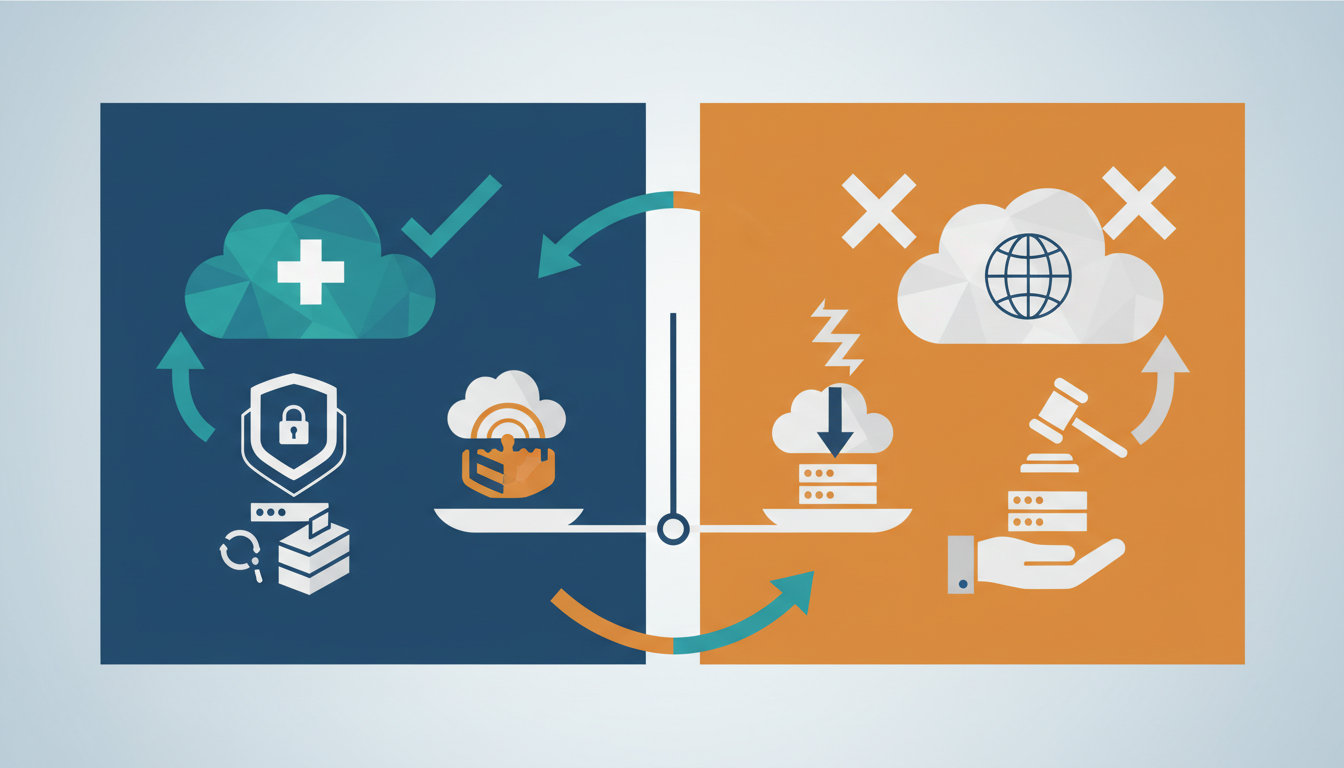
The US Cloud Act grants foreign authorities legal access to data held by US-based hyperscalers regardless of physical storage location. Sovereign cloud models reject this extraterritorial reach by keeping legal jurisdiction and physical infrastructure within Swiss borders. data residency alone does not prevent a foreign subpoena if the service provider falls under foreign law.
Ailanto addresses this gap by deploying DS3 Composer to create a federated model where no single entity holds complete data files. The system fragments objects into encrypted shards distributed across partner data centers, ensuring that even a compromised node yields nothing useful to an attacker. This architecture supports cantonal-level data sovereignty Such granularity satisfies sectoral rules that broad national compliance often misses.
| Control Dimension | Hyperscaler Standard | Swiss Sovereign Model |
|---|---|---|
| Legal Jurisdiction | US/EU Mixed | Swiss Exclusive |
| Data Access Risk | High (Cloud Act) | Negligible |
| Shard Location | Global Regions | Cantonal Geofence |
| Operator Visibility | Limited Logs | Full Audit Trail |
Market valuations for local providers reflect this shift, with firms trading at 5.0 to 7.0 times EBITDA due to rising demand for controlled infrastructure. However, operators must accept that sovereign models trade global edge presence for strict local compliance. The cost of this control is the loss of one-click global replication found in hyperscaler consoles. Prioritize jurisdictional control over convenience.
Real-World Cost Savings: Ailanto's 1 Petabyte Sovereign Deployment
Ailanto launched its sovereign cloud with an initial 1 petabyte capacity. This deployment uses data pulverisation to fragment objects across partner facilities, eliminating single points of failure while satisfying strict geofencing rules for individual Swiss regions. Operators choosing on-premises DS3 Composer avoid egress fees entirely, whereas hyperscaler models often lock clients into unpredictable pricing tiers. The architectural shift enables significant operational expenditure reduction compared to traditional public cloud contracts.
Enterprises must weigh the administrative overhead of managing a federated model. While hyperscalers offer global reach, their centralized storage pools conflict with the US Cloud Act constraints facing Swiss financial entities. Ailanto's approach sacrifices global edge presence for absolute local legal control. This trade-off proves necessary for sectors where data exposure carries existential legal liability.
Use this architecture for organizations prioritizing regulatory adherence over global distribution latency. The solution supports bare metal or Kubernetes deployments, allowing firms to repurpose existing hardware assets. Early adopters report that the S3 compatibility layer prevents application refactoring during migration.
Deploying S3-Compatible Sovereign Storage in Five Steps
DS3 Composer Deployment Models: Managed Swiss Hosting vs On-Premises Kubernetes

Operators select between fully managed hosting in partner facilities or self-managed Kubernetes clusters on existing hardware. The managed model offloads infrastructure maintenance while the on-premises variant retains absolute physical control over storage nodes.
- Define the target geofencing scope for specific Swiss cantons.
- Select the deployment mode based on internal DevOps maturity.
- Deploy the DS3 Gateway using the provided container images.
- Configure data pulverisation policies to fragment objects across locations.
| Feature | Managed Swiss Hosting | On-Premises Kubernetes |
|---|---|---|
| Infrastructure Owner | Ailanto Partners | Customer |
| Maintenance Burden | Vendor | Internal Team |
| Deployment Speed | Immediate | Variable |
| Capital Expenditure | Operational Only | Hardware Required |
Managed services accelerate time-to-value but introduce dependency on partner SLAs for uptime guarantees. Conversely, on-premises installations demand specialized Kubernetes expertise yet eliminate third-party access vectors entirely. Regulated banks often prefer on-premises control while smaller entities opt for managed efficiency. Align the choice with specific data sovereignty risk tolerances rather than cost alone.
Implementing Geofenced Zones for Swiss Cantonal Compliance and Sectoral Rules
Ailanto configures DS3 Composer to restrict data placement within specific Swiss cantons, satisfying sectoral rules that global regions cannot address. System integrators define geofencing policies by mapping storage nodes to physical sites approved for sensitive workloads. Unlike hyperscalers offering only broad region-level control, this architecture enforces custom redundancy rules at the municipal or cantonal level. The configuration process isolates shards so no single fragment leaves the assigned legal jurisdiction.
- Identify the target canton and select partner data centers within those borders.
- Apply data localization tags to the bucket policy to lock egress points.
- Verify that the DS3 Gateway rejects any write request violating the geographic constraint.
This granularity prevents extraterritorial access requests from succeeding, as the full object never exists in a single searchable location. The trade-off involves reduced pool elasticity; restricting shards to one canton limits the available hardware compared to a global federation. Operators must balance strict data sovereignty against the need for massive scale during peak ingestion windows. Audit cantonal statutes before finalizing the node map, as some sectors mandate zero cross-canton replication.
Operational Readiness Checklist: Using Cubbit Support for SLA and Go-to-Market
Partners activate joint go-to-market initiatives by completing a four-step validation sequence to secure high.
- Execute technical training modules to master DS3 Composer deployment on Kubernetes clusters.
- Align sales narratives with Swiss Data Sovereignty Demand trends to target regulated sectors effectively.
- Configure the gateway to use data fragmentation for cost reduction as distribution scales.
- Launch services while monitoring mindshare growth against declining hyperscaler dominance.
Operators must balance rapid deployment strict cantonal compliance, as rushing geofencing rules risks invalidating sovereignty claims. The limitation here is that sales support effectiveness depends entirely on accurate node mapping before customer onboarding begins. Delay public announcements until the technical support pipeline validates local redundancy counts. This approach prevents SLA breaches during the initial capacity ramp-up phase.
About
Alex Kumar, Senior Platform Engineer and Infrastructure Architect at Rabata. Io, brings deep technical expertise to the evolving environment of sovereign cloud storage. With a specialized background in Kubernetes storage architecture and disaster recovery, Alex understands the critical infrastructure requirements for enterprises demanding data sovereignty and strict regulatory compliance. His daily work involves designing resilient, cost-optimized storage solutions that eliminate vendor lock-in, directly aligning with the industry shift toward secure, localized data hosting. At Rabata. Io, a provider of high-performance S3-compatible object storage with GDPR-compliant EU data centers, Alex uses his experience to ensure scalable infrastructure meets the rigorous needs of modern enterprises. This practical engagement with distributed storage systems positions him uniquely to analyze partnerships like Ailanto and Cubbit, where technical integration and data sovereignty are paramount for Swiss businesses seeking secure, competitive cloud alternatives.
Conclusion
Scaling sovereign storage reveals a critical fracture point: geographic rigidity creates capacity bottlenecks during sudden data ingestion spikes that global pools easily absorb. While local compliance satisfies auditors, it introduces latent operational friction when demand triples by 2027, forcing architects to choose between strict cantonal boundaries and necessary elasticity. The true cost driver shifts from per-gigabyte rates to the complexity of managing fragmented capacity across isolated legal jurisdictions. Organizations must treat data residency not as a static checkbox but as a flexible constraint requiring active federation strategies to prevent performance degradation.
Adopt a hybrid-federation model by Q4 2027 for any workload exceeding massive scale, ensuring you maintain sovereignty without sacrificing the elasticity needed for peak loads. Do not commit to single-region locks unless your regulatory framework explicitly forbids cross-canton replication; otherwise, use partner networks to distribute risk while staying within national borders. This approach secures the 80% cost advantage while mitigating the single-point-of-failure risks inherent in overly restrictive geofencing.
Start by auditing your current node map against projected 2026 ingestion volumes this week to identify where local capacity will fail under load. Map these gaps to specific cantonal statutes immediately, rather than waiting for a compliance crisis to force a reactive and expensive architectural overhaul.
Frequently Asked Questions
Operators spin up compliant environments in fifteen minutes. This speed bypasses lengthy procurement cycles while eighty-six percent of financial institutions implement such sovereign strategies by 2026 to ensure immediate data control.
Microsoft committed four hundred million dollars to local infrastructure. This significant funding signals that global players must adapt to digital sovereignty demands to remain viable against new federated storage models.
Files split into encrypted shards prevent unauthorized reconstruction. No single jurisdiction holds a complete object, ensuring foreign warrants lose force against this architecture designed for strict data geofencing within borders.
Integrators manage gateway durability locally rather than relying on provider SLAs. Operators must actively monitor node health and latency between fragmented shards to maintain the distributed swarm effectively.
Customers choose between fully-managed cloud object storage or on-premises deployment. Ailanto delivers flexible service tiers from a single interface, adapting specifically to sectoral requirements of individual Swiss cantons.