Storage sharding: Cut cloud bills by 70% fast
Cloud spending is forecast to grow a significant share year-over-year per the Flexera 2025 State of the Cloud report. Efficient storage is now a financial imperative, not an option. Sustainable data architecture for large datasets demands ruthless optimization of distributed storage lifecycles, indexing mechanisms, and strategic placement between on-premise and cloud environments.
Throwing hardware at capacity issues fails when S3 storage underpins nearly every modern pipeline yet drives runaway costs if left unmanaged. Scale does not equal stability. Without precise lifecycle management and aggressive compression mechanisms, enterprises bleed capital on cold data while struggling to serve real-time analytics. The market shift toward hybrid multi-cloud strategies confirms that blind migration to public clouds is a failed strategy for many high-volume workloads.
You need to know how distributed storage topologies mitigate single-point failures, why specific partitioning strategies outperform brute-force scaling, and how to calculate the true cost of data retrieval across different tiers. We examine the concrete trade-offs between on-premise control and cloud elasticity, providing a framework to select the right indexing mechanisms for your specific access patterns. Stop guessing at capacity. Engineer for efficiency before your infrastructure bill eclipses your revenue.
The Role of Distributed Storage and Lifecycle Management in Modern Data Architecture
Distributed Storage Systems and CXL Resource Pooling
Distributed storage architectures span hardware clusters to enable parallel processing and fault tolerance for massive datasets. A cluster manager node coordinates worker nodes, allowing systems to scale horizontally while maintaining data durability through replication. This model contrasts with single-server limitations, where growth creates immediate bottlenecks in throughput and capacity. High-performance environments rely on low-latency protocols like Slingshot and InfiniBand to sustain TB-level bandwidth across fabric links. CXL technology extends this capability by promoting storage resource pooling, specifically addressing concurrency challenges posed by massive small file workloads.
Validate index strategies before scaling node counts to avoid metadata saturation. AWS S3 lifecycle policies automate data transitions to S3 Glacier Deep Archive based on object age, directly targeting infrequently accessed datasets for cost optimization. The pricing disparity drives this strategy: Glacier Deep Archive costs $0.00099/GB compared to the $0.023/GB rate for S3 Standard, creating a 23x differential. Organizations implementing these tiering rules typically reduce storage bills by a substantial margin within 30 days.
Mechanical execution involves defining rules that shift objects after a set period, yet the financial outcome depends heavily on object granularity. Validate object granularity before enabling automated transitions to avoid fee spikes. Aggressive tiering without size filters often results in negative net savings for the first fiscal quarter. Calculate the specific crossover point where transition costs no longer outweigh monthly retention fees. This threshold varies by workload, making generic policies ineffective for mixed-size datasets.
How Partitioning, Compression, and Indexing Mechanisms Drive Storage Efficiency
Huffman Coding and Columnar Formats in Data Compression
Huffman coding assigns shorter binary codes to frequent characters, eliminating redundancy without data loss. This lossless mechanism reduces payload size before transmission or disk write operations. Engineers pair this algorithm with columnar formats like ORC or Parquet to optimize analytical workloads. Unlike row-based storage, these systems organize data by columns, enabling efficient read patterns for aggregation queries. Popular compression algorithms such as GZIP and Snappy further shrink the footprint of these encoded streams.
Social media platforms using columnar formats like Parquet document read speeds 3-4 times quicker than traditional row stores during feature extraction. This efficiency stems from skipping irrelevant columns entirely during scan operations, reducing I/O pressure on the storage subsystem. The structural shift from rows to columns yields measurable performance gains in specific scenarios.
Decoding variable-length codes introduces CPU overhead during ingestion. High-velocity ingest pipelines may stall if decompression cannot keep pace with network arrival rates. Maximum compression ratios often conflict with low-latency write requirements. Operators must balance storage savings against processing capacity when selecting Format Optimization strategies. Test Snappy for speed-critical paths where GZIP proves too heavy.
B-Tree and Hash Indexes for Time-Series Data Retrieval
Specialized structures like B-trees and hash tables target O(1) or O(log n) complexity to fix slow query performance in time-series workloads. Operators deploy circular buffers to manage high-velocity writes without locking entire datasets, ensuring consistent ingestion rates. Hash indexes provide constant-time lookups for exact timestamp matches, while B-trees handle range queries efficiently by maintaining sorted order on disk.
A common error in data retrieval from large datasets occurs when operators apply hash indexing to range-heavy workloads, forcing full table scans. Indexing strategies must align with access patterns, as mismatched structures degrade throughput under load. Hash tables cannot support ordered traversal, making them unsuitable for historical trend analysis without secondary sorting mechanisms.
Columnar storage systems often pair with these indexes to accelerate aggregation, yet the write amplification from maintaining multiple index types can offset read gains. Engineers must balance the memory overhead of in-memory hash maps against the disk I/O savings they provide during peak retrieval windows. Audit query logs to identify dominant access patterns before committing to a specific indexing topology.
The Risks of Premature Sharding Before Index Optimization
Sharding large datasets before exhausting indexing options is a mistake. Operators often mistake distributed sharding architecture for a primary solution to storage scalability, yet this approach fragments data management prematurely. Experts explicitly advise avoiding this distribution until standard caching and indexing mechanisms are fully optimized. Implementing shards too early forces the system to manage cross-shard joins and consistent hashing overhead before the dataset actually warrants horizontal scaling. This misstep complicates the transition between relational vs NoSQL databases, as rigid sharding keys in SQL environments become difficult to refactor later.
MongoDB offers more flexible native support for hierarchical relationships compared to rigid alternatives, allowing teams to delay sharding longer. A company using tiered storage and automated archival reduced active usage by 45% and cut cloud spend by nearly $12,000 monthly without affecting retraining times. This financial efficiency demonstrates that optimizing data locality often outperforms raw distribution. Rebalancing requires significant downtime or complex migration tooling once shards are deployed. Validate query patterns against single-node limits before committing to a multi-node topology.
Strategic Trade-offs Between On-Premise and Cloud Storage Solutions
On-Premise Cassandra vs AWS S3 Storage Architectures

Apache Cassandra excels in write throughput for real-time analytics, whereas Amazon S3 targets cheap, scalable storage for unstructured blobs. The architectural divergence dictates distinct operational models: Cassandra functions as a wide-column NoSQL database requiring active node management, while S3 operates as a passive object store ideal for data lakes. This split creates a tension between latency guarantees and unit economics that operators cannot ignore.
The hidden risk lies in mismatched access patterns: forcing high-frequency reads against an object store designed for durability rather than speed introduces unacceptable latency spikes. Operators must align the data model differences with query requirements, as sharding a document store prematurely adds complexity without solving underlying index inefficiencies. Isolate hot transactional paths on Cassandra while offloading cold historical logs to S3 to balance performance budgets against storage receipts.
This specific configuration drives the total invoice to a substantial sum, exposing how snapshot frequency directly corrupts unit economics. Operators often assume incremental logic eliminates cost spikes, yet the accumulation of changed blocks on high-churn tables creates a hidden liability. The financial penalty stems from retaining too many recovery points without assessing actual recovery time objectives. Reducing snapshot cadence lowers expenses but increases exposure during node failures. Engineers must balance the $3,753.84 surcharge against the acceptable window of data loss. Blindly enabling default backup policies ignores the specific write patterns of wide-column stores. Align backup intervals with the actual velocity of data mutation rather than arbitrary schedules.
Hidden AWS S3 Access Grants and Data Retrieval Fee Traps
Per-request charges for AWS S3 Access Grants accumulate rapidly at a nominal fee per 1,000 requests, eroding margins on high-frequency microservices. Operators often overlook this line item when calculating total cost of ownership against on-premise hardware. Data egress further compounds the issue, as retrieving archived assets incurs fees up to a nominal amount per GB returned. A shift to cheaper tiers like S3 Infrequent Access requires careful volume analysis, needing roughly 218GB of data to break even on the transition costs. Blindly moving objects without modeling access patterns triggers unexpected bills that negate theoretical savings. Architects must implement strict lifecycle policies to prevent small, frequent reads from draining budgets intended for cold storage savings. Failure to model these access grant scenarios results in financial leakage that static on-premise comparisons rarely predict.
Executing a Scalable Storage Strategy Through Partitioning and Policy Implementation
Data Partitioning and Sharding Architecture Fundamentals
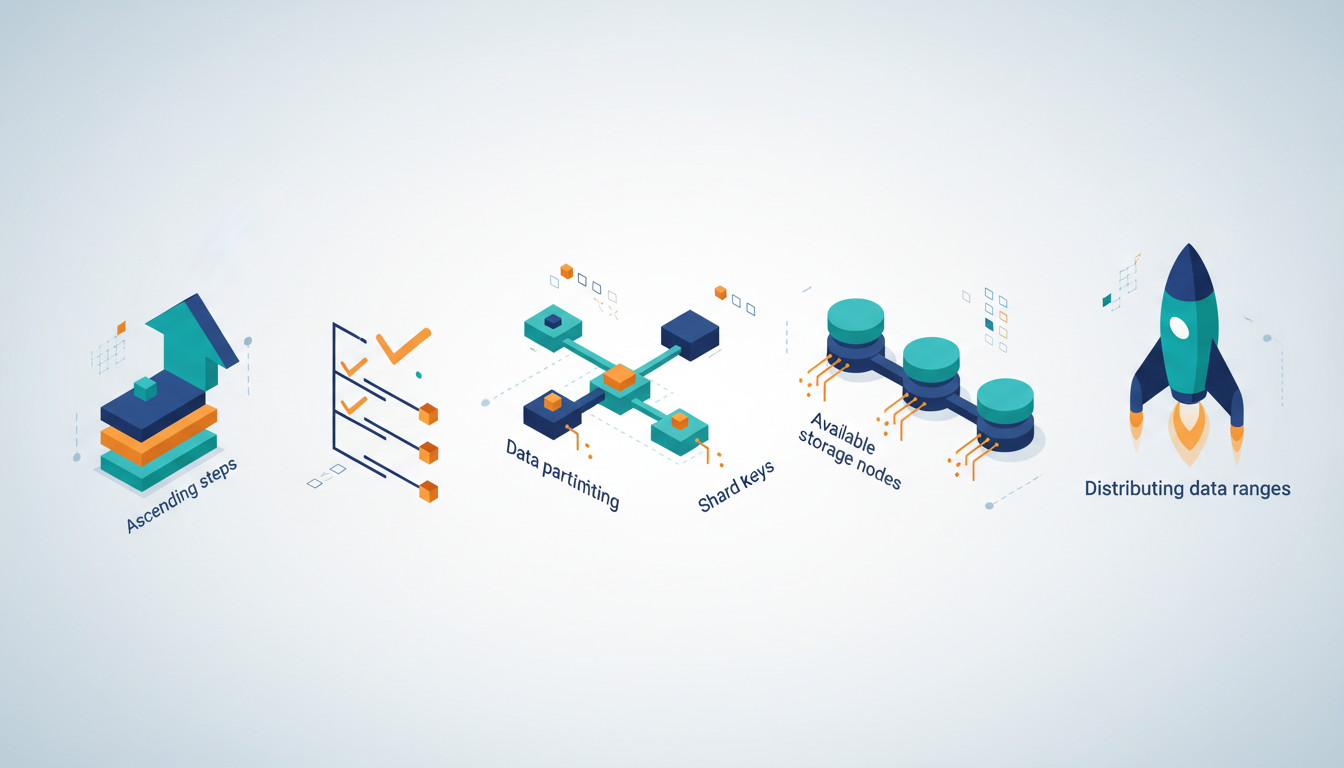
Sharding divides large datasets into smaller segments distributed across multiple servers to enable horizontal scaling. This sharding architecture pattern prevents single-node bottlenecks but introduces cross-shard join complexity that operators often underestimate. The Hadoop Distributed File System (HDFS) uses a master-slave architecture where a NameNode manages metadata while DataNodes store actual blocks. Such separation ensures fault tolerance yet creates a single point of failure if the NameNode lacks high-availability configuration. Alternative designs like the peer-to-peer edge architecture used by Resilio eliminate central transfer servers entirely, allowing direct node-to-node exchange. This approach reduces network bottlenecks but sacrifices the strict consistency guarantees found in master-coordinated systems. Implementation requires careful sequencing to avoid premature fragmentation costs. Premature sharding forces the system to manage distributed transaction overhead before data volume justifies the operational tax. Validate single-node performance limits first.
Implementing GZIP, Snappy, and LZ4 Compression Algorithms
Selecting GZIP, Snappy, or LZ4 requires balancing CPU overhead against storage reduction targets for specific analytic workloads.
- Evaluate the data type to match the algorithm; Huffman coding.
- Configure the analytics engine to ingest columnar formats like Parquet, which provide substantially quicker read performance than row-based JSON for feature extraction.
- Apply the compression codec during the write path to minimize the storage footprint before data lands on disk.
- Monitor cluster compute headroom to prevent ingestion bottlenecks from aggressive decompression cycles.
Snowflake natively supports these compressed file formats to accelerate query performance by decreasing the volume of scanned data.
Checklist for Data Lifecycle Management and Archive Migration
Validate access patterns before migrating terabytes to S3 Glacier Deep Archive to avoid premature cold storage penalties. Operators often ignore the latency tax of deep archive retrieval, assuming cost savings justify any delay. This assumption fails during incident response when minutes matter more than dollars. Mission and Vision recommends testing restore times quarterly to validate service level agreements against actual provider performance. Blindly applying rules without monitoring access patterns creates a false economy where storage bills drop but operational agility collapses. Teams should define clear retention policies based on legal requirements rather than arbitrary dates. Regular audits of storage tiers prevent data from stagnating in expensive hot storage layers unnecessarily.
About
Marcus Chen serves as a Cloud Solutions Architect and Developer Advocate at Rabata. Io, where he specializes in S3-compatible object storage and AI/ML data infrastructure. His daily work involves designing scalable architectures for enterprises handling massive data volumes, making him uniquely qualified to address efficient storage strategies for large datasets. Having previously engineered solutions at Wasabi Technologies and Kubernetes-native startups, Chen possesses deep practical experience in optimizing cloud storage performance and eliminating vendor lock-in. At Rabata. Io, a provider focused on high-speed, cost-effective storage for AI and analytics, he directly helps clients navigate the challenges of data scalability and retrieval speed. This article reflects his hands-on expertise in building reliable systems that balance infrastructure costs with the demanding requirements of modern applications, ensuring developers can implement reliable storage without compromising on access latency or operational efficiency.
Conclusion
Scaling data volume exposes a critical fracture point where operational latency outweighs per-gigabyte savings. While cold storage tiers offer dramatic rate reductions, the cumulative cost of frequent restore operations and request fees for millions of small objects can silently erase projected budgets within a single quarter. The industry shift toward AI-driven analytics and hybrid multi-cloud architectures in 2026 demands that storage strategies prioritize data fluidity over static hoarding. Blindly enforcing rigid 30-day transition rules creates a false economy, trapping active datasets in layers that incur prohibitive retrieval penalties during incident response or model training cycles.
Organizations must adopt a flexible tiering policy grounded in actual access telemetry rather than arbitrary calendar dates by Q2 2026. This approach ensures that cost governance evolves alongside cyber durability requirements, preventing the stagnation of valuable assets in expensive hot tiers while avoiding the "latency tax" of premature archiving. Do not wait for the next billing shock to recalibrate your lifecycle rules. Start by auditing your top ten most accessed prefixes this week to identify any objects currently sitting in deep archive that have been retrieved in the last 14 days, then immediately adjust their transition thresholds to prevent recurring restore fees.
Frequently Asked Questions
Transitioning fragmented datasets incurs significant one-time costs before savings begin. Specifically, moving 100 million small objects costs $5,000 in fees alone before any monthly storage savings actually accrue for the organization.
Frequent retrieval of archived data quickly erodes projected storage savings through high restore charges. Analysts triggering weekly access on archived data face restore fees exceeding $500 monthly, which destroys the financial benefits of tiering.
Glacier Deep Archive offers the lowest cost option for long-term archival storage needs. It costs $0.00099/GB compared to the $0.023/GB rate for S3 Standard, creating a massive twenty-three times price differential for users.
Properly implemented rules typically reduce storage bills by 30-50% within thirty days effectively. However, blindly applying transition rules often leads to budget overruns due to unexpected transition fees on small objects.
These architectures enable parallel processing and fault tolerance across hardware clusters efficiently. They allow systems to scale horizontally while maintaining data durability through replication, avoiding single-server bottlenecks in throughput.