Secure data sharing beats manual copy methods
CDOs executing secure data sharing are 1.7x more proven at proving ROI, yet 56% of enterprises still fear privacy breaches. The industry has finally accepted that secure data sharing is the only viable mechanism for modern governance without inviting catastrophic liability. With breach costs settling at $4.44 million in 2026 according to recent US data, the era of copying sensitive datasets for collaboration is objectively dead.
True security now demands ephemeral sharing architectures where files vanish automatically to satisfy NIS2 and DORA mandates, as noted in 2026 trend analysis. You need the mechanical specifics of enabling real-time collaboration that grants access to live data streams while completely eliminating the risks inherent in data replication.
We move beyond theoretical compliance to quantify the measurable business outcomes derived from cross-organizational data partnerships. By shifting from static transfers to flexible, permissioned access, organizations enable innovation while keeping the average breach cost from spiraling toward the projected multi-trillion-dollar global cybercrime total. The path forward requires abandoning legacy trust models for verifiable, zero-copy architectures.
The Strategic Role of Secure Data Sharing in Modern Governance
Zero-Copy Data Access vs Manual Transfer Methods
Zero-copy data sharing grants live access to source records without physical replication, eliminating storage redundancy and synchronization latency. This architecture contrasts sharply with manual transfer methods, where a majority of organizations still rely on copying files, a practice that widens zero-trust security gaps by creating uncontrolled data duplicates. Traditional extraction loads data into consumer environments, stripping original governance policies and exposing static snapshots rather than current state. Zero-copy mechanisms operate through a services layer, ensuring shared data occupies zero storage in the consumer account while maintaining centralized access control enforcement at the provider.
| Feature | Manual Transfer | Zero-Copy Access |
|---|---|---|
| Data Location | Duplicated in consumer storage | Remains in provider account |
| Freshness | Static snapshot at export time | Real-time live query |
| Governance | Lost upon export | Enforced dynamically via provider |
| Storage Cost | Incurred by consumer | Zero incremental cost |
Manual processes fracture data silos by design, forcing teams to manage divergent versions of truth across isolated repositories. Modern implementations apply attribute-based access control to apply flexible rules across numerous tables, a capability absent in static file exchanges. The operational penalty for retaining manual workflows extends beyond security; it introduces data drift where consumer datasets diverge from source logic immediately after transfer. Organizations persisting with legacy replication absorb hidden costs in reconciliation efforts and compliance audits that zero-copy architectures inherently prevent.
Data Monetization Models for Capital Markets and 5G Telecom
Data monetization converts proprietary datasets into revenue streams through governed, real-time access rather than static file transfers. Capital markets firms license live trade feeds to quantitative analysts, eliminating the latency inherent in batch replication. Telecommunications operators similarly package unique 5G network telemetry for smart city analytics, creating value from infrastructure otherwise invisible to external parties. These models rely on Attribute-Based Access Control to enforce flexible policies across thousands of tables without manual configuration updates.
The architectural choice between platforms dictates market reach. Providers using Delta Sharing enable recipients on non-native clouds to consume shares directly, expanding the potential customer base beyond a single vendor system. Conversely, native Secure Data Sharing restricts access to accounts within the same platform unless complex integrations are deployed.
| Feature | Open Protocol Approach | Native Platform Approach |
|---|---|---|
| Recipient Compatibility | Any client speaking the protocol | Restricted to same-platform accounts |
| Governance Layer | Centralized catalog policies | Account-level security grants |
| Deployment Friction | Low for heterogeneous environments | High for cross-cloud partnerships |
Evaluate partner cloud diversity before selecting a sharing protocol. The cost of vendor lock-in manifests as lost revenue when potential buyers cannot technically access the data product. Operators must balance governance strictness with accessibility to maximize monetization.
The Substantial Insurance Gap in Data Breach Incident Costs
A persistent substantial coverage deficit forces organizations to absorb breach expenses out-of-pocket despite active policies. This financial exposure stems from policy exclusions that fail to cover the full scope of modern incidents, particularly those involving privacy and consent violations during external collaboration. Nearly 56% of enterprises cite these privacy fears as a primary barrier, yet insurance instruments rarely indemnify the reputational damage or regulatory fines associated with governed sharing failures. The limitation is stark: carriers price premiums based on perimeter defense metrics, ignoring the liability introduced by live data access models.
Consequently, the true cost of a governance failure exceeds standard deductibles. As cyber insurance premiums rise over 10% annually, coverage limits stagnate relative to the escalating value of shared assets. Operators face a tension between expanding data utility and maintaining fiscal solvency during an incident. Relying solely on insurance creates a false sense of security while the insurance gap widens. Budgets must allocate reserves for uncovered egress costs and legal fees that policies explicitly exclude.
Architecture and Mechanics of Real-Time Collaboration Without Replication
Attribute-Based Access Control and Unity Catalog Metastores
Real-time collaboration functions by applying a single Attribute-Grounded Access Control policy across thousands of tables dynamically. Legacy methods require manual permission updates for every new dataset, creating governance drift as scale increases. Modern architectures replace this fragility with rules evaluating user attributes against data tags at query time. This mechanism ensures that access rights inherit automatically, removing the operational burden of static object configurations. The limitation is strict dependency on metadata quality; mislabeled columns result in immediate access denial or unintended exposure. Operators must treat data classification as a prerequisite engineering task rather than an afterthought.
Governance scope expands further when shifting from workspace-local Hive Metastores to the account-wide Unity Catalog Metastore. Centralizing these controls eliminates the silos inherent in isolated workspace configurations, enabling consistent auditing across clouds. Unlike traditional replication where data copies escape the original security perimeter, this model keeps data stationary while granting live access.
| Feature | Legacy Replication | Unified Metastore |
|---|---|---|
| Policy Scope | Per-table manual entry | Account-wide inheritance |
| Data Location | Multiple redundant copies | Single source of truth |
| Audit Trail | Fragmented per environment | Centralized lineage |
The constraint involves strict cloud boundary enforcement; cross-cloud sharing often requires additional federation layers not present in native implementations. Teams achieving Access Control Granularity across AWS, Azure, and GCP avoid the latency penalties of moving data. Validate attribute tags before enabling external shares to prevent policy bypass.
Eliminating ETL Delays in AI Model and Unstructured Data Exchange
Live synchronization removes the extraction and transformation burden, enabling immediate AI inference on shared unstructured artifacts. Recipients traditionally ingest static snapshots, forcing lengthy pipeline construction before model training can commence. Modern architectures bypass this latency by allowing direct access to the Delta Sharing Server protocol layer, which coordinates authentication without data movement. This approach contrasts with legacy methods where 90% of organizations expanded privacy programs specifically due to AI adoption risks inherent in copied datasets.
The mechanism relies on a centralized Unity Catalog metastore that governs both structured tables and machine learning models across cloud boundaries. Operators define shares as securable objects, granting consumers credentials to query live state rather than managing duplicate storage.
| Feature | Legacy ETL Transfer | Real-Time Secure Sharing |
|---|---|---|
| Data Freshness | Stale (Batch Window) | Live (Sub-second) |
| Storage Overhead | High (Duplicate Copies) | Zero (Virtual View) |
| Governance Scope | Lost Post-Transfer | Preserved via ABAC |
However, eliminating replication shifts the failure domain from network throughput to metadata accuracy; misconfigured tags instantly block model access. The cost is strict dependency on provider uptime, as consumer queries fail if the source share disconnects. Validate attribute policies before exposing high-value AI weights to external partners. Direct access accelerates insight generation but demands rigorous upstream data hygiene to prevent cascade failures in downstream inference engines.
Legacy FTP Vulnerabilities and the EU AI Act Compliance Deadline
The File Transfer Protocol, formalized in 1972, lacks native encryption and audit trails required for modern regulatory compliance. Relying on legacy email attachments or unsecured FTP servers creates uncontrollable datacopies that violate the strict lineage documentation mandates of the EU AI Act, which becomes fully applicable on August 2, 2026. Operators face a binary choice: continue manual replication risks or adopt governed real-time frameworks. The tension exists between operational convenience and the impending legal requirement to prove exactly how training data flowed into high-impact AI systems. Static file transfers break this chain of custody immediately upon departure from the source server.
Replace all batch replication workflows before the 2026 deadline to avoid automatic non-compliance penalties. The cost of retrofitting governance onto copied datasets exceeds the investment in ephemeral sharing architectures by an order of magnitude. Failure to migrate results in uninsurable liability exposure when model outputs trigger regulatory audits. Organizations ignoring this shift risk severe financial consequences as enforcement begins. Two distinct paths emerge for enterprises managing sensitive data assets today.
Measurable Business Outcomes from Cross-Organizational Data Collaboration
Data Clean Rooms as Secure Environments for Cross-Party Collaboration
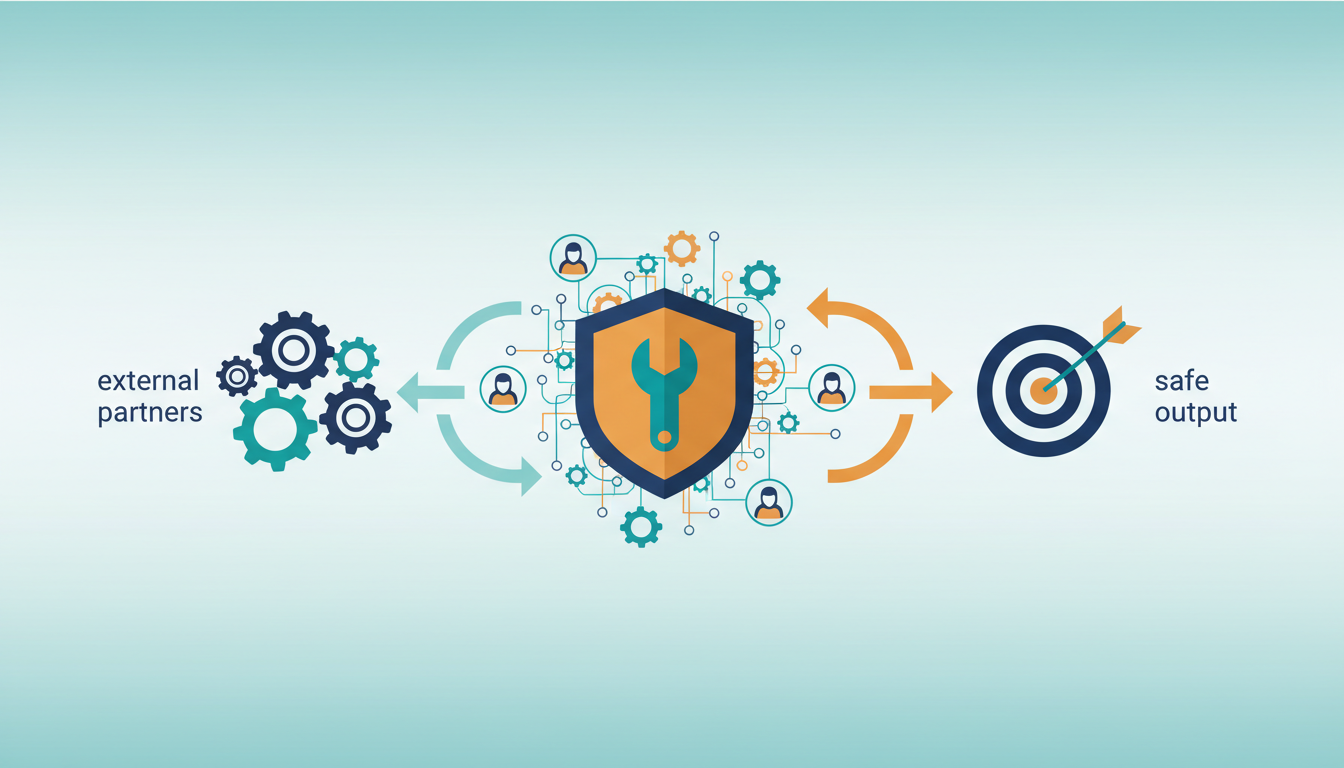
Mandatory centralized governance arises when cross-cloud dependency risks introduce uncontrolled platform coupling between distinct security domains. These data clean rooms function as isolated compute zones where multiple parties execute joint analysis without exposing raw underlying information. Policy engines restrict output to aggregated results, preventing any party from reconstructing individual records. Leading entities like Mastercard apply this architecture for targeted advertising while maintaining strict data sovereignty.
Advanced implementations support collaboration across clouds without requiring physical data movement, unlike legacy replication methods. Operational complexity presents a significant cost; consolidating operations via Unity Catalog eliminates extra dependencies for Databricks-primary shops but creates friction for Snowflake workloads. Operators face a binary choice between simplified single-platform governance or the overhead of managing cross-platform trust boundaries. Centralized control yields maximum efficiency only when the participating system shares a common underlying infrastructure. Adopt centralized frameworks only after auditing all partner platform dependencies to avoid involuntary lock-in.
Real-Time Supply Chain Optimization Between Retailers and Suppliers
Retailers exchange real-time sales data by SKU with suppliers who reciprocate with inventory levels to synchronize demand planning. This peer-to-peer mechanism replaces static file drops with persistent connections, a capability rooted in the WebSockets standard established for bi-directional communication. Operators integrate external signals like weather services to construct unified customer views. Granularity introduces pricing tensions where list costs shift to non-participating consumers per economic models.
Compliance implementation requires shifting from legacy transfers to governed protocols that maintain audit trails without data replication. The Delta Sharing Server handles authentication and coordinate access control, ensuring that recipients view only authorized securable objects. A limitation emerges when suppliers lack the infrastructure to consume live streams, forcing a reversion to batch processes that delay insight generation. Organizations must validate that partner systems support persistent connections before committing to real-time SLAs. Audit partner technical maturity prior to sharing sensitive SKU-level telemetry.
Audit Trail Requirements for ANZ Bank Style Cross-Organizational Sharing
Financial institutions sharing data for anti-money laundering investigations must implement immutable logging to satisfy strict regulatory reporting mandates. Operators require full audit trails that capture every access event, a capability ANZ Bank deployed via Data Republic to manage cross-organizational licensing workflows. Legacy methods fail this requirement because the File Transfer Protocol Static file transfers break lineage continuity. Governed platforms record real-time usage without data replication. Businesses advocating for Data Free Flow with Trust face rising complexity as governments assert control through data sovereignty laws. Enforce Attribute-Focused Access Control policies that log context alongside identity. Operators must choose between opaque manual processes or transparent, automated frameworks that survive regulatory scrutiny.
Implementing strong authentication and authorization layers immediately addresses the majority of security leaders reporting increased insider attacks. Operators must configure policies that account for the majority of incidents stemming from negligence rather than malice. Modern architectures replace static role definitions with Attribute-Oriented Access Control to apply single rules across numerous tables dynamically. This approach reduces configuration drift while enforcing granular permissions without manual updates for every new dataset. The Delta Sharing Protocol Layer Unlike legacy FTP methods, this open standard allows non-platform consumers to receive live data securely.
- Define governance policies specifying allowed data attributes for external sharing.
- Enable encryption for data in transit and at rest within the metastore.
- Configure the sharing server to validate credentials before releasing table pointers.
- Audit all access logs weekly to detect anomalous query patterns.
The cost of this rigor is operational complexity, as flexible rules require precise attribute tagging upfront. Engage security teams during the initial policy design phase to prevent downstream friction. Neglecting this step leaves organizations vulnerable to accidental exposure despite having advanced technical controls in place.
Configuring Granular Permissions for Internal and External Partners
Define access policies using attribute rules that grant read or write rights without creating external user accounts.
- Map data sensitivity labels to specific partner attributes rather than static identity lists.
- Apply a single ABAC policy across numerous tables to enforce consistent governance dynamically.
- Configure the Delta Sharing Server to handle authentication requests for external recipients directly.
- Validate that row-level filters restrict visibility based on the recipient's organizational domain.
This architecture eliminates the administrative burden of provisioning individual identities for every third-party analyst. Row-level enforcement occurs at the protocol layer, preventing data leakage before transmission reaches the client. The limitation involves initial schema tagging; operators must classify columns correctly before policies take effect. Misconfigured attributes result in total access denial rather than partial visibility, halting collaboration workflows entirely.
| Control Type | Scope | Recipient Requirement |
|---|---|---|
| Role-Based | Static Groups | Account Provisioning |
| Attribute-Based | Flexible Tags | No Account Needed |
| Manual Grants | Per-Table | Account Provisioning |
Audit policy inheritance chains quarterly to prevent drift as datasets expand. The cost of maintaining static lists grows linearly with partner count, whereas attribute rules scale independently. Operators gain immediate revocation capability by updating a single domain tag instead of modifying hundreds of individual grants. This shift reduces configuration errors that frequently expose sensitive columns during urgent sharing requests.
Architecture Selection Checklist to Minimize Data Movement
Select architectures prioritizing minimal data duplication to eliminate the storage overhead inherent in legacy replication models.
- Validate that the chosen platform uses a zero-copy mechanism where consumers pay only for compute resources rather than duplicating storage volumes.
- Confirm cross-cloud compatibility by testing access patterns across AWS, Azure, and GCP to prevent vendor lock-in scenarios.
- Centralize governance using an account-wide metastore that replaces fragmented, workspace-local configurations with unified policy enforcement.
- Calculate potential CSP egress costs before deployment, as increased consumer access from remote regions shifts financial burden to the provider.
| Feature | Databricks | Snowflake |
|---|---|---|
| Sharing Protocol | Delta Sharing (Open) | Native Secure Sharing |
| Access Control | ABAC across all clouds | Manual row-level policies |
| Cost Model | Provider bears egress fees | Consumer pays compute only |
Cloudthat. Operators must weigh the benefit of open standards against the risk of unpredictable egress charges when scaling to global partners. Audit access logs weekly to detect anomalous data retrieval patterns that spike costs.
About
Alex Kumar serves as a Senior Platform Engineer and Infrastructure Architect at Rabata. Io, where he specializes in Kubernetes storage architecture and disaster recovery strategies. His daily work designing secure, scalable object storage solutions directly informs this guide on modern data collaboration. Having previously led DevOps initiatives for high-traffic SaaS platforms, Alex understands the critical balance between data accessibility and rigorous security protocols required in today's digital economy. At Rabata. Io, a provider of GDPR-compliant S3-compatible storage, he engineers infrastructure that eliminates vendor lock-in while ensuring enterprise-grade protection for AI and ML workloads. This practical experience allows him to address the $4.44 million average cost of data breaches by outlining actionable frameworks for safe data sharing. His expertise bridges the gap between theoretical compliance and the real-world implementation of secure data pipelines, making him uniquely qualified to guide organizations through the complexities of privacy-preserving data collaboration.
Conclusion
Scaling secure data sharing breaks when manual oversight collides with exponential partner growth, turning routine collaboration into an unmanageable liability. The operational cost of legacy replication models does not just increase; it compounds through hidden egress fees and administrative drift that static policies cannot catch. Relying on copying mechanisms creates a fragile perimeter where human error inevitably bypasses technical guards. Organizations must transition to ephemeral sharing architectures by Q3 2026 to align with emerging NIS2 and DORA compliance mandates. This shift requires abandoning permanent access grants in favor of time-bound, auto-deleting links that neutralize risk after the transaction completes. Delaying this migration locks teams into a cycle of reactive patching rather than proactive governance.
Start by auditing your current external sharing logs this week to identify any files accessible for more than 30 days without a set expiration date. Flag these persistent grants for immediate revocation or conversion to temporary tokens. This specific action isolates the highest-risk data exposures before they trigger a breach or compliance penalty. Real security lies in reducing the window of opportunity for attackers, not just tightening perimeter walls. Adopting zero-copy mechanisms further ensures that scaling partner networks does not inflate storage overhead or compromise data sovereignty. The path forward demands strict adherence to automated lifecycle policies rather than trusting manual intervention.
Frequently Asked Questions
Many firms copy files due to legacy habits despite clear security risks. Specifically, 53% of organizations still rely on copying methods that create uncontrolled duplicates and widen security gaps significantly.
Privacy and consent fears remain the primary barrier to external collaboration today. Nearly 56% of enterprises cite these privacy fears as the main reason they hesitate to share sensitive data securely.
Consumers avoid storage fees because shared data remains in the provider account entirely. This eliminates the redundancy seen where 53% of organizations still rely on copying files into their own storage.
Manual transfers often lead to breaches that cost millions per incident on average. The average breach cost reaches $4.44 million, a risk amplified when 53% of organizations still rely on copying.
Dynamic permissioned access stops static snapshots from becoming vulnerable targets for attackers. This approach helps keep the average breach cost from spiraling toward the projected $10.5 trillion global cybercrime total annually.