S3 metadata tables fix AI context drift without re-uploads
Attach up to 1000 annotations per object, each reaching 1 MB, to change static S3 storage into a flexible data layer. This isn't just about storage; it's about turning the bucket into a database. We need to talk about data integrity. Five new checksum algorithms, including XXHash128 and SHA-512, now secure conditional writes against corruption. You can implement S3 Inventory on directory buckets for S3 Express One Zone, ensuring visibility across high-performance workloads. We also examine the practical application of account regional namespaces to isolate bucket creation within specific AWS Regions.
Enterprise security controls have shifted. Use the UpdateObjectEncryption API to modify server-side encryption types on existing objects without data movement. Track object states using S3 Metadata live inventory tables while managing retention costs through journal record expiration. These updates demand a reevaluation of how architects approach object storage management in 2026.
The Role of S3 Annotations and Metadata Tables in Modern Data Architectures
Defining S3 Annotations as Mutable Queryable Context
Stop treating metadata as an afterthought. S3 Annotations establish a mutable, queryable context layer allowing up to 1 GB of rich data attachment directly to objects. AI agents need immediate dataset semantics, not external database dependencies. Traditional object tags restrict users to small key-value pairs, but the new annotation APIs accept substantial payloads like AI-generated summaries or processing logs. Mutability is the key differentiator; operators update contextual metadata independently of the underlying binary. Costly object re-uploads during iterative model training become unnecessary.
Data immutability often conflicts with context fluidity. The primary object remains static for integrity while the attached annotation table evolves. This dual-state system demands careful lifecycle management to avoid context drift. Such an architecture fundamentally shifts how teams implement ABAC in S3, as access policies now evaluate flexible attributes stored within the annotation layer rather than static bucket tags. Understanding the definition of an S3 directory bucket becomes necessary here. These high-performance containers often host the massive, unstructured datasets where rich context provides the highest value for retrieval systems.
| Feature | Traditional Tags | S3 Annotations |
|---|---|---|
| Mutability | Immutable on existing objects | Fully mutable |
| Capacity | Limited kilobytes | Up to 1 GB |
| Query Target | Bucket listing filters | Direct object context |
Media workflows benefit most from this pattern. Clip descriptions change frequently while source footage remains archived. Maintaining separate metadata stores introduces latency that direct attachment eliminates entirely. The operational cost is measurable.
Querying Apache Iceberg Metadata Tables for AI Workflows
Apache Iceberg tables expose S3 object metadata as read-only SQL surfaces for direct analytical access. Operators configure these tables on general purpose buckets to enable high-speed discovery without data movement. Fully managed, read-only tables store the metadata and update automatically as objects change. Data teams annotate training sets with mutable context up to 1 MB per annotation, then immediately query those tags via standard SQL engines. Adding annotations requires calling specific APIs to attach rich, queryable context directly to objects alongside the primary binary.
Separating mutable operational tags from immutable lineage markers prevents query drift during model retraining. There is a catch: the metadata tables are read-only. Users cannot modify object state through SQL `UPDATE` commands. Pipeline design must shift so metadata enrichment happens at ingestion while analysis remains strictly decoupled from storage mutation. This separation maintains data integrity while accelerating time-to-insight for large-scale AI workflows. This pattern reduces the complexity of maintaining external metadata databases.
S3 Annotations Versus Traditional Immutable Object Tags
S3 Annotations provide a mutable, queryable context layer that distinguishes itself from static object tags by allowing direct updates to attached intelligence. Standard metadata often requires full object replacement to modify, but this new architecture enables operators to refresh AI-generated summaries without rewriting the primary binary payload. The system supports attaching rich context directly to objects. Autonomous agents gain a unified data and metadata surface.
Operators select from ten distinct checksum algorithms to verify integrity across these flexible layers. Mutable context accelerates model iteration yet decouples the lifecycle of intelligence from the source truth. Strict governance prevents annotation drift. Teams must treat these annotations as first-class assets rather than ephemeral comments. Use this mutability for active learning loops where dataset labeling evolves quicker than raw media ingestion.
Internal Mechanics of S3 Data Integrity and Conditional API Operations
S3 Checksum Algorithms: CRC64NVME, XXHash, and SHA-512 Mechanics
On 2026/04/22, 44 updated API methods introduced five additional checksum algorithms including MD5, SHA-512, and XXHash variants. These algorithms validate data integrity by calculating a hash of the payload before transmission and verifying it against the server-side calculation upon receipt. Users can choose from ten supported algorithms depending on specific application requirements for speed or cryptographic strength.
Streaming uploads benefit from non-cryptographic options like XXHash64, which offer high throughput for large AI training datasets where collision resistance is secondary to performance. Conversely, regulatory archives often mandate SHA-512 to satisfy strict compliance mandates regarding tamper evidence.
| Algorithm | Type | Best Use Case |
|---|---|---|
| CRC64NVME | Cyclic Redundancy Check | High-speed NVMe local writes |
| XXHash128 | Non-cryptographic | Large-scale media processing |
| SHA-512 | Cryptographic | Legal evidence and compliance |
Selecting a stronger algorithm like SHA-512 increases CPU overhead on the client side during the upload process. Operators must balance security posture against ingestion latency, particularly when bandwidth is constrained. Legacy SDK versions may not automatically compute these newer checksums without explicit configuration updates.
Evaluate XXHash128 for cost-sensitive media workflows where the marginal gain of cryptographic proofs does not justify the compute expense. Operators must ensure their ingestion pipelines explicitly request the desired algorithm, as default behaviors vary by SDK version.
Implementing Conditional Writes and Deletes in PutObject and CopyObject APIs
Engineers prevent race conditions by attaching ETag preconditions to PutObject and CopyObject requests to verify object state before modification. This mechanism rejects writes if the target content identifier differs from the client's expectation, ensuring update safety without distributed locks. The AWS SDK can automatically calculate a checksum as it streams data into S3, reducing boilerplate code for integrity verification. However, enabling strict validation requires careful SDK configuration, as older clients lacking specific algorithm support may skip verification entirely unless explicitly configured.
Deletions now support similar guards, allowing operators to specify conditions that block DeleteObject calls if metadata has changed since retrieval. This approach eliminates silent data loss during concurrent cleanup jobs or automated lifecycle management. While conditional logic adds latency to high-frequency write paths, the trade-off prevents costly corruption in shared datasets. Organizations managing AI training pipelines should prioritize these controls to maintain consistent dataset versions across distributed nodes. Deploy these patterns early to avoid complex migration later when data volume grows.
Failure Modes in SSE-C Write Blocking and ListBuckets Pagination Errors
Blocking SSE-C writes prevents accidental exposure of keys when bucket policies forbid customer-managed encryption contexts. This safety feature, introduced November 2025, rejects uploads missing valid key headers before data transfer completes. Operators relying on legacy tools often face silent failures because older SDK versions do not surface the specific `AccessDenied` cause clearly. Strict compatibility is the limitation; applications must explicitly support the updated header validation logic or data ingestion halts.
Listing thousands of buckets introduces pagination complexity where missing region parameters cause incomplete inventory returns. Recent API updates now return bucket names alongside AWS regions to resolve cross-account enumeration gaps.
| Failure Mode | Root Cause | Resolution Strategy |
|---|---|---|
| SSE-C Write Reject | Policy forbids non-KMS encryption | Update client headers or switch to SSE-S3 |
| Partial ListBuckets | Missing region pagination token | Include `bucket-region` query parameter |
| Annotation Limit | Exceeding 1 MB per object | Split metadata across multiple keys |
Administrators attaching annotations must respect the 1 MB ceiling per object to avoid write rejection. Validate client SDK versions against the latest API specifications before deploying strict encryption policies. Failure to align client capabilities with server-side constraints results in immediate operation denial without partial success states.
Enterprise Implementation of S3 Security, Inventory, and Encryption Controls
ABAC and SSE-C Write Blocking Mechanics in S3 General Purpose Buckets
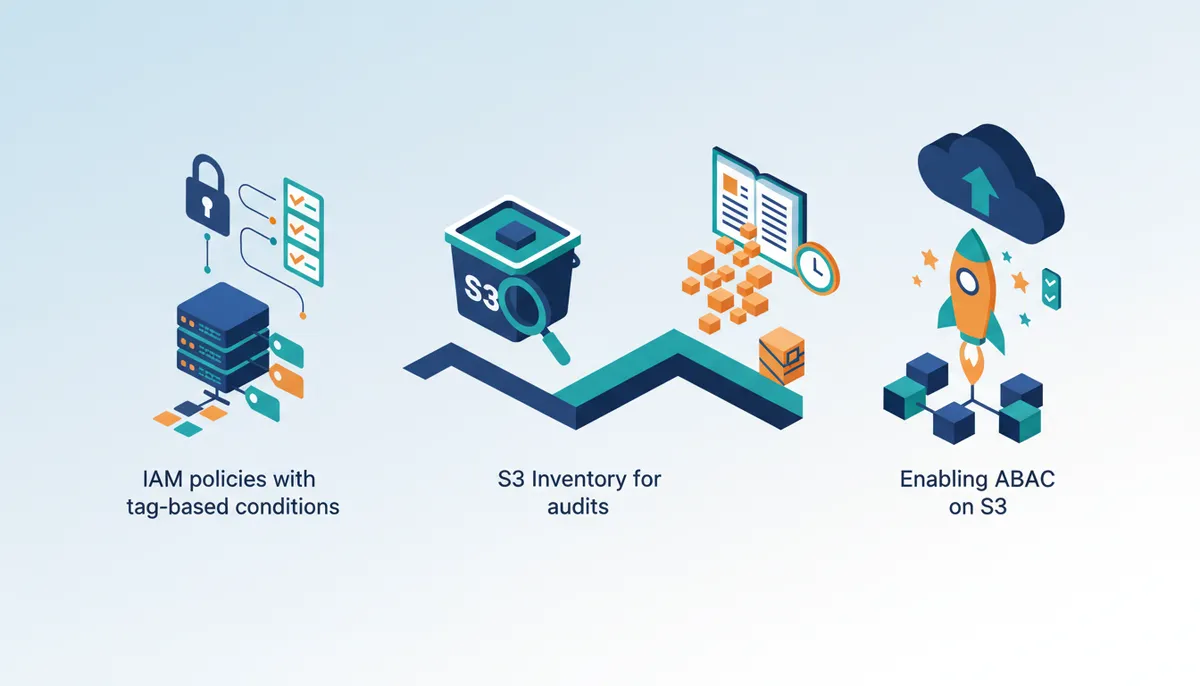
Enabling Attribute-Based Access Control on general purpose buckets requires invoking specific API methods released on 2025/11/20. These two new operations shift authorization logic from static bucket policies to flexible identity attributes, reducing policy sprawl across large organizations. Granularity introduces complexity when legacy applications rely on fixed customer-managed keys. API updates from 2025/11/19 address this by allowing administrators to explicitly block SSE-C writes, preventing clients from specifying encryption headers that bypass centralized key management. This constraint enforces strict compliance but may break existing backup workflows expecting unrestricted header passthrough. Operators must balance the security benefit of enforced server-side encryption against the operational risk of disrupting established data ingestion pipelines.
To implement these controls effectively, follow this configuration sequence:
- Call the enable ABAC API to activate attribute-based evaluation for the target bucket.
- Verify that all accessing identities possess the required tags in their IAM policies.
- Apply the SSE-C write block update to reject any client-side encryption headers.
- Test application connectivity using standard SDKs to confirm acceptance of default encryption.
Immediate security hardening often conflicts with uninterrupted service availability. Enforcing these blocks without prior client audit causes measurable disruption to data flows. Stage these API changes in non-production environments to validate tag propagation before enterprise rollout.
Configuring S3 Inventory with LifecycleExpirationDate and FSX_ONTAP Storage Classes
Operators must configure the new LifecycleExpirationDate field within S3 Inventory reports to drive automated transitions to the FSX_ONTAP storage class. This capability relies on 14 updated API methods released on 2025/12/02 that formally introduce the target storage tier. Engineering teams should first enable inventory reporting to capture object age and access patterns before defining lifecycle rules. The following configuration demonstrates the required JSON structure for setting these expiration triggers:
Changing object encryption after upload now requires the UpdateObjectEncryption API, a distinct operation from modifying lifecycle states. This separation means administrators cannot bundle encryption updates with storage class transitions in a single request, adding a step to compliance workflows. While NetApp provides tools to manage S3 object storage within ONTAP clusters, AWS users must rely on these specific API calls for native bucket management. Operational friction results from separating encryption updates from lifecycle actions; this prevents accidental data loss but increases the complexity of batch remediation scripts. Enterprises moving petabytes of AI training data must account for this additional API call volume when estimating migration timelines. Test these sequences in non-production environments to validate that encryption key rotation does not conflict with active lifecycle transitions.
Validation Checklist for Conditional CopyObject Writes and Annotation Table Setup
Engineers must verify conditional write protections on destination keys before enabling production traffic. This capability relies on one updated API method released on 2025/10/28 that adds conditional writes in CopyObject to prevent unintended object modifications. Operators should confirm their applications supply the correct ETag or version ID to enforce these safeguards effectively.
- Validate that destination key preconditions block overwrites when the target object state changes.
- Configure the annotation table to store mutable context separately from immutable object data.
- Enable ABAC on general purpose buckets to restrict access based on flexible identity attributes.
- Attach up to 1 GB of rich, queryable context directly to objects for AI agent consumption.
| Feature | Standard Metadata | S3 Annotations |
|---|---|---|
| Mutability | Immutable | Mutable |
| Max Size | Limited KB | Up to 1 GB |
| Query Target | Object Key | Context Fields |
The following configuration initializes the required table structure for tracking object states:
Double encryption becomes necessary when regulatory frameworks mandate distinct keys for data at rest and in transit. This separation isolates failure domains but increases the operational overhead of key rotation schedules. Test these conditional logic paths rigorously, as a misconfigured precondition can silently block valid writes during high-velocity AI training pipelines. Reduced data corruption risk comes with increased application-side complexity.
Performance Implications of S3 Express One Zone Versus General Purpose Buckets
S3 Express One Zone Single-AZ Latency Architecture

S3 Express One Zone eliminates cross-AZ synchronization overhead by confining data to a single availability zone. This architectural choice removes the distributed consensus latency inherent in general purpose buckets, which replicate objects across three distinct zones for durability. The result is a significantly reduced latency profile for data access compared to the multi-zone coordination required by standard storage classes. On 2023/11/28, AWS released 2 new and 15 updated API methods to add support for S3 Express One Zone. The trade-off is explicit: operators sacrifice multi-AZ resiliency for raw speed, necessitating alternative strategies for disaster recovery scenarios.
| Feature | S3 Express One Zone | General Purpose Buckets |
|---|---|---|
| Availability Zone | Single AZ | Multi-AZ (3 zones) |
| Latency Profile | Reduced latency | Variable (network dependent) |
| API Support | Directory buckets only | Standard buckets |
| Durability | AZ-redundant | Region-redundant |
This design serves workloads where compute proximity dictates performance, such as streaming massive datasets directly to GPU clusters without intermediate caching layers. However, the lack of automatic region-wide redundancy means data availability is tied to the specific zone. Teams must weigh the performance gain against the operational complexity of managing failure domain risks in their architecture. For startups prioritizing training velocity over archival safety, this single-AZ placement offers a distinct competitive advantage in iteration speed.
High-Throughput AI Workload Patterns on S3 Express
S3 Express One Zone delivers reduced latency by confining data to a single availability zone, removing cross-zone consensus delays. This architecture supports high-throughput AI training where thousands of small files must be read simultaneously to prevent GPU starvation. Unlike general purpose buckets that coordinate across three zones, the directory bucket structure enables efficient access patterns necessary for modern machine learning pipelines.
Operators sacrificing multi-AZ resiliency gain raw speed, yet this requires careful planning for zone failures. Cost-conscious enterprises should reserve general purpose buckets for durable backup storage rather than high-velocity compute tasks.
S3 Inventory Metadata Fields: Express vs General Purpose
S3 Inventory configurations now support the optional 'LifecycleExpirationDate' field, enhancing granular access auditing across storage tiers. On 2023/07/13, 5 updated API methods were released, enabling S3 Inventory to support Object Access Control List and Object Owner as available object metadata fields. This expansion supports rigorous compliance checks by exposing lifecycle structures directly in batch reports. Operators must account for these structural differences when designing unified governance policies.
The trade-off is visibility versus speed; Express prioritizes low-latency access. Users requiring deep forensic analysis of object-level permissions may find general purpose buckets necessary for archival data. Engineers must validate that their security tools parse directory bucket formats correctly to avoid blind spots in their data governance frameworks.
About
Marcus Chen is a Cloud Solutions Architect and Developer Advocate at Rabata.io, where he specializes in S3-compatible object storage and AI/ML data infrastructure. His daily work involves designing scalable cloud architectures and benchmarking S3 API performance, making him uniquely qualified to analyze the latest 2026 Amazon S3 updates. As Rabata.io builds the fastest S3-compatible alternative to AWS, Marcus constantly evaluates new features like annotation support and advanced checksum algorithms to ensure smooth interoperability for enterprise clients. His hands-on experience helping organizations migrate from AWS to Rabata's GDPR-compliant storage allows him to contextualize how these API changes impact real-world data integrity and cost optimization strategies. By bridging the gap between complex cloud storage specifications and practical implementation, Marcus provides actionable insights for engineers managing massive datasets in hybrid and multi-cloud environments.
Conclusion
Scaling AI workloads reveals that raw throughput often masks critical governance gaps when directory structures replace traditional object hierarchies. The shift toward single-zone performance architectures introduces a specific operational debt: reduced visibility into object-level permissions creates blind spots during compliance audits. Teams relying on near real-time queries for training data must accept that forensic analysis of access patterns will lag behind general purpose bucket capabilities. This is not a temporary glitch but a permanent architectural trade-off requiring distinct monitoring stacks for high-velocity storage.
Organizations should mandate a hybrid strategy by the next fiscal planning cycle, reserving general purpose buckets for any data requiring granular, object-level audit trails while directing compute-heavy training sets to single-zone deployments. Do not attempt to force a unified governance policy across both types without accounting for their divergent metadata latencies. The cost of failure here is downtime but unverifiable data lineage.
Start by auditing your current S3 Inventory configurations this week to verify if your security tools can parse directory bucket formats correctly. You must ensure your logging pipeline captures the new 'LifecycleExpirationDate' fields before relying on these buckets for production ML pipelines. Configure and manage ONTAP object storage servers to validate that your cluster handles these distinct metadata schemas without losing forensic fidelity.
Frequently Asked Questions
Each individual annotation supports a limit of 1 MB to store specific context. You can attach up to 1000 of these annotations per object, creating a rich queryable layer without moving the primary binary data.
Users can attach a total of 1 GB of rich, mutable context directly to an object. This capacity allows AI agents to store extensive summaries or logs alongside static binaries for immediate querying.
The system now supports five new checksum algorithms including XXHash128 and SHA-512. These options secure conditional writes against corruption by allowing flexible, application-specific validation methods during upload and download processes.
Yes, support for S3 Inventory now extends to directory buckets used by S3 Express One Zone. This update ensures visibility across high-performance workloads while maintaining the strict latency requirements these specialized storage containers demand.
The UpdateObjectEncryption API allows modification of server-side encryption types on existing objects. This feature eliminates the need for costly re-uploads when changing encryption standards, preserving the static nature of the primary binary.
References