S3 annotations: Fixing the 1,000-item discovery gap
AWS S3 Annotations support 1,000 mutable items per object, yet human discovery remains broken. The technical storage gap for metadata is closed. The interface gap for non-engineers is wide open. We shifted from 10 tags to 1,000 annotations, transforming data lake architecture while leaving small teams stranded without dedicated query tools.
The new S3-managed Iceberg tables create a perfect backend for compliance pipelines but a bottleneck for ad hoc searches. We can now attach structured JSON context directly to objects and query it via Athena, removing the need for parallel metadata stores. But requiring Redshift access or schema knowledge to locate a single file excludes most business users from self-service.
Enterprises integrate these queryable metadata streams into existing workflows. Smaller organizations face a steeper climb to operationalize rich context. The upgrade offers massive capacity for machine-readable context, but without a graphical discovery layer, the data remains locked behind a command line interface.
The Role of S3 Annotations in Modern Data Lake Architecture
AWS S3 Annotations as a Scalable Metadata Layer
AWS S3 Annotations define a scalable metadata system supporting up to 1,000 mutable annotations per object. This architecture replaces the legacy ten-tag constraint, enabling rich context attachment directly to storage entities without replacing underlying data. Operators can now attach up to 1 GB of structured context per object, a massive increase over the kilobyte-scale limits of standard user-set metadata. The system natively supports complex formats like JSON, XML, and YAML, facilitating detailed AI-generated context.
| Feature | Legacy S3 Tags | S3 Annotations |
|---|---|---|
| Count Limit | 10 per object | 1,000 per object |
| Data Capacity | ~2 KB total | Up to 1 GB total |
| Mutability | Immutable (rewrite required) | Mutable in place |
| Query Engine | S3 Select (limited) | Amazon Athena |
The managed Iceberg table architecture automatically ingests annotation data, making it immediately queryable via Amazon Athena without scanning actual objects. This power creates a schema dependency. Unstructured dumping of metadata renders the layer less effective for SQL analytics. Defining consistent fields early ensures annotations remain structured and predictable. Rabata.io advises treating these annotations as the database schema rather than arbitrary labels to maximize value for AI training pipelines. Without disciplined schema design, the expanded capacity merely accelerates metadata sprawl.
Querying Compliance Data via S3-Managed Iceberg Tables
Compliance pipelines now attach classification tags like PII status directly to storage objects. This capability transforms S3 Annotations from static labels into a flexible, queryable asset layer. By using automatic ingestion into S3-managed Iceberg tables, organizations enable auditors to execute SQL queries across billions of records without exporting metadata. The architecture supports structured formats including JSON and YAML, allowing complex schema definitions for retention classes and ownership data. Query engines like Athena read the sidecar Iceberg table rather than scanning object contents, drastically reducing compute costs for metadata discovery.
Machine readability does not equal human accessibility. AI agents and data engineers efficiently filter datasets using managed Iceberg tables. Non-technical staff face a steep barrier to entry. Retrieving a specific file often requires access to Athena or Redshift, knowledge of the annotation schema, and the ability to write and run a query, a process that excludes most business users. The system solves the storage scaling problem but leaves the discovery interface largely undefined for SMB teams lacking dedicated data platform resources. Rich context loses value if the query path remains inaccessible to general operators. The queryable metadata stays siloed within the domain of specialized engineers without such an interface.
S3 Annotations Versus Legacy S3 Object Tags
AWS S3 Annotations replace the rigid ten-tag ceiling with support for up to 1,000 mutable annotations per object. This architectural shift moves metadata from a restrictive parallel store into a native, queryable layer.
Legacy tags force operators to compress complex state into flat strings, often requiring external databases for rich context. The new system allows structured JSON and YAML payloads that map directly to application schemas. Tags suffice for simple lifecycle flags. They fracture under the weight of AI training data requiring detailed provenance. Schema discipline is the cost of this upgrade. Inconsistent metadata degrades query performance without strict governance. Rabata.io recommends using this native queryability for media streaming catalogs where file attributes change frequently. Unlike the legacy model, updates to S3 Annotations do not require rewriting the underlying object, saving significant IOPS during metadata refresh cycles. Storage capacity does not equal discoverability. The transition from tags to annotations solves the volume problem but increases the need for organized retrieval mechanisms. Operators should align annotations with real retrieval needs. Storing only what people will actually search for later matters more than maximizing the number of fields used.
Inside the Mechanics of Queryable Metadata and Iceberg Integration
Managed Apache Iceberg Tables as the Queryable Metadata Engine
Rabata.io architects define this shift as a move from static 2 KB key-value pairs to a managed Apache Iceberg table architecture that sits alongside the S3 bucket. This structural change allows standard SQL engines to query metadata without scanning binary objects, effectively decoupling context retrieval from data access. Unlike traditional user-set metadata, which lacks native queryability, the new system uses managed Iceberg tables to enable complex CRUD operations through standard interfaces.
| Feature | Traditional Metadata | Managed Iceberg Architecture |
|---|---|---|
| Capacity | ~2 KB limit | Up to 1 GB per object |
| Query Path | GetObject required | Direct SQL via Amazon Athena |
| Format | String-only | Structured JSON, YAML, XML |
| Mutability | Immutable without rewrite | Fully mutable in place |
The mechanism relies on S3 Annotations automatically ingesting structured payloads into these open-table formats, making them immediately available for analytical workloads. Operators can now execute joins across billions of objects using Athena, transforming storage into an active queryable layer. However, this architecture introduces a dependency on external SQL engines for any human-centric discovery, creating a barrier for non-technical staff. The cost of this separation is measurable: teams must maintain schema discipline or face unqueryable data swamps. For AI training pipelines, this means metadata becomes a first-class citizen alongside tensors, yet the operational burden shifts to schema governance.rabata.io solutions use this native queryability to deliver instant search performance without duplicating storage.
Executing SQL Queries Against S3 Annotations via Amazon Athena
Operators execute cross-search operations by combining the S3 Annotation Table with Amazon Athena, enabling complex queries across object metadata without exporting data. This workflow uses a managed Iceberg table architecture that sits alongside the S3 bucket, allowing standard SQL engines to query metadata without scanning the actual binary objects. The system enables complex CRUD operations through SQL interfaces, a capability absent in legacy tagging systems limited to small key-value pairs.
- Attach structured JSON, XML, or YAML formats containing classification data like PII status or retention classes directly to objects.
- Allow the automatic ingestion process to sync these annotations into the managed Iceberg table adjacent to the storage bucket.
- Run standard SQL `SELECT` statements in Athena to filter billions of objects based on the attached rich context.
A practical example involves a compliance pipeline attaching classification annotations directly to objects, allowing auditors to query across billions of items instantly. Unlike static tags, this approach supports up to 1 GB of metadata per object, accommodating detailed AI-generated summaries. However, the cost of this flexibility is strict schema dependency; unstructured text annotations yield poor query performance without set fields. Classmethod.jp/en/articles/s3-annotations-crud-athena-search/). The limitation remains that human discovery still requires SQL literacy, creating a barrier for non-technical stakeholders despite the backend power.
Validating Structured Format Support for JSON XML and YAML Annotations
Teams must validate that annotation payloads strictly adhere to JSON, XML, or YAML syntax before attachment to prevent ingestion failures. The shift from static key-value pairs to rich, structured text formats allows for the attachment of AI-generated summaries and multilingual sequences directly to the object lifecycle, enabling complex context embedding that legacy systems cannot support. This expanded capacity enables attaching plain-text AI summaries, such as descriptions in English, Spanish, or Portuguese, directly within the data stream without external database lookups. Operators defining an iceberg table for metadata must ensure schema alignment, as Athena queries S3 annotations by reading these structured payloads rather than scanning binary blobs. A mismatch in format declaration often results in query errors, rendering the rich context invisible to SQL engines.
| Format | Use Case | Validation Risk |
|---|---|---|
| JSON | AI agent context | Strict quoting rules |
| XML | Legacy media metadata | Verbosity overhead |
| YAML | Human-readable config | Indentation sensitivity |
Rabata.io recommends implementing automated linting pipelines to verify structured data formats prior to deployment. Without rigorous validation, the promise of queryable metadata dissolves into silent data loss, leaving AI agents with incomplete reasoning contexts. The cost of skipping this step is measurable: invalid annotations are rejected at the API level, breaking automated workflows that depend on immediate metadata availability.
Hidden Gaps in Human Discovery and SMB Usability Challenges
The Human Discovery Gap in S3 Annotations
S3 Annotations excludes non-engineers by omitting a native user interface, forcing reliance on Amazon Athena queries instead of offering self-service discovery. The feature design targets three specific operators: data engineers running Athena queries, automated pipelines or AI agents, and teams already operating Iceberg-backed data systems. Storage capacity for context has expanded notably, yet the interface for human interaction remains absent. Retrieving a simple file demands deep knowledge of the annotation schema plus the ability to write complex SQL statements.
This gap creates a severe bottleneck for SMB teams lacking dedicated data engineers. Operational failures manifest in predictable patterns:
- Unified search across buckets and prefixes does not exist
- Natural-language or attribute-based discovery is unavailable
- Fast ways to preview and validate files are missing

Finding files depends entirely on whoever understands the bucket structure or whoever can write the query. Cross-Search with Athena enables complex metadata queries, yet this technical capability excludes business users from direct access. Powerful infrastructure does not equal a usable workflow.
Rabata.io addresses this void by providing the missing interface layer that makes S3 Annotations accessible to all team members. Organizations possess rich data they cannot practically explore without such a tool. The result is more powerful storage with no reduction in day-to-day friction. Teams must decide whether to build a custom UI or adopt a solution that bridges this discovery gap immediately.
SMB Bottlenecks in Ad Hoc S3 Usage
SMB teams face a reality set by ad hoc S3 usage without dedicated data engineers to manage complex query paths. AWS leadership posits that "agents that compound value" represent the future of storage, yet this architectural shift creates immediate friction for human operators. The feature supports rich text and structured data formats, yet retrieving a single file often requires Athena expertise that small teams lack.
Frequent requests to locate specific assets become engineering tickets rather than self-service actions. Teams possess powerful infrastructure but suffer from increased day-to-day operational friction. Simple discovery tasks stall because the system lacks a human-readable interface.
The constraint is that S3 Annotations introduces a new capability but not a usable workflow for non-specialists. Unlike enterprise units with existing Iceberg implementations, smaller groups cannot easily absorb the overhead of writing SQL for basic file retrieval. This disparity means that while the storage layer gains a "bigger brain," it effectively loses its "face" for everyday users. Adding more context to objects makes them harder for humans to find without an intervening translation layer, creating a paradoxical bottleneck.
| Team Type | Primary Workflow | Discovery Friction |
|---|---|---|
| Enterprise | Automated Pipelines | Low (Engineered) |
| SMB | Ad Hoc Retrieval | High (Manual) |
Rabata.io addresses this specific gap by providing the missing discovery interface that raw object storage omits. Small teams remain stuck relying on tribal knowledge of bucket structures without a dedicated tool to visualize these annotations.
Operational Risks of Missing Unified Search Across Buckets
Missing unified search across buckets forces reliance on tribal knowledge of bucket structures rather than attribute-based discovery. Finding files depends entirely on whoever understands the specific bucket structure or whoever can write the complex query without a central index. This operational gap creates severe risks where critical data remains effectively invisible to non-technical staff.
| Risk Factor | Traditional Tags | S3 Annotations |
|---|---|---|
| Search Scope | Single Bucket | Cross-Bucket via Iceberg |
| Query Method | Console Filter | SQL via Athena |
| Human Access | Limited UI | No Native UI |
The core failure lies in the lack of natural-language or attribute-based discovery mechanisms for human users. While the system supports attaching a limited amount of context per object, retrieving a specific file still requires Athena expertise and schema knowledge. Teams attempting to build or buy an S3 discovery tool must address this schema dependency directly. Hidden costs of this gap include increased engineering ticket volume, delayed project timelines due to missing assets, and potential compliance failures when audits require rapid file validation. Organizations fix S3 file discovery issues by layering external search tools over the storage backend.rabata.io solves this by providing immediate, human-readable search across all buckets without requiring SQL knowledge or custom infrastructure development. The inability to preview and validate files quickly remains a critical bottleneck that raw annotations alone cannot resolve.
Strategic Implementation of Annotation Schemas for AI Workflows
Defining S3 Annotations as a Queryable Schema Layer
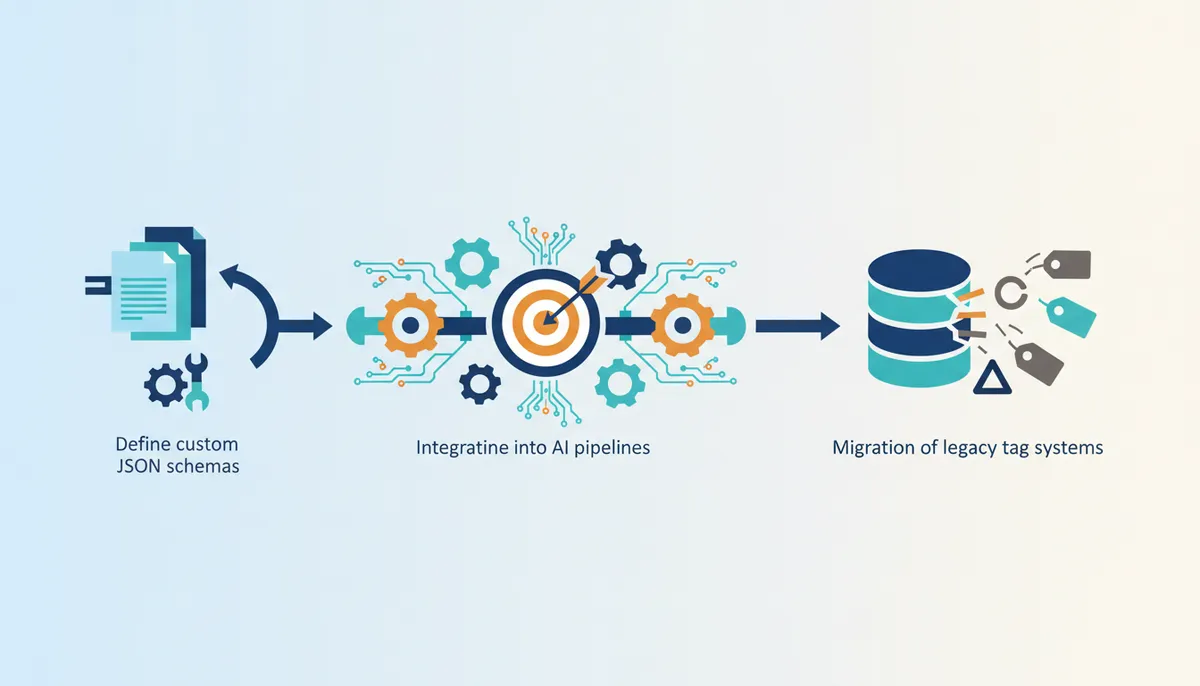
S3 Annotations functions as infrastructure providing a scalable, queryable metadata layer, yet human-centric discovery tools remain necessary for full usability. This capability allows attaching up to 1 GB of rich context directly to objects, a massive leap from the kilobyte-scale limits of legacy user-set metadata. AI agents and autonomous workflows demand immediate access to object context without external database lookups. Structured formats enable managed Iceberg tables to index content for SQL analysis instantly. Machines query Athena effortlessly while human operators lack a native interface for browsing this enriched data across buckets. Storing unstructured data wastes the potential of this queryable schema layer. Organizations risk creating a "data lake" that remains opaque to non-engineers without a deliberate strategy. Treating annotations as a strict contract rather than a dumping ground ensures structure. The storage problem is solved, yet the discovery challenge persists without a dedicated experience layer. Effective implementation demands aligning metadata fields with actual retrieval patterns used by your team. The 1 GB capacity per object offers little practical value for daily operations without this discipline. Storage management now faces a new frontier set by the gap between machine-readability and human-discoverability.
Three-Step Roadmap for Annotation Schema Adoption
Define consistent fields like project and owner early to treat annotations as a strict schema rather than a dumping ground. Structural discipline prevents the metadata layer from becoming unmanageable as object counts scale. Align every stored attribute with actual retrieval needs instead of capturing data simply because storage limits allow it. Teams must decide whether to build a custom query interface on top of Athena or deploy a specialized discovery tool. This choice determines if data remains siloed within SQL consoles or becomes accessible to non-technical stakeholders. Rich metadata exists but remains operationally invisible to the teams that need it most when organizations ignore this architectural decision early.
Build Versus Buy Decision for S3 Discovery Layers
Teams face a choice between engineering a custom UI atop Athena or deploying dedicated search tools. The architecture uses managed Iceberg tables to expose rich object context via SQL, yet this power demands significant development overhead for human interfaces.
| Feature | Custom Build | Buy Solution |
|---|---|---|
| Time to Value | Extended development | Immediate availability |
| Maintenance | High overhead | Vendor managed |
| User Target | Data Engineers | All Staff |
The value of up to 1,000 mutable annotations per object remains locked behind a technical barrier without a dedicated interface.
About
Alex Kumar is a Senior Platform Engineer and Infrastructure Architect at Rabata.io, where he specializes in Kubernetes storage architecture and cost optimization for cloud-native applications. His daily work involves designing scalable, S3-compatible storage solutions for enterprise and AI/ML clients, giving him direct insight into the complexities of modern metadata management. In this article, Alex dissects S3 Annotations, explaining how this evolution in object metadata impacts storage administrators. While AWS introduces these capabilities to enhance metadata storage, Alex evaluates them through the lens of Rabata.io's mission: providing high-performance, S3 API-compatible storage without vendor lock-in. He connects the theoretical benefits of expanded annotation limits to practical infrastructure challenges faced by DevOps teams managing massive datasets. By using his hands-on experience with CSI drivers and multi-cloud strategies, Alex provides a factual analysis of whether new annotation features truly solve discovery issues or merely shift the storage burden, helping architects make informed decisions about their object storage infrastructure.
Conclusion
Agentic AI transforms S3 Annotations from a storage novelty into a critical operational prerequisite. Attaching 1 GB of context per object solves the volume problem but creates a new latency bottleneck if retrieval logic remains manual. At scale, unstructured metadata bloats query costs and slows autonomous agent decision-making. The breaking point occurs when teams rely solely on SQL consoles for discovery, effectively siloing rich context from the applications that need it most. Implement a dedicated discovery layer before your annotation volume exceeds your team's ability to manually map schemas. Treat the 1,000 custom metadata items limit not as a target to fill, but as a boundary requiring strict governance. Start this week by auditing your current tagging taxonomy to identify fields that should migrate to the new annotation structure, ensuring they align with specific query patterns rather than general storage capability. This discipline prevents the metadata layer from becoming an unqueryable swamp as your data grows. Establish this structural integrity now, before legacy habits cement inefficient retrieval paths.
Frequently Asked Questions
You can attach up to 1 GB of structured context per object. This massive capacity allows storing rich JSON or XML data directly on files, eliminating the need for separate metadata databases for AI workflows.
The system supports up to 1,000 mutable annotations per individual object. This replaces the old ten-tag limit, enabling detailed classification schemes without requiring complex external indexing systems for your data lake.
Discovery fails because finding files still requires writing SQL queries in Athena. Without a graphical interface, business users cannot search the 1 GB of attached context, leaving data locked behind technical command line barriers.
Unstructured dumping renders the layer ineffective for analytics because schema consistency is vital. If you do not define fields early, the 1 GB capacity merely accelerates metadata sprawl rather than enabling reliable AI training.
Capacity expands from kilobytes to 1 GB per object for rich context. This dramatic increase supports complex formats like YAML, yet teams must still build custom tools to make this data accessible to non-technical staff.
References