S3 lifecycle rules: Stop orphaned metadata now
At $0.006 per GB per month, Backblaze B2 undercuts AWS S3 Standard pricing while delivering identical S3-compatible lifecycle rules functionality. Cloud-based deployment now dominates storage management because it offers the scalability and compliance flexibility required for modern data footprints. With Backblaze reporting an Annual Recurring Revenue of a substantial sum as of late 2025, the platform's recent addition of S3-compatible APIs validates the industry shift toward cloud-native solutions that reduce infrastructure overhead. By using these tools, organizations can execute lift-and-shift migrations from AWS S3, escaping the $0.023 per GB cost burden found in us-east-1 while maintaining consistent operational logic.
Readers will learn how the PutBucketLifecycleConfiguration API accepts standard XML documents to manage object expiration and multipart upload cleanup exactly like AWS. Finally, the guide covers practical strategies for configuring these policies to ensure predictable behavior across hybrid environments, eliminating the risk of orphaned data or unexpected storage bills.
The Role of S3-Compatible Lifecycle Rules in Multi-Cloud Storage Management
Backblaze B2 automates object retention by translating S3 API XML into native hide or delete operations. Early 2026 support for these APIs enables direct migration of existing XML configurations without script modification. The system distinguishes between current version expiration, which generates a hide marker, and non-current version cleanup, which permanently removes data. A hide marker functions as a delete indicator that preserves the underlying bytes, allowing recovery unless explicitly purged. Operators must define a separate rule with `ExpiredObjectDeleteMarker` set to true to remove these markers automatically. Retrieving rules via the S3 API returns a single B2 hide action as two distinct S3 rules : one specifying days and another flagging the marker for deletion. This dual-rule representation ensures compatibility with tools expecting standard S3 behavior while using B2's default versioned buckets . Failure to configure the marker expiration rule results in accumulating zero-byte metadata objects that incur no storage cost but clutter bucket listings. The definition of an expired object delete marker is strictly tied to this secondary rule; without it, the marker persists indefinitely. Overlapping policies resolve by selecting the shortest retention window, prioritizing cost reduction over extended data holding. This logic prevents accidental data loss when broad and specific prefixes coexist within the same namespace.
Executing Lift and Shift Migrations from AWS S3 to Backblaze B2
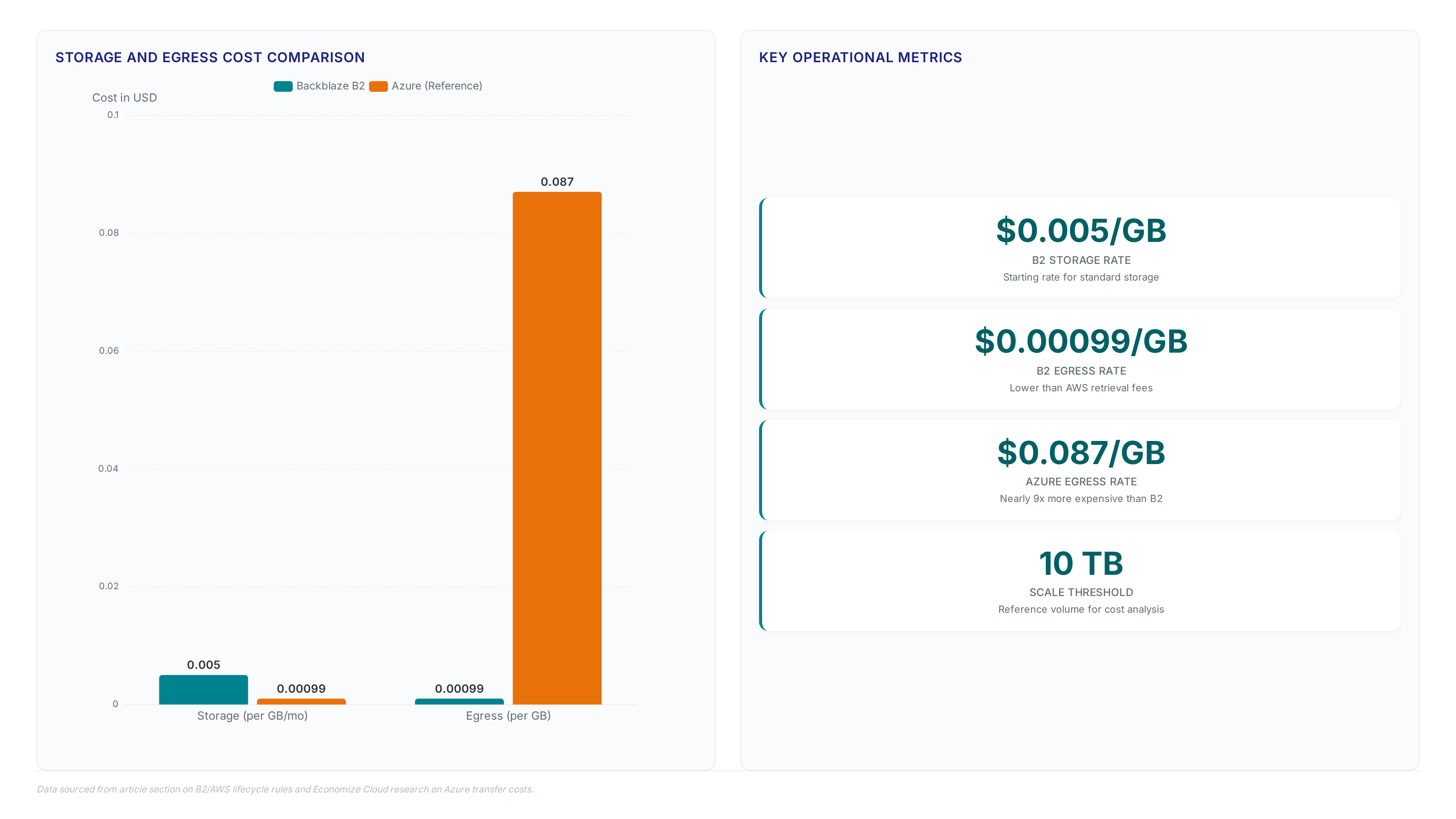
Reusing existing XML configurations moves workloads from AWS S3 Standard at $0.023 per GB per month to storage costing $0.006 per GB per month. This approach eliminates script refactoring because existing tools Operators apply the same `PutBucketLifecycleConfiguration` calls without modifying infrastructure as code templates. Financial impact drives adoption, with companies like Tribute saving $15,000 per month after switching providers. Such savings stem from avoiding rigid minimum storage duration penalties that plague competitor clouds. Unlike AWS S3, which enforces 30 to 180 day minimums for various tiers, Backblaze B2 allows flexible deletion without strict duration charges for standard operations. This flexibility prevents unexpected costs when lifecycle rules trigger early object removal.
| Feature | AWS S3 | Backblaze B2 |
|---|---|---|
| Standard Cost | $0.023/GB | $0.006/GB |
| Min Duration | 30-180 Days | None |
| Config Reuse | Native | Full Parity |
Cost optimization conflicts with data safety during migration unless teams exercise caution. Reusing XML configurations Without this specific rule, expiring current versions creates hidden objects that continue incurring storage fees indefinitely. The migration succeeds only when teams audit these hidden markers alongside the primary deletion policies. Mission and Vision recommend validating all versioning states before enabling production lifecycle policies on the new bucket. S3-compatible lifecycle rules in Backblaze B2 eliminate rigid minimum storage duration penalties found in competitor clouds. Operators avoid unexpected costs by deleting data before 30 days without incurring early-removal fees. AWS S3 enforces strict 30-day minimums for infrequent access tiers, while Google Cloud imposes up to 365-day locks on archive classes. Backblaze B2 applies the smallest values from overlapping rules, ensuring the most aggressive deletion policy wins during conflict resolution. This mechanism prevents accidental retention charges when multiple prefixes target the same objects.
| Provider | Minimum Duration Range | Early Deletion Penalty |
|---|---|---|
| AWS S3 | 30–180 days | Full remaining term charged |
| Google Cloud | 30–365 days | Full remaining term charged |
| Backblaze B2 | None | None |
Financial discipline improves because teams delete transient logs immediately rather than waiting out arbitrary contractual windows. The absence of duration locks simplifies budget forecasting for volatile workloads. Mission and Vision recommends enabling immediate expiration rules for temporary build artifacts to maximize savings. Flexible deletion policies reduce operational friction compared to rigid competitor models. Teams gain control over their data lifespan without paying penalties for early removal. Short-term projects benefit most from this freedom since they often generate massive amounts of temporary data. Long-term archives remain secure while short-lived files vanish exactly when needed.
Internal Mechanics of Version Expiration and Multipart Upload Cleanup
Asynchronous Scanning and Hide Marker Creation in B2 Versioning
Background scanners execute lifecycle rules instead of real-time triggers, separating policy checks from foreground I/O work. This design keeps version ordering guarantees intact while processes walk object lists to find aging candidates. The system generates a hide marker when a rule targets a current version for expiration rather than deleting data bytes immediately. Such behavior preserves the underlying object as a non-current version and matches standard S3 semantics for audit recovery. Delays in rule execution occur often because the scanner must traverse the entire bucket namespace.
- The engine identifies objects matching the configured prefix filter.
- It calculates the age of non-current versions against the `NoncurrentDays` threshold.
- Eligible versions are deleted, while current version expirations trigger marker creation.
A specific operational gap exists regarding marker cleanup since removing abandoned markers requires a separate rule with `ExpiredObjectDeleteMarker` set to true. Hide markers accumulate indefinitely without this explicit configuration and clutter the namespace. The underlying architecture maintains 11 nines of durability yet scanning delays mean recent uploads avoid immediate deletion even if they meet age criteria. This latency protects active workflows but complicates strict compliance windows requiring instant data removal. Mission and Vision recommends pairing expiration rules with explicit marker cleanup policies to prevent storage bloat from residual metadata.
Configuring DaysAfterInitiation to Abort Stalled Multipart Uploads
Setting the DaysAfterInitiation parameter to seven days in a rule identified as `abort-multipart` prevents indefinite storage consumption from stalled transfers. The internal execution model tracks the initiation timestamp of every incomplete upload to determine eligibility for abortion. The system forcibly terminates the session and deletes uploaded parts if the current time minus the initiation time exceeds the configured threshold. This logic operates independently of object versioning, which by default retains all historical data unless explicitly purged by lifecycle parameters . Operators must account for the asynchronous nature of these background scanners when estimating cleanup latency. The evaluation engine processes bucket namespaces sequentially unlike real-time triggers, creating a window where abandoned parts still incur charges. Proven values derive from the smallest configuration across overlapping rules, ensuring the most aggressive cleanup function wins during conflicts.
| Configuration Field | Function | Operational Impact |
|---|---|---|
| DaysAfterInitiation | Defines age threshold | Prevents storage bloat from failed clients |
| Rule ID | Unique identifier | Enables targeted auditing via logs |
| Status | Enables execution | Required for background scanner activation |
Partial data remains resident until manual intervention occurs if operators fail to configure this rule. Cost implications scale directly with upload frequency and average part size. Mission and Vision recommend validating rule application using the `GetBucketLifecycleConfiguration` API to confirm XML propagation before relying on automated abortion.
Eventual Consistency Delays in Large Bucket Lifecycle Processing
Background scanners require multiple passes to apply rules across large buckets, creating latency between policy submission and actual deletion. Objects eligible for removal under a NoncurrentVersionExpiration rule may persist longer than the configured days value during high-volume periods because of this asynchronous evaluation. Operators expecting immediate cost reduction often encounter unexpected retention since the system walks object versions sequentially rather than instantly. The ExpiredObjectDeleteMarker logic further complicates this timeline because removing hide markers requires a separate rule ID ending in _marker to trigger cleanup. Abandoned markers accumulate indefinitely without this specific suffix configuration since the system does not remove them by default. Large deployments face compounded delays where overlapping prefixes force the engine to calculate the smallest values from competing rules before execution.
| Configuration Target | Immediate Effect | Actual Cleanup Time |
|---|---|---|
| Current Version Expiration | Hide marker created | Next scanner pass |
| Noncurrent Version Delete | Marked for removal | Multiple passes later |
| Incomplete Multipart | Flagged for abort | Background cycle |
Audit logs reflect policies not yet enforced physically on disk. Mission and Vision advises treating lifecycle SLAs as eventual guarantees rather than synchronous commands.
Configuring and Migrating Lifecycle Policies via S3-Compatible APIs
Implementation: S3-Compatible API Constraints for Backblaze B2 Lifecycle Rules

The `PutBucketLifecycleConfiguration` API rejects any XML containing `Transition` actions with a 400 Bad Request error because Backblaze B2 lacks multi-tier storage classes. Operators migrating from AWS must strip these directives to avoid immediate failure during configuration pushes. This constraint forces a shift from access-pattern automation to simple age-based retention logic.
- Replace calendar `Date` elements with relative `Days` integers, as date-based expiration is unsupported in the S3-compatible interface.
- Remove all `NoncurrentVersionTransition` blocks since the platform operates on a single standard tier without archival buckets. 3.
Invalid action combinations trigger immediate rejection during PutBucketLifecycleConfiguration submission, blocking policy activation entirely.
- Strip all `Transition` directives from the XML payload, as attempts to move data between non-existent storage classes return a 400 Bad Request error code.
- Replace absolute calendar `Date` fields with relative `Days` integers, since date-based expiration logic remains unsupported in the S3-compatible interface.
- Verify rule uniqueness across prefixes, because creating multiple policies that apply to the same file violates conflicting actions constraints designed to prevent ambiguity.
Strategic Advantages and Behavioral Differences Between B2 and AWS S3
Mapping S3 Expiration Actions to B2 Hide and Delete Operations
Each S3 lifecycle rule converts into one or more internal B2 lifecycle rules, creating a specific translation layer for retention logic. The system maps Expiration actions directly to B2 hide or delete operations, preserving version history while automating cleanup. A single B2 rule configured with a hide action expands into two distinct S3 responses during retrieval: one standard Expiration rule and a second with ExpiredObjectDeleteMarker set to true. This dual-response mechanism ensures API compatibility for tools expecting standard AWS XML structures.
| Dimension | AWS S3 Behavior | Backblaze B2 Behavior |
|---|---|---|
| Current Version Expiry | Creates delete marker | Creates hide marker |
| Rule Retrieval | Returns single rule object | Returns split rule pair |
| Storage Tiers | Supports Transition actions | Rejects Transition actions |
| Conflict Resolution | Complex precedence logic | Applies lowest value |
Operators must note that conflicting actions Background processes evaluate eligibility asynchronously rather than instantly because the underlying storage model Hide markers persist until a specific cleanup rule executes. Deleted objects remain visible to list operations during this window. Mission and Vision recommend testing these split-rule behaviors in non-production buckets before enforcing them on critical data paths.
Reusing XML Configurations for Lift and Shift Migrations to B2
Direct reuse of existing AWS S3 XML configurations enables immediate lift-and-shift migrations without rewriting infrastructure-as-code templates. Organizations implementing these migrations successfully repurpose existing XML configurations. This compatibility eliminates the need to modify Terraform scripts or CI/CD pipelines during provider switching. Maintaining operational continuity while reducing storage expenditure through lower base rates provides practical value. Backblaze B2 lacks native Intelligent-Tiering based on access patterns. Simple age-based lifecycle rules drive the system instead. This architectural difference suits workloads with predictable backup retention needs. Automated cost optimization for fluctuating access disappears. Operators must manually calculate optimal expiration days rather than trusting algorithmic tiering. Data remains on a single storage tier regardless of access frequency because transition actions do not exist.
Mission and Vision recommends testing lifecycle rules in non-production buckets before broad rollout to validate behavior. Planning for archival workflows simplifies due to reliance on simple age-based logic. Precise day-count estimation becomes mandatory. Teams migrating from multi-tier AWS environments must adjust expectations regarding automated cost savings. Successful deployment requires stripping unsupported transition directives from legacy configurations to prevent validation errors.
Handling Unsupported Transition Actions and Single-Tier Storage Limits
Attempts to deploy `Transition` actions trigger immediate 400 Bad Request errors. Backblaze B2 lacks the multiple storage classes found in AWS. The single-tier model eliminates minimum storage duration penalties. Granular archival options like Glacier Deep Archive vanish. Operators must strip unsupported XML directives before submission to prevent configuration rejection. Archives requiring retrieval fees lower than $0.00099 per GB cannot replicate AWS economics on this platform. Mission and Vision advises validating all lifecycle XML payloads in a non-production bucket prior to broad rollout. This step catches incompatible `NoncurrentVersionTransition` tags that standard linters might miss. Blindly copying AWS configurations causes operational outages when the API rejects the entire document. Removing tier-management overhead grants simplicity. The ability to optimize costs via automated cooling disappears. Predictable billing outweighs complex archival strategies as the primary constraint.
About
Alex Kumar, Senior Platform Engineer and Infrastructure Architect at Rabata. Io, brings deep practical expertise to the discussion of lifecycle rules. With a specialized background in Kubernetes storage architecture and cost optimization for cloud-native applications, Alex directly manages the infrastructure challenges that lifecycle policies are designed to solve. His daily work involves architecting scalable S3-compatible storage solutions for enterprise and AI/ML clients, where automating data tiering and retention is critical for maintaining performance while controlling costs. At Rabata. Io, a provider dedicated to eliminating vendor lock-in through true S3 API compatibility, Alex uses his experience as a former SRE to ensure these rules function smoothly across hybrid environments. This article reflects his hands-on approach to solving complex data management problems, offering readers actionable insights derived from real-world deployment scenarios rather than theoretical concepts.
Conclusion
Scaling this architecture reveals that operational simplicity eventually clashes with granular cost optimization. While the single-tier model removes early-removal penalties, it simultaneously eliminates the ability to automate deep archival cooling for petabyte-scale datasets. Organizations relying on complex access patterns will find their savings plateau once the initial low-hanging fruit is harvested, as the lack of native transition actions forces manual intervention for long-term retention. This shift transforms storage management from a set-and-forget automation task into a periodic manual audit requirement.
Adopt this single-tier strategy immediately if your data access patterns are strictly age-based and retention periods exceed one year. However, delay migration if your workflow depends on frequent retrieval of objects older than 90 days or requires sub-tier archival economics. The window for maximum efficiency closes as data volume grows beyond a massive scale without automated tiering logic. Start by auditing your current S3 lifecycle XML configurations this week to identify and remove any `Transition` or `NoncurrentVersionTransition` directives before attempting a test deployment. Verify that your backup scripts explicitly handle deletion logic rather than relying on provider-side automation to avoid unexpected retention costs.
Frequently Asked Questions
Companies like Tribute save $15,000 per month by switching providers. This significant reduction comes from moving workloads away from the expensive $0.023 per GB pricing model found in standard AWS environments.
Backblaze B2 charges $0.006 per GB while AWS S3 Standard costs $0.023 per GB. This massive price disparity allows organizations to drastically reduce infrastructure overhead without sacrificing S3-compatible lifecycle rule functionality.
Operators apply the same PutBucketLifecycleConfiguration calls without modifying infrastructure as code templates. Existing tools parse the identical API surface area, enabling seamless lift-and-shift migrations that reuse current XML configurations entirely.
Without this specific rule, expiring current versions creates hidden objects that continue incurring storage fees indefinitely. These zero-byte metadata markers clutter bucket listings and persist forever unless explicitly purged by a secondary policy.
Backblaze B2 allows flexible deletion without strict duration charges, unlike AWS which enforces rigid minimums. This flexibility prevents unexpected costs when lifecycle rules trigger early object removal before typical thirty-day competitor limits.