S3 files now resolve writes in under 2s
S3 Files resolves write conflicts in under two seconds. This definitively proves object storage can now function as a reliable NFS share. The decade-long dogma that S3 is strictly for immutable blobs is dead. We finally have a managed bridge for AI workloads demanding file-based access without sacrificing cloud scale. The service uses an EFS-backed cache to handle active data while keeping bulk storage costs low. Distinct sync mechanics create specific propagation delays for new versus updated files. Organizations must weigh these latencies against the strategic trade-offs of third-party tools like Mountpoint for S3.
AWS architected this system with a clear admission: the boundary between files and objects cannot be invisible. The filesystem acts as a view, not a direct copy. Community drivers like s3fs-fuse historically risked data corruption during simultaneous writes. This service ensures S3 remains the authoritative store, aggregating filesystem mutations into single PUT operations over a fixed window. The pricing model reflects this hybrid reality. You pay premium rates only on the hot fraction of data residing on the filesystem. The rest stays at standard S3 tiers.
Writes from the mount point aggregate over a specific 60-second window before committing. Updates to existing files propagate fifteen times quicker than new file creation. NFS clients mutating data every few milliseconds need a buffer zone that raw S3 API calls do not provide. These latency variances and the deliberate separation of concerns determine fit. Does this managed service suit your data pipelines? Or does the eventual consistency model introduce unacceptable friction for real-time processing?
The Role of S3 Files in Modern Cloud-Native Storage Architectures
S3 Files as an EFS-Backed NFS 4.2 Bridge for S3 Buckets
Amazon released this managed service on Tuesday, April 9, 2026. It mounts S3 buckets as NFS shares atop EFS infrastructure. A high-performance cache handles active data while bulk objects sit in standard storage tiers. Support for NFS versions 4.1 and 4.2 lets legacy applications touch object storage without code refactoring. Operators pay $0.30/GB monthly for the caching layer, a rate matching Amazon EFS. Inactive data stays at the standard $0.023/GB rate. This tiered model contrasts with Mountpoint for S3, which translates FUSE calls directly to API requests without an intermediate filesystem tier. AI workloads read hot datasets at file speeds while cold data retains object storage economics.
Delete operations carry measurable risk due to eventual consistency. Files removed via the S3 API remain readable on the NFS mount for up to 18 seconds. Deleted content persists in the cache view during this window. Asynchronous sync mechanisms protect S3 from frequent filesystem mutations, causing this lag. Network engineers must account for this delay when designing workflows requiring immediate data invisibility after deletion. The service functions best as a read-heavy accelerator rather than a strict POSIX-compliant replacement for traditional systems.
Real-World Conflict Resolution in S3 Files NFS Mounts
Ten simultaneous write collisions between NFS mounts and S3 API calls resolved with S3 winning every instance in under two seconds. Corey Quinn executed this stress test by targeting the NFS mount interface while concurrently pushing updates via the API, expecting data loss. The system maintained zero split-brain states. The object store authority superseded filesystem mutations in a deterministic outcome. Open-source FUSE drivers historically offered no consistency guarantees during such races. Operators gain data integrity but lose the ability for NFS clients to overwrite concurrent API updates.
A managed cache layer invalidates local inodes upon detecting external changes to enforce this hierarchy. Synchronization windows remain fixed at 60 seconds for new objects. This creates a brief visibility gap for files created outside the mount point. Legacy applications expecting immediate POSIX coherence across all access paths will encounter stale reads during this propagation delay. Deployment strategies must isolate write paths to either the NFS interface or the API. Never use both simultaneously to avoid silent data overwrites.
| Access Method | Conflict Outcome | Visibility Delay |
|---|---|---|
| NFS Mount | Loses to API | Immediate |
| S3 API | Wins over NFS | 30 seconds |
| Mixed Race | S3 Authority | < 2 seconds |
Segregate workloads to prevent race conditions inherent in dual-path write scenarios. This architecture separates hot working sets from cold object repositories, creating an economic profile distinct from flat-rate block storage or pure object tiers. Competitor Google Cloud Storage Standard pricing sits at $0.020/GB. Azure Blob Storage Hot tier matches that $0.020/GB baseline without including a native managed NFS cache layer. The absence of an integrated caching tier in these competitor offerings forces operators to architect separate solutions for low-latency access. Complex data movement policies often inflate total cost of ownership. These tools lack the automatic conflict resolution and POSIX metadata handling found in the managed service. The cost is favorable for S3 Files only when the operational overhead of maintaining self-hosted FUSE drivers exceeds the premium for the managed cache layer. Model active data ratios before migrating legacy NFS workloads to this hybrid tier.
Inside S3 Files: Sync Mechanics and Eventual Consistency Behaviors
The 60-Second Write Aggregation Window and Three Sync Speeds
Filesystem writes aggregate over a fixed 60-second window before committing to S3 as single PUTs. This creates a deterministic delay for new data visibility. The mechanism prevents thrashing of object versions during active editing sessions but introduces a hard latency floor for replication. Operators must account for this gap when designing workflows that depend on immediate cross-region availability or real-time analytics on fresh writes. Propagation speeds vary drastically based on whether the filesystem recognizes the target inode. Updates to known files complete in 1.8 seconds. New objects created via the API require roughly 30 seconds to appear on the mount due to event propagation delays.
| Operation Type | Propagation Time | Mechanism |
|---|---|---|
| Known File Update | 1.8 seconds | Cached inode invalidation |
| New API File | 30 seconds | S3 event propagation |
| NFS Write Commit | 60 seconds | Aggregation window |
This disparity creates a specific failure mode. Applications reading immediately after an external upload encounter file-not-found errors despite successful completion signals from the control plane. The filesystem invalidates cached entries rather than polling the bucket continuously. Isolate workloads sensitive to sub-minute consistency into dedicated buckets to avoid cascading timeouts in dependent services. The constraint is measurable: any process expecting POSIX-like immediacy for external mutations will fail without explicit retry logic accommodating the 30 seconds.
Debugging Invisible Objects: Edge Cases with Emoji and Path Traversal
Six objects with edge-case keys vanished from the filesystem view without generating client errors or log entries. Testing revealed that keys containing emoji, trailing slashes, or path traversal patterns trigger silent import failures. These objects persist in the bucket but remain invisible to NFS clients. A dangerous gap opens between stored data and mounted views. The root cause lies in strict adherence to the 1,024-byte S3 object key size limit and metadata constraints.
Operators cannot rely on standard `ls` commands to detect these missing files. A specific CloudWatch metric named ImportFailures fires correctly in the `AWS/S3/Files` namespace. No client-side indication appears. This design forces administrators to monitor external dashboards rather than trusting local terminal output. The limitation stems from how the service handles non-POSIX-compliant characters during the translation layer.
| Failure Mode | Visibility in S3 | Visibility in NFS | Error Signal |
|---|---|---|---|
| Emoji in key | Present | Missing | None |
| Trailing slash | Present | Missing | None |
| Path traversal | Present | Missing | None |
| Valid key | Present | Present | None |
Silent failure costs operational blindness during migration projects. Legacy applications expecting standard filesystem behavior will skip these files without raising alarms. Improved instrumentation pointing to exact unimported objects remains on the roadmap, leaving current deployments vulnerable to data gaps. Audit key names before mounting buckets to avoid losing access to critical assets.
Silent Failure Modes: The Gap Between CloudWatch Metrics and Client Visibility
Six incompatible objects vanish from the NFS view while remaining stored in S3 without triggering local errors. This silent failure mode creates a dangerous divergence where data persistence does not equate to data accessibility. Operators modifying legacy buckets risk losing visibility into specific keys containing emoji or path traversal patterns. The filesystem strictly enforces POSIX constraints, yet the underlying object store accepts broader character sets. Client applications receive successful read responses for existing files but encounter no error codes when specific keys fail import. Detection relies entirely on monitoring the ImportFailures metric within the AWS/S3/Files namespace rather than standard NFS return values.
Strategic Trade-offs Between S3 Files and Mountpoint for Data Pipelines
Mountpoint for S3 Versus S3 Files Architectural Roles

Mountpoint for S3 operates as an open-source FUSE driver built for large-file throughput where unsupported operations fail immediately. This utility serves single-instance workloads needing direct object translation without an intermediate cache layer. S3 Files addresses AI/ML training pipelines requiring a real NFS API for shared agentic workspaces. The read bypass technology here stems directly from lessons learned building the earlier driver.
Open-source alternatives like Mountpoint for S3 charge only underlying storage fees. They avoid the additional costs of a managed cache tier. S3 Files uses a managed layer backed by high-performance storage, whereas the driver translates calls directly to the API. This distinction creates a sharp operational boundary: the driver suits stateless batch jobs, while the managed service supports collaborative editing. Performance consistency remains fixed within specific synchronization windows. Older drivers historically suffered from data corruption during conflicts per stress test analysis.
The cost implication forces a choice between capital efficiency and operational safety. Operators paying for the managed cache gain predictable conflict resolution but absorb higher per-gigabyte rates for active working sets. Deploying the driver reduces expenses but shifts the burden of handling inconsistency to the application logic layer. Reserve the managed service for multi-reader scenarios where split-brain states carry unacceptable business risk.
Ephemeral Filesystem Views for Data Pipeline Tasks
Ed Naim envisions S3 Files evolving into ephemeral filesystem views that operators spin up for task durations, sync changes, and tear down. This model suits batch-oriented AI/ML training pipelines where shared workspaces exist only during compute windows. Unlike persistent mounts, these transient views minimize cache costs by limiting the active working set to the specific data required for the task.
The architectural distinction lies in write handling; all modifications land in the EFS cache first, incurring a $0.06/GB charge before aggregation.
The financial structure creates a dual-dimension pricing model. Operators pay for cache storage at premium rates while the bulk of data remains in standard object storage. Open-source tools like Mountpoint for S3 and s3fs-fuse avoid these specific access fees entirely. They charge only standard request costs without a managed cache. The economic constraint favors S3 Files only when the active working set remains a small fraction of the total bucket size. Large-scale sequential scans trigger significant expenses compared to the flat rates of competitor blob storage tiers. Operators migrating from legacy NAS must calculate whether the performance gain justifies the incremental access charges on hot data.
Operational Best Practices for Mounting S3 and Resolving Permission Errors
POSIX Ownership Defaults for S3 API Objects in Access Points
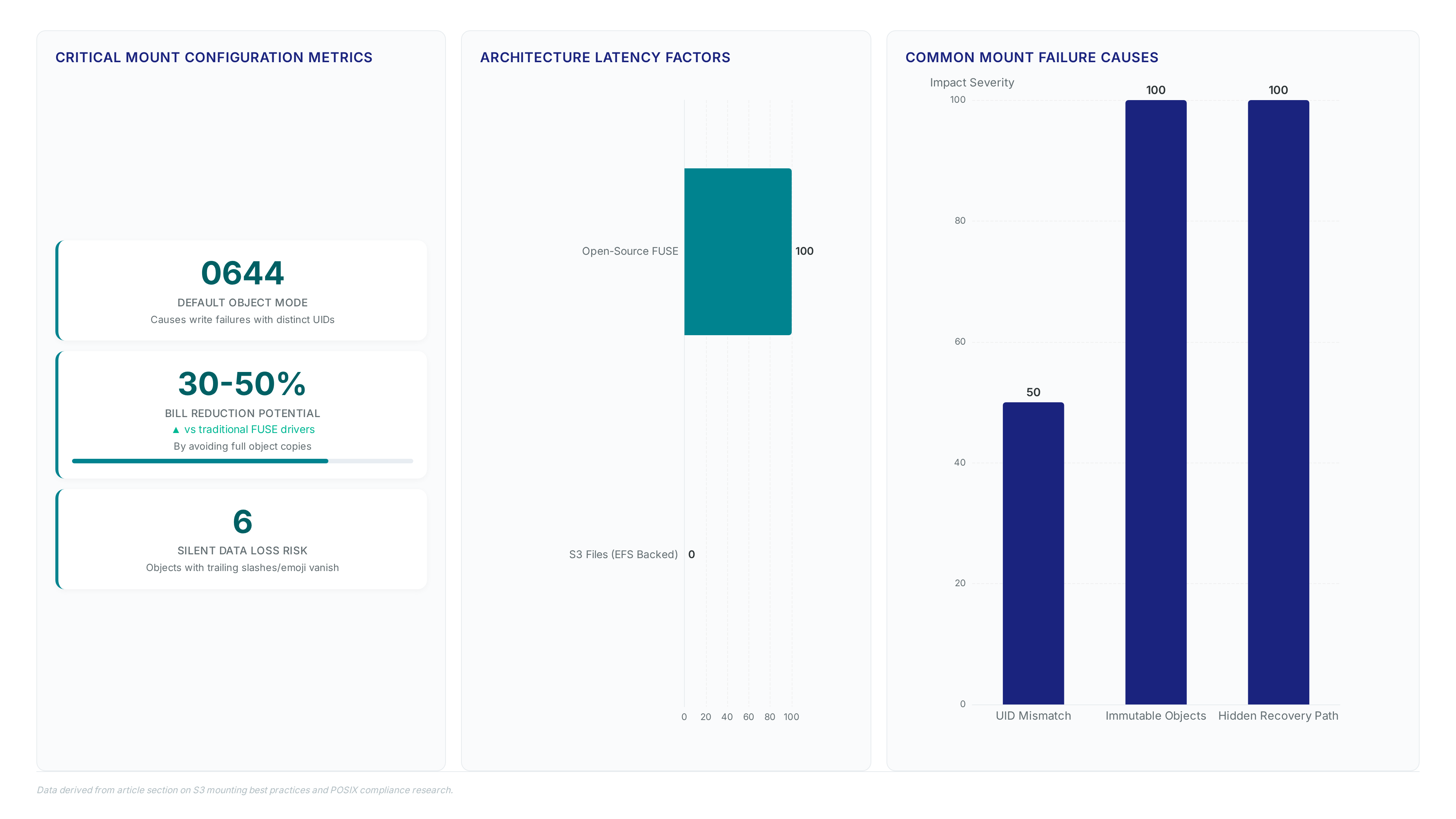
Objects created via the API lack ownership metadata. They default to root:root with mode 0644. This causes immediate write failures when access points enforce distinct UIDs.
- Verify the calling identity possesses the necessary IAM permissions to assume the specific IAM roles required for file system access before mounting.
- Configure security groups to allow TCP port 2049 traffic, as missing rules silently block NFS handshakes despite valid credentials.
- Inspect imported files for root:root ownership and adjust ACLs if the access point UID differs from the default.
S3 objects are immutable; filesystems expect mutability. This is the core tension. Writes directed to the cache incur access charges. Open-source FUSE drivers force full object copies for every modification, creating structural latency that S3 Files avoids through its EFS backing. This architectural choice eliminates copy-on-write delays but introduces a strict ownership model that APIs do not populate. Treat the NFS mount as a transient view rather than a persistent state holder. Failure to align UIDs results in readable but unwritable datasets. Pipeline automation breaks without generating explicit permission denied errors at the API level. You pay for cache storage while managing metadata gaps that traditional NAS solutions handle natively.
Locating the .s3files-lost+found- Directory for Conflict Resolution
Conflicting filesystem versions land in the . S3files-lost+found- directory situated at the real filesystem root. Operators must navigate to the bucket root to inspect this hidden folder. Mounting via an access point scoped to a subdirectory renders the recovery path invisible. This architectural constraint means files resolved by S3 during simultaneous writes vanish from the user's mounted view if the mount point does not include the root.
- Unmount any current subdirectory access points and remount the bucket targeting the root path explicitly.
- List all files including hidden entries to reveal the . S3files-lost+found- directory containing orphaned versions.
- Verify recovery steps immediately after any suspected conflict.
Six objects with trailing slashes or emoji vanish silently from the NFS view despite persisting in the bucket.
- Scan the bucket for keys exceeding the 1,024-byte S3 object key size limit before attempting any mount operation.
- Verify that POSIX permission metadata for every directory remains under the 2 KB threshold to prevent export failures.
- Monitor the ImportFailures metric in the AWS/S3/Files namespace rather than relying on client-side error logs.
- Remount the bucket at the root path if the . S3files-lost+found- directory appears missing due to access point scoping.
| Failure Mode | Client Signal | Detection Method |
|---|---|---|
| Invalid Key Name | None | CloudWatch Metric |
| Metadata Overflow | None | Pre-mount Audit |
| Access Point Scope | Hidden Directory | Root Remount |
Execute a pre-flight script to flag non-compliant keys. The NFS protocol returns success even when imports fail. Legacy naming conventions clash with full filesystem visibility. Objects violating these constraints remain accessible via the S3 API but disappear from the mounted hierarchy without generating NFS response errors. This silent failure mode creates a dangerous blind spot. Data integrity appears intact while specific files become unreachable to applications expecting standard POSIX behavior. Automate key validation pipelines to block non-compliant uploads before they enter the production bucket.
About
Alex Kumar, Senior Platform Engineer and Infrastructure Architect at Rabata. Io, brings deep practical expertise to the analysis of S3 Files. With a specialized background in Kubernetes storage architecture and disaster recovery, Kumar daily navigates the complexities of mounting object storage as persistent volumes for cloud-native applications. His direct experience optimizing S3-compatible infrastructure for AI/ML startups provides a unique lens for evaluating AWS's new NFS integration. At Rabata. Io, a provider dedicated to vendor lock-in elimination and high-performance object storage, Kumar constantly tests the boundaries of S3 API compatibility and conflict resolution mechanisms. This article uses his frontline work in designing cost-effective storage solutions to critically assess how S3 Files impacts real-world data consistency and enterprise scalability. His technical scrutiny ensures the evaluation moves beyond marketing hype to address genuine infrastructure challenges faced by engineers managing hybrid cloud environments.
Conclusion
Scaling S3 Files for AI workloads exposes a critical fracture. The operational latency of metadata reconciliation cannot keep pace with high-throughput training jobs without explicit architectural segmentation. The technology bridges object and file storage. Relying on default configurations for petabyte-scale datasets invites silent data invisibility where valid objects vanish from the filesystem view despite remaining billable. The real cost emerges not in storage rates, but in the engineering hours spent debugging missing tensors that the NFS layer failed to surface. Treat S3 Files as a specialized access layer rather than a universal drop-in replacement for legacy systems.
Adopt a hybrid segregation strategy by Q3 2026. Route static training datasets through direct S3 API calls for maximum throughput. Reserve the NFS mount exclusively for interactive debugging and low-frequency checkpointing. Do not attempt to force high-velocity write patterns through the filesystem interface until AWS reduces the metadata propagation window below five seconds. This separation prevents the consistency lag from corrupting model iteration cycles while maintaining human-readable access for operations teams.
Start by auditing your current bucket keys against the 1,024-byte limit and POSIX metadata thresholds this week using a serverless scanner. Block any uploads violating these constraints at the ingress point.
Frequently Asked Questions
Active data on the high-performance cache layer costs $0.30 per gigabyte monthly. Inactive data remaining in the underlying bucket stays at the standard $0.023 rate, ensuring bulk storage economics persist.
Read operations hitting the cache incur charges of $0.03 per gigabyte transferred. Write operations cost $0.06 per gigabyte because all data writes first to the EFS-backed cache layer.
Reads exceeding 128 kB stream directly from S3, avoiding extra cache fees entirely. This direct streaming capability supports throughput rates reaching 3 GB per second for each connected client.
New objects created through the S3 API take roughly 30 seconds to appear on the mount. This delay results from event propagation mechanisms synchronizing the filesystem view.
Files deleted via the API remain readable on the NFS mount for up to 18 seconds. This window exists because asynchronous sync mechanisms protect S3 from frequent mutations.