S3 Express One Zone: Why ML Teams Need Single-Digit Latency
AWS documentation claims data access speeds reach up to 10 times quicker than standard storage classes. This isn't just an incremental bump; it's a fundamental shift in how S3 Express One Zone redefines performance-critical storage. The architecture deliberately sacrifices multi-zone redundancy to achieve single-digit millisecond latency. That trade-off forces a rewrite of traditional cloud design patterns.
This article dissects the directory bucket mechanics driving that throughput. We'll look at why machine learning pipelines gain massive efficiency by co-locating compute and storage within a single failure domain. We also cover the operational reality of deploying these resources when Amazon S3 performance requirements outstrip what traditional object storage can deliver.
Forget the marketing fluff. We are addressing the tangible constraints of availability zone storage. By focusing on the technical implementation of low latency storage, we clarify exactly when this specialized class is necessary versus when it adds unnecessary complexity. Architects managing cloud object storage strategies in 2026 need these distinctions to avoid over-engineering or under-performing.
The Role of S3 Express One Zone in Low-Latency Cloud Architectures
S3 Express One Zone as a Single-Availability Zone Storage Class
S3 Express One Zone is a high-performance, single-Availability Zone storage class designed to deliver consistent single-digit millisecond data access for latency-sensitive applications. Unlike standard regional buckets that distribute data across multiple zones, this architecture co-locates compute and storage within a specific Availability Zone to eliminate cross-zone network hops. This shift from region-level to AZ-level placement fundamentally changes how engineers approach low latency storage design patterns.
Placing storage in a single zone removes availability redundancy inherent in regional classes, creating a direct dependency on the health of that specific zone. Operators must architect applications with failure domain awareness, trading multi-zone durability for predictable performance gains. The S3 directory bucket structure supports this throughput by enabling parallel access streams optimized for performance-sensitive applications.
This configuration is particularly effective for ephemeral training datasets or intermediate shuffle spaces where speed outweighs the need for zonal failover.
| Feature | Standard S3 Bucket | S3 Express One Zone |
|---|---|---|
| Placement Scope | Regional (3 AZs) | Single Availability Zone |
| Bucket Type | General Purpose | Directory Bucket |
| Latency Profile | Variable milliseconds | Consistent single-digit ms |
| Throughput Limit | Scales with prefixes | Up to millions of RPS |
Teams migrating batch jobs often overlook this architectural shift, assuming identical resiliency characteristics between bucket types. They don't.
Co-locating Compute and S3 Express One Zone for Latency-Sensitive Workloads
Co-locating compute resources with S3 Express One Zone in the same Availability Zone eliminates cross-zone network hops to accelerate data retrieval. This architectural alignment allows engineers to run workloads quicker while simultaneously lowering overall compute costs by reducing idle wait states.
Such capacity enables frequent access patterns typical in machine learning training loops where thousands of small files must be read concurrently. Unlike regional buckets that replicate data automatically, this single-zone design prioritizes speed over multi-zone durability. This approach suits transient processing clusters where performance outweighs the need for multi-zone durability during the job runtime. This pattern is well-suited for batch processing pipelines that can tolerate zone boundaries in exchange for significant speed gains.
S3 Express One Zone Versus S3 Standard: Speed and Cost Trade-offs
S3 Express One Zone delivers data access speeds up to 10x faster than S3 Standard for latency-sensitive workloads. This performance leap stems from storing objects in a directory bucket within a single Availability Zone, removing the coordination overhead inherent in regional designs. Operators gain single-digit millisecond latency necessary for iterative machine learning training where straggler tasks delay entire epochs.
Request costs drop significantly, with reductions up to 80 percent compared to the standard tier when accessing frequently used datasets. The economic model favors high-frequency access patterns over archival storage, shifting the total cost of ownership for active data lakes. Teams must weigh this efficiency against the risk of zone-localized outages, as data resides in only one facility.
This tier is specifically deployed for transient processing layers where compute proximity dictates overall pipeline throughput. Use cases like media transcoding or real-time analytics benefit most from this co-located architecture. Understanding these storage classes ensures architects match infrastructure capabilities to application durability needs without overspending on unused redundancy.
Inside S3 Express Architecture and Directory Bucket Mechanics
S3 Directory Bucket Mechanics and the CreateSession API
Amazon S3 Express One Zone delivers single-digit millisecond latency by confining storage to a single Availability Zone. This architecture introduces the directory bucket, a distinct container type that replaces the flat namespace of general purpose buckets with a hierarchical structure optimized for high throughput.
This session-based mechanism supports high-performance workloads by maintaining persistent connections that reduce authentication overhead for object requests. Applications requiring consistent speed for latency-sensitive tasks benefit from this tight coupling of resources.
| Feature | General Purpose Bucket | Directory Bucket |
|---|---|---|
| Namespace | Flat | Hierarchical |
| Access Pattern | Request/Response | Session-based |
| Optimization | Durability | Low Latency |
| Zone Scope | Multi-AZ | Single-AZ |
The trade-off is reduced redundancy; single-zone deployment sacrifices multi-AZ durability for speed. Because data is stored in a single Availability Zone instead of being replicated across multiple zones, the storage class offers lower redundancy than standard options. This configuration is purpose-built for latency-sensitive applications where compute speed is prioritized. The CreateSession workflow fundamentally changes how clients interact with object storage, using persistent connections to minimize protocol chatter and maximize data transfer efficiency for training pipelines.
Co-locating EC2 and EKS with S3 Express for AI/ML Workloads
This architectural alignment allows artificial intelligence frameworks like PyTorch to ingest batches with single-digit millisecond latency, effectively turning object storage into a high-speed scratch pad for active datasets. The mechanism relies on the S3:CreateSession API to maintain persistent connections, ensuring that thousands of parallel workers do not saturate authentication gates during data shuffling.
However, this performance gain introduces a strict dependency on local zone availability; if the specific Availability Zone hosting the compute resources suffers an outage, the co-located data becomes inaccessible until recovery, unlike multi-zone replicated storage. Operators must weigh the benefit of quicker iteration cycles against the risk of localized failure domains when designing fault-tolerant pipelines. This configuration is best suited for workloads where data can be re-ingested or replicated from a durable source of truth. The cost implication favors high-throughput scenarios where reduced compute time offsets the premium for low-latency access.
Directory Buckets Versus General Purpose Buckets: Latency and Redundancy
S3 Express One Zone delivers data access speeds up to 10 times quicker than the Amazon S3 Standard storage class by fundamentally altering redundancy models. Unlike S3 Standard, which replicates data across a minimum of three Availability Zones to achieve high availability, S3 Express One Zone stores data in a single Availability Zone. General purpose buckets replicate objects across three distinct Availability Zones to achieve high durability, a design that inherently introduces network latency during write and read operations. In contrast, directory buckets reside exclusively within a single Availability Zone, allowing compute instances to access storage locally without traversing the wider regional network.
Engineers deploying these systems must recognize that moving to directory buckets shifts the storage location from a multi-zone distributed model to a single-zone model, requiring application logic to account for zone-specific availability. This configuration is appropriate for stateless compute clusters where data can be re-ingested or replicated via alternative pipelines if a zone failure occurs.
Deploying S3 Express for Machine Learning and Analytics Workloads
S3 Express One Zone Latency Mechanics for AI Training
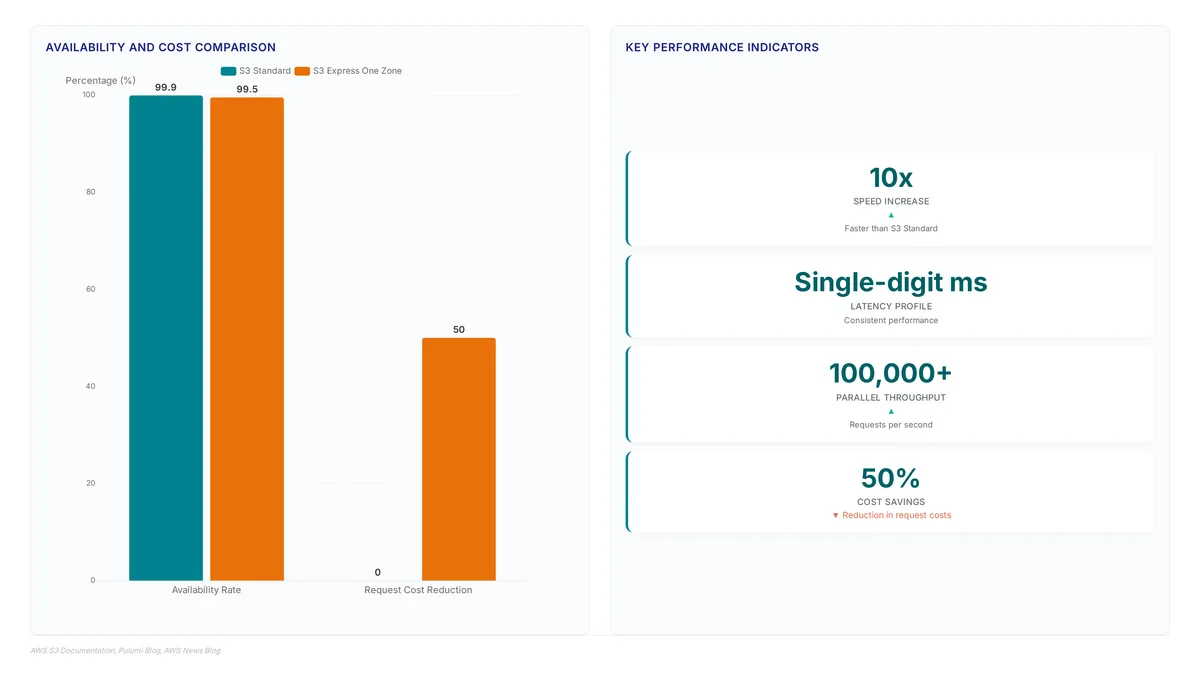
Co-locating compute and storage within a single Availability Zone delivers consistent single-digit millisecond request latency for performance-intensive workloads. This architecture eliminates the network hops typical of regional storage, accelerating model training by processing datasets significantly quicker than standard access patterns allow.
The mechanism relies on directory buckets, a specialized container type that maps directly to local zone resources. Unlike general-purpose buckets, these structures bypass distributed coordination overhead, enabling data access speeds up to 10x faster for latency-sensitive applications. Request costs drop 50 percent compared to standard tiers, rewarding high-throughput read patterns common in AI development.
However, this performance gain introduces a strict availability constraint: data resides in only one zone. A failure in that specific Availability Zone renders the bucket inaccessible until service restoration, unlike multi-zone replicas that survive local outages. Operators must weigh this risk against the throughput benefits, often mitigating it by maintaining asynchronous copies in durable regional storage.
Selecting the right storage class depends on whether the workload prioritizes raw speed or durability against zone failures.
Scaling Interactive Analytics on Petabytes with S3 Express
Querying petabytes of data requires quicker processing speed to gain insights without latency bottlenecks. Organizations asking should i use s3 express for analytics must prioritize workloads demanding high-throughput access patterns. The mechanism uses directory buckets that co-locate storage and compute within a single Availability Zone. This architecture accelerates query speed significantly compared to standard object storage tiers. Data access speeds improve dramatically, allowing Trino and Spark engines to scan massive datasets efficiently.
However, the single-AZ design introduces a durability trade-off; data durability relies entirely on one zone rather than regional replication.
Architectures scale to millions of requests per minute without pre-provisioning by using familiar Amazon S3 APIs. This elasticity removes capacity planning bottlenecks for machine learning training clusters that demand sudden throughput spikes. Operators configure directory buckets to co-locate data with compute instances, ensuring single-digit millisecond latency persists during elastic expansion. The mechanism bypasses standard regional routing, allowing applications to ingest data at speeds previously impossible with general-purpose storage.
A hidden tension exists between maximum throughput and cross-zone redundancy; scaling purely for speed concentrates risk within one failure domain. Teams using Amazon EMR can validate this architecture by linking directly to supported Spark workloads for immediate performance gains. The cost implication is clear: request charges drop significantly compared to standard tiers, optimizing TCO for high-frequency access patterns. However, relying on a single Availability Zone means durability depends entirely on that zone's health, requiring strong backup strategies elsewhere.rabata.io recommends deploying this pattern specifically for ephemeral training data where performance outweighs regional durability needs.
- Verify instance placement matches the bucket's Availability Zone.
- Confirm application SDKs support the new bucket type.
- Monitor request rates to ensure linear scaling behavior.
- Establish replication rules for critical dataset preservation.
- Test failover procedures to standard storage if needed.
- Review billing metrics after initial high-volume ingestion.
This approach ensures teams gain speed without sacrificing operational control over their data pipelines.
Migrating Data to S3 Express Directory Buckets in Five Steps
Defining the S3 Directory Bucket and Import Button Workflow

Creation of an S3 directory bucket inside a specific Availability Zone unlocks single-digit millisecond data access. This container type separates itself from general purpose buckets by placing storage directly alongside compute resources within that same zone.rabata.io engineers select this architecture for AI/ML training data because latency directly influences model convergence time. The design uses directory buckets that handle hundreds of thousands of requests per second, avoiding the throttling often seen in regional storage. Performance gains come with a constraint: data durability exists only in one zone. Architects must manually replicate critical datasets to satisfy disaster recovery plans.
Migration happens through the Import button, a managed method for copying objects from a general purpose bucket or prefix located in the same AWS Region. This workflow removes the need for complex ETL jobs when shifting terabytes of media assets or backup archives. Source and destination buckets must sit in the same AWS Region to use this native transfer capability. Cross-region imports demand alternative tools like the AWS CLI or third-party sync utilities instead.
- Select the target Availability Zone matching your compute fleet.
- Configure the new bucket as a directory type.
- Initiate transfer via the Import function for same-region sources.
Applying S3 Express One Zone to AI/ML Frameworks Like PyTorch
Direct co-location with compute instances in a single Availability Zone allows directory buckets to support artificial intelligence and machine learning services effectively. Frameworks like PyTorch bypass network hops under this architecture, delivering the single-digit millisecond latency high-throughput training jobs require. Engineers at Rabata.io configure EKS clusters to mount these buckets as primary data sources, which eliminates distributed storage bottlenecks during epoch shuffling.
- Identify the target dataset residing in a standard general-purpose bucket within the same AWS Region.
- Initiate the transfer using the Import button in the console to copy objects directly into the new directory bucket.
- Update the PyTorch `DataLoader` configuration to point to the `s3express` endpoint for the specific zone.
Applications processing hundreds of parallel nodes show significant runtime reductions for data-intensive workloads AWS News Blog. Speed introduces a limitation since data resides only in one zone, unlike the 99.999999999% durability of regional buckets. Operators replicate critical assets manually if disaster recovery across zones is a requirement. ML teams should reserve this tier for active training sets where latency dictates model convergence time rather than cold archival storage.
Checklist for Configuring Access and Validating TCO Reduction
Confirmation of single-digit millisecond latency after migration validates access configurations and TCO gains. Engineers at Rabata.io recommend verifying that applications co-located within the same Availability Zone achieve the expected performance uplift before scaling workloads.
- Create a new directory bucket in the target Availability Zone to establish the high-performance storage endpoint.
- Select the source dataset from a general-purpose bucket and click the Import button to copy objects into the new container.
- Update application endpoints to point to the new bucket URI, ensuring compute instances reside in the matching zone.
- Monitor API request counts to confirm the reduction in request costs compared to standard storage tiers.
Lower latency, quicker processing times, and decreased compute overhead reduce overall TCO through this architectural shift. The Import button simplifies migration, yet operators must manage replication strategies manually because durability is scoped to a single zone. This constraint favors performance-critical paths where speed outweighs multi-zone redundancy requirements. Validating these metrics confirms the deployment meets strict demands of latency-sensitive analytics.
About
Alex Kumar is a Senior Platform Engineer and Infrastructure Architect at Rabata.io, where he specializes in Kubernetes storage architecture and cost optimization for cloud-native applications. His daily work designing persistent storage solutions and managing high-performance data pipelines gives him unique insight into the critical need for single-digit millisecond latency in machine learning workflows. At Rabata.io, an S3-compatible object storage provider built for AI/ML startups, Alex directly addresses the performance bottlenecks that standard cloud storage often introduces. He uses deep expertise in CSI drivers and infrastructure-as-code to help teams co-locate storage and compute effectively. This practical experience allows him to analyze S3 Express One Zone's directory bucket structure and performance claims against real-world production requirements. By evaluating how low-latency storage impacts model training speeds, Alex provides authoritative guidance on whether migrating to performance-critical storage classes aligns with specific architectural goals and budget constraints.
Conclusion
Scaling high-throughput workloads reveals that raw speed often masks a fragile reliance on single-zone integrity. While request costs drop significantly, the operational burden shifts from managing latency to engineering durability manually. You cannot assume infrastructure will self-heal across zones when data locality is the primary design constraint. This architectural trade-off demands a disciplined separation between ephemeral processing layers and persistent system-of-record storage. Treat this tier as a high-velocity cache rather than a permanent archive to avoid catastrophic data loss scenarios.
Adopt this storage class specifically for active machine learning instruction sets or intermediate shuffle spaces where compute wait-times dominate total job duration. Do not migrate static assets or compliance-critical logs that require inherent multi-zone redundancy. The window for casual experimentation is closing as production standards mature; by 2027, this technology will be a standard utility rather than a novelty optimization. Your strategy must reflect this shift from experimental tuning to rigorous operational policy.
Start by auditing your current batch processing logs this week to identify jobs where I/O wait time exceeds twenty percent of total runtime. Isolate one non-critical pipeline and provision a test directory bucket in the same Availability Zone as your compute fleet. Measure the delta in completion time against your baseline to validate the performance uplift before committing broader datasets.
Frequently Asked Questions
Access speeds reach up to 10 times faster than standard classes. This enables consistent single-digit millisecond latency for your most performance-critical workloads.
Request costs drop by up to 50% compared to standard tiers. This significant reduction makes high-frequency access patterns much more economical for active datasets.
The system handles up to a large number requests per second. This massive parallelism supports thousands of concurrent compute nodes without creating bottlenecks.
Data resides in one zone, lacking the 99.999999999% durability of regional buckets. You must design applications to tolerate single-zone failures for this speed.
Costs for frequent access can be reduced by up to 80%. This model favors active workloads where speed and low cost outweigh multi-zone redundancy needs.
References