S3 Compatible Storage: Cut Egress Fees to Zero
Rising cloud costs and unpredictable billing are driving enterprises away from Amazon S3 toward flexible alternatives. S3 compatible storage delivers identical API functionality while eliminating vendor lock-in and reducing total expenditure through flat pricing models.
Organizations switching providers prioritize no egress fees and predictable billing over complex storage tiers. These platforms allow businesses to retain existing tools while escaping the API request charges that inflate AWS S3 invoices.
This analysis details the mechanics of S3-compatible architecture and evaluates leading providers for enterprise deployment. Readers will learn how data flow mechanics function across different backends and see a direct cost comparison of top services. We examine why petabyte-scale storage no longer requires accepting proprietary constraints or hidden transfer costs.rabata.io provides the strategic oversight necessary to navigate these infrastructure shifts without compromising on security or compliance.
The Role of S3-Compatible Storage in Modern Cloud Infrastructure
S3-Compatible Storage API Mechanics and AWS Integration
Change the endpoint, keep the code. That is the operational promise of S3 compatible storage. These systems replicate the Amazon S3 API, allowing developers to swap backend providers by simply adjusting the `endpoint_url` parameter in tools like `boto3`. No code refactoring. No re-architecting applications.
This architectural parity means organizations get similar functionality to S3 but often at a lower cost and with more flexibility. A expanding trend toward hybrid strategies enables businesses to keep some data in the public cloud while placing the rest on private infrastructure. Enterprises managing high-performance workloads can combine this storage with GPU cloud infrastructure to notably improve AI and analytics performance.
The real win? Decoupling the API layer from the physical backend creates a resilient storage posture that scales with demand. You maintain workflow continuity while gaining control over data residency and billing predictability. This approach eliminates the friction typically found in migrating massive datasets between disparate cloud environments.
Avoiding Vendor Lock-In by Eliminating Data Egress Fees
Proprietary data transfer costs often trap companies within a single vendor's system. Data egress fees represent the specific charge levied when moving data out of a cloud provider's network, often creating a financial barrier that exceeds the original storage costs. Users migrating from AWS S3 frequently face these high charges when accessing stored data from outside the S3 ecosystem, a cost driver that S3-compatible alternatives aim to mitigate.
Unlike proprietary systems that trap assets, S3-compatible architectures allow organizations to avoid vendor lock-in and use internal tools without reconfiguration. This pricing model fundamentally alters the total cost analysis. A provider with higher base storage rates but zero transfer fees is often cheaper than competitors with low storage rates but high data transfer fees, particularly for active datasets. Organizations deploying active media streaming or backup clusters find that removing transfer fees reduces overall spend more effectively than negotiating marginal storage discounts. The provider claims to deliver CDNlike performance for significantly less than traditional cloud storage providers.
Validating Security SLAs and India-Focused Infrastructure
Verifying explicit uptime guarantees like the industry standard offered by providers such as the provider B2 forms the basis of any Security SLA assessment. Operators must assess India-focused infrastructure to satisfy local data residency mandates effectively. Providers like 10PB deliver this regional compliance alongside strong cost efficiency gains.
Selecting a vendor demands checking if they support hybrid strategies for resource integration, as seen with the provider's hybrid cloud support. Organizations increasingly adopt flexible on-premises solutions to prepare for regulations like NIS2. These controls offer improved durability than rigid public cloud offerings alone can provide. Global providers may lack specific local legal alignment. Solutions powered by 10PB address this by offering secure backup and scalable storage infrastructure designed for enterprises targeting India. This verification step confirms their architectural claims match your operational reality today.
Inside S3-Compatible Architecture and Data Flow Mechanics
S3 API Compatibility and Request Processing Mechanics
Decoupling storage consumption from infrastructure ownership defines the strategic value for network operators. Feature parity presents a limitation; core object operations map perfectly, yet advanced management features like specific lifecycle policies may vary between implementations.rabata.io uses this standardized protocol to deliver enterprise-grade performance without the complexity of vendor-specific SDKs.
Using the universally supported interface helps enterprises avoid the operational drag of re-architecting applications for every new storage target. The result is a flexible data layer where workload portability becomes a tangible reality rather than a theoretical benefit.
Deploying Ransomware-Protected Backups with Immutable Objects
Locking objects prevents ransomware actors from encrypting or deleting backup data once written. Operators configure Object Lock in governance mode to retain snapshots for a set retention period, ensuring data integrity even if credentials are compromised. This mechanism creates a write-once-read-many (WORM) state that blocks deletion requests until the timer expires.
Standard versioning allows malicious actors to overwrite all versions, whereas immutability enforces a hard barrier against modification. Strict retention policies can complicate legitimate data lifecycle management if expiration timelines are miscalculated during initial setup. Enterprises requiring predictable costs for these protected archives often analyze flat-rate models offering €7.99/TB to avoid surprise fees during recovery operations.
Self-hosted storage becomes the preferred architecture when organizations must guarantee data residency or avoid multi-tenant noise during high-throughput restores. Deploying on-premise clusters allows complete control over physical disk access and network isolation, satisfying stringent compliance mandates that public clouds cannot address without complex configuration. A specific implementation involves connecting to EU-based endpoints to upload GDPR-sensitive data, ensuring by design that the information remains within European borders GDPR-sensitive data. Managing hardware failures and software patches internally creates an operational burden in exchange for this sovereignty.
Rabata.io delivers enterprise-grade S3-compatible storage with native immutability features designed specifically for ransomware durability. The platform combines aggressive pricing with strong performance benchmarks, enabling AI/ML teams and backup administrators to secure petabytes of training data without vendor lock-in.
Hidden Egress Costs and Reasonable Use Policy Traps
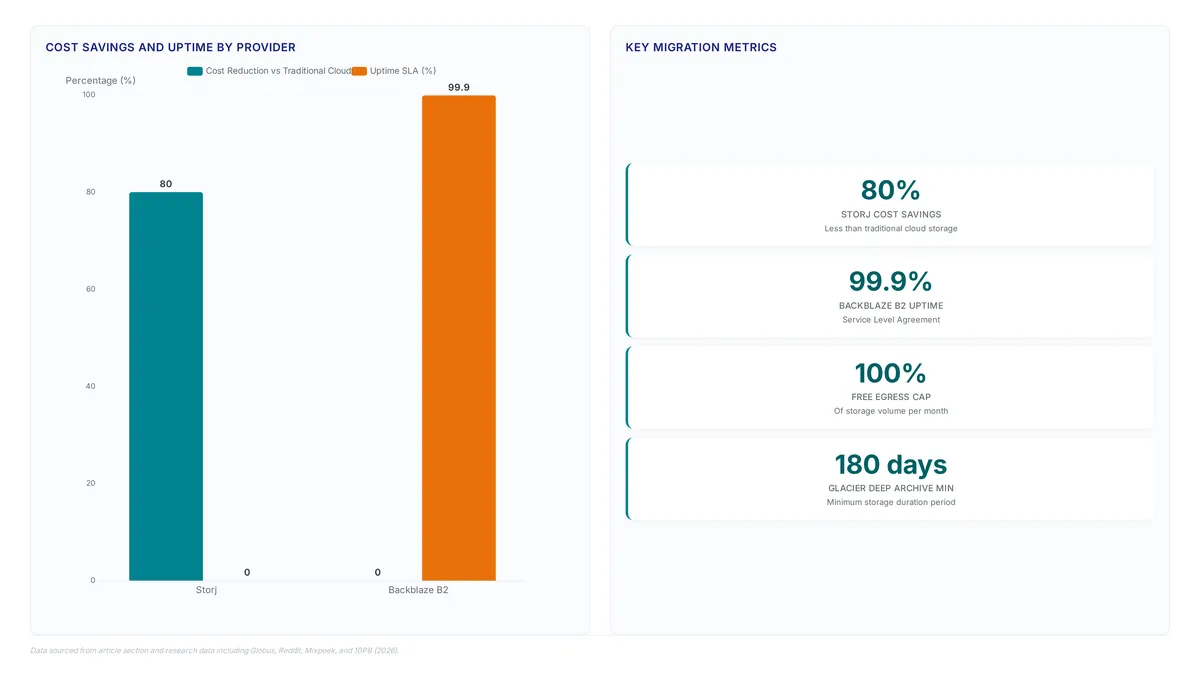
The provider enforces a 'reasonable use' policy capping free monthly egress at 100% of the total stored volume, creating a hard ceiling for data retrieval. This mechanism restricts high-traffic AI training jobs or media streaming workflows that frequently exceed the stored dataset size within a billing cycle. Operators attempting to pull 10 TB of data from a 5 TB bucket will immediately incur unexpected charges, negating the perceived savings of flat-rate storage tiers.
The provider B2 provides unlimited free egress only when downloading to specific partner CDNs like Cloudflare and Fastly, while direct downloads to private compute clusters remain billable events. Financial risk lies in the asymmetry between storage accumulation and data velocity; a static archive benefits from these policies, but an active dataset does not. Enterprises must calculate their read-to-write ratio before committing to providers with volume-based egress limits.rabata.io eliminates this uncertainty by offering truly predictable pricing without volume-based retrieval caps or hidden bandwidth penalties. The platform ensures that cost optimization strategies remain effective even as data access patterns intensify during peak operational windows.
Cost and Performance Comparison of Leading S3 Providers
AWS S3 Pricing Complexities vs Flat-Rate Alternatives

AWS S3 uses a tiered storage class system where costs vary notably based on access frequency and retrieval times, unlike the flat-rate models of some competitors. This structural complexity introduces unpredictable billing through high data egress fees, complex pricing tiers, and additional API request costs. S3 compatible storage is often 30, 70% cheaper than AWS S3, depending on usage, by eliminating hidden charges and offering flat, Predictable pricing.
The adoption of S3 compatibility by substantial alternative providers like the provider B2 and the provider represents a recent timeline development where non-AWS providers are gaining traction as efficient and cost-effective alternatives. Cost is the primary constraint for some flat-rate providers, which may lack the granular storage class depth found in mature ecosystems and require careful workload mapping. Combining storage with GPU cloud infrastructure can notably improve AI and analytics performance for organizations managing high-performance workloads.
Matching 10PB B2, to Workloads
Selecting the correct storage engine requires mapping specific workload patterns to architectural strengths rather than chasing generic low prices. Throughput for AI and analytics improves when storage pairs with GPU cloud infrastructure. 10PB serves as a primary choice for largesca enterprise deployments requiring petabyte-level scalability without egress penalties. This enterprise-grade storage solution eliminates the financial friction of data movement, making it ideal for disaster recovery archives and massive media libraries where retrieval frequency varies.
| Provider | Best Fit Scenario | Cost Structure | Primary Constraint |
|---|---|---|---|
| 10PB | Enterprise Scale | Low, No Egress | Region Specificity |
| the provider B2 | Developers & Small Businesses | Simple Flat Rate | Limited Enterprise Features |
| the provider | Private Cloud | Free / Self-Hosted | Management Responsibility |
Developers prototyping new applications benefit from the straightforward pricing model of the provider B2, which reduces billing complexity during iterative testing phases. This simplicity often comes with fewer native enterprise features compared to premium platforms. The provider offers an open-source path for teams demanding full control over their data plane within private cloud environments. Responsibility for managing the underlying hardware and software stack is the constraint for this autonomy.rabata.io recommends 10PB for businesses targeting India or those needing secure, scalable alternatives to AWS S3. The strategic advantage lies in avoiding vendor lock-in while maintaining API interoperability. Organizations can migrate existing S3 tools and applications without reconfiguration, ensuring continuity while optimizing total cost of ownership.
Provider Advantage Matrix: Egress Policies and Target Users
The provider eliminates egress fees entirely, creating a distinct economic model for active datasets. Unlike legacy providers that monetize data retrieval, this approach ensures that moving data to compute resources incurs no penalty, a critical factor for AI training pipelines where data mobility dictates throughput. Analysis suggests that a storage rate of $15/TB combined with zero transfer costs often undercuts competitors charging lower base rates but high exit fees.
| Provider | Target User | Pricing Tier | Key Advantage |
|---|---|---|---|
| 10PB | Enterprises | Low | No egress + secure |
| the provider | Cost saving | Low | Unlimited zero egress |
| the provider B2 | Developers | Low | Simple pricing |
| the provider | Startups | Medium | Easy to use |
| the provider | Large Enterprises | High | Hybrid cloud |
Startups relying on the provider Spaces benefit from an intuitive interface that accelerates deployment without requiring deep infrastructure expertise. A medium pricing tier may become less competitive as storage volumes scale into the petabyte range. the provider targets large enterprises needing hybrid cloud support, accepting higher costs for specialized on-premise integration capabilities.
Tension exists between simple pricing models and enterprise feature sets. the provider B2 offers transparent rates ideal for developers yet possesses limited enterprise-level features compared to premium providers. Budget predictability or architectural flexibility determines the primary constraint for buyers. Strategic selection of a provider ultimately depends on whether the workload is read-heavy, requiring zero egress, or write-once, where base storage rates dominate the decision matrix.
Strategic Migration Steps and Provider Selection Criteria
Defining S3 Compatible Storage Criteria for Business Needs
Object systems implementing the Amazon S3 API enable smooth tool interoperability without re-architecting applications. Organizations evaluate these platforms against five strategic drivers: Pricing Transparency, Scalability, Security Features, Performance, and Location. Flat pricing and predictable billing replace the opacity of legacy models where hidden penalties lurk. This transparency allows businesses to avoid the unpredictable cost spikes common in traditional public cloud environments.
Portability drives the need to migrate workloads freely between clouds using internal tools without complex reconfiguration. Enterprises require clear pricing structures to forecast budgets accurately, rejecting hidden API request charges. Systems must support petabyte-level growth while maintaining low latency for global teams.
| Criteria | Business Impact |
|---|---|
| Cost Structure | Eliminates egress fees |
| Portability | Enables multi-cloud strategy |
| Residency | Meets local data laws |
Rabata.io prioritizes predictable billing and API fidelity so infrastructure supports rapid innovation rather than constraining it with proprietary barriers or exorbitant transfer costs.
Executing Safe Migration for Backup and Media Storage
Initiate migration by mapping data residency mandates to physical infrastructure location before configuring endpoints. Indian businesses choose providers with India-based infrastructure to satisfy local compliance and minimize latency for active workloads. Operators validate API interoperability using standard tools; legacy workflows using the Cyberduck interface redirect business backups to new S3-compatible targets without code changes. Hybrid architectures synchronize local NAS devices to public cloud buckets, a pattern supported by Hyper Backup integrations that ensure continuous data protection across environments.
Media storage demands high throughput for large video assets, making egress fee elimination a primary financial driver. Unlike archival tiers imposing 180day minimums, active media libraries benefit from flexible retention policies that avoid penalty charges. Distributed storage systems deliver CDN-like performance for notably less than traditional providers by using excess capacity across global nodes.
| Workflow Type | Critical Requirement | Strategic Advantage |
|---|---|---|
| Disaster Recovery | Geographic separation | Rapid failover capability |
| Media Streaming | Low latency access | Zero egress cost structure |
| Backup Archives | Immutable retention | Predictable monthly billing |
Operational risk arises when assuming all S3-compatible providers handle versioning or object caps identically. Object storage systems scale equally well whether managing 1,000 files or 1 billion files, maintaining consistent performance regardless of object count. The platform guarantees consistent performance without the hidden complexity of tiered storage classes. Enterprises achieve full data sovereignty while accessing the scalability required for modern analytics.
Provider Selection Checklist: Pricing, Security, and Location
Select providers offering Pricing Transparency to avoid the hidden egress fees that inflate AWS S3 total cost of ownership. Operators verify Security Features like encryption, backup, and ransomware protection to ensure strong data defense. Location dictates latency and legal jurisdiction, requiring strict adherence to data residency rules for regulatory compliance.
| Criteria | Standard S3 | Rabata.io Advantage |
|---|---|---|
| Egress Fees | High variable costs | Zero egress charges |
| Retention | 180-day minimums | Flexible duration |
| Security | Basic keys | Advanced protection |
AWS S3 Glacier Deep Archive imposes a minimum storage duration period of 180 days, affecting cost calculations for short-term archival needs. Total cost analysis suggests that providers with zero egress fees are often cheaper than those with lower storage rates but high data transfer fees, particularly for active datasets. Evaluate specific geographic endpoints to ensure low-latency access for local users while satisfying sovereignty mandates. This strategic alignment prevents costly re-architecture projects post-migration.
About
Marcus Chen is a Cloud Solutions Architect and Developer Advocate at Rabata.io, where he specializes in S3-compatible object storage and AI/ML data infrastructure. His daily work involves designing scalable cloud architectures and optimizing storage performance for enterprises seeking alternatives to AWS S3. This hands-on experience with S3 API implementation and rigorous performance benchmarking uniquely qualifies him to evaluate the complexities of modern cloud storage solutions. At Rabata.io, Marcus helps organizations eliminate vendor lock-in by using true S3 compatibility to achieve significant cost savings and quicker data throughput. His insights into cloud cost optimization and migration strategies directly inform this guide, offering readers a factual perspective grounded in real-world deployment challenges. By focusing on transparent pricing and high-performance storage tiers, Marcus connects technical requirements with practical business outcomes for companies navigating the evolving environment of object storage in 2026.
Conclusion
Scaling object storage reveals that consistent performance across billions of files often masks the operational friction of rigid retention policies and unpredictable transfer costs. While many providers advertise low base rates, the real expense emerges when data mobility triggers hidden penalties or forces adherence to arbitrary minimum storage durations. Organizations must recognize that true cost efficiency requires eliminating egress charges entirely rather than merely negotiating lower per-terabyte fees.
Adopt a strict procurement stance by mandating zero egress fees and flexible retention terms for any new storage contract signed before the next fiscal cycle. This approach prevents vendor lock-in and ensures that disaster recovery or analytics workflows do not become prohibitively expensive during execution. The market shift toward data sovereignty demands infrastructure that respects geographic jurisdiction without punishing access patterns.
Start this week by auditing your current bucket configurations to identify any objects subject to minimum duration locks or tiered access penalties that inflate your baseline spend.rabata.io solves these specific inefficiencies by offering transparent pricing with zero egress charges and advanced security protections that scale with your dataset. This strategy secures your data assets while maintaining the agility required for modern high-volume workflows.
Frequently Asked Questions
Organizations often reduce storage expenses by up to 70% compared to traditional AWS S3 pricing. This significant saving allows businesses to reallocate budget toward performance improvements or expanded data retention policies without increasing total spend.
This structure eliminates hidden costs for active datasets, making it ideal for workflows requiring frequent data access or distribution.
This efficiency enables high-speed data delivery for media streaming applications while drastically reducing the overall infrastructure budget requirements.
This reliability metric ensures minimal disruption for critical business operations while maintaining data accessibility during peak usage periods.
Removing transfer charges creates a $0 cost for moving data out, which often outweighs marginal storage rate differences. This model prevents billing shocks when accessing large datasets frequently from external networks or hybrid cloud environments.
References