S3-compatible object storage cuts AWS costs by 70% today
S3-compatible object storage lets you run Amazon S3 workloads outside AWS without rewriting a single line of code. This technology has evolved from a simple clone into the mandatory backbone for AI data ingestion and hybrid cloud architectures. By decoupling the S3 API from Amazon's proprietary infrastructure, organizations eliminate vendor lock-in while retaining the ability to scale unstructured data to petabytes.
You will learn how the S3 API functions as a universal translator for MLOps pipelines and backup systems, allowing smooth data movement between on-premises nodes and public clouds. The discussion details the internal mechanics of bucket addressing and how erasure coding distributes data across drives to ensure durability without the complexity of traditional file hierarchies. We also examine why this model outperforms legacy block storage for continuously expanding machine learning training sets.
While Amazon S3 Standard storage costs $0.023 per GB-month for the first 50 TB in the US East region according to AWS pricing data, the real value lies in portability. F5 notes that this compatibility creates a common storage language, ensuring applications assume S3 semantics by default regardless of the underlying hardware. The result is a resilient system where capacity scales horizontally with minimal operational friction.
The Role of S3-Compatible Object Storage in Modern Data Architectures
Defining S3-Compatible Object Storage and the S3 API Model
S3-compatible object storage functions as a cloud or on-premises system using the identical API and operational model found in Amazon S3. Instead of arranging data into files or blocks, the system organizes information into self-contained objects that bundle raw data with metadata and unique identifiers. Any platform implementing the S3 API qualifies as compatible, enabling applications written for Amazon S3 to manage data without modification. This definition establishes an interoperability layer where storage behaves like S3 even when operating outside AWS infrastructure. Industry guides highlight that this storage has evolved from a simple "write-and-forget" tier to a component of active application architectures. AI platforms, analytics engines, and MLOps pipelines all speak this API, allowing organizations to plug tools into systems without rewriting code. The system now features a divergence in pricing models regarding egress fees. This semantic gap means that while data movement is smooth, governance policies require explicit verification across different backends to ensure compliance.
Deploying S3-Compatible Storage for AI Platforms and MLOps Pipelines
Adopt S3-compatible storage when AI platforms require petabyte-scale expansion without rewriting application code. Organizations integrate analytics engines and MLOps pipelines by simply updating the endpoint URL, using the S3 REST API to maintain operational continuity across hybrid environments. This architectural approach treats data as flat objects within buckets, avoiding the complexity of hierarchical file systems while supporting continuous growth. The architecture scales naturally to petabytes and beyond, suiting machine learning training sets, feature stores, log archives, media files, and other forms of unstructured data. The decision between object and block storage hinges on access patterns; block storage suits low-latency transactional databases, whereas object storage optimizes throughput for unstructured datasets. A drop-in replacement strategy allows teams to shift workloads to cost-effective tiers immediately. Unlike block systems that struggle with scale, this model handles massive feature stores efficiently.
Latency for random read-modify-write operations increases within this flat architecture compared to block devices. Operators sacrifice low-level file manipulation for immense durability and global accessibility. As GPU infrastructure increasingly pairs with these stores, pricing models offered by various providers further reduce total cost of ownership for data-intensive AI workflows. This configuration is particularly the for enterprises prioritizing data portability over legacy filesystem semantics.
AWS S3 Native Costs Versus S3-Compatible Provider Savings
Amazon S3 Standard storage costs $0.023 per GB-month for the first 50 TB in the US East (N. Virginia) region. This baseline rate excludes egress charges, which are applied at a nominal fee per GB for data transferred to the internet. Such fee structures create significant variable cost exposure for AI training pipelines that require frequent data retrieval across network boundaries. S3-compatible storage alternatives are frequently 30, substantially cheaper than AWS S3 depending on usage patterns and workload types. Some providers achieve cost savings by eliminating egress fees and simplifying per-request charges via different pricing structures. The market is shifting toward zero-egress models where competitors challenge the traditional revenue model of data transfer fees found in legacy public clouds. An architecture relying on frequent data access suffers under high egress tariffs, whereas a zero-egress model flattens the cost curve for read-heavy workloads. Lower list prices sometimes correlate with reduced service level agreements or limited regional availability. Engineers must validate that performance benchmarks meet production requirements before migrating critical data lakes. Teams forecasting costs based solely on per-GB headline rates often face "bill shock" due to unanticipated request and retrieval charges.
Internal Mechanics of S3 API Data Flow and Bucket Addressing
S3 REST API Request Flow and Object Metadata Structure
Data movement within S3 REST API environments relies on standard HTTP verbs to manipulate content inside globally unique buckets.
- Request Initiation: Applications issue PUT commands containing payload and headers.
- Object Wrapping: Every piece of stored information is wrapped as an object containing data, metadata, and an identifying key, eliminating the need for a conventional directory structure. 3.
Flat namespaces replace traditional directory trees, permitting teams to deploy workflows anywhere the interface remains accessible.
| Feature | Traditional File System | S3 Object Model |
|---|---|---|
| Structure | Hierarchical Directories | Flat Key Space |
| Identifier | File Path | Unique Key |
| Scaling | Vertical (Single Node) | Horizontal (Distributed) |
Adoption of this model prevents vendor lock-in while sustaining interoperability across hybrid cloud boundaries. Strict immutability defines the operational cost; modifying an object necessitates a complete DELETE followed by a full replacement cycle. Engineers frequently architect pipelines that append logs to fresh objects instead of altering existing files in place. This constraint preserves data integrity yet forces application-level logic to handle versioning strategies explicitly.
Erasure Coding and Horizontal Scaling for AI Data Ingestion
Erasure coding distributes data shards across multiple nodes to guarantee durability without the storage overhead of full replication. The underlying store fragments objects into pieces accompanied by parity data, enabling reconstruction even when specific drives fail completely. High-throughput workflows exploit this parallelism, where solutions like the provider HyperStore support transfer speeds of up to 100 Gbps for massive scale. As storage nodes are added, capacity and throughput scale horizontally with minimal operational complexity, avoiding the fork-lift upgrades required by traditional SANs.
| Feature | Replication | Erasure Coding |
|---|---|---|
| Overhead | High (Multiple Copies) | Lower (Parity Based) |
| Durability | High | Extremely High |
| Rebuild Time | Fast | Compute Intensive |
Computational latency presents the primary drawback; reconstructing data from shards consumes more CPU cycles than reading a single copy, potentially impacting low-latency interactive queries. Architects often tier data to mitigate this issue, keeping hot datasets on replicated tiers while moving cold training sets to erasure-coded pools. Organizations managing these high-performance workloads combine S3-compatible storage with GPU cloud infrastructure to notably improve AI and analytics performance while managing costs. Maximum durability conflicts with write latency; aggressive parity schemes protect data but can slow ingestion rates during massive parallel uploads. Tuning shard widths based on specific cluster sizes helps balance reconstruction speed against storage efficiency. This approach ensures the S3 REST API remains responsive even as the underlying fabric expands to petabytes.
Connectivity Failures from Misconfigured Bucket Policies and Access Keys
Access depends on valid credentials paired with permissive resource definitions; a single syntax error in the policy JSON denies all traffic. Flat namespaces require precise key matching, so missing wildcards prevent object retrieval entirely.
| Failure Mode | Root Cause | Operational Impact |
|---|---|---|
| 403 Forbidden | Invalid Credentials | Request Rejection |
| Access Denied | Restrictive Bucket Policy | Data Access Blocked |
| Timeout | Network Configuration | Connection Failure |
The S3 security model demands exact alignment between identity policies and bucket constraints to function correctly. A misconfigured `Allow` statement excluding specific IP ranges prevents access, mimicking network congestion rather than permission errors. Troubleshooting network paths wastes hours when the fix resides in policy logic.
- Audit bucket policies for explicit `Deny` rules overriding allows.
- Test connectivity using standard PUT and GET operations.
Providers like the provider highlight this friction by offering zero egress fees, yet complex policies still alter flow regardless of cost structure. Granular security reduces operational agility; overly strict defaults protect data but can paralyze AI training jobs requiring broad read access. Validating policies against least-privilege templates before deploying production workloads helps avoid these silent failures.
Strategic Advantages of S3 Compatibility for AI and Hybrid Cloud
S3 API as the Universal Language for Hybrid Cloud Data

The S3 API functions as the de facto standard for large-scale data environments by decoupling application logic from underlying infrastructure. Any platform implementing this interface qualifies as S3-compatible, enabling AI platforms and analytics engines to read or write data without code modification. This interoperability eliminates vendor lock-in while establishing a common storage language across clouds, data centers, and edge sites. Organizations consolidate unstructured data such as backups and cloud-native application data across on-premise and cloud environments using this unified layer.
| Deployment Scope | Legacy Integration | S3-Compatible Approach |
| Code Changes | Extensive rewrites required | Zero code changes needed |
| Endpoint Config | Proprietary drivers | Update URL and credentials |
| Scalability | Vertical lift-and-shift | Horizontal node addition |
Teams execute migrations by simply updating the endpoint URL and credentials, allowing existing tools to continue functioning immediately. However, relying solely on API compatibility ignores performance variances where throughput can differ significantly between providers despite identical interfaces. The operational risk lies in assuming functional equivalence; while the S3 REST API ensures connectivity, throughput bottlenecks during massive AI training set ingestion require specific benchmark validation.
Eliminating Code Rewrites in MLOps and Analytics Pipelines
Changing only the endpoint URL and credentials allows existing MLOps tools to function immediately without source code modification. This drop-in replacement capability ensures that analytics engines and backup systems continue operating while shifting backend infrastructure to reduce costs. Organizations using S3 compatibility avoid the engineering debt associated with refactoring pipelines for proprietary APIs. The S3 API acts as a universal translator, enabling smooth data movement between on-premise clusters and public clouds.
| Integration Factor | Proprietary API | S3-Compatible Approach |
|---|---|---|
| Code Changes | Extensive rewrite required | Zero modification needed |
| Deployment Time | Weeks of testing | Immediate cutover |
| Vendor Risk | High lock-in potential | Portable architecture |
Teams often overlook that API consistency does not guarantee identical performance characteristics across different storage backends. Write speeds and latency profiles vary significantly depending on the underlying hardware and erasure coding configuration. Performance varies dramatically depending on the underlying hardware and erasure coding configuration, highlighting the need for workload-specific benchmarking before adoption. Enterprises consolidate unstructured data across hybrid environments by using this interoperability to unify operations.
AWS S3 Egress Fees Versus S3-Compatible Cost Savings
AI training workloads incur massive data transfer costs when retrieving datasets from native cloud buckets. Some S3-compatible providers offer cost savings of 35-75% compared to AWS S3 by eliminating egress fees and simplifying per-request charges. the provider charges a modest fee per TB per month for storage, making it cost-effective for high-transfer scenarios.
However, the trade-off involves network proximity; performance benchmarks indicate that Time to First Byte (TTFB) can vary significantly, with some S3-compatible solutions demonstrating higher latency compared to Amazon S3 in specific tests. Teams must balance storage savings against potential impacts on data loading times caused by these performance variances. For batch-oriented AI pipelines where data loading happens once or occurs asynchronously, the significant reduction in storage and egress costs often supports the migration case. This approach optimizes the total cost of ownership without sacrificing the interoperability of the S3 API.
Implementing Secure and Scalable Storage with F5 and S3 Protocols
F5 BIG-IP Components for S3 Traffic Orchestration
The F5 Application Delivery and Security Platform operates as an intelligent control plane directing traffic across distributed S3 environments. Specific BIG-IP modules manage distinct pipeline stages so data flows efficiently from extraction to refinement.
- BIG-IP Local Traffic Manager (LTM) directs client requests to storage nodes, managing traffic distribution across the infrastructure.
- BIG-IP DNS resolves global namespace queries, steering applications to the nearest available data center or cloud region.
- BIG-IP Advanced Firewall Manager (AFM) inspects network-layer traffic to protect the storage fabric.
- BIG-IP Advanced WAF secures the S3 REST API by validating HTTP requests against known exploit signatures.
- BIG-IP DDoS Hybrid Defender mitigates denial-of-service attempts targeting data ingestion endpoints.
GPU cloud infrastructure combined with these controls boosts analytics performance while containing costs. Traffic optimization, security, and availability remain consistent for pipelines training models, fine-tuning parameters, powering retrieval-augmented generation (RAG), or handling other AI workloads.rabata.io suggests deploying this orchestration layer to preserve interoperability while securing high-volume data streams.
Deploying F5 BIG-IP for AI Model Training and RAG Workloads
Consistent traffic optimization strengthens pipelines involved in model training or retrieval-augmented generation tasks. The F5 Application Delivery and Security Platform keeps AI data pipelines efficient, resilient, and secure as they traverse S3-compatible object stores.
- Configure BIG-IP Local Traffic Manager (LTM) to manage SSL/TLS processing and traffic shaping.
- Apply BIG-IP Advanced WAF policies to help prevent injection attacks on metadata.
- Enable BIG-IP DNS to steer RAG queries to storage nodes across hybrid environments.
- Activate BIG-IP DDoS Hybrid Defender to help protect model refinement engines from volumetric floods.
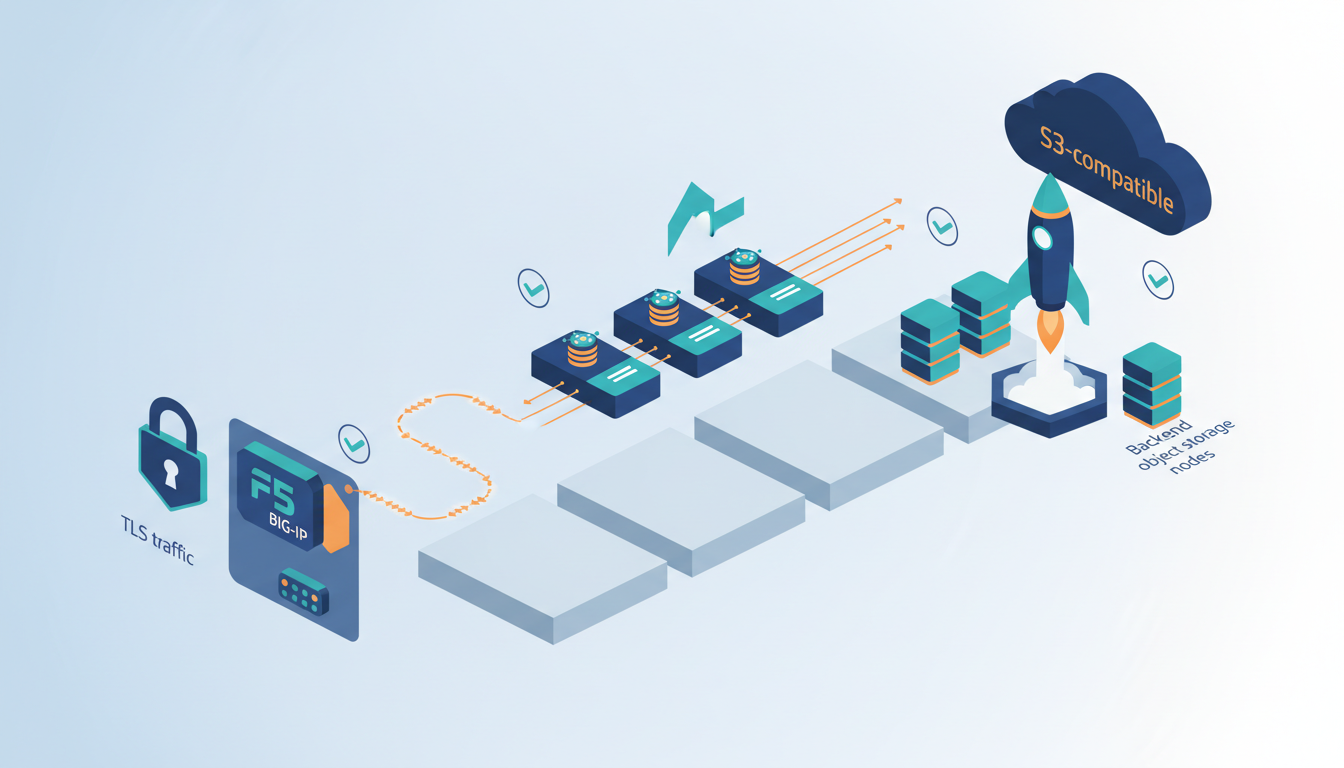
Market shifts toward zero-egress pricing models challenge traditional fee structures. This transition changes how operators dimension F5 throughput capacity for bursty AI workloads.sentient.io uses F5 Distributed Cloud Services to democratize AI access. Strict security postures must align with the low-latency demands of real-time inference.
Validation Steps for Secure S3-Compatible Storage Integration
Validate BIG-IP configurations against specific S3 API verbs to guarantee secure backend connectivity.
- Inspect SSL/TLS offload settings on BIG-IP Local Traffic Manager (LTM) to manage decryption and policy enforcement.
- Apply BIG-IP Advanced WAF signatures tuned for object storage PUT and GET requests to block metadata injection.
- Verify BIG-IP Advanced Firewall Manager (AFM) rules restrict network access.
- Test BIG-IP DDoS Hybrid Defender thresholds to help ensure pipeline availability.
Providers like the provider B2 offer storage at low-cost per GB, making efficient configuration necessary.
| Validation Target | Configuration Check | Risk Mitigated |
|---|---|---|
| Traffic Flow | LTM SSL Profile | Data Exposure |
| API Security | WAF S3 Signatures | Injection Attacks |
| Network Edge | AFM Policy Rules | Unauthorized Access |
| Durability | DDoS Thresholds | Service Outage |
Security policies on BIG-IP Advanced WAF secure the S3 REST API while maintaining performance.rabata.io recommends validating these settings in a staging environment before production rollout to avoid performance degradation. Operators must balance strict security policies with the latency requirements of AI training jobs.
About
Marcus Chen serves as Cloud Solutions Architect and Developer Advocate at Rabata.io, where he specializes in S3-compatible object storage and AI/ML data infrastructure. His deep expertise makes him uniquely qualified to explain the nuances of S3 compatibility, having previously worked as a Solutions Engineer at the provider Technologies and a DevOps Engineer for Kubernetes-native startups. In his daily role at Rabata.io, Marcus helps enterprises migrate from AWS S3 by using true API compatibility to eliminate vendor lock-in while reducing costs. He routinely architects high-performance storage solutions for generative AI startups, directly applying the technical knowledge shared in this article. By focusing on developer-first integration and performance benchmarking, Marcus ensures that Rabata.io's platform delivers the speed and reliability required for modern workloads. His practical experience with tools like Terraform and boto3 allows him to provide actionable insights on deploying scalable, GDPR-compliant storage that behaves exactly like Amazon S3 without the associated complexity or expense.
Conclusion
Scaling object storage for active AI workloads reveals that egress fees often exceed the base cost of retention, fundamentally breaking the economic model of write-and-forget architectures. As applications shift toward real-time inference, the operational burden moves from simple capacity planning to managing throughput volatility without incurring prohibitive data transfer penalties. Organizations relying on traditional pricing structures face unpredictable expenditures that stifle innovation, whereas platforms eliminating these fees offer a clear path to sustainable growth.
Teams should migrate non-critical data to zero-egress providers within the next two quarters if their current egress spend exceeds thirty percent of their total storage budget. This transition is not merely about cost reduction but about enabling the high-frequency data access required by modern machine learning pipelines without financial friction. The window to optimize these architectures before AI traffic volumes explode is narrowing, making immediate evaluation necessary for long-term viability.
Start this week by auditing your current egress logs to isolate traffic patterns destined for external analytics or inference engines. Identify the specific buckets generating the most outbound volume and calculate the potential savings against alternative pricing models. This data provides the concrete evidence needed to justify shifting workloads to more economical, S3-compatible endpoints that align with active application demands.
Frequently Asked Questions
You can reduce storage expenses by up to 70% compared to standard AWS rates. This significant saving occurs because many alternative providers eliminate egress fees that typically increase costs for frequent data retrieval.
Amazon charges $0.023 per GB-month for the first 50 TB of standard storage. This baseline price excludes internet transfer fees, which can drastically increase total costs for data-heavy AI workloads.
AWS charges $0.09 per GB for data transferred to the internet, creating high variable costs. These fees often become the largest expense for applications requiring frequent data movement across network boundaries.
Yes, you can deploy these systems as drop-in replacements without modifying existing application code. This compatibility allows teams to scale machine learning training sets to petabytes while avoiding vendor lock-in risks.
Random read-modify-write operations face higher latency compared to traditional block storage devices. However, this architecture sacrifices low-level file manipulation speed to achieve massive scalability and high durability for unstructured data.