Replication rules: metadata fidelity in S3 copies
S3 replication copies most objects within seconds, delivering 99.999999999% availability for critical data workflows. Confusion persists between S3 Cross-Region Replication and S3 Same-Region Replication, often resulting in inflated bills or fragile disaster recovery postures.
This analysis dissects the mechanical divergence between live replication S3 events and S3 Batch Replication for on-demand synchronization. We examine where Replication Time Control (S3 RTC) becomes mandatory for strict compliance windows versus standard asynchronous copying. The goal is clarifying when bi-directional replication architectures outperform simple one-way mirrors for log aggregation.
We strip away marketing noise to focus on architectural decisions impacting latency and data sovereignty in 2026. Understanding these mechanics matters because S3 Backup protects against deletion, whereas true replication guarantees business continuity across geographic boundaries.
The Role of S3 Replication in Modern Cloud Data Strategies
S3 Replication Mechanics: Live vs On-Demand Copying
S3 replication enables automatic, asynchronous copying of objects across buckets to satisfy data sovereignty needs. The mechanism operates through two distinct modes: live event-driven synchronization and on-demand batch processing. Live replication copies most objects within seconds of the source event, ensuring minimal lag for active workloads requiring consistency across geographic boundaries. Conversely, on-demand copying uses batch operations to manage billions of objects via a single API request. This method excels at replicating existing assets that predate rule configuration.
The relationship between source and destination buckets allows objects and their each metadata to be replicated to one or more destination buckets in the same or different AWS Regions. Cost and recovery time objectives often collide here. Live replication involves continuous metadata tracking and network utilization. Batch processing offers efficiency for large-scale tasks but introduces latency unsuitable for real-time failover. Organizations can achieve high durability targets while optimizing costs through intelligent tiering. The choice fundamentally depends on whether the workload prioritizes immediate availability or economic scale.
Real-World Use Cases for S3 Replication Metadata and Ownership
Organizations replicate objects to preserve immutable audit trails and enforce cross-account data ownership boundaries.
When systems replicate S3 objects, the process copies all associated metadata, including original creation times and version IDs, ensuring the replica remains an identical forensic copy of the source. This fidelity is necessary for regulatory compliance where altering timestamps could invalidate legal holds or chain-of-custody records. Without this strict metadata retention, organizations risk losing critical context required for e-discovery or historical analysis. A distinct operational requirement involves the owner override option, which allows Amazon S3 to change replica ownership to the AWS account owning the destination bucket.
Live S3 replication typically copies objects within seconds, yet the service level agreement guarantees completion within 15 minutes. This distinction separates typical operational velocity from the contractual safety net provided for critical workloads. While most transfers finish almost instantly, the system ensures that 99.99% of objects reach the destination bucket within the quarter-hour window. This guarantee protects against rare network partitions or transient service delays that might otherwise stall data synchronization. Architects must recognize that replication time variance impacts recovery point objectives differently than average latency suggests.
Batch Replication functions as the assigned on-demand mechanism for synchronizing objects that predate rule configuration. Unlike live event-driven workflows, this approach processes historical data sets without requiring manual re-ingestion or application-level retries. Operators apply this mode specifically when migrating legacy archives or correcting gaps where initial live replication events were missed. A distinct technical advantage involves the ability to replicate objects that were themselves created as replicas, a capability unique to the batch processing engine. This specific function enables complex topologies where data must cascade through multiple tiers while preserving version history.
Cross-Region Replication (CRR) and Same-Region Replication (SRR) diverge primarily in their latency profiles and account boundary flexibility. Both replication modes support copying objects between different AWS accounts, enabling distinct security domains for source and destination data. CRR specifically addresses disaster recovery by duplicating data across geographically separated locations, while SRR targets log aggregation and live testing within the same geographic region.
| Capability | CRR | SRR |
|---|---|---|
| Boundary | Different Regions | Same Region |
| Account Scope | Cross-account supported | Cross-account supported |
| Typical Latency | Seconds to minutes | Seconds to minutes |
| Primary Use | Disaster recovery | Log aggregation |
Architects must recognize that neither standard mode guarantees immediate consistency for critical failover scenarios. The reliance on best-effort delivery means recovery time objectives cannot be strictly enforced without upgrading to time-controlled services. This structural limitation forces a choice between cost efficiency and predictable performance metrics. Organizations requiring strict compliance windows should evaluate solutions that provide deterministic replication performance without the complexity of managing multiple regional endpoints.
Strategic Selection Criteria for CRR SRR and Bi-Directional Patterns
CRR vs SRR: Geographic Scope and Compliance Boundaries
S3 Cross-Region Replication moves objects between distinct AWS Regions, whereas Same-Region Replication keeps data within one geographic boundary. This technical difference determines data sovereignty compliance because CRR meets mandates requiring physical storage separation across national borders. Architects frequently deploy Same-Region Replication for log aggregation or latency reduction without incurring inter-region data transfer costs. Cross-Region Replication becomes necessary when disaster recovery protocols demand geographic isolation across distinct AWS Regions.
| Feature | CRR Pattern | SRR Pattern |
|---|---|---|
| Scope | Inter-Region | Intra-Region |
| Compliance | Data Residency Laws | Operational Redundancy |
| Latency | Higher (WAN) | Minimal (LAN) |
Choosing CRR purely for redundancy creates unnecessary expense if the failure domain remains regional rather than global. Financial efficiency competes directly with geopolitical risk mitigation in these designs. Organizations targeting EU markets must verify that their primary region aligns with tenant residency requirements before enabling replication streams. Replication configurations require explicit definition of the owner override option to maintain access control consistency across target buckets. Misaligned replication scope relative to legal boundaries produces non-compliant data sprawl. Strategic selection guarantees that replication rules match the specific recovery time objectives of the workload.
Bi-Directional Replication for Active-Active Workloads
Bi-directional replication synchronizes data across buckets in multiple regions to support active-active architectures. Two-way replication involves specific rules to maintain synchronization while allowing writes in multiple locations. Teams deploy this strategy when local read latency matters globally while preserving a single logical dataset view.
| Dimension | One-Way CRR | Bi-Directional Pattern |
|---|---|---|
| Data Flow | Unidirectional only | Mutual synchronization |
| Failover Mode | Manual promotion required | Automatic continuity |
| Use Case | Disaster recovery archives | Collaborative AI training |
Monitoring these complex flows requires visibility into replication metrics available via monitoring services or the access point dashboard itself.
Rabata.io simplifies this architecture by offering S3-compatible storage that replicates data across geographically distributed nodes with predictable pricing. The platform eliminates the egress fees typically associated with frequent cross-region synchronization, making active-active designs financially viable for startups. Third-party clouds often charge premiums for bidirectional data movement, yet Rabata.io provides the infrastructure necessary for high-availability workloads without prohibitive costs. Architects gain the durability of multi-region deployments while avoiding the vendor lock-in often tied to proprietary replication APIs.
Decision Framework: Log Aggregation vs Disaster Recovery Patterns
Architects select Same-Region Replication to aggregate logs from multiple buckets or accounts into a single, in-Region bucket for simpler processing. This pattern avoids inter-region data transfer costs while centralizing analytics pipelines within a specific geographic boundary. Physical separation protects against regional outages, satisfying strict disaster recovery requirements. The choice fundamentally balances cost efficiency against durability needs for specific workloads.
| Dimension | Log Aggregation (SRR) | Disaster Recovery (CRR) |
|---|---|---|
| Primary Goal | Centralized processing | Geographic isolation |
| Cost Driver | Storage volume | Data transfer fees |
| Failure Scope | Single Region | Multi-Region safe |
Rabata.io delivers S3-compatible storage that supports these distinct patterns without locking teams into proprietary ecosystems. Organizations deploying log aggregation strategies benefit from reduced egress charges when keeping data local. Relying solely on same-region copies creates a single point of failure for critical assets. This tension requires careful rule configuration to prevent unnecessary duplication costs. Teams must align replication modes with recovery time objectives rather than defaulting to global redundancy. Properly configured systems meet compliance mandates without overspending on unused bandwidth. The replication strategy directly impacts both operational complexity and monthly cloud expenditure.
Implementing Strong Replication Rules and Troubleshooting Common Failures
Implementation: Configuring Live and On-Demand S3 Replication Rules
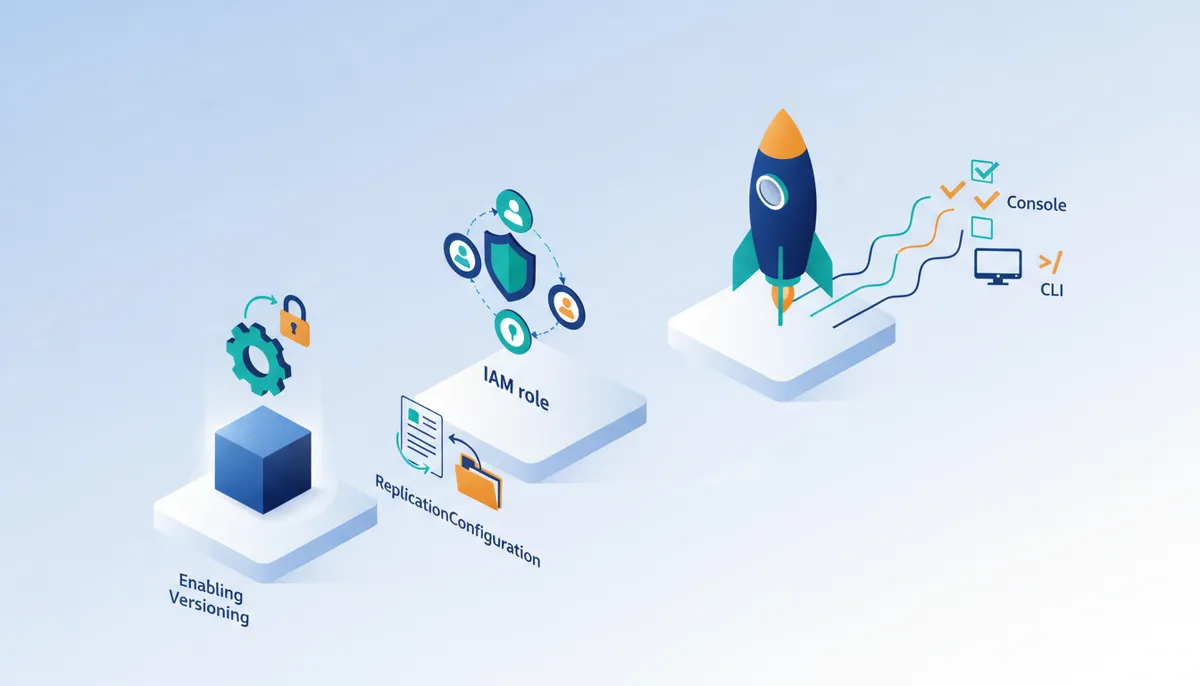
Live replication automatically copies new objects as writes occur but ignores data existing prior to rule creation. This mechanism ensures low-latency redundancy for active workloads without manual intervention. Operators must distinguish this from S3 Batch Replication, which handles historical datasets on demand. The replication time control feature governs live streams to meet specific time targets, whereas batch jobs rely on scheduled API requests to migrate billions of objects efficiently.
- Define the source bucket and enable versioning to track object iterations.
- Select destination regions to satisfy data sovereignty requirements.
- Configure rules to copy specific object tags and metadata selectively.
- Execute batch jobs for pre-existing data to ensure complete synchronization.
Tension exists between immediate consistency and cost. Live replication incurs continuous write charges. Batch operations allow for scheduled budget management. Unlike live streams, batch processes operate on scheduled intervals rather than real-time triggers. Strategic separation allows organizations to maintain compliance postures without over-provisioning high-performance storage for static records.
Applying Owner Override and Storage Class Changes in Replicas
Changing replica ownership via the owner override option shifts object ownership to the destination bucket owner. Without this setting, the original uploader retains ownership of the replicated objects.
Directing replicated objects into archival storage classes optimizes costs for long-term retention. This approach aligns storage economics with regulatory hold periods automatically.
- Enable versioning on both source and destination buckets to support replication workflows.
- Configure the replication rule to include the owner override parameter for access control.
- Specify the target storage class in the destination configuration to enforce cost tiers.
- Validate that S3 Batch Replication handles existing objects while live rules capture new writes.
Overriding ownership shifts full lifecycle management to the destination account. Operators must verify IAM policies allow the replication service account to write with the new owner context. The replication time control metric offers visibility into latency but focuses on object replication timing rather than permission propagation. A constraint involves the complexity of cross-account policy alignment.
Diagnostic Checklist for Missing Replicas and Permission Failures
Verify that source buckets maintain versioning to enable valid replication workflows.
- Inspect replication metrics to identify error codes like `AccessDenied` or `NotFound`.
- Validate that IAM roles explicitly grant the destination bucket write access.
- Retry failed jobs using batch interfaces for objects missing from the target.
| Failure Mode | Likely Cause | Resolution Strategy |
|---|---|---|
| Missing Objects | Versioning disabled | Enable versions on source |
| Access Denied | Role policy gap | Update IAM permissions |
| High Latency | Network congestion | Check Replication Time Control |
Assuming live replication covers historical data represents a frequent oversight. The process strictly handles new writes, leaving pre-existing files untouched without batch intervention. Permission failures often stem from configuration mismatches rather than broad bucket policies. Silent data divergence occurs when applications read stale or missing datasets despite appearing healthy. Enterprises avoid these pitfalls by enforcing strict pre-flight validation on all replication rules before production deployment. Regular audits of replication metrics prevent undetected synchronization gaps.
About
Alex Kumar is a Senior Platform Engineer and Infrastructure Architect at Rabata.io, specializing in Kubernetes storage architecture and disaster recovery. His daily work designing resilient, S3-compatible storage solutions for enterprise clients directly informs this analysis of S3 replication strategies. At Rabata.io, an S3-compatible object storage provider built for performance and cost efficiency, Alex engineers systems where cross-region and same-region replication are critical for data sovereignty and high-availability. He uses Rabata.io's true S3 API compatibility to demonstrate how organizations can achieve reliable bi-directional replication and meet strict compliance needs without vendor lock-in. By focusing on Rabata.io's GDPR-compliant data centers in the EU and US, Alex provides actionable insights on configuring replication time control and syncing objects across regions. His expertise ensures that the discussion on live replication and batch operations reflects real-world architectural challenges faced by DevOps teams managing scalable cloud-native applications today.
Conclusion
Scaling S3 replication exposes a hard truth: standard asynchronous workflows cannot satisfy compliance frameworks demanding strict 15-minute SLAs. Basic setups move data eventually, but they lack the deterministic guarantees required for disaster recovery validation. The gap between simple availability and verified delivery becomes the primary risk vector as data volumes grow. Organizations must treat the 15-minute mark not as an average but as a hard boundary for business continuity. Relying on default configurations invites silent gaps where historical data remains unprotected until manual batch jobs intervene.
Deploy Replication Time Control immediately if your recovery strategy depends on sub-hour consistency across regions. This approach shifts the operational model from hopeful monitoring to guaranteed delivery. Do not wait for a failed audit to validate your architecture. The cost of unverified replication far exceeds the compute expense of enforced latency controls.
Start by auditing your current replication metrics this week to identify any objects exceeding the 15-minute threshold. Cross-reference these findings against your S3 Cross-Region Replication policies to ensure versioning is active on all source buckets. If gaps appear, enable strict time controls before assuming your disaster recovery plan is viable.
Frequently Asked Questions
Standard replication usually copies objects within seconds for fast access. However, the service guarantees 99.99% completion within 15 minutes, providing a critical safety net for compliance frameworks requiring strict delivery windows.
Combining these strategies delivers 99.999999999% availability for data protection. This extreme durability ensures business continuity across regions while protecting against accidental deletion or ransomware attacks on critical workflows.
This option allows the destination account to gain full control over replicas. It resolves friction where source accounts retain billing but destination accounts need independent lifecycle management or access policies without relying on the original entity.
Use batch operations to replicate existing assets that predate rule configuration. While live syncing handles new uploads instantly, batch processing efficiently manages billions of objects via single API requests for large-scale historical data migration.
The process copies all metadata, including creation times and version IDs. This fidelity ensures replicas remain identical forensic copies, which is vital for maintaining valid legal holds and chain-of-custody records during regulatory e-discovery investigations.
References