Regional availability data stops bad deployments now
AWS now serves regional availability data directly via S3 Access Points, bypassing manual dashboard checks entirely. This shift transforms static planning documents into flexible, queryable assets that integrate smoothly with existing CI/CD pipelines and data lakes. As storage costs deflate toward 2 cents per GB according to AWS Blogs, treating infrastructure metadata as cheap, durable object storage becomes an architectural imperative rather than an optional optimization.
You will learn how regional availability datasets map to specific service features and API operations, enabling precise pre-deployment validation before code ever reaches production. We dissect the S3 Access Point architecture that allows any AWS Principal to pull fresh JSON, CSV, or Apache Parquet files without complex onboarding procedures. Finally, the guide details a five-step implementation for automating these checks, ensuring your infrastructure templates never target unsupported regions or missing capabilities.
Relying on interactive web pages for critical expansion decisions is inefficient when Amazon S3 offers programmatic access to the same truth source. By syncing this data into your own environment, teams can run gap analysis against data residency requirements using standard SQL queries in Amazon Athena. This approach eliminates the friction of manual verification, allowing architects to focus on durability patterns instead of hunting for feature support matrices across dozens of global locations.
The Role of Regional Availability Data in Cloud Architecture Planning
Defining AWS Local Availability Data Categories
Stop treating "service availability" as a binary switch. AWS zone-based availability data splits reality into three distinct groups: services and features, APIs, and CloudFormation resources. These labels dictate specific planning phases. The AWS Capabilities by Region interface lets operators compare these groups across global locations interactively. Services and features confirm product functionality, such as checking S3 feature parity before designing storage systems. API data verifies operation availability so application code targets supported endpoints in the destination region. CloudFormation resources prove infrastructure type support, a necessary step for validating templates before execution. Teams automate this validation using the AWS Knowledge MCP Server to query resource types programmatically. Subscribing to availability notifications delivers weekly digests on new category additions. Manual checks alone introduce latency that automated pipelines remove completely. The gap between API support and resource type support often decides if a migration moves forward or stalls. Operators must view these categories as independent variables instead of a single service status. A missing CloudFormation resource type breaks template deployment even if the general service exists. This detail forces precise dependency mapping during the design phase.
Validating c7i.metal Instances and DynamoDB APIs
Architectural commitment requires proof, not hope. Regional capability validation demands verifying specific instance types and API operations before you write a single line of deployment code. Operators use the AWS Capabilities by Region tool to confirm that c7i. Metal-24xl and c7i. Metal-48xl bare-metal instances exist across all targeted deployment zones. This step stops provisioning failures where templates reference hardware unavailable in a specific geography. The APIs category within this dataset allows engineers to check DynamoDB operation support prior to writing application logic, ensuring code compatibility with regional endpoints. Static manual checks create latency between data updates and deployment decisions.
Checklist for Data Residency and Template Validation
CloudFormation resources validation prevents deployment failures by confirming resource type support before expansion. Operators must verify template compatibility against regional constraints to satisfy complex data residency requirements. Static documentation often lags behind live infrastructure changes, creating risks for global deployments. The AWS Knowledge MCP Server provides programmatic access to current availability states, surpassing manual checks. Teams should cross-reference local laws with supported service footprints across the 24 geographical regions where S3 operates. Compliance teams generate audit reports using structured datasets landed directly in a data lake. This approach ensures continuous visibility rather than relying on point-in-time snapshots. Failed deployments and potential regulatory fines represent the cost of ignoring these checks. Organizations must integrate these validations into CI/CD pipelines to catch issues early. Automating this process maintains parity across all targeted markets.
Inside the S3 Access Point Architecture and Data Refresh Mechanics
S3 Access Point Authentication and Manifest.json Structure
Standard IAM permissions govern access to the public S3 Access Point, specifically requiring the `s3:GetObject` action. Operators attach policies that restrict traffic to the exact data access point ARN, shielding other storage buckets from unintended exposure. This model differs from automated traffic routing in multi-region setups, where latency optimization often supersedes strict identity verification. A daily refreshed manifest. Json file acts as the primary integrity gate, embedding a timestamp that confirms data freshness before ingestion pipelines execute. Fetching this metadata consumes negligible bandwidth. Moving actual dataset payloads across regions incurs a data routing cost 01/GB.
Parsing the manifest. Json structure reveals whether the Available status applies to the specific Parquet or JSON payload needed for automation scripts. A missing timestamp signals a stale feed, creating risks for teams deploying templates against outdated capability maps. Local caches diverge from live infrastructure states when engineers skip this verification step. Validate the manifest hash before triggering downstream CI/CD jobs to prevent propagation of corrupted availability data.
JSON vs CSV vs Parquet: Format Selection for Analytics Workloads
Parquet delivers columnar compression for Amazon Athena queries where JSON remains a scripting utility. Format selection forces a choice between human readability and query efficiency. JSON supports immediate parsing for validation scripts. CSV enables spreadsheet imports for manual audits. Parquet requires schema definition but reduces scan volume notably for large datasets.
| Format | Primary Use Case | Query Efficiency |
|---|---|---|
| JSON | Programmatic access | Low |
| CSV | Reporting imports | Medium |
| Parquet | Data lake analytics | High |
Diagnostics labs store results in Parquet files to create unified SQL views without database loading. This approach uses AWS Glue to catalog metadata while keeping data stationary in storage. Avoiding data movement fees associated with traditional ETL pipelines lowers overall costs. Big data workloads benefit from predicate pushdown capabilities inherent to the columnar structure. Scripting tasks still demand JSON for its flexibility with nested structures in automation logic.
Updates require rewriting entire Parquet files rather than appending rows. JSON allows line-delimited appends suitable for real-time logging streams. Teams building CI/CD checks should prefer JSON for speed. Analytics teams must adopt Parquet for scale. Excessive compute costs arise during regional parity analysis when engineers ignore this distinction. Align format choice with the specific consumption pattern of the downstream tool.
Prerequisites Checklist: AWS CLI, Python 3.10+, and PyYAML Setup
Local execution fails without IAM permissions granting `s3:GetObject` on the public access point ARN. Operators must install Python 3.10+ and the PyYAML library via pip to parse the daily refreshed datasets. Scripting logic depends on these specific versions to handle the nested structure of the `manifest. Json` metadata file correctly. A constraint involves the Anthropic Opus 4.6 model used in demonstration environments, which possesses a knowledge cutoff of May 2025. AI-assisted code generation may suggest deprecated APIs if the local environment lacks the latest regional data files. Teams should verify their toolchain against current infrastructure rather than relying on model training data for post-2025 service launches.
- Configured AWS CLI with valid credential chains.
- Python 3.10+ runtime environment installed locally.
- PyYAML package for deserializing configuration templates.
- Updated regional availability datasets to bypass AI knowledge gaps.
Neglecting the version check introduces a silent failure mode where validation scripts pass locally but reject valid resources during deployment. Routing errors carry a low financial cost. Debugging false negatives consumes significant engineering hours. Automate the library version assertion within the CI/CD pipeline entry point. This single step prevents downstream incompatibility when parsing complex CloudFormation resource definitions across multiple geographical zones.
Implementing Automated Availability Checks in Five Steps
IAM Policy Structure for S3 DataAccessPointArn Conditions
The policy demands `s3:GetObject` action on Resource `*` while enforcing a condition where `s3:DataAccessPointArn` matches `arn:aws:s3:us-east-1:686591367145:accesspoint/aws-capabilities-public`.
- Define the IAM policy JSON block allowing read access strictly to the public capability dataset.
- Apply the `StringEquals` operator to enforce the exact ARN constraint, preventing cross-bucket confusion.
- Attach this policy to the execution role before running validation scripts against regional manifests.
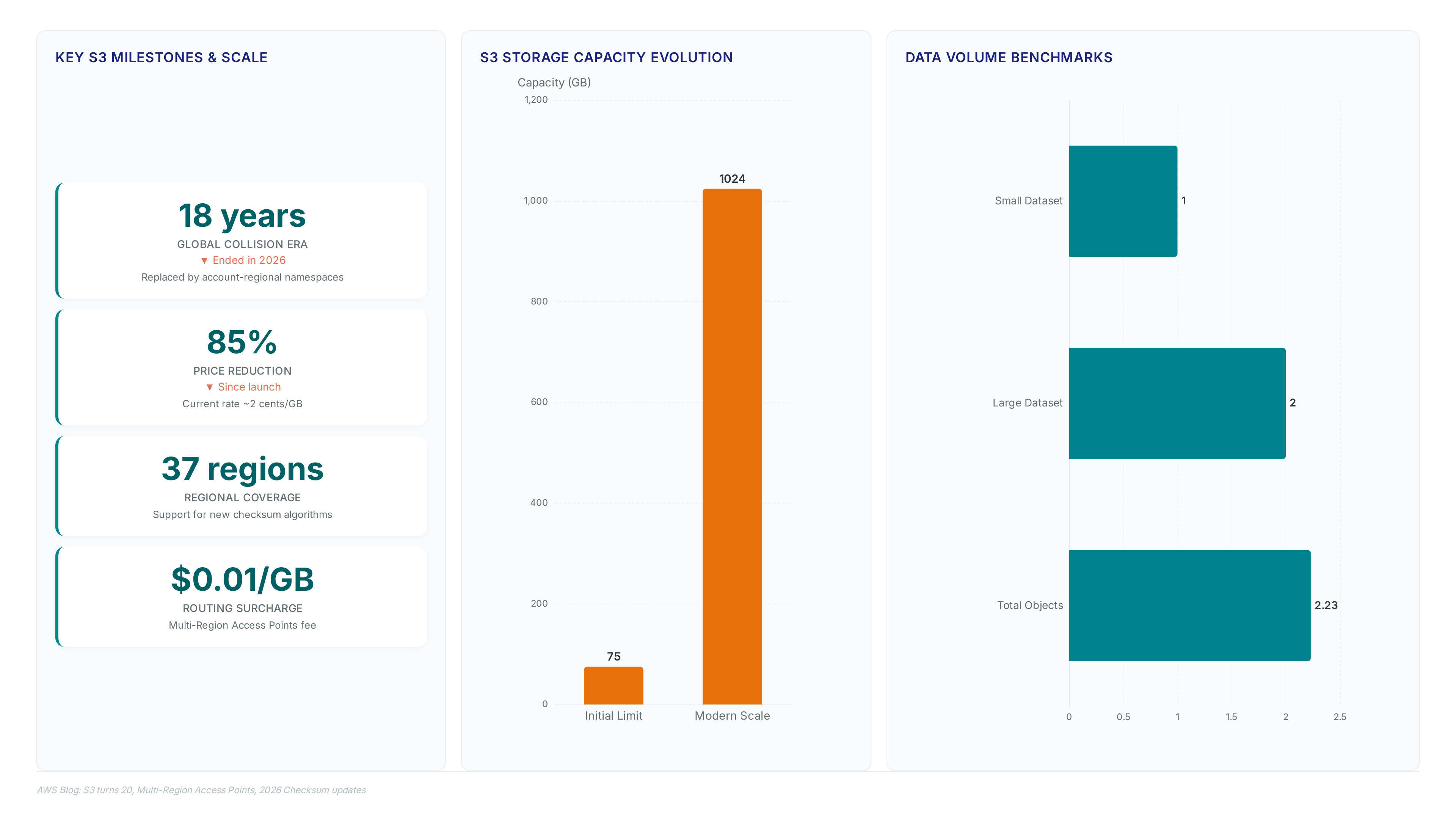
Scoping via condition keys instead of hardcoding bucket names prevents breakage during namespace updates. In March 2026, AWS announced account-regional namespaces for S3, ending 18 years of global bucket name collisions. This structural change reduces the risk of confused deputy attacks where a malicious actor tricks a service into accessing an unintended bucket. The condition key acts as a logical fence. It differs from the automated traffic routing. Operators relying solely on broad `s3:*` permissions expose their pipelines to accidental data exfiltration if bucket policies drift. Operational overhead is the cost. Every new public dataset requires a specific ARN update in the trust policy. Audit these conditions quarterly to align with any shifts in public endpoint ARNs.
Executing AWS CLI Commands to Retrieve Manifest.json and Index Files
Operators download the latest index and manifest files using specific AWS CLI copy commands targeting the public S3 alias.
- Fetch the version index: `aws s3 cp s3://aws-capabilities-pub-ybkxdwgxrkfhwmq8b1neoq8ny6ua4use1b-s3alias/public/index.
- Retrieve the metadata manifest: `aws s3 cp s3://aws-capabilities-pub-ybkxdwgxrkfhwmq8b1neoq8ny6ua4use1b-s3alias/public/v1/manifest.
- Parse the `last_updated` timestamp immediately to verify data freshness before proceeding with downstream automation.
Skipping timestamp validation risks deploying templates against stale regional constraints. Early adoption cycles showed this failure mode clearly. The daily refresh cycle aligns with broader industry shifts toward real-time data integrity checks across storage classes. Teams integrating these pulls into CI/CD pipelines benefit from automated regional checks that prevent build failures caused by unavailable resource types. JSON supports direct scripting. Larger analytics workloads often convert these streams to Parquet for efficiency. This format choice mirrors the scale seen in S3 Vectors deployments handling billions of elements. Operators must decide whether to parse inline or land data first. Direct command execution offers speed but lacks the audit trail of stored objects. Store the manifest locally to create a historical record of regional capability changes over time.
Avoiding Access Denied Errors Through Account-Regional Namespace Security
Confused deputy attacks trigger immediate access denied failures when scripts assume global bucket uniqueness across tenants. The March 2026 shift to account-regional namespaces eliminates these collisions by partitioning storage using the unique 12-digit account ID. Authentication logic now restricts data retrieval strictly to verified AWS principals. Operators must update policies to explicitly trust the new namespace structure rather than relying on legacy global naming conventions.
- Replace wildcard resource conditions with specific DataAccessPointArn constraints matching the regional alias.
- Verify that the calling identity possesses valid credentials before issuing `s3:GetObject` requests.
- Audit existing automation scripts for hardcoded bucket names that ignore the new account-id partition.
Correct account identification becomes a strict dependency. Tools hardcoding external bucket names break under this architectural change. Legacy integrations failing to adopt the account-regional namespace standard will face persistent permission errors despite valid IAM roles. Treat the account ID as a primary security boundary rather than a secondary metadata.
Real-World Application of Availability Data in CI/CD and Compliance Workflows
Automated CloudFormation Validation via CI/CD Integration

Pipeline executions fail when templates reference CloudFormation resources that target regions do not support. Ingesting daily S3 data feeds resolves this gap. A pipeline stage must fetch the `cfn_resources` dataset in JSON format before the `aws cloudformation validate-template` command runs. Scripts parse the local copy to assert that every resource type in the YAML template exists in the destination region list. This approach shifts failure detection left. Incompatibilities surface during the commit phase rather than at runtime. Integration complexity arises because the AWS Knowledge MCP Server offers an alternative API method. Some teams prefer this over file-based parsing for real-time checks. File-based validation provides deterministic reproducibility necessary for audit trails. Live API calls introduce external latency and potential rate-limiting variables. Storage overhead represents the primary constraint. Maintaining a local mirror of regional data consumes space but guarantees build consistency regardless of upstream API availability.
| Validation Mode | Latency Impact | Reproducibility |
|---|---|---|
| Static File Check | Low | High |
| Live API Query | Variable | Medium |
Operators must treat the `last_updated` timestamp in `manifest. Json` as a hard gate. Builds proceed only if the data is less than 24 hours old. Neglecting this freshness check risks validating against stale constraints, leading to production rollbacks. Serverless implementations of this pattern demonstrate measurable cost savings by eliminating wasted compute cycles on doomed deployments. Enforce this gate strictly to maintain deployment velocity.
Generating Audit-Ready Reports for Data Residency Compliance
Compliance officers generate audit evidence by querying the CloudFormation resources dataset. They prove service parity across 24 geographical regions. Scripts extract supported API operations for specific jurisdictions. Mapping them against local data sovereignty laws flags gaps. The process transforms raw JSON into tabular reports showing exactly which storage classes meet residency mandates. This granular visibility satisfies auditors requiring proof that no data crosses prohibited borders. Service lifecycles introduce volatility into these static reports. Teams must filter out capabilities reaching end-of-support. Features deprecated on March 31, 2026 should not appear in active compliance documentation. Existing users retain access after April 30, 2026, but new deployments cannot rely on retiring services for long-term compliance.
| Report Element | Data Source | Audit Value |
|---|---|---|
| Service List | Services & features | Proves allowed compute types |
| API Matrix | APIs | Validates encryption standards |
| Resource Types | CloudFormation resources | Confirms template legality |
The daily refresh cycle creates a specific limitation. A regulation changing at noon might not reflect until the next automated check runs at 23:46 GMT. Operators must timestamp every generated document using the `last_updated` field from `manifest. Json`. This action establishes a defensible chain of custody. Relying on cached data without verifying freshness creates a false sense of security during regulatory inspections.
Preventing Deployment Failures Through Real-Time Availability Alerts
Static JSON snapshots fail to capture sudden regional capability withdrawals. Pipeline breaks occur when services vanish between daily refreshes. Reliance on cached data ignores the latency between infrastructure changes and the next scheduled S3 object update. Subscribing to AWS Builder Center. This mechanism bypasses the 24-hour delay inherent in batch downloads. Active event-driven triggers replace passive polling. These triggers halt deployments before they reach the `aws cloudformation deploy` stage. Operators configure CI/CD stages to listen for these webhook events. Compatibility checks run against the live state rather than yesterday's manifest. The cost of this integration remains minimal compared to the downtime incurred by rolling back failed stacks in production environments.
About
Alex Kumar serves as a Senior Platform Engineer and Infrastructure Architect at Rabata. Io, where he specializes in Kubernetes storage architecture and disaster recovery strategies. His daily work designing resilient, multi-region storage solutions directly informs his expertise in navigating complex cloud availability landscapes. As organizations increasingly face strict data residency regulations, Kumar's experience building S3-compatible infrastructure for Rabata. Io provides critical insights into evaluating regional capabilities. Rabata. Io, a specialized provider offering GDPR-compliant EU and US data centers, operates as a high-performance alternative to AWS, making comparative regional analysis necessary for their enterprise and AI/ML clients. Kumar uses his background as a former SRE to translate raw AWS territorial availability data into actionable architectural decisions. By automating these checks, he helps teams ensure their deployments meet both performance goals and compliance requirements across geographies, bridging the gap between theoretical service maps and practical, cost-optimized infrastructure execution.
Conclusion
Scaling this event-driven model reveals a hidden operational tax: the sheer volume of false positives generated by transient network glitches can paralyze deployment pipelines if threshold logic remains static. As your infrastructure expands across multiple accounts, the cost of managing these alert streams grows linearly, demanding a shift from simple existence checks to context-aware failure analysis. You cannot rely solely on real-time webhooks to guarantee success; they merely confirm presence, not capacity or quota limits. Therefore, teams must evolve their validation layers to include predictive capacity modeling within the next two quarters to prevent bottlenecks that availability flags miss entirely.
Adopt a hybrid verification strategy immediately. Do not replace your existing batch processes yet; instead, run them in parallel with the new event stream for thirty days to calibrate your sensitivity thresholds. This dual-track approach isolates genuine service withdrawals from noise before you fully automate the gatekeeping logic. Start by auditing your current CI/CD webhook listeners this week to ensure they possess the fallback logic required to query the secondary email digest channel when primary alerts fail. This specific configuration step secures your audit trail against silent delivery failures without requiring a complete architectural overhaul today.
Frequently Asked Questions
Data transfer out to the internet costs $0.09 per GB for the first 10TB. Transferring data to CloudFront within the same region remains free of charge for optimization.
Request costs for specific storage tiers run approximately 50% cheaper per operation than Standard tiers. PUT operations cost roughly $0.0025 per 1,000 requests in these optimized configurations.
Processes must proceed only if the data is less than 24 hours old to ensure accuracy. Neglecting this freshness check risks deploying infrastructure based on outdated regional capability information.
Integrating data into build workflows bypasses the 24-hour delay inherent in traditional batch download methods. This allows teams to access fresh JSON or Parquet files instantly.
Cross-region replication incurs charges for storage in the destination class and replication PUT requests. Inter-Region Data Transfer OUT from S3 to each destination Region also adds costs.