Object Storage for Iceberg: Why API Completeness Matters
the provider archived its community edition in late 2025. That decision forced self-hosted teams to scramble for a new home for every Parquet file and Iceberg manifest. S3 API completeness is not a checkbox; it is the single biggest determinant of Spark query speed and Flink write consistency. When compute engines like Trino rely entirely on the storage layer for ACID transactions, any gap in that API becomes a hard stop. We are no longer comparing raw throughput. We are comparing survival rates of decoupled architectures when nodes fail.
Public cloud users take managed durability for granted. On-premises operators do not have that luxury. The market, once dominated by a single vendor raising undisclosed funding rounds before entering maintenance mode, is now wide open. Air-gapped deployments specifically face a vacuum. Replacing the storage layer demands rigorous testing of concurrent access patterns. You cannot afford to guess about metadata handling.
The Role of S3-Compatible Object Storage in Decoupled Lakehouse Architectures
Defining the Decoupled Lakehouse Storage Layer
Compute and storage separation makes object storage the immutable system of record. This is the hardest architectural decision to reverse. Every Parquet file, every Iceberg manifest, and every shard of metadata lives here and nowhere else. Traditional data warehouses weld compute and storage together. Decoupled architectures let engines like Spark and Flink scale independently against a shared truth. But do not treat the object store as a passive bucket. It is the operational bottleneck.
A storage layer lacking Kubernetes support or unable to handle concurrent reads stalls the entire pipeline. Raw throughput matters less than API completeness. Iceberg depends on specific S3 operations for ACID transactions and time travel that generic file servers botch. the provider dominated this space until its community edition was archived. Teams now evaluate alternatives like Ceph RGW or SeaweedFS for active development. Self-hosted durability is not free; it requires manual management of erasure coding and node failure domains.
| Feature | Traditional Warehouse | Decoupled Lakehouse |
|---|---|---|
| Storage Location | Local or Proprietary | External Object Store |
| Scaling Unit | Compute + Storage | Independent Layers |
| Data Format | Proprietary Blocks | Open Parquet/Iceberg |
Prioritize API completeness over marginal latency gains. Migrating later costs far more than getting it right now.rabata.io recommends validating S3 compatibility against Iceberg's specific metadata requirements before deployment.
How Spark and Flink Access Iceberg Metadata on Object Stores
Parallel reads starve without complete S3 API support. Compute engines including Spark, Flink, Trino, and platforms like IOMETE read metadata to access data directly from the storage layer. These engines issue thousands of concurrent requests to fetch Parquet file footers and manifest lists simultaneously. If the store cannot handle dozens of Spark executors hitting it at once, the pipeline backs up. Metadata operations within a single transaction are strictly sequential. All workers wait on the slowest API response.
the provider AIStor delivered consistent sub10ms latency for high-performance object stor operations. Metadata lookups did not become the limiting factor. The system natively supported the S3 API for objects, Iceberg for tables, and SFTP for files. Multi-protocol access existed within a single data store.
| Requirement | Impact on Compute |
|---|---|
| ListObjectsV2 | Partition pruning speed |
| Conditional Writes | ACID commit success |
| High Concurrency | Executor utilization |
Verify your chosen storage supports atomic commits and versioning. Without these, write conflicts corrupt table state.rabata.io recommends validating API completeness against production workloads before migrating petabyte-scale datasets.
Why Iceberg ACID Guarantees Fail Without Durable Object Storage
If the object store loses data, Iceberg ACID guarantees are worthless. Open table formats manage transaction logs and schema evolution, but they cannot reconstruct Parquet files that physically disappear. Durability depends entirely on the store's ability to survive hardware faults. Public clouds offer 99.999999999% durability SLAs. Self-hosted teams must engineer this redundancy manually through replication or erasure coding.
The risk escalated when the provider entered maintenance mode and was subsequently archived in late 2025. Many deployments now lack long-term community support for critical bug fixes. the provider has moved to a source-only archived state for its community edition. SeaweedFS remains Apache 2.0 licensed. This licensing offers a more permissive open-source alternative for GDPR-compliant self-hosted setups.
| Failure Mode | Table Format Response | Actual Outcome |
|---|---|---|
| Disk Corruption | None (Data missing) | Permanent Data Loss |
| Node Failure | Metadata points to void | Permanent Data Loss |
| API Incompatibility | Transaction Commit Fail | Pipeline Halt |
Storage backends must support atomic multipart uploads and strong consistency to prevent split-brain scenarios during writer failures. Rabata.io recommends validating S3 API completeness against real-world Spark concurrency patterns before committing to a specific distribution. Migrating petabytes later costs far more than the initial effort of selecting a truly durable, actively maintained storage engine.
How S3 API Completeness and Durability Mechanics Drive Spark and Iceberg Performance
S3 API Completeness Gaps and Spark Executor Concurrency
Missing ListObjectsV2 implementations cripple parallel throughput via sequential scanning. If an object store lacks full API fidelity, compute layers struggle to locate manifest files efficiently, stalling jobs during metadata resolution. This is a protocol-level failure, distinct from raw bandwidth limits. The storage system simply cannot handle concurrency patterns specific to distributed SQL engines. Validate that your platform supports the complete spectrum of S3 operations required by modern table formats.
| API Operation | Function in Iceberg | Consequence of Gap |
|---|---|---|
| `ListObjectsV2` | Partition scanning | Full namespace scans increase latency |
| `PutObject` | Parquet file writes | Job failures or data corruption |
| `DeleteObjects` | Data compaction | Inability to reclaim space efficiently |
| `HeadObject` | Existence checks | Excessive network round-trips |
the provider AIStor targeted these high-concurrency needs, yet the project's archival status introduces operational risk. The platform claims optimization for GPU-driven workloads, suiting AI pipelines, but the shift to a proprietary model limits community verification. API completeness dictates executor utilization rates more than network speed. A storage system might saturate network links yet fail to scale Spark jobs if it serializes metadata requests. Prioritize API fidelity over marginal latency gains. Incomplete endpoints create hard ceilings on compute scalability that hardware acceleration cannot bypass.rabata.io recommends rigorous conformance testing before committing production data to any S3-compatible layer.
Diagnosing Slow Iceberg Queries via Storage Latency Metrics
Idle wait states consume Spark executors when storage latency exceeds 10ms during metadata fetches. Query planning stalls while workers poll for object headers if Iceberg manifests reside on systems lacking optimized I/O paths. This bottleneck mimics compute starvation but originates in the storage layer's inability to saturate network throughput with small random reads. Distinguish between bandwidth saturation and high tail latency. A cluster might sustain massive throughput yet fail under concurrent `ListObjectsV2` requests if the backend serializes metadata operations. Object systems introduce variable overhead per request unlike block storage, making consistency more critical than peak speed.
| Metric | Target | Failure Symptom |
|---|---|---|
| p99 Latency | < 10ms | Executor timeout errors |
| Concurrent Lists | High | Query planning hangs |
| Multipart Init | Instant | Write pipeline backpressure |
Visibility gaps widen as architectures shift toward commercial-only models. Teams lack deep instrumentation to trace delays to specific disk queues or network threads since the open-source repository became read-only. Diagnosing whether a slowdown stems from erasure coding overhead or network stack inefficiency requires guessing without active community patches.rabata.io recommends deploying storage that exposes per-bucket latency histograms rather than aggregate node metrics. Engineers can confirm if slow queries result from storage contention only by isolating the metadata path from the data path. Ignoring this distinction leads to unnecessary compute scaling while the actual bottleneck remains unresolved in the object layer.
The Risk of Archived Repositories on Iceberg Metadata Safety
The owner archived the provider's upstream project repository on April 25, 2026, halting active development for the community edition. This structural change means the software now receives no new features, no community contributions, and no guaranteed security patches. Security vulnerabilities are evaluated, yet fixes are not guaranteed, leaving self-hosted lakehouses exposed. Alternatives remain Apache 2.0 licensed, but this source-only archived state forces a binary choice between stagnation and expensive enterprise migration.
Fundamental metadata fragility extends the danger beyond missing features. Iceberg relies on atomic commits to update manifest files; without active maintenance, S3 API edge cases during these transactions may remain unresolved. A corrupted manifest file renders entire tables unreadable, regardless of underlying data integrity. Operators depending on the free tier face hidden operational debt where compatibility with evolving Spark or Trino versions is no longer tested.
| Risk Factor | Active Project Status | Archived Repository Status |
|---|---|---|
| Security Patches | Guaranteed | Evaluated but not guaranteed |
| API Compatibility | Continuous Updates | Static / Frozen |
| Community Support | Active Contributions | None |
"Read-only" code does not equal "stable" infrastructure; it equals decaying compatibility. Static storage layers become increasing mismatches as compute engines evolve, leading to silent data corruption or query failures. Teams implementing durable storage for Iceberg must prioritize vendors with active development cycles.rabata.io recommends verifying that your object storage provider maintains an open, active roadmap rather than relying on archived binaries.
Comparing Self-Hosted Alternatives to the provider for Enterprise Lakehouse Deployments
Defining Enterprise S3 Alternatives: Ceph RGW, SeaweedFS, Garage, and RustFS
CERN validates Ceph RGW across thousands of clusters, relying on complex CRUSH maps to manage massive scientific datasets. SeaweedFS takes a different path by packing files into volumes that allow O(1) disk seeks. Benchmarks indicate notably higher throughput for small 4KB objects compared to traditional stores. Garage provides a lightweight, geo-distributed alternative written in Rust. It contrasts sharply with heavier options by prioritizing multi-site replication from day one. The community is actively evaluating alternatives due to shifting licensing landscapes in the object storage market. These projects form the core of modern self-hosted S3-compatible object storage strategies.
| Feature | Ceph RGW | SeaweedFS | Garage |
|---|---|---|---|
| License | LGPL | Apache 2.0 | AGPL-3.0 |
| Best Fit | Multi-PB Scale | Billions of Files | Geo-Distribution |
| Complexity | High | Medium | Low |
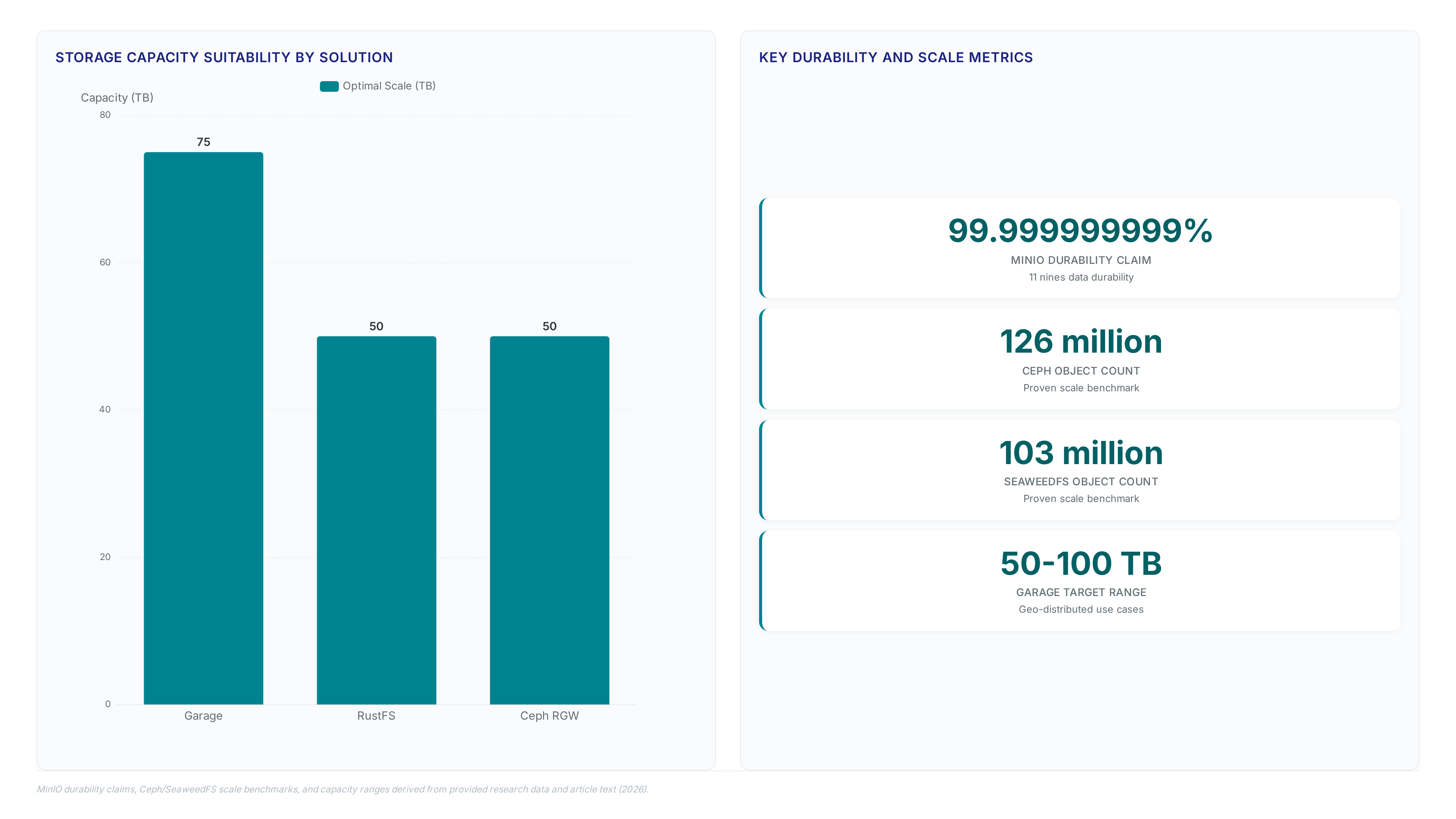
Operational overhead defines the Ceph experience, whereas Garage focuses on specific geo-distributed use cases. Teams cannot assume direct functional equivalence when replacing MinIO. Ceph is often described as complex to manage but capable of scaling effectively where licensing models may be a barrier. Conversely, simpler systems may require careful validation against specific workload growth. Validating S3 multipart upload fidelity is necessary before migration. Iceberg and compute engines depend on specific S3 API operations, and an object store that implements only a portion of the S3 API may break in production.
Teams migrating from the provider must assess whether their workload patterns justify the learning curve of distributed consensus systems. A mismatch here creates a bottleneck where compute resources idle waiting on storage latency. Organizations should prioritize API completeness for Iceberg compatibility over raw throughput metrics. Starting with SeaweedFS for AI workloads and reserving Ceph for multi-petabyte scientific archives is a common strategic.
Operational Pitfalls: Licensing Traps, Unfinished Features, and Coordination Bottlenecks
Garage enforces an AGPL-3.0 license that mandates source disclosure for any modified service provided to users. This copyleft requirement creates immediate legal friction for proprietary lakehouse platforms unwilling to open their differentiation layers. RustFS presents a different risk profile as key capabilities like distributed mode remain marked Under Testing rather than production-ready. SeaweedFS avoids licensing traps but relies on a centralized master server that acts as a single coordination point. This architectural choice simplifies deployment but introduces a potential bottleneck during massive concurrent metadata bursts common in Spark jobs. Unlike these fragmented options, Ceph RGW offers stable governance under the Linux Foundation yet demands significant operational expertise to manage placement groups correctly.
The hidden cost of selecting immature storage is not downtime but the engineering hours spent patching missing S3 APIs. Validating API completeness against specific compute engine requirements is critical before committing to migration.
Te Small file performance Medium Garage large Geodistribution Low RustFS <50TB Resour. Age 50+TB Geodistribution Low RustFS <50TB Resource efficiency Low Teams migrating.
Executing a Safe Migration from the provider to a Sustainable Object Storage Platform
the provider Archive Status and AIStor Commercial Shift
The open-source the provider repository became read-only in early 2026, halting all community contributions and new feature development. While existing binaries continue to function, the project now operates in a fixed state where security patches are merely evaluated rather than guaranteed. This transition forces organizations to view the software as a static artifact rather than an evolving platform, creating immediate risk for production lakehouses requiring active vulnerability management. The strategic pivot toward AIStor means advanced capabilities and multi-node distributed storage now require commercial enterprise subscriptions, effectively ending the era of the free, high-performance default for self-hosted storage.
Select SeaweedFS for mid-scale Apache 2.0 needs or Ceph RGW when enterprise multi-tenant capabilities exceed 50-100TB thresholds.
- SeaweedFS Deployment: Apply this Apache 2.0 licensed store to avoid copyleft friction in proprietary stacks. Its O(1) seek architecture optimizes small file performance for AI training datasets without complex sharding logic.
- Ceph RGW Deployment: Scale Ceph RGW using the Rook operator for massive scientific datasets requiring strict isolation. This mature platform handles billions of objects where simpler masters might bottleneck.
Teams must weigh operational complexity against raw scale; Ceph demands dedicated storage expertise while SeaweedFS simplifies day-two operations. A hidden tension exists between license compliance and feature completeness, as some permissive alternatives lack production-ready distributed modes. Organizations migrating from archived projects should prioritize S3 API completeness to guarantee Iceberg manifest compatibility.rabata.io recommends validating ListObjectsV2 latency under load before finalizing architecture decisions. The cost of delayed migration includes prolonged exposure to unpatched vulnerabilities in legacy systems.
Migration Validation Checklist for S3-Compatible Backends
Validate S3 API completeness to confirm ListObjectsV2 and multipart uploads function before migrating Iceberg manifests.
- Verify backend connectivity using `aws s3 ls` against the target endpoint to ensure basic reachability.
- Test concurrent read/write locks by simulating Spark executor loads, as IOMETE relies on this for metadata consistency.
- Confirm data integrity post-migration by comparing checksums of Parquet files between source and destination buckets.
- Select Garage for teams managing under 50TB who require simple geo-distribution without complex orchestration.
The cost of skipping validation is silent metadata corruption that renders historical data unreachable. Operators must prioritize API fidelity over raw throughput numbers during this phase. This script verifies object existence and size but not bit-level integrity without flags.rabata.io recommends running full checksum comparisons during maintenance windows to avoid network saturation.
About
Marcus Chen serves as Cloud Solutions Architect and Developer Advocate at Rabata.io, where he specializes in designing resilient S3-compatible object storage architectures for data-intensive workloads. His deep expertise in this field stems from years of hands-on experience optimizing storage layers for AI/ML infrastructure and Kubernetes environments at previous roles with the provider Technologies and various startups. This article addresses the critical challenges of selecting self-hosted lakehouse storage, a domain where Chen's daily work directly intersects with customer realities. At Rabata.io, a provider dedicated to high-performance, cost-effective object storage, he routinely helps engineers navigate the complexities of Parquet files and Iceberg manifests. His insights reflect real-world scenarios where storage failures halt entire data pipelines. By using his background in DevOps and cloud architecture, Chen provides a factual evaluation of storage options, ensuring teams avoid costly reversals while building scalable, vendor-lock-in-free data platforms that support modern compute engines like Spark and Flink.
Conclusion
Latency spikes above 10ms force compute clusters into idle wait states, eroding the economic benefits of avoiding public cloud premiums. Public providers guarantee extreme durability through massive redundancy. On-premises teams absorb the operational burden of maintaining similar integrity without specialized hardware. The critical failure point for expanding deployments is not raw capacity but the inability to sustain sub-10ms response times as metadata operations multiply. Teams managing datasets exceeding 50TB must prioritize architectures with proven multi-tenant isolation to prevent noisy neighbor effects from degrading overall cluster performance.
Standardize on solutions offering complete S3 API fidelity specifically for ListObjectsV2 operations before attempting any large-scale migration of Iceberg manifests. Perform this validation immediately during the next scheduled maintenance window to prevent silent metadata corruption. Do not assume throughput benchmarks equate to production readiness under concurrent load.
Execute `aws s3 ls` commands against your target endpoint while simulating concurrent Spark executor loads to measure real-world latency degradation. This specific stress test exposes locking contention that single-threaded benchmarks miss entirely. Only after confirming stable performance under these conditions should you proceed with moving production workloads.
Frequently Asked Questions
Incomplete APIs break ACID transactions and time travel features. Missing conditional writes corrupt table states during concurrent updates. Teams must validate ListObjectsV2 support before migration to prevent pipeline stalls.
High latency forces Spark executors into idle wait states. the provider AIStor previously delivered sub-10ms latency to keep pipelines flowing. Without this speed, metadata lookups become the primary bottleneck for query performance.
Public clouds offer 99.999999999% durability SLAs that self-hosted teams must replicate manually. Losing physical Parquet files renders Iceberg metadata useless. Operators need robust erasure coding to survive node failures without data loss.
Garage serves teams managing under 50TB requiring simple geodistribution. Larger deployments exceeding 100TB need enterprise multitenant capabilities instead. Selecting the wrong tier causes resource inefficiency and potential scaling issues later.
Migrating petabytes risks downtime and data loss if the new layer fails. With 204 verified companies previously relying on the provider, finding a stable replacement is critical. Poor planning leads to weeks of operational disruption and recovery efforts.