Multipart upload secrets: From 72s down to 28s
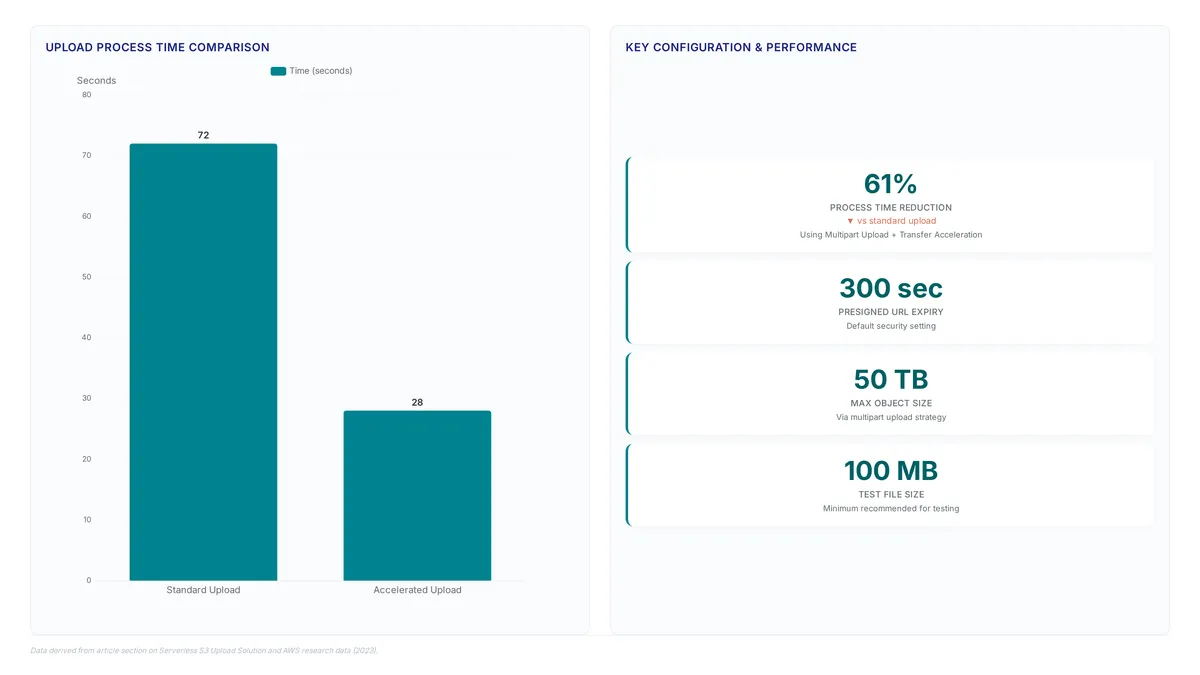
Combining multipart upload with transfer acceleration cuts large file transfer time by 61 percent.
Single-stream transfers are obsolete for large object storage. Architects clinging to legacy upload patterns invite unnecessary latency. The solution lies in parallelized data flows secured by presigned URLs, which authorize transactions without exposing credentials. This ensures edge location data flow remains fast and protected.
We dissect the specific API calls like CreateMultipartUpload and UploadPart that enable this parallelism. The analysis covers splitting files into chunks and reassembling them server-side. Finally, the guide details deploying a serverless solution using AWS CDK and API Gateway to automate this architecture. By using tested reduction from 72 seconds to 28 seconds, organizations can eliminate bottlenecks inherent in moving massive datasets. This approach transforms a typically fragile process into a reliable, scalable pipeline.
The Role of Multipart Upload and Presigned URLs in Secure Large Object Storage
S3 Multipart Upload and Upload ID Mechanics
S3 multipart upload splits large objects into parallel parts to bypass TCP throughput limits and latency barriers.
The process follows a strict three-step API sequence: Initiate, Upload, and Complete. Operators first call `CreateMultipartUpload` to obtain a unique Upload ID, which acts as the correlation token for all subsequent part transfers. This identifier allows the storage backend to track independent data streams for a single logical object before assembling them.
| Step | API Action | Key Output |
|---|---|---|
| 1 | Initiate | Upload ID |
| 2 | Upload Parts | ETag per part |
| 3 | Complete | Final Object |
Managing thousands of parallel connections introduces state coordination overhead that single-stream uploads avoid. Every part upload requires the Upload ID to correlate the data stream, meaning client-side logic must persist this token reliably across potential network failures or application restarts. If the completion step fails after parts are uploaded, the storage bucket retains orphaned data fragments until a lifecycle policy removes them, incurring unnecessary costs.
Modern AI/ML pipelines apply this architecture to enable a serverless backend design where short-lived functions coordinate uploads without maintaining persistent disk state. Teams decouple the upload path from the application server to scale ingestion capacity elastically while maintaining strict security boundaries through presigned URLs. This pattern serves workflows moving large datasets over unpredictable networks effectively.
Serverless Presigned URL Architecture for Direct Uploads
A serverless backend generates time-limited presigned URLs to authorize direct browser-to-storage transfers without exposing long-term credentials.
This architecture decouples the control plane from the data plane, allowing clients to upload parts directly to edge locations while the application retains strict governance over access rights. These URLs remain valid only for a set duration, a constraint that notably narrows the attack surface should a token leak during transmission. The approach eliminates the need for the application server to proxy massive data streams, freeing compute resources for business logic rather than I/O waiting.
Operators deploy this pattern when handling large datasets where client-side latency varies or when scaling to thousands of concurrent uploaders. Increased architectural complexity represents the primary limitation; debugging failed parts requires correlating logs across the client, the signing service, and the storage backend rather than inspecting a single server stream.
| Component | Responsibility | Security Boundary |
|---|---|---|
| Client | Splits file, requests URLs, uploads parts | Holds temporary token only |
| Backend | Validates policy, signs URLs | Holds master keys |
| Storage | Accepts authenticated parts | Enforces time limits |
AI/ML training pipelines benefit from this topology where ingesting terabytes of data securely is paramount. The Upload ID ties these distributed parts into a single logical object upon completion.
Orphaned Parts and Storage Cost Risks in Incomplete Uploads
Orphaned parts accumulate storage charges when multipart sessions terminate before the final `CompleteMultipartUpload` call.
Interrupted multipart transfers persist as billable objects until explicitly deleted or purged by policy, unlike single-upload failures that leave no trace. Network instability during large file transfers often triggers partial writes that operators might overlook. Multipart upload allows for quicker recovery from network errors by only restarting failed parts, yet every abandoned attempt leaves behind data fragments. These fragments consume capacity indefinitely unless a lifecycle rule targets them. A lifecycle policy can automatically clean up abandoned uploads to avoid storage costs.
| Upload Method | Failure Residue | Cleanup Requirement |
|---|---|---|
| Single Put | None | Automatic |
| Multipart | Orphaned Parts | Manual or Lifecycle Policy |
High-churn environments generating thousands of temporary upload IDs daily face significant waste without automation, making the financial implication subtle but compounding. Configurations should pair multipart enablement with immediate expiration rules to prevent cost leakage. Ignoring this maintenance creates a hidden tax on development workflows where test uploads frequently fail.
Inside the Architecture of Parallel Uploads and Edge Location Data Flow
S3 Transfer Acceleration and Edge Location Routing Mechanics
Latency drops when the nearest edge location accepts and acknowledges file uploads before data crosses the AWS backbone. Standard S3 uploads send traffic straight from the client to the bucket region, leaving the transfer vulnerable to public internet congestion and unpredictable hop counts. S3 Transfer Acceleration requires activation on the S3 bucket and uses the endpoint `bucketname.s3-acceleration.amazonaws.com`. This setup moves the initial handshake to a nearby CloudFront point of presence, letting the protocol optimize the route through Amazon's private network infrastructure.
| Feature | Standard Upload | Transfer Acceleration |
|---|---|---|
| Routing Path | Direct to Region | Edge Location to Region |
| Network Type | Public Internet | Optimized AWS Backbone |
| Latency Impact | High over distance | Minimized at source |
The system splits large objects into smaller segments that upload at once over multiple connections to maximize bandwidth. Parallelism paired with edge routing cuts upload times for long-distance transfers. Network architects balance this expense against speed requirements, especially when moving terabytes of AI training data across continents. The architecture works best when latency barriers endanger SLA compliance, particularly for transfers spanning great distances where minimizing latency via the private network yields the most benefit. Multipart upload cuts AWS transfer time by 61 percent.
Coordinating Parallel Part Uploads via Three-Step API Sequence
The CreateMultipartUpload API call returns a unique upload ID that anchors every subsequent part transmission in a coordinated sequence. This identifier lets the client send multiple UploadPart requests at once, turning a single linear bottleneck into a highly parallelized data stream.
- Initiate the session to receive the upload ID.
- Upload distinct parts in parallel threads using the ID.
- Send CompleteMultipartUpload to assemble the final object.
This workflow maximizes bandwidth use by keeping multiple TCP connections active, effectively bypassing the throughput limits of a single stream. Managing hundreds of concurrent parts adds complexity to error handling and state tracking. A single part failure does not abort the whole upload, but the application must track missing segments to retry them specifically. This granularity fixes failed S3 multipart upload scenarios more efficiently than restarting a monolithic file transfer.
| Strategy | Concurrency Model | Failure Recovery |
|---|---|---|
| Single Stream | Sequential | Full Restart |
| Multipart | Parallel | Retry Specific Parts |
Tension exists between maximizing parallelism and overwhelming the client network stack or storage endpoint. High concurrency demands careful tuning to avoid degrading overall throughput. Parallel processing notably improves upload speed for large files by distributing load across available network paths.
Validating Secure Direct Uploads with Time-Limited Presigned URLs
Frontend applications upload large objects to S3 using S3 transfer acceleration and presigned URLs to bypass backend bottlenecks. A common secure architecture has a frontend application talk to backend services to generate time-limited presigned URLs, keeping credentials inside the server environment. This method prevents exposure of long-lived keys while allowing direct data paths from the client to the storage edge.
| Validation Step | Requirement |
|---|---|
| URL Generation | Backend creates unique signatures with short expiration windows |
Increased complexity arises when managing stateful upload sessions across transient network failures. If a multipart upload fails mid-stream, the client cannot simply retry the whole object but must identify the specific failed part using the upload ID. This approach maintains security posture while recovering from intermittent connectivity loss without restarting massive transfers.
Deploying a Serverless S3 Upload Solution with AWS CDK and API Gateway
Defining the CDK Context Variables for S3 Bucket Deployment
Pipeline initialization starts by defining specific context variables that govern S3 bucket naming and API Gateway security boundaries. Engineers configure the `env` variable to establish the target region and bootstrap AWS CDK before proceeding. A new S3 bucket is created dynamically to ensure unique resource isolation per environment. Operators also define the `urlExpiry` context variable, which sets a specific expiration time on the S3 presigned URL, with a default value of 300 seconds. This configuration restricts API Gatewa to specific network parameters, creating a tight security perimeter around the upload endpoint. The `whitelistip` value limits API Gateway access to a single IP address. Relying solely on bucket policies without this API-level restriction exposes infrastructure to broader network attacks. Strict IAM roles prevent credential leakage during the multipart handshake.
Executing the CDK Deploy Command with IP Whitelisting
Deploying the serverless backend requires cloning the repository and installing dependencies within the `backendv2` directory before invoking the AWS CDK. This sequence initializes the Lambda functions and API Gateway resources necessary for secure data ingestion. Operators must supply specific context flags to define the runtime environment and enforce network perimeter controls. The command structure accepts an `env` parameter for region selection and arguments that restrict API access to trusted addresses.
- Clone the source repository to your local workstation.
- Navigate to the `backendv2` folder and run `npm install` to resolve all package dependencies.
- Execute the deployment command with your specific environment identifier.
Only authorized clients can request presigned URLs through this mechanism, effectively mitigating exposure during the upload window. Engineers validate connectivity using a sufficiently large test upload file of at least 100 MB to confirm that the multipart upload lo functions correctly under load. The default configuration creates a unique bucket, yet strict network constraints prevent accidental public exposure if a bucket policy misconfiguration occurs. Pairing this deployment pattern with a corporate VPN or static egress gateway ensures consistent access control.
Validating Presigned URL Generation for Multipart Upload Parts
Verification requires confirming that the Lambda function generates time-limited presigned URLs by accepting specific Bucket, Key, and UploadId parameters for every part. The application uses these unique links to allow direct data transfer to the edge location closest to the user without requiring explicit write access to the underlying storage container. When combined with multipart upload, a presigned URL can be generated for each part.
- Construct the parameter object using the file key and the active upload session identifier.
- Generate a distinct presigned URL for each sequential part index to enable parallel transmission.
- Ensure the expiration window aligns with the expected network latency for large file transfers.
Generated URLs must remain valid long enough to complete the upload of large test files, as premature expiration causes immediate transaction failures. A common oversight involves mismatched expiration times where client-side retry logic exceeds the server-side URL validity period. Synchronizing the `urlExpiry` context variable with the maximum expected round-trip time for distant clients prevents authentication errors during high-latency events.
Measurable ROI from Transfer Acceleration in High-Latency Environments
Defining Transfer Acceleration Performance Metrics

Answering should I use transfer acceleration requires establishing a quantifiable baseline against client network constraints. Operators often observe performance ceilings due to TCP windowing limits over distance. The Speed Comparison tool validates throughput by executing multipart uploads across various geographic regions to isolate latency impact. Transfer acceleration is particularly beneficial when transferring data over long distances, as it minimizes latency by routing data through a strong, private network. Enabling acceleration involves specific cost structures. The primary goal is reducing network latency and providing a consistent user experience to web and mobile app users across the globe. Architects must verify that their specific use case involves high-latency paths where the potential improvement justifies the operational expense. Failure to benchmark these specific parameters often leads to over-provisioning bandwidth or unnecessary service fees.
Executing Multipart Uploads with Parallel Configuration
Configuring part sizes and concurrency limits directly addresses TCP throughput saturation during large object ingestion. Operators split files into smaller parts to maximize pipeline utilization while minimizing retry overhead. This specific concurrency setting helps manage connections efficiently, avoiding potential bottlenecks associated with browser limits on concurrent connections to the same server. Tuning these parameters based on available network bandwidth rather than maximizing thread counts blindly is recommended. The mechanical advantage lies in keeping multiple TCP connections active without overwhelming the local network stack.
| Parameter | Recommended Value | Constraint Reason |
|---|---|---|
| Part Size | Variable | Balances overhead and granularity |
| Parallel Threads | Optimized Count | Manages connection limits |
| Protocol | HTTPS | Required for presigned URL security |
Enabling this architecture requires activating transfer acceleration on the target bucket to route traffic through optimized edge networks. The system coordinates these independent transfers, ensuring data integrity upon final assembly. Proper configuration ensures the client sustains maximum possible throughput without triggering protocol-level backpressure.
Single vs Multipart Upload Speed Differentials
Answering should I use transfer acceleration requires isolating the latency penalty inherent in single-stream TCP handshakes. A standard single-part transfer without edge optimization consumed 72 seconds to complete the operation, while single upload with transfer acceleration resulted in 43 seconds. Enabling transfer acceleration alone reduced this duration notably by routing traffic through optimized network paths. Switching to a multipart upload strategy without acceleration yielded quicker speeds than the single-part baseline by dividing large files into smaller parts and uploading them concurrently over multiple connections. This differential proves that parallelizing data streams often provides greater throughput gains than network path optimization alone for mid-sized objects.
| Upload Strategy | Acceleration Enabled | Completion Time | Performance Gain |
|---|---|---|---|
| Single Part | No | 72 seconds | Baseline |
| Single Part | Yes | 43 seconds | Moderate |
| Multipart | No | 45 seconds | Significant |
| Multipart | Yes | ~28 seconds | Maximum |
| Configuration | Acceleration | Time | Improvement |
| Single | No | 72 seconds | Baseline |
| Single | Yes | 43 seconds | Moderate |
| Multipart | No | 45 seconds | Significant |
| Multipart | Yes | 28 seconds | Maximum |
The table illustrates that combining both techniques yields the lowest latency, yet the marginal return diminishes if the client network is already saturated. Operators must recognize that excessive parallelism can trigger browser limits on concurrent connections, causing request blocking before the storage service rejects the load. Validating part counts against client-side constraints helps avoid self-inflicted throttling. The architectural tension lies between maximizing pipeline utilization and respecting the finite connection pools of end-user environments.
About
Alex Kumar is a Senior Platform Engineer and Infrastructure Architect at Rabata.io, where he specializes in Kubernetes storage architecture and cost optimization for cloud-native applications. His daily work involves engineering high-performance data pipelines for AI/ML startups, making him uniquely qualified to analyze large object transfer strategies. At Rabata.io, an S3-compatible storage provider built for speed and scalability, Alex routinely addresses the bottlenecks of moving massive datasets, such as video assets and training models. He uses deep expertise in S3 multipart upload mechanics and transfer acceleration to ensure enterprise clients achieve optimal throughput without vendor lock-in. This article draws directly from his production experience optimizing storage layers where latency reduction and reliable uploads are critical. By connecting theoretical API concepts like `CreateMultipartUpload` to real-world infrastructure challenges, Alex provides actionable insights grounded in the rigorous demands of modern data engineering.
Conclusion
Scaling large object transfers reveals that raw network speed often matters less than connection management. While the data shows a dramatic reduction to 28 seconds when combining strategies, the real operational risk lies in client-side saturation. Browsers enforce strict limits on concurrent connections, meaning an aggressive multipart configuration can trigger request blocking before the storage service ever processes the load. This creates a fragile system where performance gains collapse under heavy user concurrency, turning a speed optimization into an availability incident.
Organizations should mandate a hybrid approach only for files exceeding 100 MB, while strictly capping part counts to respect end-user environment constraints. Do not apply maximum parallelism universally, as the marginal latency gain does not justify the increased probability of connection failures on standard consumer networks. The architecture must balance pipeline utilization against the finite resources of the client device.
Start by auditing your current presigned URL configurations this week to ensure part sizes align with typical user network conditions rather than theoretical maximums. Adjusting these parameters now prevents future bottlenecks without requiring new infrastructure. Focus on stabilizing the upload experience for the majority of users before chasing the absolute fastest edge-case metrics.
Frequently Asked Questions
Combining these methods cuts transfer time by 61 percent. This speed gain eliminates bottlenecks inherent in moving massive datasets over standard connections. Architects should adopt parallelized flows to avoid unnecessary latency issues.
The strategy supports individual objects as large as 50 TB. This capacity enables storage of massive data sets like high-resolution video without requiring file splitting into separate logical containers.
Engineers should use a test file of at least 100 MB. This minimum size confirms that the multipart upload logic functions correctly before deploying to production environments with larger datasets.
These URLs authorize direct transfers without exposing long-term credentials. They remain valid for a defined duration, which notably narrows the attack surface should a token leak during transmission.
Orphaned parts accumulate storage charges when sessions terminate early. Interrupted transfers persist as billable objects until explicitly deleted, so operators must monitor incomplete uploads to prevent unnecessary costs.
References