Flash Stretch analysis: Stop buying new arrays
Flash Stretch targets the 70% of cold data clogging expensive arrays while NAND prices surge 234% in 2026.
Buying new hardware right now is a trap. Flash Stretch exists to stop organizations from falling into it. With Gartner predicting a 130% spike in combined DRAM and SSD costs by year-end, ignoring inactive data isn't just sloppy budgeting; it's a strategic failure.
This isn't a sales pitch for migration. It's a breakdown of the Flash Stretch assessment workflow. The service analyzes technical metadata to build cost avoidance models without moving a single byte. You get a map of exactly which files to tier to cheaper targets, freeing up massive capacity blocks. We compare this free assessment against competitor tools and traditional hardware expansion to show why manual optimization collapses under modern Memflation pressure.
Krishna Subramanian, COO of Komprise, puts it bluntly: better data management eliminates the need for new purchases entirely. Reclaiming just one petabyte of flash via this method yields savings exceeding $350,000 at current 2026 market rates. Do the math before you sign a PO.
The Role of Flash Stretch in Modern Primary Storage Optimization
Flash Stretch Definition and Cold Data Identification
Komprise launched Flash Stretch on 26 Mar 2026 as a dedicated assessment service. Its job is simple: find inactive data on primary storage. The tool scrapes technical metadata across network-attached storage systems to pinpoint files ready for tiering, leaving active workloads alone.
Here, cold data means unstructured information that stays accessible but sees zero user interaction for long stretches. The stat that matters: 70 percent of enterprise unstructured data is inactive and cold, yet it sits on primary storage, eating the expensive flash capacity needed for AI inferencing. Flash Stretch quantifies this waste, projecting potential savings of $350,000 per petabyte through strategic movement.
Flash Stretch Use Cases for AI Readiness and Cost Reduction
AI workloads starve when cold files choke the array. Flash Stretch clears the lane.
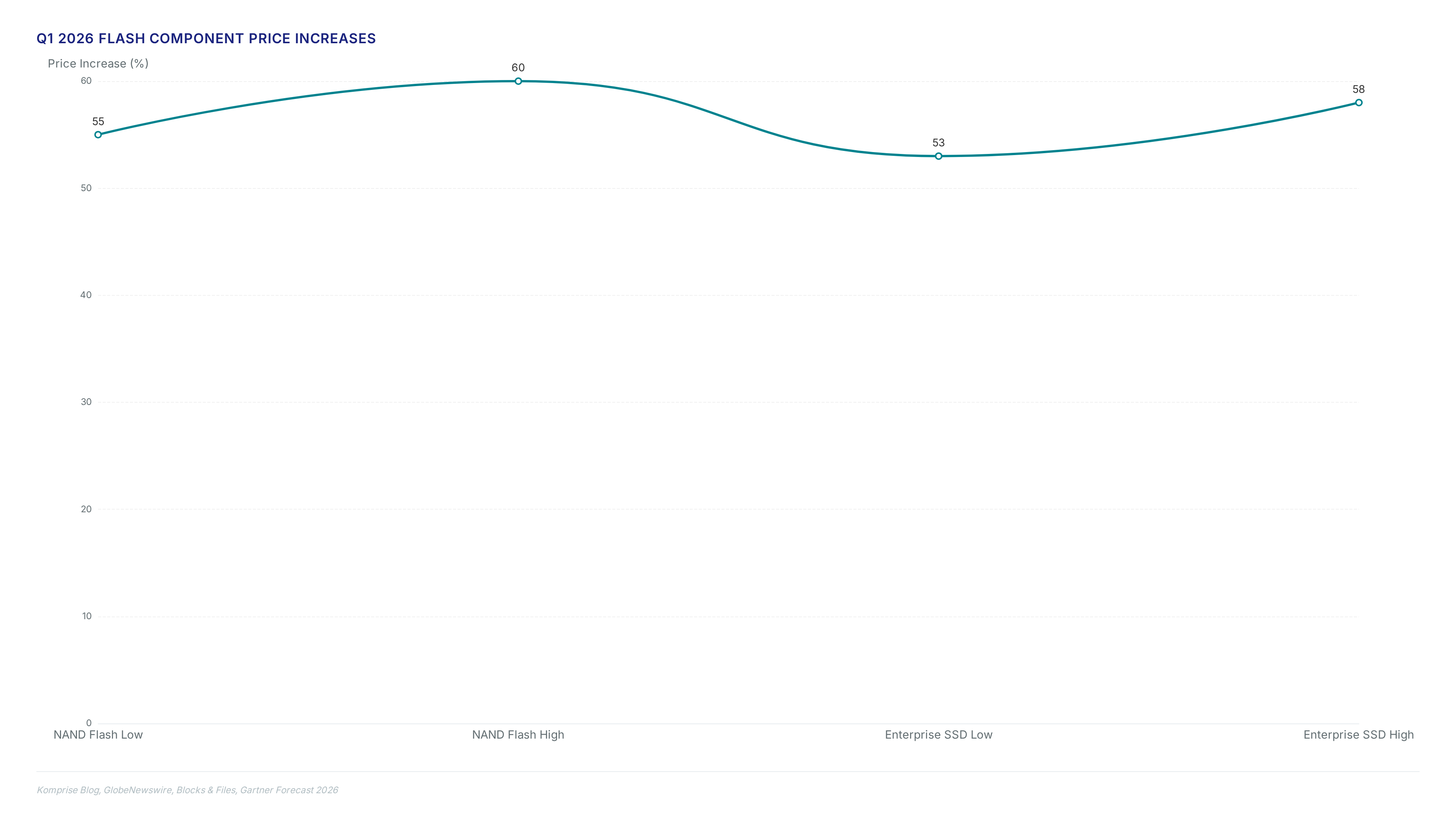
The mechanism rates files by access usage, age, and type, generating a tiering model for public cloud disk storage. This reclamation hits the storage bottleneck head-on, specifically where NAND flash prices rose 234% in 2026, crushing budgets for high-performance compute.
District Medical Group of Arizona proved the concept. They validated this approach with $100,000 in storage cost savings over three years and a 5.5TB reduction in backup data. They also saw 75% faster backup processes. Tiering improves infrastructure efficiency; it's not just about recovering capacity.
Reactive purchasing ignores the 70 percent of inactive data already consuming expensive slots. If you delay cold data identification, you face a structural deficit: new AI workloads can't find space without prohibitive hardware outlays. When price curves decouple from performance gains, storage tiering becomes a financial imperative, not an architectural preference.
Treat flash as a scarce resource reserved strictly for active inference tasks.
- Reclaim existing flash capacity first.
- Tighten contract Renewals Locks in inflated rates for 36 months.
- Analyze data across hybrid and cloud environments.
- Categorize and define tiering policies via virtual appliance rules.
- Execute file migrations to Amazon S3 or similar object stores.
- Monitor access heatmaps for future optimization cycles.
Inside the Flash Stretch Assessment and Data Migration Workflow
Deep Analytics Metadata Tagging in Flash Stretch
Deep Analytics tags file attributes like age and access frequency to isolate cold data without moving storage blocks. This metadata-only inspection runs as a virtual appliance on multi-vendor NAS systems. It avoids the performance penalties of block-level scanning.
The process generates granular insights. IT teams execute migrations based on precise file characteristics rather than coarse directory estimates. Unlike proprietary solutions tied to specific hardware, this approach supports transparent movement to any public cloud disk storage.
| Feature | Block-Based Tiering | Deep Analytics Tagging |
|---|---|---|
| Inspection Level | Storage block headers | File metadata attributes |
| Migration Scope | Vendor-locked arrays | Storage-agnostic targets |
| Performance Impact | High during scan | Negligible metadata read |
Operators can define rules for cold data reclamation before buying optimization licenses. There is a catch: assessment results require a separate subscription to Komprise Analysis for automated execution. Relying solely on the free assessment leaves the actual data movement as a manual task for administrators. This separation ensures the initial footprint analysis remains unbiased by implementation costs.
Executing File-Based Tiering from Primary Storage to Cloud
File-based tiering migrates cold datasets to AWS S3 Deep Archive, leveraging a 23 times cost differential to offset primary flash expenses.
Operators execute this workflow through a set sequence that separates analysis from action:
- Deploy the virtual appliance to scan multi-vendor NAS.
- Apply Deep Analytics tags to isolate files based on access age and type.
- Configure tiering policies that trigger automatic movement once files meet inactivity thresholds.
- Validate the migration path to ensure cloud file system costs remain below on-premises retention rates.
This approach contrasts sharply with block-level proprietary methods that often lock data into specific hardware ecosystems.
| Feature | File-Based Tiering | Block-Level Proprietary |
|---|---|---|
| Scope of Savings | Storage, backups, replication | Primary copy only |
| Cloud Portability | High ( | Low (vendor-locked) |
| Implementation | Policy-driven automation | Hardware-dependent |
| Metadata Handling | Transparent namespace | Opaque translation layer |
Policy definition is where things break. Overly aggressive rules risk moving semi-active data that requires frequent rehydration, spiking egress fees. Unlike block methods, file-based tiering saves on underlying storage, cloud file system costs, replication, and backups simultaneously. A workwear manufacturer demonstrated this efficiency by reducing Azure costs from $1.00 to $0.25 per GB through precise policy tuning. Successful execution reclaims capacity for AI workloads while stabilizing budgets against volatile flash pricing.
Flash Stretch Eligibility and Two-Week Assessment Timeline
Qualification for the free service requires a minimum 500 terabytes of primary storage capacity to prevent skewed sampling results.
Organizations falling below this threshold face a flat fee of $18/TB, altering the return on investment calculation for smaller footprints. The assessment mechanism runs for two weeks. This duration allows the virtual appliance to rate files by age and type across multi-vendor NAS environments before generating a tiering model.
A common planning error involves assuming the assessment itself migrates data. The tool only identifies candidates, leaving execution to separate licensed products. Delaying this initial scan risks compounding costs as flash prices continue their upward trajectory unchecked.
Flash Stretch Versus Competitor Tools and Alternative Approaches
Komprise Storage-Agnostic Control Plane Versus NetApp BlueXP
Architectural divergence starts here: Komprise operates as a storage-agnostic control plane across all hybrid data estates without vendor lock-in.
NetApp BlueXP functions as a unified data control plane specifically engineered for NetApp hybrid cloud storage and services, creating an inherent boundary for non-NetApp assets. Operators must choose between deep integration within a single vendor stack or broad visibility across a heterogeneous environment. Dell PowerScale uses SmartPools for automated tiering strictly within the OneFS system, whereas external analytics layers can tier data from Dell and other vendors to any cloud target. Native tools hit a wall when migrating to low-cost object storage like Amazon S3, Azure, or Wasabi, where platform-specific constraints often block optimal placement.
| Feature | Komprise Control Plane | NetApp BlueXP | Dell SmartPools |
|---|---|---|---|
| Storage Scope | Agnostic across all vendors | NetApp systems only | OneFS system only |
| Cloud Targets | Any S3-compatible object store | FabricPools integrated targets | cloud tiers |
| Lock-in Risk | None; metadata stays external | High; tied to OnTap stack | High; tied to PowerScale |
| Market Share | N/A | 10.5% mindshare | 14.5% mindshare |
Managing mixed fleets carries tangible risk. Deploying vendor-specific tools leaves cold data on expensive primary arrays if that data resides on competing hardware. The cost is reduced flexibility; agnostic planes require separate governance policies compared to the unified but restricted BlueXP interface. Evaluate total estate heterogeneity before selecting a control plane to avoid stranded capacity.
These outcomes validate moving inactive files when primary flash prices surge, yet specific savings depend heavily on the target cloud tier selected. Weigh the immediacy of cash flow relief against the latency penalties inherent in deep archive retrieval classes.
Aggressive cost cutting has limits. Compliance mandates often prevent moving certain regulated data off-premises, regardless of access frequency. Organizations with massive footprints and flexible retention rules see the highest returns, while those with strict sovereignty requirements face diminished benefits. Choose the right moment to tier by analyzing access heatmaps rather than relying on arbitrary age thresholds. Match the tiering policy to the specific business value of the data; do not apply blanket rules. Validate recovery time objectives before executing large-scale migrations to avoid operational disruption during emergency restorations.
VAST Data Amplify DASE Architecture Versus Flash Stretch Tiering
VAST Data delivers up to 6x effective capacity through its Disaggregated Shared Everything (DASE) architecture, contrasting with external analytics tiering.
This approach expands the physical flash pool rather than isolating cold files for migration to cheaper targets. Operators choosing DASE gain performance consistency across the entire dataset but incur higher upfront hardware costs compared to software-only solutions. Flash Stretch identifies the 70 percent of cold data to move it off-array.
The trade-off involves latency. DASE keeps all data on fast media, while tiering introduces retrieval delays for archived content. Komprise provides a storage-agnostic layer that moves data from Dell or other vendors to any cloud, avoiding the vendor lock-in inherent in proprietary hardware expansions.
| Dimension | VAST Data Amplify | Komprise Flash Stretch |
|---|---|---|
| Mechanism | Hardware scaling via DASE | External analytics and migration |
| Data Location | Remains on primary flash | Moves to cloud object storage |
| Vendor Scope | VAST proprietary systems | Multi-vendor NAS and cloud |
| Cost Model | Capital expenditure for hardware | Operational expenditure for cloud |
The strategic divergence forces a choice: preserve low-latency access for all data or accept retrieval penalties to maximize cash flow relief. Organizations with strict performance SLAs for legacy datasets may find hardware expansion necessary despite the premium. Those prioritizing budget optimization over universal speed will favor the tiering strategy to offload cold assets.
Measurable ROI and Strategic Savings from Flash Stretch Deployments
Quantifying Strategic Savings Through Flash Stretch Metrics

Primary storage offset calculations must isolate flash avoidance from backup reduction. Inflated ROI projections happen when operators conflate reduced backup windows with capital expenditure deferral. The financial mechanisms differ fundamentally. Backup savings derive from shrinking the data footprint requiring replication, a secondary benefit distinct from primary tier economics. Memflation drives hardware costs independently of backup software licensing models.
| Metric Category | Financial Driver | Operational Impact |
|---|---|---|
| Primary Offset | Flash media acquisition | Defers hardware refresh cycles |
| Backup Reduction | Replication bandwidth | Lowers egress and storage fees |
| Total TCO | Combined Avoidance | Improves cash flow timing |
Implementation latency is the bottleneck. Realizing these offsets requires purchasing the corresponding optimization product after the free assessment concludes. Without this second step, the identified potential savings remain theoretical rather than realized accounting entries. Teams must budget for the transition from analysis to action to capture value. Strategic planning demands separating one-time hardware avoidance from recurring operational expense reductions. Audit current flash utilization rates before committing to expansion projects.
District Medical Group Three-Year Cost Reduction Execution
District Medical Group of Arizona executed a tiering strategy targeting backup data reduction and cost avoidance over a three-year horizon. Implementation requires defining metadata tags to isolate non-compliant or aged data before migration to object storage.
Distinguish between immediate cash flow relief from flash avoidance and the operational gains of reduced backup windows. Savings realization depends heavily on the selected cloud target and the specific retention policies enforced by the organization. Aggressive tiering to low-cost tiers risks violating retrieval time Service Level Agreements during patient care incidents. Validate retrieval latency requirements before finalizing migration policies to prevent clinical workflow disruption.
This volatility exposes AI inferencing data workflows to severe cost overruns when cold datasets occupy expensive flash tiers unnecessarily. Reactive purchasing fails because budget approval cycles cannot match the speed of memflation. Deferring action forces IT teams to absorb these shocks rather than reclaiming existing capacity through strategic tiering. Isolate non-necessary data before the next pricing cycle locks in higher rates.
About
Marcus Chen serves as a Cloud Solutions Architect and Developer Advocate at Rabata. Io, where he specializes in optimizing S3-compatible object storage for AI and machine learning workloads. His deep expertise in data infrastructure makes him uniquely qualified to analyze Komprise's Flash Stretch service, which targets the critical inefficiency of storing cold data on expensive primary flash systems. In his daily role, Chen architects scalable storage solutions that separate hot and cold data tiers to maximize performance while minimizing costs for enterprise clients. This article connects directly to his professional focus on eliminating storage waste, a practice central to Rabata. Io's mission of providing cost-effective, high-performance alternatives to traditional cloud providers. By evaluating how Flash Stretch identifies inactive data for tiering, Chen uses his background in Kubernetes persistent storage and cloud economics to guide organizations toward smarter, more efficient data management strategies necessary for modern AI initiatives.
Conclusion
Scaling Flash Stretch architectures reveals a critical breaking point: the operational overhead of managing metadata tags often eclipses initial hardware savings if governance remains manual. Organizations treating this as a simple hardware swap rather than a process redesign will find their efficiency gains consumed by the complexity of maintaining retrieval SLAs during clinical emergencies. The window for passive optimization has closed; waiting for budget cycles to align with market volatility guarantees capital inefficiency.
Deploy a governed tiering policy immediately if your environment holds over a massive volume of static data and faces a hardware refresh within six months. Do not attempt a full migration without first establishing automated validation gates for retrieval latency to prevent workflow disruption during peak demand. Start by auditing your top five largest backup datasets this week to identify candidates for immediate cold storage migration before the next quarterly pricing adjustment locks in higher rates. This targeted action isolates quick wins while building the operational muscle required for broader implementation.
Frequently Asked Questions
The service projects potential savings of $350,000 per petabyte through strategic data movement. This figure helps organizations offset the need for new hardware purchases during periods of extreme price inflation.
The organization achieved $100,000 in storage cost savings over three years alongside a 5.5TB reduction in backup data. They also realized 75% faster backup processes by tiering inactive files effectively.
Typically 70% of enterprise unstructured data is inactive yet consumes high-speed flash intended for AI inferencing workloads. Flash Stretch identifies these cold files to reclaim capacity without disrupting active operations.
NAND flash prices rose 234% in 2026, creating a severe bottleneck that constrains budgets for high-performance compute resources. Ignoring inactive data now represents a strategic failure rather than a simple oversight.
Implementing the recommended policies requires a separate paid subscription at roughly $100 per TB annually. This cost follows the free two-week assessment that identifies specific files suitable for tiering.