Edge storage cuts 4K latency for distributed teams
OpenDrives Edge delivers local-speed 4K/8K access to distributed teams, eliminating the latency plaguing traditional cloud-only workflows.
The industry's shift toward hybrid cloud-edge architectures is no longer optional but a financial necessity driven by soaring compute demands. With AI workloads now serving as the primary catalyst for cloud spending growth in 2026, CloudZero data confirms that enterprises must move intensive processing closer to the data source to avoid unsustainable egress fees. OpenDrives Edge acts as a performance accelerator, bridging the gap between central data hubs and remote creatives without forcing them to abandon existing tools or endure sluggish file transfers.
This article dissects how OpenDrives Edge changes distributed media infrastructure by replacing manual file management with automated, policy-based orchestration. Finally, we analyze why these hybrid cloud-edge workflows consistently outperform rigid cloud-only models, offering IT leaders precise governance over storage tiers and significant reductions in operational overhead.
The Role of OpenDrives Edge in Modern Distributed Media Infrastructure
OpenDrives Edge launched April 13, 2026, as a hybrid cloud-edge performance accelerator eliminating latency for distributed teams. This architecture defines intelligent edge syncing by caching data locally after a single pull, enabling local-speed 4K and 8K workflows without recurring egress fees. The system marks a strategic transition from pure storage hardware to thorough data services following the November 2025 launch of Astraeus. Unlike AWS Storage Gateway, which charges per-GB processing fees for all traffic, Edge maintains a live sync between edge and cloud without manual device shipping or per-GB processing fees. Traditional hardware-only storage fails to support remote editors needing instant access to central repositories. Edge resolves this by keeping hot data on-premises while automating movement to the central data hub. The solution explicitly delivers local-speed video workflows, removing friction between creative users and inaccessible datasets.
Reliance on local cache capacity introduces a tension between immediate performance and total storage footprint at remote sites. Operators must balance aggressive tiering policies against available disk space to prevent sync stalls during large ingest events. This constraint demands careful planning of edge node specifications before deployment. Mission and Vision recommends evaluating site bandwidth limits prior to enabling automated orchestration features.
Enabling Local-Speed Access for 4K and 8K Video Workflows
Local-speed data access means editing 8K timelines at LAN latency while the master dataset resides in a central cloud hub. Traditional storage cannot keep up with modern video-intensive workflows where more content must be immediately used by distributed editors. OpenDrives Edge supports native integration with DaVinci Resolve and Adobe Premiere, bypassing the configuration overhead general-purpose file sync solutions require for real-time performance. The system caches data locally after a single pull, eliminating the per-GB processing fees that plague AWS Storage Gateway during heavy read operations.
| Workflow Stage | Traditional Cloud Pull | OpenDrives Edge Cache |
|---|---|---|
| Initial Load | High latency | Single fetch |
| Repeat Access | Egress fees apply | Local disk speed |
| Sync Direction | Manual upload | Automated bidirectional |
General-purpose gateways often lack the continuous low-latency capability of live sync. The cost advantage emerges when teams avoid shipping physical devices like AWS Snowball for every project iteration. However, this architecture demands sufficient local SSD capacity to hold active project bins, creating a tension between cache size and site hardware budgets. Operators must balance local storage costs against the recurring expense of cloud egress for repeated file accesses. Mission and Vision recommends sizing edge nodes to hold at least 15% of total project assets locally to maximize throughput gains.
OpenDrives Edge Versus Ineffective Cloud-Only Workflows
Pure cloud strategies fail video editing because direct AWS Storage Gateway access introduces unmanageable latency and per-GB processing fees. OpenDrives Edge functions as a hybrid cloud-edge performance accelerator that caches data locally to eliminate these bottlenecks. Alex Dunfey the that the solution removes friction so teams focus on work rather than data movement mechanics. This approach contrasts sharply with physical transfer methods like AWS Snowball, which lack the continuous live sync. The market for such edge computing solutions is projected to reach $347.82 billion by 2031, reflecting widespread rejection of ineffective cloud-only models.
| Feature | Cloud-Only Workflow | OpenDrives Edge |
|---|---|---|
| Latency | High (WAN dependent) | Local-speed (LAN) |
| Cost Model | Per-GB egress fees | Fixed local cache |
| Sync Method | Manual or delayed | Continuous automated |
| Workflow Support | Interrupted 4K/8K | Uninterrupted 4K/8K |
Operators relying solely on public cloud storage face unpredictable costs and version conflicts during high-resolution rendering. The limitation of cloud-only architectures is the inability to sustain local-speed throughput for multiple concurrent users without prohibitive expense. Edge caching resolves this tension by keeping hot data on-premises while maintaining a central source of truth. Mission and Vision recommends deploying edge accelerators to prevent workflow stalls caused by network congestion.
Inside the Architecture of Intelligent Edge Syncing and Automated Data Movement
Policy rules trigger automatic migration of inactive files from local SSD caches to cold cloud storage tiers. Administrators define retention windows and access frequency thresholds within the Atlas interface to govern data placement without manual intervention. The system pulls content once, then serves subsequent requests at local LAN speed while background processes evaluate file metadata against active policies. Hot data remains on-premises for immediate editing, whereas cold data shifts to cheaper object storage to optimize costs.
- Set access time thresholds for automatic tiering decisions.
- Configure bandwidth limits for background sync operations.
- Define exclusion lists for active project folders.
- Enable versioning retention policies for compliance archives.
This mechanics layer prevents egress charges by ensuring only modified blocks traverse the WAN link back to the central hub. Unlike generic gateways that incur region-specific data charges for every read operation, this architecture keeps frequent accesses on the edge network. Teams avoid the latency penalties inherent in pulling entire datasets from public cloud sources during active editing sessions. The limitation involves initial cache warming; large datasets require significant time to populate local disks before full policy enforcement begins. Operators must balance aggressive tiering against the risk of re-fetching data if editors suddenly need archived assets. Strategic deployment ensures high-value creative work proceeds uninterrupted while IT maintains strict governance over storage spending.
Resolving Sync Conflicts for Distributed Creative Teams
Widely distributed creative teams frequently stall production while manually reconciling version mismatches across 4K and 8K assets. OpenDrives Edge eliminates this friction by caching data locally after a single pull, allowing editors to work at local-speed. The system maintains a live sync between the edge and the central hub, ensuring the cloud remains the source of truth while preventing the latency inherent in direct public cloud access. Native support for Adobe Premiere and DaVinci Resolve enables real-time performance that general-purpose file sync tools cannot match without extensive configuration.
| Conflict Trigger | Traditional Resolution | Edge Automation |
|---|---|---|
| Simultaneous Edit | Manual merge or overwrite | Atomic lock on hub |
| Large File Transfer | Hours of WAN upload | Background delta sync |
| Version Drift | Email chains for verification | Single source of truth |
Operators must balance immediate local write availability against the consistency window required for global synchronization. Aggressive local caching accelerates editing but delays conflict detection until the next sync cycle completes. This cost is clear: local changes remain invisible to remote collaborators until the sync finishes. The architecture avoids the manual device shipping required by physical transfer options like AWS Snowball, providing continuous live sync. Mission and Vision recommend defining strict retention windows to prevent cache saturation during high-volume ingestion periods.
Mitigating Unpredictable Cloud Egress Charges in Hybrid Workflows
Transferring terabytes across public providers triggers significant per-gigabyte egress charges that destabilize operational budgets. Pure cloud inference models incur costs roughly 15 times higher than hybrid architectures over three years, penalizing workflows that pull data repeatedly for editing. OpenDrives Edge prevents this financial leakage by caching hot datasets on-premises, ensuring frequent access avoids region-specific data charges entirely. The architecture shifts the economic model from variable consumption to fixed infrastructure investment.
Operators must configure automated movement policies to sustain these savings without manual intervention:
- Define access frequency thresholds to identify candidates for local caching.
- Set retention windows that keep active 4K assets on edge storage.
- Enable background sync to return changes to the central hub automatically.
- Restrict direct cloud reads to cold data tiers only.
The drawback is reduced flexibility for ad-hoc global access, as data must reside locally before editing begins. This constraint forces disciplined data governance but eliminates the surprise bills common in ineffective cloud-only workflows. Mission and Vision recommends auditing current egress logs to quantify potential savings before deployment.
Hybrid Cloud-Edge Workflows Outperform Traditional Cloud-Only Architectures
Hybrid Cloud-Edge Architecture Versus Pure Cloud Models
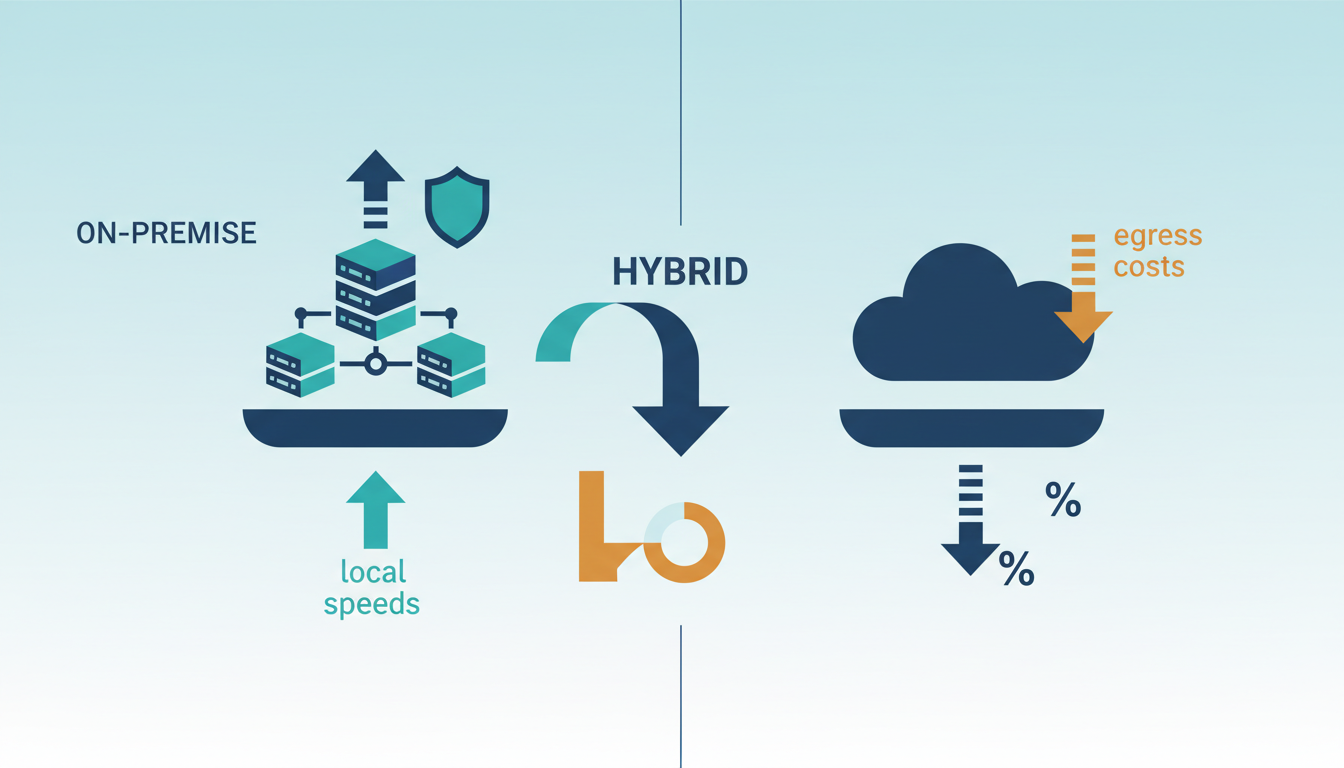
Hybrid workflows decentralize processing to local caches, whereas pure cloud models force all compute through centralized data centers. This structural shift addresses the latency inherent in accessing large datasets directly from public storage. Operators pulling 4K/8K video frames over WAN links face unacceptable lag, while edge architectures deliver local-speed performance by serving content from on-premises nodes. The financial divergence is stark; pure cloud inference costs roughly 15 times more than hybrid equivalents over a three-year horizon due to cumulative egress fees.
| Dimension | Pure Cloud Model | Hybrid Cloud-Edge |
|---|---|---|
| Data Locality | Centralized only | Distributed cache + Hub |
| Access Latency | High (WAN dependent) | Low (LAN speed) |
| Cost Structure | Variable per-GB egress | Fixed infrastructure CapEx |
Seventy-six percent of migrating businesses now apply hybrid or multi-cloud. Gartner predicts that by 2027, over 70% of enterprises will adopt industry cloud platforms to accelerate initiatives. The trade-off involves higher upfront hardware investment for edge nodes, yet this expense stabilizes long-term operational budgets against volatile transfer rates. Relying solely on centralized resources creates a single point of congestion that degrades creative collaboration as team size scales. Distributed teams lose productivity managing sync conflicts when version alignment depends entirely on wide-area throughput. The logical conclusion for video-intensive operations is a distributed topology that keeps active assets near the user.
Eliminating Latency in 4K and 8K Distributed Workflows
Direct WAN access to 4K and 8K assets introduces frame-drop latency that halts creative review sessions for distributed teams. OpenDrives Edge resolves this by caching data locally after a single pull, enabling editors to work at local-speed. The system maintains a live sync between the edge node and central hub, ensuring the cloud remains the source of truth while preventing the lag inherent in direct public cloud access. Unlike AWS Storage Gateway, which charges per-gigabyte processing fees for all traffic, this architecture serves subsequent requests from the local.
Physical transfer methods like AWS Snowball lack the continuous connectivity required for iterative editing, forcing manual device shipping that breaks workflow continuity. OpenDrives Edge sustains a persistent link that updates changes automatically, supporting native tools like Adobe Premiere without protocol translation layers.
The market for such hybrid solutions reflects broader spending trends, with worldwide edge computing investment projected to reach a substantial sum by 2027. Operators must balance the upfront capital expenditure of edge nodes against the variable operational costs of constant cloud fetching. A critical tension exists between data freshness and bandwidth consumption; aggressive sync policies ensure version alignment but may saturate limited uplinks at remote sites. Mission and Vision recommends configuring bandwidth limits during peak creative hours to preserve local-speed performance while deferring large background syncs to off-peak windows. This approach prevents network congestion from degrading the very latency advantages the edge architecture seeks to provide.
Financial Risks of Unmanaged Cloud Egress Charges
Unmanaged data pulls trigger volatile per-gigabyte fees that destabilize operational budgets for video workflows. Moving terabytes across public providers incurs significant per-gebabyte egress charges. Pure cloud inference models cost roughly 15 times more than hybrid architectures over three years, creating a severe financial penalty for repeated data access. OpenDrives Edge mitigates this leakage by caching hot datasets on-premises, ensuring frequent access avoids region-specific data charges.
| Dimension | Pure Cloud Workflow | Hybrid Edge Workflow |
|---|---|---|
| Cost Structure | Variable per-GB egress | Fixed local storage |
| Latency Profile | WAN-dependent lag | Local LAN speed |
| Version Control | Manual sync conflicts | Automated hub alignment |
| Three-Year Cost | 15x baseline expense | Baseline expense |
Operators ignoring these dynamics face compounding expenses as dataset sizes grow beyond initial projections. A tension exists between immediate cloud scalability and long-term fiscal predictability; choosing the former without caching layers guarantees budget overruns. Most enterprises now favor hybrid approaches to balance these competing goals, with 76% of businesses using multi-cloud strategies to mitigate risk. The limitation remains that initial edge hardware requires capital expenditure, though this upfront cost prevents recurring operational drain. Mission and Vision recommend deploying local caches to change unpredictable variable costs into manageable fixed assets.
Deploying OpenDrives Edge for Local-Speed Workflows in Enterprise Environments
Accessing OpenDrives Edge via the Atlas Containers Marketplace
Existing OpenDrives customers deploy the solution immediately through the Atlas. This entry point bypasses the complex orchestration tools like AWS EKS or Azure Arc that competitors require for similar hybrid management capabilities. The current release connects directly to Amazon Web Services, Google Cloud, and Microsoft Azure, establishing a unified control plane for distributed caches. Operators avoid the fragmentation typical of multi-cloud setups by managing edge nodes within a single interface rather than juggling disparate provider consoles. Future roadmap items include support for Oracle Cloud and the ability to run directly on customer servers, expanding beyond the initial Atlas-centric deployment model. The strategic limitation remains that non-Atlas environments must wait for subsequent hardware certification updates before integration. This centralized access model reduces the operational overhead of maintaining sync policies across global teams. Mission and Vision recommends using this marketplace integration to standardize data governance before scaling to additional cloud providers.
Implementing Policy-Based Data Tiering for Media Post-Production Pipelines
Policy-based data tiering keeps active datasets local while shifting cold media to cost-efficient storage tiers automatically. The LA Kings Therapy Studios utilized similar distributed architectures for the "What Drives Us" documentary, managing high-resolution files across dispersed teams without manual transfer bottlenecks. Storagenewsletter. This approach avoids the complexity of reserved capacity plans found in Azure while delivering continuous low-latency editing capability.
| Workflow Stage | Data Location | Access Speed | Cost Implication |
|---|---|---|---|
| Active Editing | Local Edge Cache | LAN Speed | Zero Egress Fees |
| Review & Approval | Local Edge Cache | LAN Speed | Zero Egress Fees |
| Archival | Central Cloud Hub | WAN Speed | Minimal Storage Cost |
The limitation remains that policy definitions must align strictly with project lifecycles to prevent premature tiering of active assets. Operators configuring automatic data movement face a tension between aggressive cost savings and the risk of latency spikes if cold data is recalled unexpectedly. Mission and Vision recommends mapping tiering rules to specific post-production phases rather than generic time-based thresholds. This structural change ensures distributed media workflows maintain predictable latency economics while maximizing storage efficiency.
Validating Cloud Compatibility for AWS, GCP, and Azure Integrations
Deployment begins by confirming native connectors for Amazon Web Services. Operators must verify that edge nodes sustain local-speed. The current release excludes Oracle Cloud, requiring teams to route non-supported workloads through alternative gateways until future updates arrive.
| Provider | Status | Constraint |
|---|---|---|
| AWS | Supported | Requires Atlas Marketplace |
| GCP | Supported | No manual device shipping |
| Azure | Supported | Limited to Phase 1 features |
| Oracle | Pending | Roadmap dependency |
Ignoring this compatibility matrix forces IT groups to manage disparate consoles instead of a unified control plane. The reliance on specific cloud APIs creates a vendor lock-in tension where switching providers mid-project incurs architectural rework. Teams should prioritize workloads matching the supported matrix to avoid integration failures during critical production windows. Mission and Vision recommends auditing existing cloud contracts against these technical constraints before provisioning edge hardware. Future expansions promise direct server installations, yet current deployments remain bound to the Containers Marketplace availability.
About
Alex Kumar, Senior Platform Engineer and Infrastructure Architect at Rabata. Io, brings deep technical expertise to the analysis of OpenDrives Edge. With a specialized background in Kubernetes storage architecture and disaster recovery, Kumar is uniquely qualified to evaluate how hybrid cloud-edge accelerators impact distributed video workflows. His daily work designing cost-effective, high-performance storage solutions for AI and enterprise clients directly aligns with the challenges OpenDrives aims to solve: eliminating latency while maintaining data accessibility. At Rabata. Io, a provider of fast, S3-compatible object storage, Kumar constantly navigates the complexities of balancing local speed with cloud scalability. This practical experience allows him to critically assess how OpenDrives Edge integrates with modern cloud-native platforms like Astraeus. His insights bridge the gap between theoretical product announcements and real-world infrastructure deployment, offering readers a grounded perspective on the future of rich media storage management.
Conclusion
Scaling distributed media workflows reveals that latency economics collapse when edge nodes function merely as passive caches rather than active compute zones. As AI-driven post-production dominates 2026 spending, the bottleneck shifts from storage capacity to the throughput consistency required for real-time model inference near the source. Relying on generic time-based tiering fails under these conditions because unpredictable cold data recalls spike costs and stall creative iteration. The operational reality demands a shift toward workload-aware architecture where local resources dynamically match the intensity of active projects.
Organizations must audit their cloud contracts against the supported connector matrix within the next thirty days to prevent integration failures during peak production. Do not provision new hardware until verifying that your primary workloads align with native AWS, GCP, or Azure APIs, as routing through alternative gateways introduces unacceptable latency variance. Teams relying on Oracle Cloud must immediately map a migration path to supported providers or isolate those specific workflows to avoid architectural rework later. This proactive alignment ensures that edge investments deliver predictable performance rather than becoming costly bottlenecks. Start this week by inventorying all active post-production projects and flagging any that depend on unsupported cloud providers or generic tiering rules for immediate remediation.
Frequently Asked Questions
Nodes must hold at least 15% of total project assets locally. This specific sizing ensures maximum throughput gains while balancing immediate performance needs against available disk space constraints.
The system avoids per-GB processing fees entirely by caching data locally after a single pull. This architecture eliminates recurring egress costs that typically plague heavy read operations in traditional cloud gateways.
Yes, the platform supports native integration with DaVinci Resolve and Adobe Premiere without extra configuration. Users maintain their current tools while gaining automated bidirectional sync capabilities for seamless distributed collaboration workflows.
Changes are automatically synced back to the central data hub serving as the source of truth. This intelligent edge syncing removes manual upload steps and resolves version conflicts across globally distributed creative teams instantly.
It serves media, corporate creative teams, and general enterprise data-intensive industries needing fast access. The solution handles large shared datasets across distributed environments while providing IT leaders greater governance over storage tiers.