Data sovereignty fails when US code controls your EU cloud
€7.1 billion in cumulative GDPR fines recorded by January 2026 proves a hard truth: physical data location in Europe guarantees nothing against US legal reach.
The problem isn't where the disk spins. It's who owns the code running the show. US vendor dependence creates unavoidable jurisdictional risks that render traditional data localization useless when American entities control the software stack. Blocks & Files editor Chris Mellor points out the brutal reality: even encrypted data stays vulnerable because US providers can access valuable metadata indexes or enforce a total denial-of-service by disabling cloud-based control planes. Osmium analysts Max Mortillaro and Arjan Timmerman add that geofencing might satisfy some adequacy paperwork, but it stops US authorities from forcing vendors to restore client data to mandated locations cold.
Stop trusting the false security of hosting data on US-owned infrastructure within European borders. We need to look at the hidden jurisdictional risks across four specific data flow scenarios, from fully European-owned stacks to mixed-dependency traps. We will see exactly how US legal authority technically overrides EU localization efforts through backend manipulation. Finally, we evaluate sovereign cloud architectures designed to kill these control plane vulnerabilities, moving past physical storage constraints to fix the root of extraterritorial exposure.
The Hidden Jurisdictional Risks of US Cloud Control in Europe
Data Sovereignty vs Geographic Storage Under the CLOUD Act
Data sovereignty demands legal jurisdiction alignment. Merely achieving geographic storage within European borders is a checkbox exercise, not a shield. Osmium Data Group warns that physical location offers zero protection if US providers retain control. The CLOUD Act compels US-headquartered firms to disclose data regardless of server location. GDPR lacks a real data localization requirement, though adequacy requirements exist for cross-border transfers.
Operational risk goes deeper than content decryption. US entities access job names, indexes, and target infrastructure information even when payload encryption holds firm. Control plane dependence creates a single point of failure where foreign injunctions trigger denial-of-service events. The AWS European Sovereign Cloud attempts mitigation through air-gapped infrastructure, yet corporate headquarters jurisdiction remains a gaping hole. Cumulative GDPR fines reaching 7.1 billion highlight the financial stakes of non-compliance.
| Ownership Model | Compliance Level | Primary Risk Vector |
|---|---|---|
| EU Source / EU Destination | Highest | Negligible |
| US Source / EU Datacenter | Medium | Metadata Access |
| US Source / US Datacenter | None | Direct Compulsion |
True sovereignty requires eliminating US-owned datacenters entirely. The sovereign cloud market expansion reflects this shift toward jurisdictional isolation. Encryption keys held by US vendors do not prevent service disabling or metadata harvesting. Operators must verify that backup applications lack remote kill switches embedded in cloud-based management layers. Legal contracts signed in Europe do not override US statutory obligations imposed on the vendor.
Metadata exposure denotes unauthorized access to backup job names, indexes, and target infrastructure details despite payload encryption. Osmium Data Group warns that US vendors retain legal use over this control plane data regardless of server geography.
| Deployment Model | Jurisdictional Risk | Metadata Exposure | Fine Liability |
|---|---|---|---|
| US Mover / US DC | Critical | Full | Maximum |
| US Mover / EU DC | High | Partial | Elevated |
| EU Mover / EU DC | Minimal | None | Negligible |
Organizations ignoring these nuances face cumulative fines that dwarfs initial cloud savings. Even physically air-gapped systems remain vulnerable if the control plane depends on US authorization servers. A single denial-of-service order can render local backups completely inoperable. True compliance requires eliminating US corporate headquarters from the data chain entirely. Shift to fully European-owned stacks to remove foreign legal exposure.
How US Legal Authority Overrides EU Data Localization Measures
Control Plane Dependencies in US-Owned EU Datacenters
US-owned providers retain administrative override of European infrastructure through remote control plane access despite physical data localization. Hyperscalers like AWS, Azure, and Google Cloud command 68% of global enterprise cloud spending, creating a centralized choke point for legal compulsion. Storage buckets might reside in Frankfurt or Paris, but the management software handling authentication and policy enforcement often routes through US-headquartered servers. This architecture allows foreign judicial orders to trigger a denial-of-service by disabling the management layer, rendering local data inaccessible regardless of encryption status.
The distinction between data-at-rest and operational telemetry creates a critical vulnerability gap. While payload content remains encrypted, US entities can legally compel vendors to expose metadata including job names, indexes, and target infrastructure details. Such information reveals organizational structure and backup frequency without decrypting a single byte. Providers are developing counter-measures; Microsoft plans to offer Azure Local Similarly, AWS uses air-gapped infrastructure for its European Sovereign Cloud to physically sever remote administrative links.
| Architecture Type | Control Plane Location | Metadata Exposure Risk |
|---|---|---|
| Standard Public Cloud | US-Headquartered | High |
| Sovereign Cloud | Isolated Region | Medium |
| Air-Gapped | On-Premises | None |
Public cloud end-user spending is forecast to hit $850 billion in 2026, yet scale often defeats sovereignty goals. The EU Data Act becomes applicable in September 2025 to mandate switching capabilities, but legacy contracts lock operators into US jurisdictional orbits. True compliance requires severing the logical link between the data center and the vendor's global management network.
Scenario Analysis: US Movers with European-Owned Datacenters
Scenario four pairs a US-owned data mover with a European-owned datacenter, creating a medium-to-low risk profile dominated by metadata exposure rather than content decryption. Blocks & Files identifies this configuration as the most deceptive architecture because physical storage location fails to neutralize legal jurisdiction over the software controlling access. Osmium analysts note that while payload encryption protects file contents, US entities retain visibility into job names, indexes, and target infrastructure details through the management layer. This telemetry allows foreign courts to map enterprise data landscapes without ever breaking cryptographic seals.
The operational danger manifests as a state-enforced denial-of-service where US authorities compel the vendor to disable the service entirely. Even if the backup data sits on sovereign soil, the solution becomes completely inoperable if the US-headquartered company cuts off the control plane. Some providers attempt to mitigate this via physically air-gapped infrastructure that prevents remote internal access, yet contractual jurisdiction often overrides these technical safeguards.
Signing a contract under EU law does not shield a US corporation from the CLOUD Act. Avoid US-owned data movers for ultra-sovereign workloads regardless of where the disks spin. The only definitive fix for data access denial involves replacing the mover itself with a European-owned alternative that lacks any US corporate parentage.
Geofencing Failures Against US Legal Reach
Geofencing mandates fail because US entities control the metadata layer regardless of physical server location. Analysts Arjan Timmerman and Max Mortillaro note that sovereignty assumptions crumble when US vendors manage the data mover, leaving job names and indexes visible to foreign courts. Encryption protects payload content but leaves operational telemetry exposed to judicial compulsion. A US provider can enforce a denial-of-service by disabling the management plane, rendering local storage inaccessible even if the datacenter is European-owned.
| Scenario | Data Mover | Datacenter | Primary Risk Vector |
|---|---|---|---|
| High Caution | US-Owned | US-Owned (in EU) | Direct legal compulsion |
| Hidden Risk | US-Owned | EU-Owned | Metadata exposure |
| Safe | EU-Owned | EU-Owned | None |
Organizations often mistake geographic boundaries for legal immunity, yet AWS and other hyperscalers remain subject to the CLOUD Act. The air-gapped architecture of sovereign clouds attempts to sever this link, but standard deployments retain remote administrative hooks. Contract jurisdiction rarely overrides the headquarters location of the vendor. True conformance requires eliminating US-owned software from the backup chain entirely, not just shifting disk locations.
Evaluating Sovereign Cloud Architectures Against US Vendor Dependence
Defining the Four Data Sovereignty Scenarios by Ownership
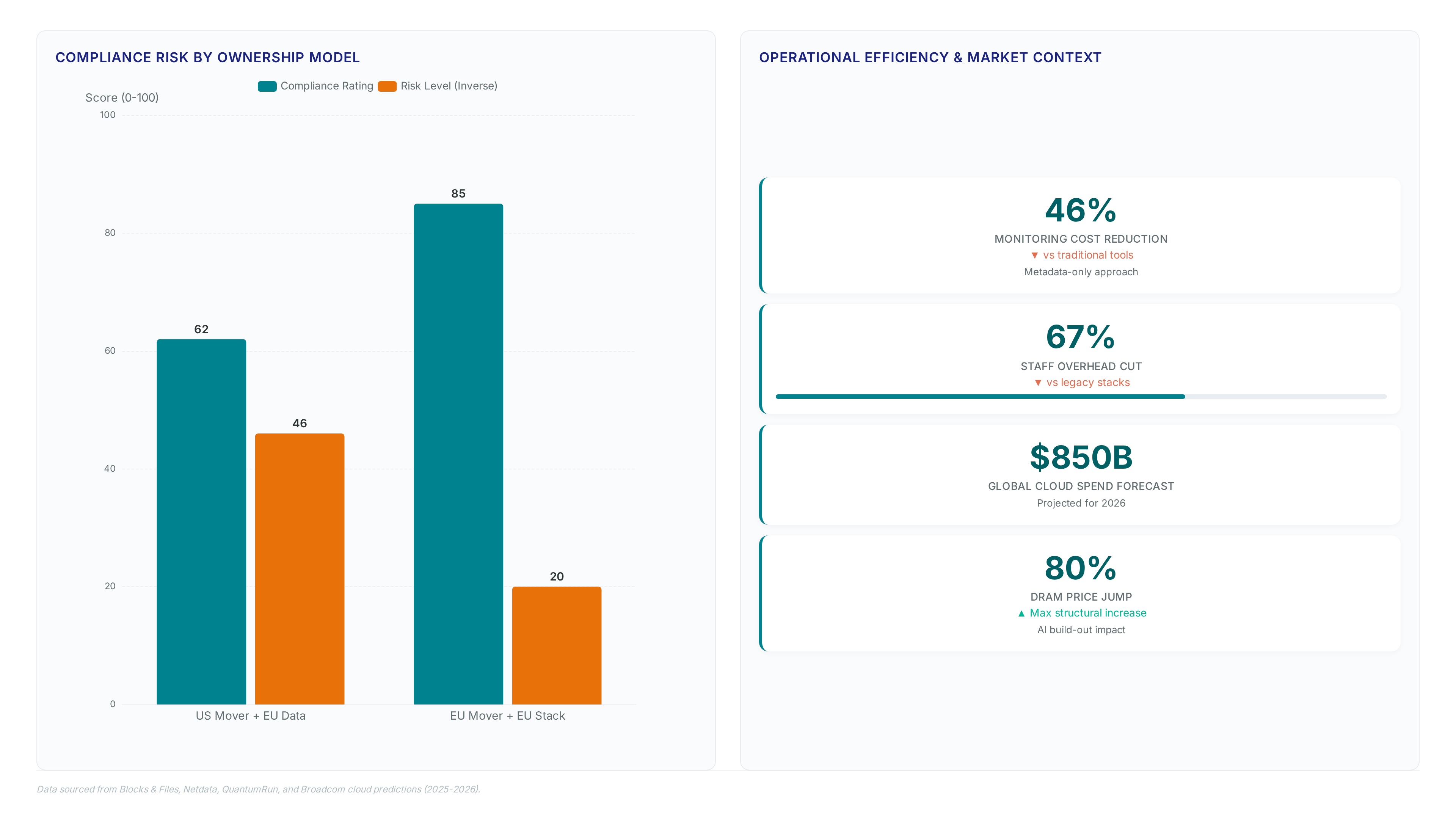
Blocks & Files delineates four architectural scenarios where data mover ownership dictates compliance more than physical storage location. Merely storing bytes in Europe fails to guarantee sovereignty if US entities control the backup application or management plane. Osmium Data Group warns that storing data in Europe remains insufficient when US cloud providers manage the infrastructure. Even encrypted payloads expose metadata like job names and indexes to foreign judicial orders. European providers like OVHcloud market inherent compliance by isolating control planes from US jurisdiction. The table below contrasts risk profiles across ownership models.
| Scenario | Data Mover | Datacenter Owner | Compliance Level |
|---|---|---|---|
| Fully Sovereign | European | European | Highest |
| Total Exposure | US | US | None |
| False Security | US | US (in EU) | Medium |
| Metadata Risk | US | European | High |
A US-owned mover paired with a European datacenter creates a deceptive high-compliance rating while retaining medium-to-low risk. The limitation lies in denial-of-service potential where US courts order the vendor to disable access remotely. True sovereignty requires eliminating US-owned movers entirely rather than relying on geographic data placement alone. Audit control plane routing to verify no authentication traffic exits the boundary.
Real-World Adoption of Europe-Owned Stacks by Phoenix Technologies and Aleph Alpha
Phoenix Technologies and Aleph Alpha secured public contracts by deploying Europe-owned source stacks that eliminate US legal jurisdiction entirely. This architecture prioritizes local control over service breadth, accepting reduced feature depth to achieve the highest compliance rating. Phoenix Technologies in Switzerland combines its kvant Cloud with Red Hat software, enabling banks to self-serve while maintaining strict data sovereignty boundaries against foreign access. Similarly, Aleph Alpha in Germany won mandates from Baden-Württemberg and Bavaria by ensuring AI training data never touches US-controlled infrastructure. These deployments prove that avoiding US hyperscalers is operationally viable despite the market dominance of AWS, Azure, and Google Cloud.
| Dimension | Europe-Owned Stack | US Hyperscaler in EU |
|---|---|---|
| Legal Jurisdiction | Local Courts Only | US CLOUD Act + EU Law |
| Metadata Access | Restricted to EU Entities | Visible to US Operators |
| Service Depth | Limited Native Tools | Extensive Global Catalog |
| Compliance Risk | Lowest | High |
Neocloud vendors are gaining adoption specifically because sovereignty laws outweigh the convenience of integrated ecosystems. Operators lose access to proprietary machine learning APIs and global content delivery networks found in larger platforms. However, this limitation forces an architectural discipline that prevents vendor lock-in and reduces exposure to cross-border legal compulsion. Organizations selecting sovereign backup solutions must verify that both the data mover and storage destination remain under European corporate ownership. Audit supply chains for hidden US equity stakes that could invalidate sovereignty claims during litigation. Reject any architecture where a US entity holds a kill switch over the management plane.
Compliance Ratings: Europe-Owned Destinations vs US-Owned Movers in Europe
Full European ownership of both data movers and destinations yields the highest compliance rating by eliminating US judicial levers entirely. This configuration removes direct or indirect involvement of US technology operators, preventing foreign entities from enforcing denial-of-service actions or demanding metadata access. In contrast, architectures using US-owned movers retain high risk profiles even when physical storage resides within European borders. Legal obligations under the CLOUD Act compel US vendors to comply with extra-judicial decisions, rendering physical geofencing insufficient for true sovereignty. The European Commission recently awarded a €180 million contract to four providers, establishing a public sector benchmark that explicitly rejects sole reliance on US hyperscalers.
| Architecture Component | Europe-Owned Stack | US Mover + EU Destination |
|---|---|---|
| Compliance Rating | Highest | High |
| Risk Profile | Lowest | Medium to Low |
| Legal Exposure | None | Metadata Access |
| DoS Vulnerability | Minimal | State-Enforced |
Organizations assuming that encrypting payloads neutralizes jurisdictional risk overlook the exposure of job names and indexes to foreign courts. A US provider can disable the management plane, making local storage inaccessible regardless of who owns the building. Real-world adoption by entities like Aleph Alpha The tension between feature depth and legal autonomy forces operators to accept reduced tooling to achieve verifiable sovereignty. Ultra-sovereign workloads must avoid US-owned datacenters entirely, as contract territory offers no protection against headquarters-based legal compulsion.
Implementing True Data Sovereignty with European Infrastructure and Air-Gaps
Defining True Air-Gapped Backups for EU Sovereignty
True air-gapping requires severing all control-plane connectivity to US vendors, not merely isolating data storage volumes. Logical separation fails because US entities retain access to metadata like job names and indexes even when payloads remain encrypted. Operators must implement physical isolation where no external cloud connectivity exists to prevent unlawful third-country data access The EU Data Act now compels providers to support switching, yet true sovereignty demands avoiding US-owned infrastructure entirely regardless of physical location. Microsoft counters with Azure.
- Deploy backup software owned and operated exclusively by European entities.
- Physically disconnect management interfaces from any public internet routing.
- Verify that no telemetry streams exit the local network boundary.
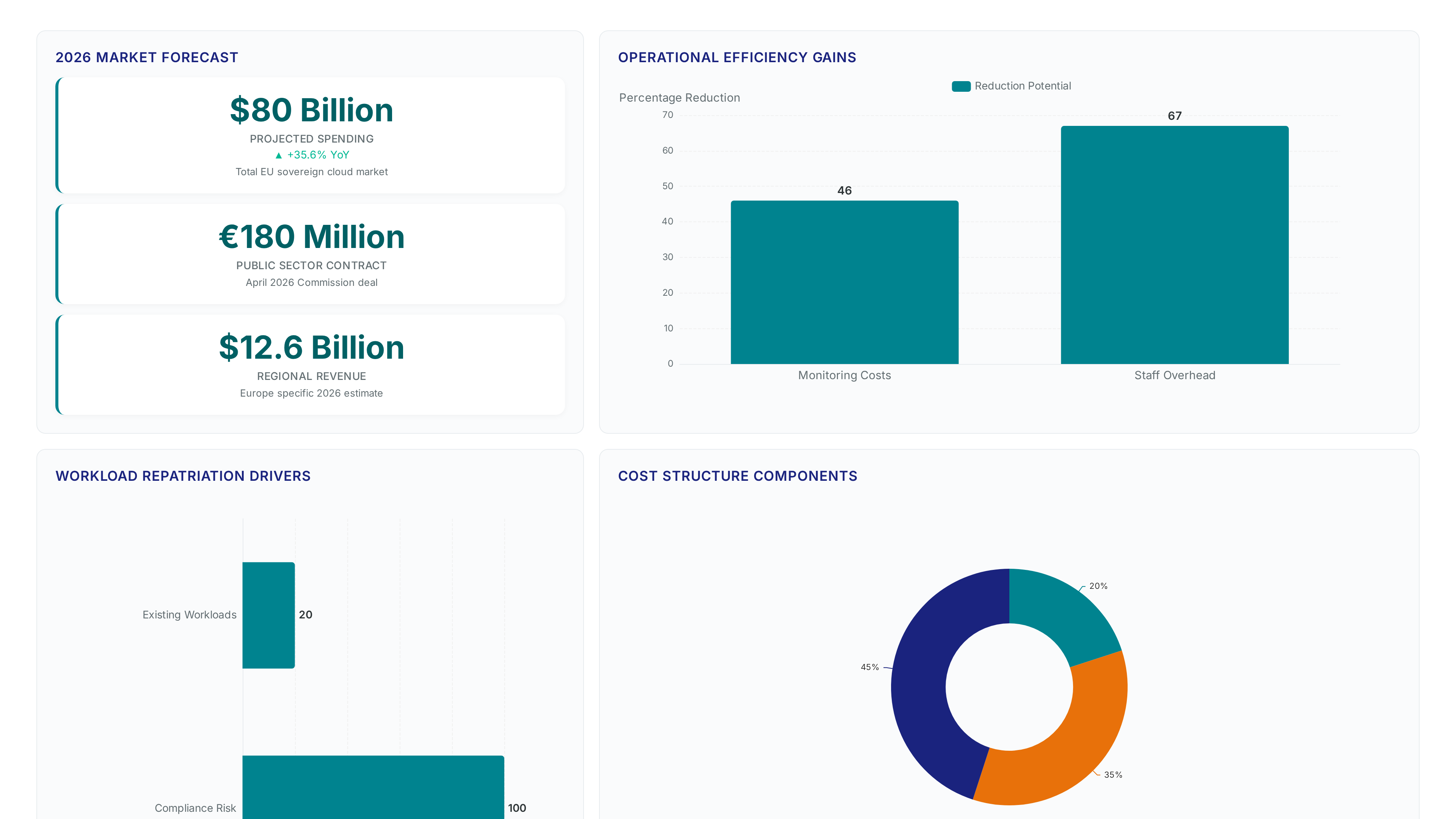
Market forecasts indicate sovereign cloud spending will reach $80 billion in 2026, reflecting a 35.6% increase. The hidden cost involves operational friction; air-gapped systems lose automated patching and require manual media transport for updates. Validate that no US headquarters retains administrative credentials before certifying any backup architecture as sovereign.
Executing Provider Audits to Eliminate US Legal Exposure
Auditors must inspect Enterprise User License Agreements for jurisdiction clauses that override physical datacenter location. Most contracts begin with legal verbiage enforcing vendor choice of law, often binding signatories to foreign statutes regardless of signing territory. Legal teams must scrutinize offerings claiming sovereignty because corporate headquarters location dictates compliance with the US CLOUD Act.
- Extract the governing law section from every active EULA and identify named jurisdictions.
- Map the ultimate parent company of each software vendor to determine national allegiance.
- Verify if the control plane connects to external networks managed by non-European entities.
- Demand written confirmation that metadata indexes remain inaccessible to foreign judicial orders.
AWS invests heavily in European infrastructure yet remains subject to US jurisdiction due to its corporate domicile. True sovereignty requires avoiding US-owned datacenters entirely rather than relying on complex contractual safeguards. Replace global hyperscalers with fully isolated stacks for ultra-sensitive workloads. The cost of ignoring these jurisdictional traps is measurable through rising regulatory penalties and lost public trust. Operators cannot assume encryption protects against state-enforced denial of service or metadata seizure. Complete isolation remains the only definitive method to prevent foreign legal compulsion from disrupting operations.
The Hidden Risks of US Public Cloud Datacenters in the EU
Physical presence in Europe fails to shield data from US jurisdiction when AWS, Azure, or Google Cloud operate the facility.
- Audit Enterprise User License Agreements for jurisdiction clauses overriding local data laws.
- Map vendor corporate headquarters to identify exposure to the US CLOUD Act.
- Replace cloud-dependent control planes with on-premises management stacks like Microsoft's Azure Local.
- Enforce air-gapped backups where no external connectivity reaches US-owned infrastructure.
Legal verbiage in contracts often masks the reality that US headquarters dictate compliance, rendering physical geofencing ineffective against federal subpoenas. Metadata access remains a critical vulnerability; even encrypted payloads expose job names and indexes to US entities capable of enforcing denial-of-service actions. True sovereignty demands avoiding US-owned datacenters entirely, regardless of their geographic coordinates within the EU. Treat any facility operated by American hyperscalers as non-compliant for sensitive state data.
About
Alex Kumar, Senior Platform Engineer and Infrastructure Architect at Rabata. Io, brings critical technical insight to the complex debate surrounding data sovereignty. With deep expertise in Kubernetes storage architecture and disaster recovery, Kumar understands that true data control extends beyond simple geographic placement to include API compatibility and vendor lock-in risks. His daily work designing cost-effective, S3-compatible storage solutions for enterprises directly addresses the challenges highlighted by Osmium regarding US cloud dominance. At Rabata. Io, a specialized object storage provider with GDPR-compliant EU data centers, Kumar engineers infrastructure that empowers organizations to maintain genuine sovereignty without sacrificing performance. By eliminating hidden egress fees and ensuring true API portability, his architectural decisions help clients navigate the regulatory environment where physical location alone cannot guarantee legal safety. This practical experience makes him uniquely qualified to analyze how alternative storage providers can mitigate the long shadow cast by hyperscale US vendors.
Conclusion
Scaling sovereign architectures reveals that operational friction spikes when teams attempt to maintain parity with hyperscaler feature sets while enforcing strict jurisdictional boundaries. The immediate bottleneck is not storage capacity, but the latency introduced by localized control planes that lack global distributed logic. Organizations attempting a full rip-and-replace by 2027 will face unsustainable engineering debt as custom middleware fails to match the elasticity of public APIs. A phased approach is strictly necessary: migrate only tier-zero classified assets to isolated stacks by Q4 2027, while retaining non-sensitive workloads on compliant regional zones to preserve agility. This hybrid model acknowledges that total isolation incurs a significant premium in maintenance overhead that most budgets cannot absorb indefinitely without sacrificing innovation velocity.
Leaders must stop treating sovereignty as a binary switch and start viewing it as a continuous compliance posture requiring dedicated legal-technical liaison roles. The window to negotiate favorable exit clauses with current providers closes as new regulations harden in 2025. Start by auditing your specific API dependencies against the four isolation steps outlined, identifying exactly which microservices break when severed from US-managed control planes. Execute this gap analysis before the next fiscal planning cycle to prevent emergency migration costs from eroding your capital reserves.
Frequently Asked Questions
Physical location fails because US providers control the software stack and metadata. Cumulative GDPR fines reaching 7.1 billion highlight the severe financial stakes of this ongoing non-compliance risk for enterprises.
Encryption keys do not shield operational telemetry or prevent service disabling by foreign governments. While 75% of large enterprises cite sovereignty as a driver, few actually eliminate the US jurisdictional link entirely.
US entities can access job names, indexes, and target infrastructure information despite payload encryption. This metadata exposure creates legal vulnerabilities that physical storage within European borders cannot effectively prevent or hide.
Authorities can mandate vendors disable service access, creating a total denial-of-service event. This architectural dependence creates a single point of failure distinct from data theft that encryption cannot stop.
A Europe-owned data source and Europe-owned datacenter destination provides the highest compliance level. This model ensures no direct involvement of US technology operators, removing levers for US government judicial entities.