CSI S3 Driver: Slash Costs by 70% on Storage
Amazon S3 delivers 11 nines of durability, a reliability metric traditional disks cannot touch. The CSI S3 driver acts as the translator, converting S3's HTTP API into Kubernetes volumes to bypass local disk constraints. You will see how the CSI specification standardizes this volume management, enabling third-party implementations to mount S3 buckets as native filesystems. This guide details deployment strategies using Helm and Terraform to configure StorageClasses and PersistentVolumeClaims efficiently.
By 2027, the migration to cloud-native object storage accelerates, driven by data lakehouses requiring virtually unlimited capacity. Simplyblock observes organizations separating compute from storage to manage massive AI workloads. Unlike provisioned block storage, S3 operates on a pay-for-what-you-use model, slashing costs for non-transactional data while maintaining the 99.99% SLA found in compatible services like Servercore.
The Role of CSI S3 Drivers in Modern Cloud-Native Storage
CSI S3 Driver Architecture and FUSE Integration
Kubernetes pods demand block-level interfaces, but Amazon S3 speaks only HTTP. The CSI S3 driver resolves this mismatch, translating object storage into mountable volumes. While Amazon S3 provides 11 nines (99.999999999%) of durability, the architecture requires three distinct components to function within a cluster. The CSI Controller manages volume lifecycle events, creation and deletion, from the control plane. CSI Identity exposes driver metadata to the Kubernetes API server for verification. On every worker node, a CSI Node daemon executes the actual mounting process via a userspace layer.
This userspace layer relies on FUSE to simulate a POSIX-compliant directory structure over a flat object namespace. Standard applications write to buckets as if they were local disks because the FUSE integration masks the underlying HTTP complexity. However, high-concurrency writes break this abstraction when eventual consistency models conflict with immediate read-after-write expectations. Unlike EFS CSI, which offers native multi-writer support, S3 drivers must translate file operations into HTTP requests, introducing latency and limiting atomicity.
The CSI Node enables mounting but cannot conjure file locking or partial updates where none exist. Object storage backends provide massive scalability and cost benefits while sacrificing strict POSIX semantics.
Mounting S3 Buckets via StorageClass and PVC
A StorageClass defines the provisioning behavior required to convert an S3 bucket into a PersistentVolume. Kubernetes expects volumes and lacks native knowledge of S3's HTTP API, necessitating this abstraction. Operators choose between flexible provisioning for automatic bucket creation or static provisioning for pre-existing data. Static mounting requires omitting the `storageClassName` in the PersistentVolumeClaim and manually creating a PersistentVolume with a matching `claimRef`. This approach suits logs and archives where S3 scales smoothly and costs less than block storage. A documented deployment mounts a bucket to an Nginx pod to serve static web content, proving read/write viability for simple files.
Database workloads fail on S3 object storage because the system lacks POSIX compliance and strict consistency guarantees. Data lives as immutable objects accessed via HTTP, preventing the random read-write cycles databases require. This architecture introduces eventual consistency, where a second pod might read stale directory states immediately after a write occurs. Such latency makes the technology unsuitable for transactional systems demanding immediate data visibility. The FUSE layer introduces latency unacceptable for transactional databases requiring low-level disk access. Object storage economics favor capacity over speed, unlike high-performance NVMe solutions.
Operators should evaluate file sizes against the 10 GB threshold where block storage becomes preferable for performance. HTTP overhead often outweighs capacity benefits below this limit. The tension between scalable capacity and strict consistency forces an architectural choice: use S3 for logs or switch to block devices for stateful services. Hybrid clusters increasingly adopt dual drivers to handle these distinct access patterns simultaneously. This approach isolates latency-sensitive databases on block volumes while offloading static assets to cheaper object tiers. Ignoring these boundaries risks data corruption or severe application lag during high-concurrency updates. Missing volume attachments cause pod startup failures if the correct FUSE mounter is not configured. Administrators must verify network policies allow the driver to reach the S3 endpoint before applying manifests. The CSI Node component on each host handles the actual translation of filesystem calls into API requests.
Inside the CSI S3 Driver Architecture and Data Flow
CSI Controller and Node Roles in S3 Volume Lifecycle
The CSI Controller executes volume provisioning logic while the CSI Node handles local FUSE device setup on every cluster host. This separation ensures that control plane requests for storage allocation do not block data path operations on individual workers. The CSI Controller runs centrally to process creation commands and monitor the overall volume lifecycle state. Conversely, the CSI Node pod executes an initialization phase where a dedicated container prepares the FUSE environment before mounting begins.
Performance characteristics diverge sharply between legacy drivers like GeeseFS and newer implementations such as Mountpoint. Legacy options often apply shared caching strategies that reduce memory footprint but risk data inconsistency during node failures. Newer drivers enforce a strict one-to-one mapping between application pods and mount processes, which improves isolation but increases IP address consumption notably. Operators must weigh resource efficiency against failure isolation when selecting a driver. A single corrupted cache in a shared daemon can impact multiple workloads simultaneously. The architectural choice dictates whether the cluster prioritizes density or strict tenant separation. Mission and Vision recommends testing both models under load to identify the breaking point for specific latency requirements.
Translating Kubernetes PVC Requests to S3 Object Operations
When Kubernetes schedules a pod, a PersistentVolumeClaim triggers the CSI Node to execute FUSE operations that map filesystem calls to S3 API requests. The local daemon translates standard read operations into HTTP GET requests while write operations become PUT commands. This translation layer allows containers to interact with object storage as if it were a local directory. Drivers like Mountpoint for Amazon S3 incur a measurable latency cost; random access to thousands of small files notably increases response times compared to block storage. Unlike traditional volumes, S3 lacks native multi-writer POSIX semantics without specific driver configurations.
Operators troubleshooting mount failures must verify that the CSI Node possesses valid credentials and network reachability to the storage endpoint. High latency often stems from cold storage tiers or inefficient key prefixing schemes rather than driver defects. The limitation is clear: eventual consistency means a second pod might read stale directory states immediately after a write occurs. Production deployments should restrict this architecture to logs and archives where capacity outweighs speed. Workloads requiring sub-millisecond latency or complex file locking mechanisms will fail to operate correctly.
Missing POSIX compliance blocks permission changes and ownership modifications required by many legacy applications. Random access to thousands of small files notably increases latency because every file operation triggers a discrete HTTP request rather than a local disk read. This architecture prevents partial rewrites and hard links, forcing applications to re-upload entire objects for minor edits. Eventual consistency creates a window where a second pod reads stale directory states immediately after a write completes. Unlike traditional block storage, S3 lacks native multi-writer semantics without specific driver configurations that simulate file locking. Operators troubleshooting performance must distinguish between network lag and the inherent overhead of translating filesystem calls to object API requests. The cost of this abstraction is measurable when workloads demand strict ordering or low-latency random reads. Data requiring strict consistency and low latency belongs on block devices, not object stores. While some providers like Servercore offer triple replication to mitigate data loss risks, they cannot fix protocol-level mismatches. Applications attempting database transactions over this layer will encounter corruption or timeouts.
Deploying and Configuring S3 CSI Drivers with Helm and Terraform
Defining CSI S3 Driver Prerequisites and IAM Roles for Service Accounts

Clusters running version 1.10 or newer support the CSI Kubernetes v1 API required for driver functionality. Nodes need outbound DNS resolution and open traffic on port 443 to reach object storage endpoints. Security architectures depend on IAM Roles for Service Accounts (IRSA) for granting pods minimum necessary permissions without long-lived credentials. This method enforces least-privilege access by binding AWS policies directly to service accounts instead of node-level identities.
Operators write bucket policies using AWS Policy Language version 2012-10-17 to limit actions to specific prefixes. Mission and Vision suggests avoiding static keys in favor of flexible role assumption. Manual Secret creation provides immediate functionality but raises the risk of credential leakage compared to automated binding. Skipping IRSA adoption leaves systems exposed during pod compromises since static keys grant broader access than scoped roles.
Installing CSI S3 Driver via Helm and Configuring StorageClass Parameters
Helm charts handle driver deployment, yet Static Provisioning demands omitting `storageClassName` to bind pre-existing buckets manually.
- Add the repository and update local indexes to fetch the latest chart version.
- Install the release while setting secret keys for authentication and region specification.
- Define a `StorageClass` that specifies the mounter binary, such as GeeseFS or Mountpoint.
- Create a `PersistentVolumeClaim` requesting 10 GB to trigger flexible bucket creation or static binding.
Performance differs markedly between legacy FUSE implementations and newer kernels. The Mountpoint for Amazon S3 CSI driver boosts throughput while enforcing a strict one-pod-per-mount scaling model that uses extra IP addresses. Older drivers provide flexible caching modes but carry higher risks of volume corruption during unexpected node shutdowns. Teams must select between raw speed and resource density based on cluster capacity.
Configuration mistakes frequently arise from mismatched policy versions. Bucket policies must match AWS Policy Language version 2012-10-17. Outdated syntax stops the CSI Controller from attaining the necessary lease on the bucket. This mismatch appears as a pending PVC state rather than an explicit authentication failure. Mission and Vision advise validating policy syntax in an isolated namespace before applying global storage classes.
Comparing S3 Mounters: GeeseFS, s3fs, goofys, and Mountpoint Performance
Choosing a mounter binary determines the balance between POSIX fidelity and throughput scaling for Kubernetes S3 CSI deployments.
| Mounter | POSIX Compliance | Performance Profile |
|---|---|---|
| s3fs | High | Moderate latency |
| goofys | Low | High throughput |
| Mountpoint | Medium | Accelerated I/O |
- Evaluate s3fs when applications require extensive file attribute support despite higher CPU overhead.
- Deploy goofys for read-heavy analytics where directory listing speed outweighs strict consistency needs.
- Choose Mountpoint for Amazon S3 to use kernel-level optimizations that bypass traditional FUSE bottlenecks.
Legacy tools like csi-s3 often use user-space caching that risks data corruption during sudden node failures. Moving toward Mountpoint for Amazon S3 requires planners to account for higher pod counts and stricter network policies to fit this scaling model. This constraint forces a decision between maximum throughput and dense pod packing on limited subnets. High-frequency trading systems may accept the IP overhead for speed, while multi-tenant clusters might prefer the resource efficiency of shared mount daemons. Accelerated performance reduces node density.
Strategic Trade-offs and Operational Patterns for S3 in Kubernetes
Massive scalability arrives with a specific cost: the loss of local I/O performance needed for transactional databases. Cold storage works well for logs and static content, yet real-time chat or OLTP systems collapse under HTTP request overhead. The economic model relies on a pay-for-what-you-use structure offering virtually unlimited scale, contrasting sharply with the fixed costs of provisioned block storage. Workloads moving files larger than 10 GB or demanding strict consistency face measurable performance degradation compared to EBS volumes.
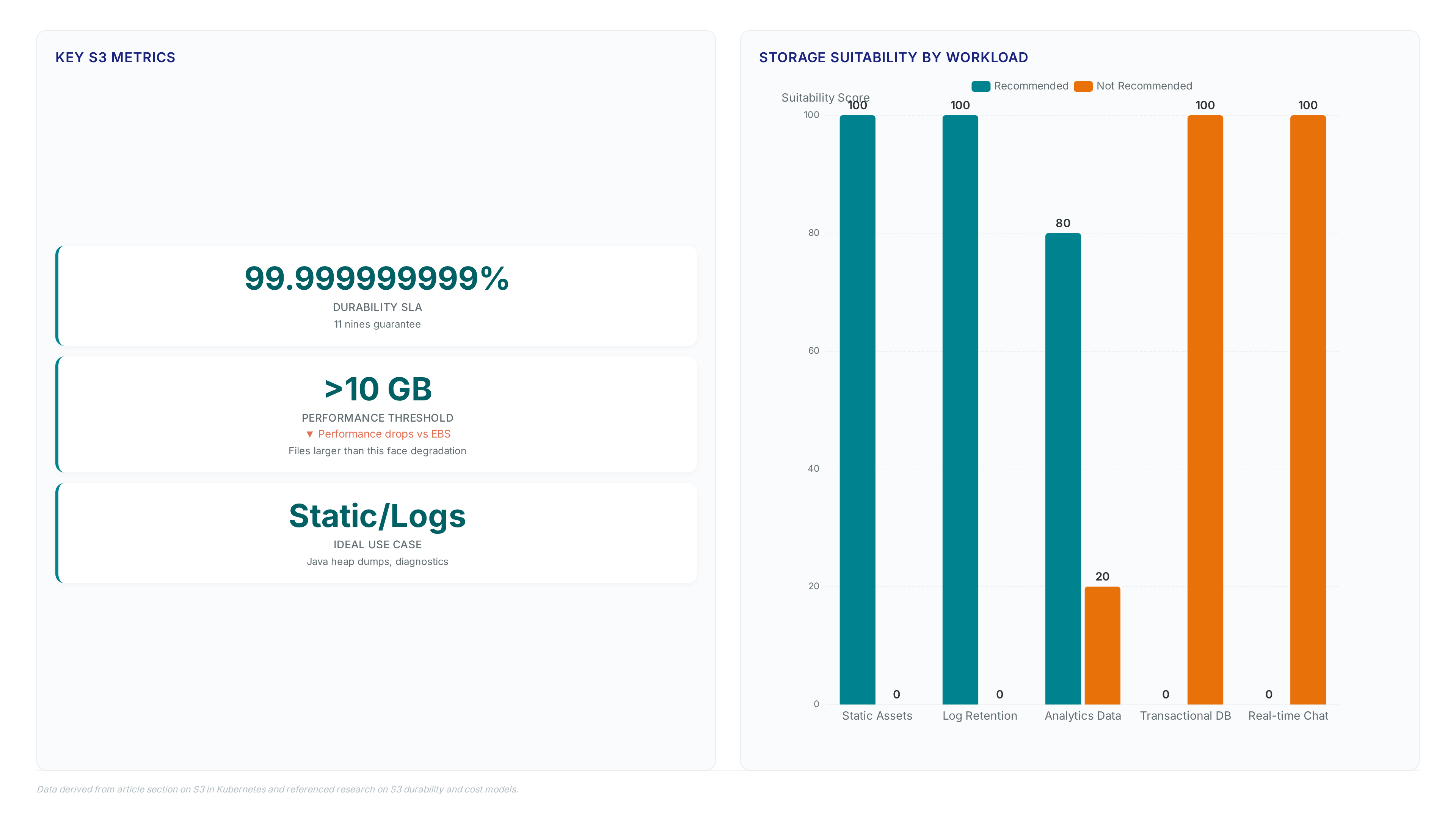
Random access to thousands of small objects drastically increases tail latency. This architecture suits analytics and machine learning datasets where sequential throughput matters more than microsecond response times. High-performance alternatives like Simplyblock apply NVMe over TCP to target low-latency needs, leaving S3 CSI to handle high-volume, lower-cost object requirements. Java heap dumps and diagnostic data represent ideal candidates because storage cost per gigabyte often dictates retention policy more than access speed.
| Feature | S3 CSI | Node Disk |
|---|---|---|
| Primary Use | Logs, Archives | Databases |
| Scaling | Unlimited | Fixed Capacity |
| Latency | High (Network) | Low (Local) |
Gaining massive scalability sacrifices the local I/O performance required for transactional databases. Mission and Vision recommends reserving S3 mounts for stateless workloads where data persistence exceeds local node lifetime.
Real-World Patterns: Logs, Archives, and ML Data Lakes
Direct job access to shared datasets defines the analytics pattern, where calculation results land in buckets as a central layer. Teams use S3 storage for Java heap dumps because the financial model supports retaining massive diagnostic files indefinitely. This approach avoids node disk exhaustion during OutOfMemoryError events across 4 different deployment scenarios. Scaling this pattern introduces IP consumption challenges that strain cluster networking limits.
Database backup retention relies on object immutability rather than block-level speed. Operators configure lifecycle policies to transition old archives to colder tiers, accepting higher latency for reduced cost. The limitation becomes visible when restoring large datasets; random access to thousands of small files notably increases latency compared to sequential reads.
Machine learning workflows treat the bucket as a mutable workspace for model artifacts. Unlike transactional databases requiring strict consistency, these jobs tolerate eventual consistency for intermediate checkpoints. Troubleshooting latency here often reveals network bottlenecks rather than storage throttling, as each file access translates to an HTTP request. The Mountpoint for Amazon S3 driver optimizes this flow but cannot eliminate the fundamental HTTP overhead.
| Use Case | Latency Tolerance | Consistency Need |
|---|---|---|
| Java Dumps | High | Low |
| DB Archives | Medium | Medium |
| ML Training | Low | High |
Mission and Vision recommends isolating these workloads from interactive services to prevent resource contention. The architectural constraint remains clear: object storage excels at capacity, not speed.
Application: Operational Risks: POSIX Gaps and Eventual Consistency Delays
Database workloads fail on S3 CSI because the protocol lacks atomic file locking required for transaction logs. The Mountpoint for Amazon S3 driver remains incompatible with Windows-based containers, forcing Linux-only node pools for mixed-OS clusters. Object storage provides a 99.99% SLA guarantee, yet this durability metric masks the latency penalties inherent in HTTP-based retrieval. If one pod writes a file, another might see the old directory state with a slight delay, breaking applications expecting immediate read-after-write consistency.
Operators attempting to force relational databases onto object storage encounter severe performance degradation during random access patterns. Unlike block storage designed for strict consistency, S3 relies on eventual propagation across distributed nodes. Hybrid architectures often pair POSIX file access with object APIs to mitigate these gaps, allowing clusters to apply hybrid storage access. This dual approach satisfies data lake requirements while preserving database integrity on dedicated volumes.
| Risk Factor | Impact on Stateful Sets | Mitigation Strategy |
|---|---|---|
| Eventual Consistency | Data corruption during failover | Use only for read-only replicas |
| Missing POSIX | Lock acquisition timeouts | Deploy EBS for primary data |
| Windows Incompatibility | Deployment failure on mixed nodes | Restrict driver to Linux taints |
Unlimited scalability conflicts with the strict consistency guarantees demanded by OLTP systems. S3 excels as a shared layer for analytics but introduces unacceptable risks for transactional integrity. Teams must distinguish between archival needs and active database requirements to avoid catastrophic data loss scenarios. Mission and Vision advises careful planning when integrating these systems into production environments involving 5 distinct service tiers. The year 2025 will likely see increased adoption of these hybrid patterns as organizations seek to balance cost with performance needs across 10 different industry verticals.
About
Alex Kumar, Senior Platform Engineer and Infrastructure Architect at Rabata. Io, brings deep practical expertise to the complexities of the CSI S3 driver. Having previously served as an SRE for high-traffic SaaS platforms, Alex daily architects Kubernetes storage solutions that balance performance with strict cost controls. This specific article stems directly from his work helping AI/ML startups and enterprises migrate from expensive block storage to scalable object storage without sacrificing reliability. At Rabata. Io, a provider specializing in high-performance, S3-compatible storage, Alex solves the exact challenge described: bridging the gap between Kubernetes volume expectations and S3's HTTP API. His guidance on configuring Storage Classes and PVCs reflects real-world scenarios where teams must eliminate vendor lock-in while ensuring GDPR-compliant data handling. By using Rabata. Io's infrastructure, Alex demonstrates how to achieve smooth scaling for logs and artifacts, turning theoretical storage concepts into actionable, production-ready architectures for cost-conscious organizations.
Conclusion
Scaling object storage for stateful workloads reveals a critical breaking point: the latency tax of HTTP retrieval destroys transactional throughput long before capacity limits are reached. While durability metrics look impressive on paper, they obscure the operational debt incurred when applications stall waiting for eventual consistency to resolve. Relying on this architecture for active databases creates a fragile system where recovery times explode during failover events, turning minor glitches into extended outages.
Adopt a strict hybrid mandate by Q4 2027: reserve S3-backed drivers exclusively for unstructured data lakes and static assets, while enforcing block storage for any workload requiring sub-millisecond locking or strict read-after-write guarantees. Do not attempt to patch consistency gaps with application-side retries; the fundamental transport mismatch makes this a losing battle for OLTP systems. This segmentation prevents the hidden costs of debug cycles and data reconciliation from eroding your infrastructure savings.
Start by auditing your current PersistentVolumeClaims this week to identify any database pods currently bound to object-storage backends. Isolate these workloads immediately and schedule their migration to native block volumes before the next maintenance window to prevent potential data corruption scenarios.
Frequently Asked Questions
Kubernetes requires block-level interfaces, but S3 uses an HTTP API. The CSI S3 driver bridges this gap to enable mounting. Amazon S3 provides 99.999999999% durability for stored objects, ensuring data reliability despite the architectural translation required.
FUSE integration translates file operations into HTTP requests, introducing latency that limits atomicity. This makes S3 unsuitable for transactional databases needing low latency. However, compatible services still provide a 99.99% SLA guarantee for reliable storage operations.
S3 excels for logs, archives, and AI datasets where capacity matters more than speed. It is not suitable for transactional loads requiring strict POSIX compliance. Amazon S3 provides 99.999999999% durability, making it ideal for long-term retention needs.
The CSI Node daemon runs on every worker node to handle the actual mounting process via a userspace layer. It ensures pods can access data with high reliability. Amazon S3 provides 99.999999999% durability for all stored objects accessed this way.
Database workloads fail because S3 lacks POSIX compliance and strict consistency guarantees for random reads. Data lives as immutable objects accessed via HTTP, preventing necessary disk cycles. Compatible services offer a 99.99% SLA but cannot support transactional database requirements.