Content addressed storage stops S3 data drift
Content addressed storage kills S3 data drift by swapping mutable keys for immutable content identifiers. This architectural shift enforces verifiable data provenance and guarantees reproducible builds without leaning on optional integrity checks. Traditional object storage systems permit silent corruption through overwrites. CID-based storage mathematically binds data identity to its content.
Migrating to content addressed object storage is the only viable path for maintaining long-term data fidelity in distributed systems. We need to examine the specific mechanics of immutable object references and how they prevent the silent failures common in standard S3 compatible buckets. We also need to dissect the architecture behind free egress storage models that enable blazing-fast file delivery without punitive cost structures.
Industry analysis positions decentralized storage solutions as critical infrastructure for 2026, offering distinct advantages over legacy silos. Comparisons of S3-compatible object storage providers reveal a market shifting toward predictable pricing storage models that decouple access costs from data volume. This transition supports fast file delivery pipelines where content addressed verification happens at the edge rather than the core.
The Role of Content Addressed Storage in Modern Data Integrity
Content Addressed Storage and CID Mechanics
Content addressed storage swaps mutable file paths for immutable hashes pulled straight from data content. A single byte change instantly flips the resulting identifier, locking file integrity against silent corruption. Systems using this model create a Content ID (CID) acting as both unique locator and verification checksum. Uploading a duplicate file triggers the system to spot the existing hash, storing just one physical copy while merging references to kill redundancy across the dataset.
This mechanism delivers inherent data provenance since the CID mathematically proves the exact byte state at hashing time. Traditional systems let metadata update independently of the payload, yet a CID reference guarantees retrieved data matches the original commit. Locking releases prevents artifact drift over time and verifies training datasets without external audit logs. Updating a file demands writing a completely new object and refreshing all downstream pointers because the original CID becomes permanently invalid for the new version. Cost is the constraint here alongside operational shifts.
Predictable pricing models emerge from these principles, dodging hidden data verification costs found in legacy clouds. The inability to modify an object in place forces explicit versioning strategies that prevent accidental overwrites. Rigorous application-level pointer management becomes necessary.
| Feature | Traditional Storage | Content Addressed |
|---|---|---|
| Identifier | Mutable Path | Immutable Hash |
| Update Method | Overwrite | New Object |
| Integrity Check | Optional | Built-in |
S3 Compatibility for Immutable Data Provenance
A single byte alteration generates a completely different hash, effectively preventing silent data drift. Updates create new version entries rather than overwriting previous states like traditional systems do. Historical artifacts remain mathematically verifiable in this permanent audit trail instead of getting lost to mutation.
Teams verifying file integrity compare the local hash against the stored CID reference. Any mismatch immediately signals corruption or tampering without separate checksum files. This approach proves necessary for reproducible builds where locking release artifacts prevents downstream dependency failures. Immutability guarantees safety while requiring applications to handle new identifiers for updated content instead of static paths. Developers must design workflows expecting new CIDs upon modification rather than assuming a fixed location always points to the latest data. AI training datasets benefit particularly since verifying the exact input version matters as much as the model output itself.
Versus AWS S3 Cost and Architecture
Content addressed storage replaces mutable paths with immutable hashes to lock data integrity.
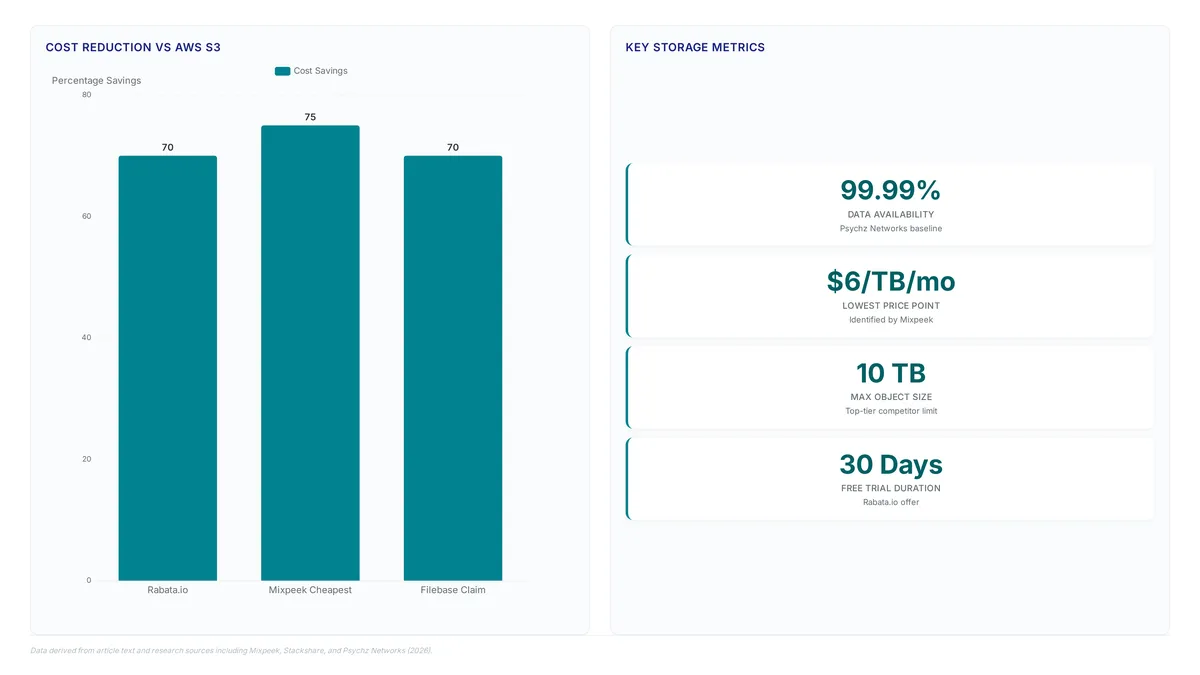
Traditional workflows rely on mutable keys where updates silently overwrite previous states, creating risks for audit trails. Content addressed systems generate a unique identifier for every byte sequence, ensuring any modification produces a distinct hash. Teams gain verifiable provenance without sacrificing the familiar S3 compatibility required for existing toolchains. Standard object stores charge premiums for data retrieval. Mainstream options now offer storage at $6/TB/mo, representing roughly one-quarter the cost of legacy Amazon S3 pricing. Alternatives to AWS S3 often provide different pricing structures, including no egress fees, fundamentally altering the cost curve for high-volume workloads.
Operational discipline becomes the limitation since teams cannot rely on in-place edits and must manage new CIDs for every iteration. This constraint forces a cleaner separation between data state and application logic, reducing drift in production environments. Organizations migrating to this model should align backup strategies with immutable object references to maximize data integrity benefits.
Inside the Architecture of S3 Compatible Free Egress Systems
How Private-by-Default Buckets and Scoped Keys Define S3 Security
S3 object storage keeps complete files as objects that APIs access, scaling automatically without capacity planning while supporting concurrent access from applications worldwide. This architecture depends on private-by-default setups where security forms the baseline posture, encrypting every object and blocking public access at the account level. These defaults stop accidental leaks by enabling granular controls through IAM policies, bucket policies, and access points instead of manual lockdown steps.
Scoped access uses keys, roles, and permissions to enforce tight control without complex re-architecture. Operators assign specific capabilities to identities so applications retrieve only authorized datasets. This model meets the S3 compatible need for verifiable data provenance while keeping tenants strictly isolated.
| Feature | Traditional Approach | Scoped Architecture |
|---|---|---|
| Default State | Often public | Private |
| Access Method | Broad credentials | Granular keys |
| Verification | Optional hashing | Immutable references |
Granular role management demands rigorous identity work to limit blast radius if credentials compromise. This approach embeds security in the storage layer rather than requiring network segmentation. Predictable pricing storage models gain from these controls by preventing unauthorized egress charges. Content addressed object storage adds strength by tying access rights to immutable references.
Network operators now see security posture depend on identity rigor over perimeter defense alone. Teams must audit role definitions regularly to keep verifiable data provenance intact. Static bucket policies cannot address all risks, so regular audits keep access rights aligned with current staff roles.
Applying Pre-Signed URLs and Fast Ingest for Predictable Delivery
Pre-signed URLs create temporary links granting time-limited access to private objects without exposing bucket credentials. This tool lets operators share specific files securely while holding a private-by-default stance for underlying storage. Temporary links enable controlled sharing by embedding expiration timestamps in request signatures, ensuring automatic revocation of access rights.
Fast ingest cuts migration windows and shr nightly sync operation duration notably. Large dataset moves benefit from accelerated upload paths that minimize transit time. Providers point to fast ingest for shortening migrations and nightly sync windows in time-sensitive workloads. Rapid ingestion paired with zero-cost retrieval builds a predictable financial model for backup architectures.
| Feature | Traditional Egress Model | Free Egress Model |
|---|---|---|
| Cost per GB Retrieved | Variable fees apply | $0 cost |
| Migration Speed | Limited by throttling | Optimized throughput |
| Delivery Predictability | Low | High |
Predictable delivery mixes aggressive caching layers with direct origin access to avoid performance surprises during peak demand. Some S3-compatible storage offers cost-effective, zero-egress answers for edge data storage. Cache hit rates rise when static assets stay immutable, lessening origin server load substantially.
Engineers should weigh content-addressed storage for backups where data integrity verification matters most. Missing retrieval fees remove financial penalties for frequent restore testing or disaster recovery drills. This setup works especially well for AI training datasets where repeated access patterns would otherwise bloat operational budgets via traditional egress charges.
Linear $15/TB Pricing Versus Traditional Egress Tax Models
Storage grows linearly as data volumes increase, swapping volatile retrieval tariffs for fixed infrastructure costs. Traditional providers often stack complex egress charges atop base storage fees, creating financial unpredictability for heavy-read workloads like AI training sets. Platforms using free egress remove the retrieval penalty, keeping backup restores and model iteration cycles cost-effective regardless of frequency. Finance teams can forecast expenses with simple multiplication instead of simulating access patterns.
Adopting content addressed storage paradigms that verify data integrity via immutable references is the cost for this predictability. Legacy systems use path-based lookups risking silent corruption, yet content-addressed approaches guarantee the retrieved byte stream matches the original hash. Operators moving from standard S3 buckets must plan for this data referencing shift, though long-term savings on egress fees often justify the change. No egress fees exist, making backups and restores less punishing at scale. Retrieval taxes disappear, dropping the marginal cost of serving extra training batches to zero and fundamentally altering large-scale machine learning economics. Enterprises valuing data liquidity and verification over legacy path compatibility find this model suitable.
Variable fees apply per GB retrieved in traditional models, contrasting sharply with the flat $15/TB structure. Migration speed remains limited by throttling constraints inherent to source systems. The $0 cost migration option appeals to budget-conscious teams, though actual throughput depends on network conditions and source API limits.
Migrating Workloads for Reproducible Builds and Backups
Defining S3-Compatible Endpoints and Storage Options
Pointing existing tools to a specific S3-compatible endpoint URL connects systems without demanding code rewrites. Teams switch providers by altering the endpoint string rather than rebuilding their entire stack or re-architecting storage layers. S3-compatible object storage describes alternative providers supporting the same API and functionality as Amazon S3. These alternatives frequently present lower costs, distinct pricing structures, zero egress fees, or self-hosted deployment options depending on the vendor. This flexibility lets teams select between standard mutable storage and content addressed systems according to specific workflow demands.
- Create a new bucket within the dashboard interface.
- Select the desired storage protocol or compatibility mode.
- Generate access keys and note the custom endpoint URL.
- Update your application configuration file with the new endpoint.
Content-addressed storage generates unique identifiers for data to maintain data integrity and stop accidental overwrites common in development environments. The approach guarantees verifiable data provenance yet demands a different update strategy than traditional storage models. Operators must validate storage types against compliance requirements before attempting bulk migration.
Implementing Pre-Signed URLs for Temporary Access
Generating pre-signed URLs requires configuring time-limited tokens that grant temporary access to private objects without exposing bucket credentials.
- Define a policy restricting the scoped key to specific object prefixes and actions like `GetObject`.
- Assign roles that bind these permissions to the temporary token generation process.
- Set an expiration timestamp to enforce automatic revocation of the URL.
- Distribute the link to external auditors or build agents for the assigned window.
Scoped access uses keys, roles, and permissions for tight control over who can retrieve data and when. This mechanism ensures that even if a URL leaks, the embedded expiration prevents unauthorized reuse after the deadline passes.
Accessibility for reproducible builds conflicts with security requirements in specific ways. Overly long expiration windows increase the attack surface while short windows may interrupt slow CI/CD pipelines. Operators balance build duration against the risk window, often requiring flexible generation just-in-time rather than static long-lived links. Standard S3 workflows might discourage frequent verification due to egress costs, yet some providers offer structures with no egress fees. This enables aggressive rotation of these tokens without financial penalty. Time synchronization remains necessary because significant drift between server and client time can cause valid signatures to fail prematurely. Reliable time configuration on all nodes requesting access becomes necessary.
Checklist for Validating Reproducible Build Storage
Validate that your S3-compatible endpoint enforces private-by-default policies to prevent accidental public exposure of build artifacts. Operators should confirm that free egress terms apply without hidden volume caps that trigger surprise billing events. This financial predictability allows teams to scale verification workflows without monitoring bandwidth throttles.
- Verify bucket ACLs reject all public read requests by default.
- Test that content addressing generates unique identifiers for every upload.
- Confirm version trails retain prior hashes to detect silent overwrites.
| Feature | Standard S3 | Content-Addressed |
|---|---|---|
| Integrity | Mutable | Immutable Identifier |
| Egress Cost | Variable | Predictable |
| Drift Risk | High | None |
Mutable convenience conflicts with verifiable provenance requirements. Choosing mutability risks undetected supply chain tampering. Locking buckets to write-once modes for production binaries enhances security. The cost is reduced operational flexibility, yet the benefit is guaranteed auditability for compliance reviews. A compromised build agent could overwrite artifacts silently without strict version trails. Teams migrating from legacy systems often overlook that standard checksums do not prevent replacement, whereas content identifiers do.
Resolving Performance Bottlenecks and Access Control Challenges
Diagnosing Slow Upload Speeds via Endpoint and Latency Factors
Suboptimal endpoint configuration frequently forces traffic onto distant network paths instead of routing through regional nodes, causing slow upload throughput in S3-compatible systems. Unnecessary round-trip time occurs during the initial TCP handshake when a client resolves a generic global endpoint before data transmission starts. This latency compound effect drastically reduces effective bandwidth for large object ingestion. Operators observing blazing-fast file delivery benchmarks must verify their applications target region-specific endpoints to minimize physical distance.
Direct connectivity to edge locations supports the infrastructure behind fast file delivery, yet misconfigured DNS can route requests through congested intermediate hops. A common oversight involves failure to enable multi-part upload concurrency limits, which restricts parallel stream utilization.
Poor endpoint selection creates specific hidden costs:
- Increased time-to-first-byte delaying AI training job initiation.
- Higher probability of timeout errors during peak congestion windows.
- Wasted compute cycles waiting on I/O completion signals.
- Reduced overall throughput for distributed team members.
Centralization prioritizes security in some architectures, but the performance penalty for geographically distributed teams becomes prohibitive without local breakouts. Centralized routing simplifies firewall rules yet introduces variable latency that disrupts consistent throughput. Engineers balance strict access control policies with the need for low-latency data movement to prevent pipeline starvation.
Resolving Bucket Access Errors with Scoped Keys and Roles
Applications lacking explicit permission to list bucket contents frequently trigger AccessDenied exceptions due to misconfigured IAM policies. AWS documentation confirms that S3 supports granular access controls through IAM policies, bucket policies, and access points to restrict operations safely. Scoped keys limit blast radius by binding credentials to specific prefixes rather than entire buckets. This approach prevents accidental cross-container data exposure during development cycles.
Debugging complexity increases as a direct result of narrow scopes because permission chains often fail silently, obscuring root causes. Operators balance tight security boundaries with operational visibility to avoid prolonged outage windows.
Inadequate key management incurs several hidden costs:
- Excessive time spent tracing silent failures across microservices.
- Increased risk of credential leakage through over-permissive defaults.
- Delayed incident response due to fragmented audit logs.
- Confusion among developers regarding specific permission denial reasons.ai/ML teams must verify bucket policies allow necessary read paths before scaling training jobs. Automated pipelines stall waiting for manual intervention without precise role definitions. Proper scoping ensures that even compromised keys cannot enumerate or delete unrelated datasets. This discipline transforms storage access from a binary gate into a verifiable, auditable workflow.
Preventing Data Drift and Integrity Loss in Version Trails
Silent overwrites corrupt version trails by replacing immutable objects with unverified data, breaking reproducibility for AI training sets. Traditional systems allow silent overwrites that erase historical states, whereas content-addressed mechanics generate a new identifier for every update to preserve the original. This design choice prevents data drift but introduces a storage cost tension where retaining full history consumes more capacity than mutable buckets.
Strict integrity competes against budget constraints when operators configure retention policies.
- Retaining every version guarantees verifiable data provenance for audit trails.
- Aggressive lifecycle policies reduce spend but risk losing recovery points.
- Misconfigured IAM policies often block read access to specific version IDs.
- Complex recovery procedures emerge when versioning logic is poorly documented.
Resolving these bucket access issues requires scoped keys that explicitly permit `GetObjectVersion` actions alongside standard listing rights.rabata.io advises testing credential scopes in non-production environments to avoid locking out recovery workflows during incidents. Immutable references increase complexity in managing application logic that expects simple key-based retrieval.
Upload speeds may also appear slow if the client fails to handle the extra round-trip required for hash verification before finalizing the write. Teams should verify their network path minimizes latency to the storage gateway to maintain blazing-fast file delivery standards. Modern implementations optimize the handshake to mitigate this delay without compromising the immutable object references, even though some architectures sacrifice speed for absolute consistency.
| Feature | Mutable Storage | Content-Addressed |
|---|---|---|
| Update Method | Overwrite | New Version |
| Integrity Check | Optional | Mandatory |
About
Marcus Chen is a Cloud Solutions Architect and Developer Advocate at Rabata.io, where he specializes in S3-compatible object storage and AI/ML data infrastructure. His deep expertise in cloud storage architecture and S3 API implementation makes him uniquely qualified to analyze how content-addressed storage resolves S3 data drift. In his daily work, Marcus assists enterprises in migrating from traditional object stores to immutable, CID-based systems that ensure verifiable data provenance. At Rabata.io, a provider of high-performance, S3-compatible storage, he uses hands-on production experience to demonstrate how content addressing enables reproducible builds and eliminates vendor lock-in. By connecting theoretical benefits of immutable object references to practical deployment scenarios, Marcus illustrates how organizations can achieve predictable pricing and blazing-fast file delivery. His analysis bridges the gap between complex storage concepts and real-world application, helping DevOps teams and cloud architects implement reliable, drift-free data strategies without compromising on performance or cost efficiency.
Conclusion
Scaling content-addressed architectures reveals that the primary bottleneck shifts from raw capacity to the operational overhead of managing exponential version growth. While retaining every hash-verified iteration guarantees an unbroken audit trail, the cumulative cost of storing redundant data blocks can quickly erode the financial benefits of cheaper underlying infrastructure. Organizations must recognize that indefinite retention of all historical states is often an inefficient default rather than a strict necessity for every dataset. Teams should implement tiered retention policies immediately, distinguishing between regulatory requirements and transient development artifacts.
Adopt a strategy where critical assets retain full version history for compliance, while ephemeral build artifacts expire after a set window. This approach balances the need for reproducible builds against the reality of storage budgets without compromising the core integrity model. The market shift toward Zero Egress standards further incentivizes this granularity, as moving large volumes of historical data for analysis becomes financially viable only when egress barriers are removed. Start this week by auditing your current bucket lifecycle configurations to ensure they explicitly allow `GetObjectVersion` actions, preventing accidental lockouts during recovery scenarios. This specific configuration check secures your ability to retrieve historical states before you enforce stricter expiration rules on older versions.
Frequently Asked Questions
Changing one byte creates a completely new hash identifier. This mechanism prevents silent data drift by ensuring any modification produces a distinct reference, forcing explicit versioning strategies rather than allowing accidental overwrites of original data.
The system stores only one physical copy when detecting identical content hashes. By merging references to that single blob, it eliminates redundancy across the dataset while maintaining multiple logical pointers to the same underlying data.
Updates require writing a completely new object because the original identifier becomes invalid. This constraint forces applications to manage new pointers explicitly, preventing the silent corruption risks found in mutable key systems.
Teams compare the local hash against the stored content identifier reference. Any mismatch immediately signals corruption or tampering without needing separate checksum files, ensuring retrieved data matches the original commit state.
Developers must design workflows expecting new identifiers upon every modification. Unlike static paths, these immutable references mean applications cannot assume a fixed location always points to the latest data version.
References