Container storage for AI: Fixing the 300% growth bottleneck
With 300% growth in containerized workloads since 2022, Gartner confirms that ephemeral compute now demands permanent, high-performance data layers. Modern AI and enterprise applications require a deliberate architectural shift from simple file systems to specialized object storage protocols. This transition is not merely about capacity but about aligning data access patterns with the specific needs of generative AI pipelines and mission-critical databases.
Readers will learn how Persistent Volumes and the Container Storage Interface have evolved to decouple state from fleeting pods, enabling true portability without data loss. Finally, the analysis provides a strategic framework for selecting the correct storage tier, moving beyond generic provisioning to match specific workload requirements.
The stakes are financial as well as technical, with Min. Io data indicating that unoptimized storage architectures are becoming the primary bottleneck for AI infrastructure in 2026. Organizations ignoring these protocol distinctions face massive inefficiencies, while those mastering the interplay between CSI drivers and container-native solutions secure the foundation for scalable intelligence. The choice is no longer if you need persistent storage, but which protocol will prevent your AI investment from stalling.
The Role of Persistent Volumes and CSI in Modern Kubernetes
The Container Storage Interface operates as an industry-standard API broker linking Kubernetes clusters to external storage arrays. This mechanism lets the orchestration platform provision block, file, and object capacity without embedding vendor logic into the core control plane. Operators trigger snapshots or cloning via persistent volume claims while keeping compute and storage layers separate.
More than 130 CSI drivers exist today. The architecture inherits limitations from traditional storage models never built for flexible scheduling. Extending these legacy systems requires vendor-specific driver customization to support features beyond basic provisioning. External hardware creates a tangible dependency. Migrating workloads often fails because the physical array remains fixed while pods move.
Analysts describe this integration as introducing a form of software-set storage lock-in that contradicts container portability promises. Sacrificing true infrastructure agnosticism grants access to enterprise-grade data services. Teams must decide if retaining existing big-iron investments outweighs the operational friction of hardware-tethered volumes.
| Feature | CSI Model | Container-Native |
|---|---|---|
| Location | External Array | Inside Cluster |
| Portability | Low | High |
| Overhead | Minimal | CPU/RAM Consumption |
Mission and Vision recommends validating driver maturity before production deployment to avoid unsupported feature gaps.
Running Mission-Critical Databases and GenAI Workloads in Containers
Modern persistent volume definitions now encompass stateful GenAI pipelines surviving container restarts, driven by a projected 300% workload increase since 2022. Enterprises previously limited to proofs of concept now deploy mission-critical databases where data persistence overrides ephemeral design patterns. Storage architectures must hold massive datasets for generative AI models without data loss during pod rescheduling.
AI agents and Model Context Protocol servers increasingly apply OCI containers to enforce software supply chain security while maintaining CI/CD pipeline compatibility. Vector search engines like Qdrant rely on these Docker containers to host contextual embeddings necessary for hybrid retrieval-generation architectures. The transition from stateless microservices to data-heavy applications forces operators to confront the limitations of external storage brokers.
Traditional extension models often fail to support the flexible scheduling required by distributed AI training jobs without significant customization. Legacy interfaces introduce latency that degrades performance for power-hungry workloads demanding high throughput. Operators weigh the stability of established arrays against the agility of software-set pools residing within the cluster itself.
Mission and Vision recommends evaluating whether portability requirements justify the CPU overhead consumed by in-cluster storage management layers. The decision matrix hinges on specific latency tolerances rather than abstract ideals of infrastructure agnosticism.
| Workload Type | Storage Requirement | Risk Factor |
|---|---|---|
| GenAI Training | High Throughput | Overprovisioning |
| Vector Search | Low Latency | Data Locality |
| Critical DB | Durability | Migration Complexity |
CSI Drivers Versus Traditional Storage Architectures Designed for Kubernetes
CSI extends legacy storage arrays not built for Kubernetes' flexible, distributed scheduling requirements. This architectural mismatch creates friction when orchestrators attempt to place pods based on real-time resource availability rather than static LUN mappings. Traditional file storage struggles with the concurrency demands of modern AI workloads, often becoming a bottleneck during distributed training jobs. Basic provisioning works out-of-the-box. Advanced features demand vendor-specific driver customization
The industry is shifting toward architectures where storage, AI, and compute converge to eliminate throughput latency inherent in older designs. Relying on external arrays introduces network hops that container-native solutions avoid by pooling local drives directly within the cluster.
Deploying persistent volumes via CSI allows reuse of existing enterprise hardware but sacrifices the agility needed for massive data science pipelines. Maintaining this hybrid model costs measurable engineering hours spent tuning drivers for non-standard behaviors.
Architecture and Data Flow of Block File and Object Protocols
Raw Volume Mechanics of Block Storage and ReadWriteOnce Access
Block storage presents data as a raw, unformatted volume attached to a single node, enforcing ReadWriteOnce constraints that prevent simultaneous multi-pod access. This architecture eliminates filesystem overhead to deliver the lowest latency and highest IOPS available for stateful container workloads. Kubernetes implements this through persistent volumes where only one pod mounts the device at any the time, creating a strict one-to-one mapping between compute and storage resources.
The absence of directory traversal logic allows direct sector addressing, making this protocol ideal for database engines requiring frequent, small updates at specific file locations. Min. Scaling operations require resizing the underlying volume and expanding the filesystem manually, introducing operational friction during capacity planning events.
| Feature | Block Storage | File Storage |
|---|---|---|
| Access Mode | ReadWriteOnce | ReadWriteMany |
| Latency Profile | Minimal | Moderate |
| Namespace | Raw Sectors | Hierarchical |
| Concurrency | Single Node | Multi-Node |
Operators must recognize that while block storage owns the inference hot path where vector databases demand massive throughput, it cannot support distributed read patterns natively. The cost of this performance is rigid topology; moving a pod to a different node necessitates detaching and reattaching the volume, causing brief service interruptions. Industry professionals discussing these AI storage challenges often gather at events like the SNIA Developer Conference to address such architectural trade-offs. Strategic roadmaps covering the transition toward autonomous management models highlight the need for hybrid approaches balancing speed with flexibility.
Database Write Patterns and Inference Hot Paths on EBS and Azure Disk
Database engines require block storage for small, frequent updates at specific file locations to avoid filesystem overhead.
Cloud services like Amazon Elastic Block Store (EBS) and Microsoft Azure Disk attach raw volumes to single nodes using ReadWriteOnce access modes. This configuration eliminates directory traversal latency, allowing direct sector addressing necessary for transactional consistency. However, scaling these volumes often requires resizing operations that alter active persistent volume claims. The limitation is clear: operators cannot mount the same block device to multiple pods across different nodes simultaneously.
AI inference workloads create a different bottleneck where vector databases demand extreme concurrency. Hyperscalers charge for every API request generated by inference, accumulating significant costs when scaled across large workloads . Traditional file systems struggle with this concurrency, forcing a shift toward optimized data paths. Thinking Machines Lab observed a 50% reduction in blocked GPU time by using rapid object storage tiers instead of standard block paths for training data loading.
| Workload Type | Recommended Protocol | Primary Constraint |
|---|---|---|
| Transactional DB | Block | Single-node attachment |
| Vector Inference | Block/Object Hybrid | API request costs |
| Shared Logs | File | Directory traversal speed |
Fixing storage performance issues in containers requires matching the protocol to the access pattern rather than defaulting to generic CSI drivers. Block storage owns the inference hot path only when IOPS requirements exceed file system capabilities. The cost of misalignment manifests as throttled throughput during peak inference windows. Mission and Vision recommends isolating stateful database pods on dedicated block volumes while offloading bulk model artifacts to cheaper object tiers.
Scaling Bottlenecks and Multi-Node Mounting Limitations in Kubernetes
Block storage enforces single-node attachment, preventing simultaneous ReadWriteOnce volume mounting across distributed pods.
This architecture creates a hard ceiling for parallel AI training jobs that require shared dataset access. Scaling operations demand manual intervention to resize the underlying device followed by filesystem expansion, introducing latency during peak load events. The cost penalty is severe, as block tiers remain the most expensive option for high-capacity workloads. Analyst James Brown notes that container-native approaches risk replacing hardware lock-in with software lock-in
Operators face a binary choice between performance isolation and concurrency.
| Constraint | Impact on AI Workloads | Mitigation Strategy |
|---|---|---|
| Single-node mount | Blocks distributed data loading | Switch to parallel file systems |
| Manual resize | Delays model retraining cycles | Pre-provision oversized volumes |
| High unit cost | Inflates total training budget | Tier cold data to object stores |
Migration complexities emerge when moving terabyte-scale persistent volumes between availability zones. Data cannot stream live during pod rescheduling, forcing application downtime or complex state synchronization logic. Industry events like the SNIA Developer Conference
Mission and Vision recommends decoupling compute from storage state to bypass these native Kubernetes limitations.
Strategic Selection of Storage Protocols for AI and Enterprise Workloads
Protocol Bifurcation in AI Pipelines and Data Lake Tiers

Whit Walters identifies protocol bifurcation as the defining architecture, where object tiers handle ingestion while block protocols serve inference hot paths. Application characteristics dictate this split, forcing operators to match latency requirements against scaling needs rather than seeking a universal solution. Object storage dominates the data lake layer, providing exabyte-scale horizontal growth with customizable metadata for native semantic discovery. Traditional file systems often fail under the concurrency demands of distributed training, making object storage the emerging system of record for high-performance access patterns.
Block storage retains ownership of the inference hot path where vector databases demand extreme IOPS that file protocols cannot sustain. This separation creates a tension between the portability promises of containers and the physical reality of multi-protocol storage consolidation on single platforms. Operators must accept that optimizing for GPU utilization frequently requires abandoning uniform storage classes in favor of tiered specificity.
| Workload Stage | Dominant Protocol | Primary Constraint |
|---|---|---|
| Data Ingestion | Object | Metadata richness |
| Model Training | File/Object | Concurrent read throughput |
| Vector Inference | Block | Single-node attachment |
The drawback of this bifurcated model is increased operational complexity, as managing distinct persistent volume claims for each tier introduces configuration overhead. Gartner's strategic roadmap through 2029 highlights a shift toward autonomous management to mitigate these manual provisioning burdens. Ignoring protocol specificity results in data stalls that starve compute resources, effectively capping return on infrastructure investment regardless of GPU count.
Matching App Characteristics to Block File or Object Storage
Application characteristics like latency requirements and container count dictate whether block, file, or object storage fits the architecture.
Tony Lock argues that selection depends on specific traits including size, security, location, and cost rather than a universal standard. Object storage dominates ingestion tiers due to exabyte-scale scaling, yet block protocols retain ownership of inference hot paths demanding extreme IOPS. This bifurcation forces operators to deploy hybrid models where S3 handles data lakes while raw volumes serve vector databases.
| Workload Type | Preferred Protocol | Access Pattern |
|---|---|---|
| Vector Database | Block | Single-node, low latency |
| Data Lake | Object | Multi-region, high throughput |
| Shared Config | File | Multi-pod read/write |
Container-native storage introduces software lock-in Gartner's strategic roadmap. The cost is measurable: tightly integrated platforms replace hardware dependencies with proprietary software constraints that break core Kubernetes agility.
Thinking Machines Lab demonstrated that optimized architectures using Rapid Bucket technology accelerate data loading speeds significantly for multi-modal training tasks. Such gains validate the need for protocol matching over generic CSI driver selection. Operators must align storage tiers with pipeline stages to avoid GPU stalls caused by context memory walls. The limitation remains that no single protocol satisfies both the semantic discovery needs of data lakes and the sector-addressing speed of transactional engines. Mission and Vision recommends evaluating workload locality before committing to a single storage class.
CSI Drivers Versus Container-Native Flexible Scheduling
The CSI driver instructs external arrays to allocate capacity when a pod requests a persistent volume claim, yet this broker model extends legacy architectures ill-suited for flexible scheduling.
Operators must weigh standardization against the reality that vendor-specific driver customization Container-native alternatives pool local node drives into a virtual resource, eliminating external dependencies but consuming cluster CPU and RAM for management overhead. This architectural shift introduces a distinct constraint: heavily integrated platforms risk replacing hardware dependencies with software lock-in
While CSI enables snapshots across cloud environments, the latency penalty grows as cluster density increases. Container-native scheduling offers quicker data locality but demands careful capacity planning to prevent storage operations from starving application GPU cycles. Teams running static workloads benefit from the stability of external arrays, whereas highly elastic AI training jobs suffer when the control plane competes for resources. The decision ultimately hinges on whether the organization prioritizes infrastructure reuse or maximum compute efficiency for transient pods.
Implementing Persistent Storage Solutions via CSI and Native Drivers
CSI Driver Provisioning Logic for Persistent Volume Claims
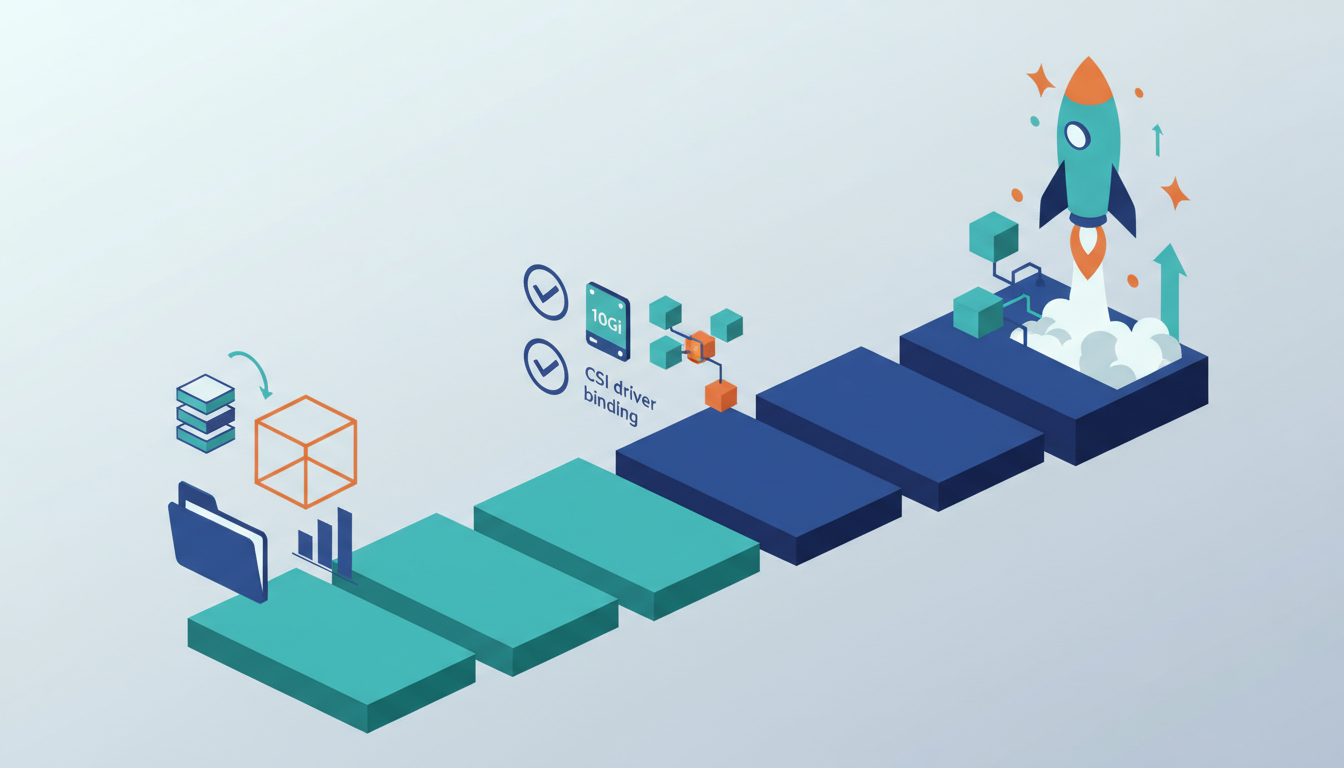
A persistent volume claim triggers the CSI driver to execute an external API call that carves capacity from a remote array before binding the volume to a node.
- The control plane validates the claim against available storage classes.
- The CSI provisioner plugin sends a `CreateVolume` request to the backend hardware.
- External storage allocates the logical unit and returns a unique identifier.
- The scheduler binds the new persistent volume to the pending.
Operators configure the `StorageClass` to define provisioning parameters explicitly because the standard interface extends legacy architectures not built for flexible distribution. This workflow relies on vendor-specific driver customization Mechanical separation creates a hard dependency on external hardware availability, contrasting with native pooling that consumes local node resources. Heavily integrated platforms risk replacing hardware lock-in with software lock-in The system offers over 130 drivers. Most require manual tuning for AI workloads demanding high concurrency. Mission and Vision recommends auditing driver logs for latency spikes during the `ControllerPublishVolume` phase to detect provisioning bottlenecks before they stall training jobs.
Deploying Dell Container Storage Modules and HPE Ezmeral Runtime
Dell expanded its Container Storage Modules in March 2026 with new intelligent data management capabilities for AI workloads.
- Install the vendor operator to inject intelligent data management functions directly into the control plane.
- Define storage classes that map persistent volume claims to specific array tiers.
- Apply the configuration to enable automated snapshot policies during model training cycles.
This approach uses existing hardware while adding orchestration layers that traditional brokers lack. The update targets automation gaps found in standard deployments. HPE's Ezmeral Runtime uses Alletra Storage MP X10000 to deliver a disaggregated architecture scaling from terabytes to exabytes. Operators deploy this by configuring node affinity rules that separate compute from storage pools. The system pools resources without binding applications to single physical nodes. This design supports massive concurrency required for generative AI pipelines. Container-native storage Heavy integration creates migration hurdles if the underlying software stack changes. The cost of this flexibility is potential dependency on proprietary in-cluster features. Deployment success depends on matching the disaggregated architecture to workload latency needs rather than assuming universal fit. Mission and Vision recommends validating driver compatibility before production rollout.
Vendor-Specific Driver Customization Risks Beyond Basic Provisioning
Extending CSI drivers beyond basic provisioning requires custom code paths that bypass standard Kubernetes scheduling logic, creating fragile dependencies on specific storage arrays.
- Identify the gap between standard persistent volume claim capabilities and required AI data services like cloning.
- Develop proprietary extensions to handle flexible scheduling conflicts, as the base API lacks native support for these complex operations.
- Deploy the modified driver, accepting that future Kubernetes upgrades may break these non-standard integrations without vendor support.
Operators must maintain forked codebases rather than relying on upstream stability. The 14 major storage vendors unveiling new technologies at Nvidia GTC 2026 highlights the industry rush to fix these exact gaps, yet custom implementations remain isolated from such standardized advances. Relying on vendor-specific driver customization. The resulting architecture trades portability for performance, effectively locking the cluster to a single hardware generation. Mission and Vision recommends avoiding deep customization unless the performance gain exceeds the cost of potential migration failure.
About
Alex Kumar, Senior Platform Engineer and Infrastructure Architect at Rabata. Io, brings deep practical expertise to the evolving environment of container storage. With a specialized focus on Kubernetes storage architecture and cost optimization, Alex directly addresses the critical shift from ephemeral containers to stateful AI workloads requiring persistent data. His daily work involves designing reliable disaster recovery strategies and managing scalable infrastructure for high-traffic environments, making him uniquely qualified to analyze the trade-offs between block and object storage. At Rabata. Io, a provider of high-performance S3-compatible object storage, Alex uses his background as a former SRE to help enterprises navigate the complexities of the Container Storage Interface (CSI) versus container-native solutions. This article reflects his hands-on experience in building cost-effective, vendor-neutral storage foundations that support the rigorous demands of modern AI and machine learning applications without compromising performance or budget.
Conclusion
Scaling container storage for AI workloads reveals a critical breaking point: custom CSI drivers that bypass standard scheduling logic create fragile, non-portable dependencies. As object storage replaces traditional file systems as the primary data layer by 2027, organizations clinging to proprietary in-cluster features will face escalating operational debt rather than performance gains. The hidden tax of maintaining forked codebases diverts engineering talent from application innovation to storage protocol debugging, effectively locking infrastructure to a single hardware generation. This architectural rigidity prevents the necessary shift toward disaggregated models required for next-generation training clusters.
Teams must halt deep driver customization immediately unless a specific workload demonstrates a 10x performance return that justifies total vendor lock-in. By Q3 2026, any storage strategy lacking native object-store integration will require costly refactoring to remain viable. The industry is standardizing around architecture-centric solutions, making isolated proprietary extensions a liability rather than an asset. Start by auditing all current CSI modifications against upstream Kubernetes compatibility matrices before the next minor version release. Identify exactly which custom code paths block migration to standard object interfaces and schedule their removal within the current sprint cycle. This proactive decoupling ensures your data layer evolves with the system instead of becoming a static bottleneck.
Frequently Asked Questions
Ephemeral storage vanishes when pods delete, causing data loss for AI pipelines. Enterprises now face a 300% workload increase since 2022, requiring persistent layers that survive rapid container restarts and scaling events.
Over 130 CSI drivers currently link Kubernetes to external arrays. However, this broker model often creates hardware dependency, reducing portability because physical arrays remain fixed while pods move across different cloud environments.
CSI leverages existing enterprise arrays but ties deployments to specific hardware locations. Container-native storage offers high portability by pooling drives inside the cluster, though it consumes additional CPU and RAM resources.
Traditional file and block approaches often fail under massive AI dataset weights. Organizations must shift to specialized object storage protocols to align data access patterns with the specific needs of generative AI pipelines.
Gartner predicts 15% of on-premise production workloads will run in containers by 2028. This shift demands storage architectures that support mission-critical databases and power-hungry generative AI models without data loss.