Cloud Storage FUSE: The Hidden TPU Bottleneck
Cloud Storage FUSE latency strangles multi-region TPU inference. While Gartner forecasts public cloud end-user spending will hit hundreds of billions of dollars in 2026, infrastructure choices determine whether high-cost TPU clusters deliver value or bleed budget on inefficiency.
Building TPU-based multi-cluster systems requires avoiding single points of failure. Data flows through cross-region deployments dictate architecture; a dedicated inference gateway beats direct storage mounting for low-latency model weight access. Proper Flexible Resource Allocation mitigates network-attached storage risks during peak loads.
This guide details a failover-ready implementation using InferenceObjective routing to direct traffic based on real-time cache utilization. By enforcing workload identity IAM and bypassing Cloud Storage FUSE pitfalls, operators ensure multi-cluster failover strategies actually work. In a distributed edge network, milliseconds beat raw storage throughput.
Core Components of TPU-Based Multi-Cluster Architectures
GKE Managed DRANET and TPU v6e Resource Allocation
GKE Managed DRANET manages flexible resource requests, allowing Pods to share accelerators within a single cluster boundary. Architects pair this with high-throughput object storage so the network layer never bottlenecks execution. Flexible allocation buys agility, but data retrieval delays kill it instantly. DRANET optimizes assignment logic, yet it cannot accelerate the initial data transfer required to warm TPU memory. Storage provisioning demands equal priority with network configuration to preserve end-to-end efficiency.
Deploying Multi-cluster GKE Inference Gateway for Regional Failover
This controller routes AI inference requests toward healthy clusters regardless of physical location, maintaining availability during regional outages. GKE Fleet registration acts as the control plane prerequisite, aggregating multiple clusters into one logical unit for global service discovery. Without this registration, the gateway cannot resolve endpoints outside the local cluster boundary, making cross-region failover impossible.
Latency-sensitive workloads show significant performance variation when balanced across diverse zones. Cross-region load balancing complicates keeping model weights consistent across all nodes. Inference results might diverge during a failover event unless Cloud Storage FUSE mounts stay synchronized. Organizations using this pattern must verify that Flexible Resource Allocation policies account for the increased latency of cross-region weight fetching. Infrastructure savings vanish if model artifacts are not cached locally at each edge location because managing state consistency carries a heavy operational cost.
Validating Cloud Storage FUSE for Model and Checkpoint Storage
Cloud Storage FUSE mounts object storage as a local file system to persist data, models, checkpoints, and logs directly in the cloud. AI workloads access remote buckets through standard POSIX-like interfaces using this mechanism without requiring application code modifications. Open-source models were downloaded successfully to this storage layer during validation exercises, confirming basic read/write connectivity for model weights.
Operators must check that workload identity IAM policies grant specific service accounts explicit access to target buckets before mounting. Pod startup failures occur when cross-region permissions are missing because default credentials do not suffice. FUSE simplifies data access yet introduces latency compared to native block storage. Teams should validate throughput against their specific checkpoint frequency requirements instead of assuming linear scalability. Testing with production-sized model artifacts exposes these scaling limits early.
Data Flow and Networking Mechanics in Cross-Region TPU Deployments
ResourceClaimTemplate Mechanics for DRANET TPU Slicing
GKE Managed DRANET functions as a managed feature allowing resource requests and sharing among Pods for both GPUs and TPUs. Operators define a ResourceClaimTemplate to specify the exact topology of a TPU v6e slice before the scheduler attempts placement. This template acts as a blueprint, ensuring the control plane reserves the correct network topology and chip count dynamically.
- The system validates the slice requirements against available cluster resources.
The architecture prevents resource fragmentation common in static assignments.
| Feature | Static Assignment | Flexible DRANET |
|---|---|---|
| Allocation Time | Pre-schedule | On-demand |
| Topology Flexibility | Fixed | Variable |
| Resource Sharing | None | Enabled |
Operational complexity rises while utilization efficiency improves. Private interconnects supporting data integrity benefit from this precise slicing to maintain throughput. Proper configuration keeps high-value accelerators fully utilized rather than stranded in unusable fragments.
Routing Gemma 3 Inference Across Dual-Region GKE Clusters
Deploying a Large Language Model (LLM), specifically Gemma 3, onto 2 GKE clusters located in different regions creates a resilient setup. This architecture eliminates single points of failure by distributing the LLM workload across geographically separated availability zones.
Operators enable this flow by defining a ResourceClaimTemplate that specifies the exact topology before the scheduler attempts placement.
- The control plane validates slice requirements against available resources in the primary region.
- Flexible allocation binds specific TPU chips to the requesting Pod based on the template.
- Network routes update instantly to enable communication across the allocated slice without manual intervention.
Caching model layers locally on GPU nodes reduces load times and minimizes upstream dependency. Consistent throughput persists even when cross-region bandwidth fluctuates under heavy demand.
Managing consistent model serialization across distinct storage buckets adds hidden cost. A properly configured system ensures that a regional outage results in a smooth handover rather than a complete service interruption for end users.
Failover Latency Risks in Cross-Region Internal Load Balancing
Cross-region health checks for the gke-l7-cross-regional-internal-managed-mc configuration often introduce detection delays that exceed typical inference timeout thresholds. This latency gap directly impacts inference availability during the critical failover moment.
Aggressive failure detection conflicts with network noise tolerance. Standard configurations can leave applications stranded for seconds while the control plane converges.
| Risk Factor | Impact Scope | Mitigation Strategy |
|---|---|---|
| Probe Interval | High latency | Reduce threshold |
| Network Jitter | False positives | Add retry logic |
| Control Plane | Slow convergence | Pre-warm backups |
Cross-region signaling cannot match local memory speeds.
Step-by-Step Implementation of a Failover-Ready Inference Gateway
Defining the GKE Inference Gateway and TPU v6e Architecture
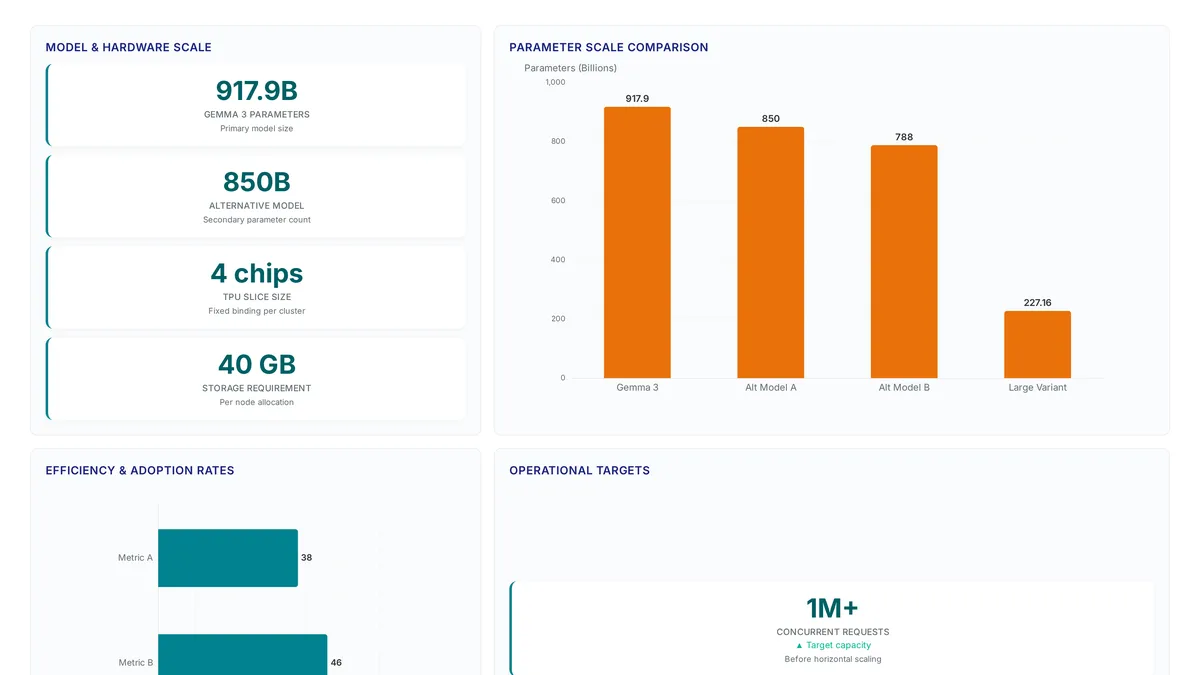
Mapping Gemma 3 inference workloads to specific TPU v6e hardware slices demands precise topology planning where each cluster uses exactly 4 TPU v6e chips. This fixed hardware binding establishes the ceiling for concurrent request capacity per node before horizontal scaling across regions becomes necessary. Operators enforce this constraint through ResourceClaimTemplates that explicitly request accelerator resources instead of relying on generic CPU limits.
- Configure the GKE cluster to recognize TPU partitions via device plugins.
- Apply the InferenceObjective custom resource to declare model placement preferences.
- Import the serving pool using GCPInferencePoolImport to expose endpoints to the mesh.
The Multi-cluster Inference Gateway serves as the single entry point, routing traffic based on real-time health checks rather than static DNS weights. Maximizing local cache hit rates while maintaining low-latency failover creates operational friction; aggressive local caching improves throughput but delays detection of regional degradation. Storage access patterns for model weights often become the latent bottleneck if Cloud Storage FUSE concurrency limits are exceeded during simultaneous pod startup across zones.
Prerequisites for VPC, Firewall, and Cloud Storage FUSE Configuration
Provisioning a proxy-only subnet starts the sequential environment setup to support the Internal regional application load balancer attached to the GKE inference gateway. This specific network segment isolates health check traffic from data plane flows, preventing firewall rules from inadvertently blocking failover signals during regional distress events.
- Create a dedicated VPC with custom subnet ranges for each target region to avoid IP overlap.
- Reserve static IP addresses for the global entry point to maintain consistent DNS records during switchover.
- Provision a Cloud Storage FUSE bucket and configure a dedicated IAM Service Account, binding it to a Kubernetes Workload Identity for secure pod access to model weights.
| Component | Configuration Goal | Failure Risk if Skipped |
|---|---|---|
| Proxy-only Subnet | Isolate LB health checks | False-negative failover triggers |
| Static IP | Maintain stable DNS entry | Client connection timeouts |
| Workload Identity | Secure model weight access | Unauthorized data exfiltration |
Linking the service account to the pod identity enables smooth, credential-free mounting of remote storage as a local filesystem. Storage services provide the data architecture enabling high-performance model training, inference, and fine tuning in the AI Hypercomputer system, yet misconfigured IAM policies often block pod startup entirely. Workload Identity Federation provides a secure, controlled way to generate time-limited Access Keys using SAML assertions and is recommended for granting workloads access to AI Object Storage in production environments. Skipping this binding causes total inference failure because pods cannot retrieve weights without explicit permission grants.
Executing Dual-Region Cluster Deployment with Gateway API Flags
Enabling the Gateway API using the flag `--gateway-api=standard` activates cross-region routing logic within each GKE cluster. This specific configuration parameter unlocks the controller responsible for managing traffic distribution between regional endpoints based on real-time health status.
- Initialize two separate GKE clusters in distinct geographic regions with identical node configurations.
- Apply the standard Gateway API flag during cluster creation to install required controllers.
- Deploy the vLLM inference server pod manifest referencing the shared model weights storage.
Configuring the HTTPRoute resource directs requests to the nearest healthy region while respecting latency constraints. The deployment sequence requires precise ordering; applying routing rules before the vLLM pods reach readiness causes immediate connection refusals at the edge. Network policies often block inter-cluster communication until explicit firewall rules permit health check probes from the global load balancer infrastructure.
Strict consistency requirements conflict with availability needs during partial outages. Enforcing synchronous replication across regions introduces latency that degrades inference throughput, whereas asynchronous setups risk serving stale model updates during failover events. This limitation dictates whether real-time financial trading applications or batch media processing workloads dominate the design choices.
Operational ROI and Durability Patterns for Enterprise AI Workloads
Defining Operational ROI in Multi-Cluster TPU Inference
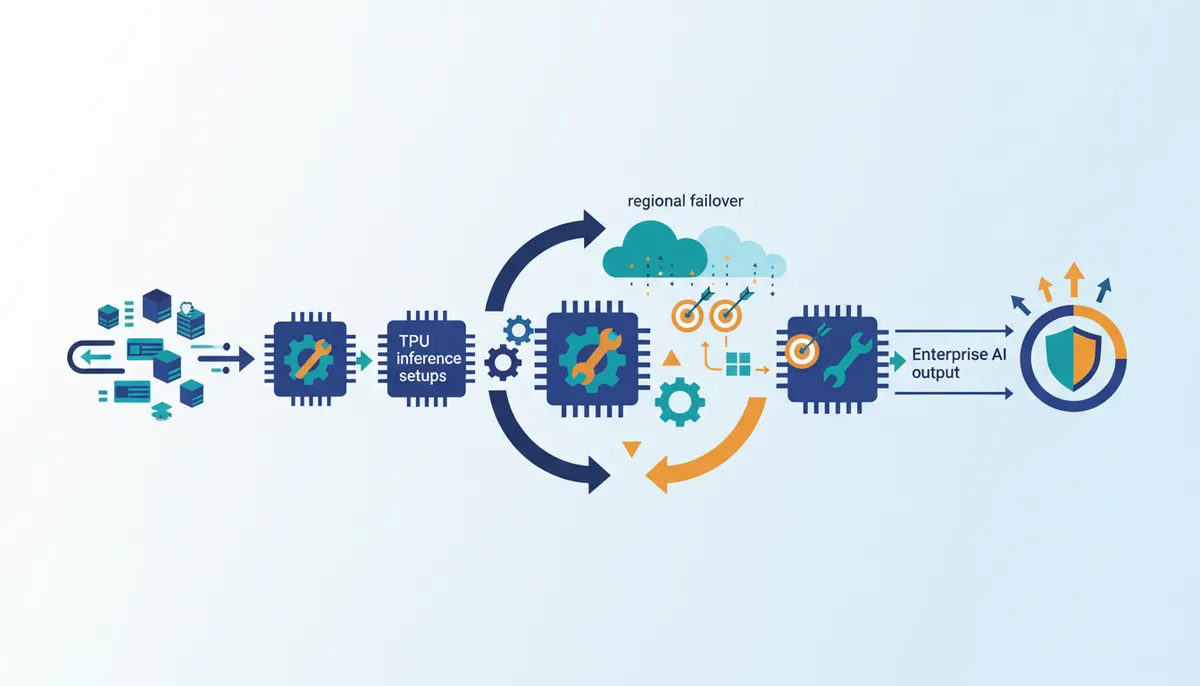
Operational ROI for TPU v6e workloads measures sustained throughput during regional outages rather than simple infrastructure savings. Data center systems spending is projected to surpass hundreds of billions of dollars in 2026, yet enterprises often overlook that single-cluster architectures forfeit availability when a zone fails. The mechanism involves GKE Managed DRANET routing InferenceObjective traffic to healthy clusters automatically. This approach transforms capital expenditure into a durability guarantee, ensuring multi-cluster AI deployments maintain service levels without manual intervention. However, the cost is increased networking complexity and the requirement for synchronized model weights across regions. Operators must weigh the expense of redundant capacity against the revenue loss from downtime. Unlike simple cost cutting, this strategy prioritizes continuous cloud AI deployment availability over minimum viable spend. The implication for network architects is clear: true value emerges only when failover logic matches data replication speed.
When the primary deployment goes offline, the Gateway automatically detects the failure and reroutes all subsequent user requests to the active secondary cluster. This mechanism relies on GKE Managed DRANET to monitor cluster health states without dropping traffic during simulated outages. The architecture ensures continuous availability by dynamically updating InferenceObjective routing rules as soon as a region becomes unreachable. Operators configure multi-cluster failover policies that prioritize low-latency paths while maintaining strict data consistency across zones.
| Failure Scenario | Detection Method | Reroute Action |
|---|---|---|
| Primary Region Outage | Health Check Timeout | Switch to Secondary |
| TPU Slice Failure | ResourceClaim Status | Reallocate Slice |
| Network Partition | Latency Threshold | Balance Load |
The limitation is that inference load balancing introduces slight latency spikes during the initial switchover window before caches warm up. Unlike single-region setups, this design tolerates total zone loss but requires careful tuning of timeout thresholds to prevent false positives. For TPU inference setup, verifying that model weights reside in replicated object storage prevents data access errors post-failover. A consequence often overlooked is that aggressive failover triggers can cause oscillation if network jitter mimics an outage, requiring hysteresis in detection logic. Organizations achieve true durability only when failover exercises become routine operational procedure rather than theoretical safeguards. Continuous verification ensures that multi-cluster AI investments deliver promised uptime during actual incidents.
Checklist for Validating GKE Inference Gateway Durability
Start validation by confirming GKE inference gateway health probes trigger automatic rerouting within acceptable latency bounds. Operators must verify that multi-cluster failover logic preserves active sessions without dropping tokens during regional outages.
- Test InferenceObjective routing updates when a primary zone becomes unreachable.
- Validate that workload identity IAM permits cross-cluster model weight access.
- Measure token throughput consistency before and after simulated failure events.
- Confirm Cloud Storage FUSE mounts remain stable under flexible pod rescheduling.
| Validation Step | Success Metric | Risk Indicator |
|---|---|---|
| Health Probe Latency | Sub-second detection | Timeout threshold exceeded |
| Throughput Continuity | higher output | Token generation stalls |
| Model Load Time | Consistent mount speed | FUSE bottleneck detected |
Comparative testing shows Google Kubernetes Engine processed roughly 1,000 more tokens per second than Amazon EKS, highlighting the performance stakes of proper configuration. The limitation is that aggressive failover policies may cause brief spikes in cold-start latency if secondary clusters lack warmed caches. Enterprises should prioritize cache utilization metrics alongside simple availability checks.rabata.io recommends stress-testing these patterns against real-world network partition scenarios. This approach ensures TPU v6e deployments meet strict enterprise SLAs without over-provisioning resources.
About
Alex Kumar is a Senior Platform Engineer and Infrastructure Architect at Rabata.io, where he specializes in Kubernetes storage architecture and cost optimization for cloud-native applications. His daily work designing persistent storage solutions and CSI drivers provides unique insight into the bottlenecks created by Cloud Storage FUSE in multi-region TPU deployments. At Rabata.io, an S3-compatible object storage provider focused on AI/ML workloads, Alex addresses the exact infrastructure challenges discussed in this analysis of GKE Managed DRANET. He understands how inefficient model weight retrieval can stall inference gateways and why flexible resource allocation is critical for multi-cluster failover. By using his hands-on experience with cross-region data strategies, Alex connects the complexities of TPU networking to practical storage performance. This expertise allows him to objectively analyze how storage latency impacts high-scale AI inference, offering a grounded perspective on optimizing GKE fleets for demanding generative AI tasks without vendor lock-in.
Conclusion
GenAI model development spending is forecast to more than double year over year in 2026. The operational cost of unverified failover logic becomes unsustainable under this pressure. Systems relying on theoretical safeguards rather than continuous verification will falter when network jitter triggers unnecessary oscillation, directly impacting the throughput continuity required for high-scale inference. True durability demands that organizations treat disaster recovery exercises as routine operational procedures instead of emergency protocols. Without this discipline, the promised uptime of multi-cluster AI investments remains an unverified assumption rather than a guaranteed service level.
Enterprises must immediately shift from passive monitoring to active, routine failure simulation to validate their infrastructure durability. Start this week by executing a controlled zone unreachability test against your production InferenceObjective routing to measure actual token throughput consistency. This specific action reveals whether your Kubernetes ecosystem configuration preserves active sessions or stalls token generation under stress. Do not wait for a regional outage to discover if your cache utilization metrics align with your availability goals. Validating these patterns now ensures your deployment can handle the surging infrastructure demand predicted for the coming years without requiring massive over-provisioning.
Frequently Asked Questions
Cloud Storage FUSE creates latency that bottlenecks multi-region TPU inference performance. This delay undermines the billions public cloud investment by causing token generation stalls during critical AI workload processing events.
GKE Fleet registration acts as the mandatory control plane prerequisite for global service discovery. Without this step, the billions market cannot support seamless regional failover because the gateway cannot resolve external endpoints.
ResourceClaimTemplate defines the exact topology for TPU v6e slices before scheduler placement occurs.
Missing cross-region permissions in workload identity IAM policies cause immediate pod startup failures.
A dedicated inference gateway maintains low-latency access to model weights better than direct mounting.
References