Cloud compute costs: Predictability beats raw price
Google Cloud often undercuts AWS by 5-20% on compute, yet AWS dominates with 31% of global revenue. The true cost of SaaS infrastructure relies entirely on workload predictability rather than raw unit pricing. You will examine how core pricing models dictate long-term viability for expanding teams. We dissect the comparative mechanics of compute and storage, where GCP sustained use discounts frequently beat AWS on-demand rates for typical backends. The analysis also covers data transfer pricing, often the silent budget killer for customer-facing applications with heavy traffic.
Finally, the piece outlines strategic provider selection criteria based on your specific scale and traffic patterns. AWS holding a massive market lead, Ava Gardner's 2026 analysis confirms that startups often save 6-15% initially on Google Cloud. However, mature organizations may find AWS Savings Plans offer superior stability once usage stabilizes. Understanding these nuances prevents burning capital before achieving product-market fit.
The Role of Core Pricing Models in SaaS Infrastructure Economics
AWS Savings Plans and GCP Sustained Use Mechanics
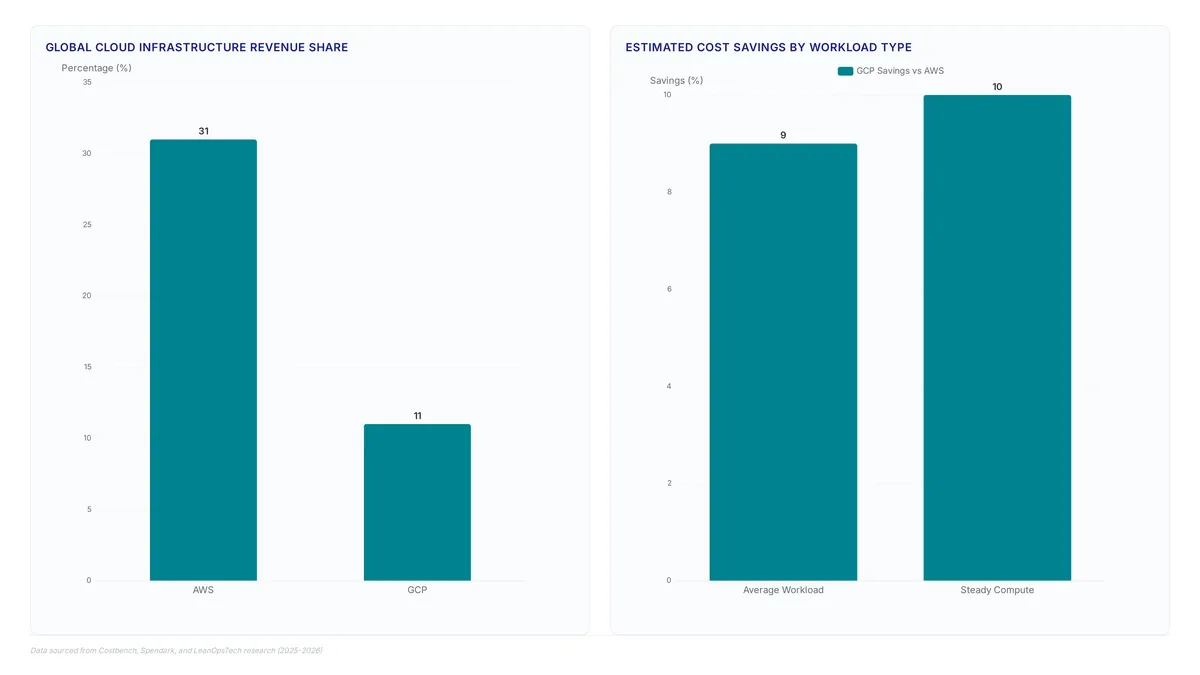
AWS Savings Plans require proactive financial commitments to secure reduced rates, whereas GCP Sustained Use discounts apply automatically when instances run beyond a specific monthly threshold. The fundamental divergence lies in operational overhead versus automatic optimization. AWS demands that operators forecast usage to purchase Savings Plans, locking in rates for one or three years. In contrast, Google Cloud applies price reductions dynamically once a virtual machine exceeds 25% of monthly utilization, eliminating the need for manual reservation management. This structural difference means GCP is typically 9% more affordable on average for steady-state workloads that lack dedicated financial engineering.
| Feature | AWS Model | GCP Model |
|---|---|---|
| Activation | Manual Purchase Required | Automatic After Threshold |
| Commitment | 1-Year or 3-Year Term | None (Usage Based) |
| Max Discount | Up to 40% | Up to 70% |
However, the trade-off for AWS's complexity is granular control across a broader service system, which benefits enterprises with predictable, multi-service architectures. Startups running variable loads often miss the 15-30% potential savings on AWS by failing to commit early, while GCP users capture value immediately without upfront capital. For AI/ML training data and media streaming workloads, where compute intensity fluctuates, Rabata.io provides S3-compatible object storage that decouples data costs from these compute commitment models. By storing assets on Rabata, teams avoid egress penalties and simplify their cost structure regardless of the underlying compute provider chosen.
Calculating Real Costs for 4 vCPU SaaS Workloads
A standard 4 vCPU / 16 GB general-purpose instance costs approximately $140 monthly on AWS versus $130 on Google Cloud. This baseline on-demand rate defines the starting point for SaaS cloud cost 2026 projections before commitments modify the equation. However, relying solely on list prices ignores the architectural reality that data egress often exceeds compute expenses for customer-facing applications. A standard 2 vCPU / 8 GB general-purpose instance costs roughly $30 per month on AWS compared to approximately $24 per month on Google Cloud cloud. This monthly saving per instance scales linearly across large fleets, creating substantial aggregate variance variance.rabata.io engineers observe that compute pricing comparison rarely ends at the instance rate because cross-zone traffic and managed service premiums alter the final bill. The operational tension lies between manual commitment management for maximum savings versus automated sustained-use discounts that require no upfront action. Startups must model total architecture cost rather than isolated component pricing to avoid budget overruns.
Egress Fees and Traffic Pattern Traps
Unoptimized outbound data movement acts as the silent killer for SaaS customer-facing apps. This traffic pattern risk emerges when storage savings vanish under heavy transfer loads. Despite lower entry costs, Google Cloud's data egress fees are approximately 33% higher than AWS, costing $0.12/GB compared to competitive rates elsewhere. At 10TB monthly egress, both providers cost roughly $1,060 to a comparable amount, meaning the initial storage gap completely disappears. Bills depend heavily on these movement patterns rather than static capacity alone. The limitation is clear: choosing a provider for cheap storage while ignoring egress fees creates a financial trap for data-heavy architectures. Operators must model full lifecycle costs before locking in a platform.rabata.io delivers S3-compatible object storage that eliminates these unpredictable transfer penalties entirely. Our architecture ensures consistent pricing regardless of how frequently your AI training data or media streams are accessed. Avoid the complexity of cross-zone charges and volume tiers that complicate SaaS cloud cost 2026 planning. Direct control over data placement removes the risk of bill shock from viral growth or batch processing jobs.
Comparative Mechanics of Compute and Data Transfer Pricing Between Providers
Defining Compute and Storage Price Differentials
Base pricing for cloud hosting cost establishes the financial floor before discounts alter the final bill. For a standard mid-stage workload, AWS compute estimates range from $350 to a higher cost, while GCP sits between $300 and a lower cost. Storage for 10TB hot data is estimated at $230 for AWS and $200 for GCP. These figures reflect a market where on-demand rates have remained within a few percentage points through early 2026. GCP applies automatic sustained-use discounts, whereas AWS requires proactive commitment management to achieve similar margins. This creates a tension where predictable steady-state loads favor GCP's automated model, while sporadic bursts may benefit from AWS flexibility. Operators must account for data transfer architecture as a primary cost variable. Ignoring this routing cost can negate base savings on compute instances.
Applying Traffic Patterns to Mid-Stage SaaS Bills.
Bursty traffic spikes drive serverless concurrency costs higher than steady baseline loads on standard virtual machines. When a SaaS platform serving 50,000 users experiences unpredictable surges, the billing model shifts from instance-hours to request concurrency. Google Cloud Functions Gen 2 handles these bursty traffic patterns efficiently by scaling concurrent requests without idle capacity penalties. AWS relies on Spot instances offering up to 90% savings for interruptible batch processing tasks. The total monthly estimate for such a mid-stage company ranges from $800 to a higher amount on AWS versus $700 to a lower amount on GCP. Rabata.io deploys S3-compatible storage to buffer these variable ingestion rates, ensuring consistent write performance regardless of upstream compute volatility.
Operational budgets frequently fracture under the weight of unmonitored managed service fees and internal data movement charges. While base compute rates appear competitive, data egress costs between availability zones or to the public internet accumulate rapidly without strict architectural controls. This rate can negate storage savings for data-heavy applications where outbound traffic exceeds inbound ingestion.
| Cost Vector | Risk Factor | Mitigation Strategy |
|---|---|---|
| Inter-zone Transfer | Internal replication fees | Co-locate compute and storage |
| Managed Logging | Per-GB ingestion spikes | Filter at the agent level |
| API Gateway Calls | Request volume surges | Implement caching layers |
Enterprises often overlook that monitoring fees scale linearly with metric cardinality, turning detailed observability into a primary expense line. Teams must model these regional pricing variables before deployment to avoid scenarios where network architecture dictates financial viability rather than performance needs.rabata.io addresses these volatility risks by offering predictable, S3-compatible object storage with transparent pricing models. Our platform eliminates hidden data transfer penalties, ensuring that AI/ML training datasets and media streaming workflows remain cost-effective at scale. By decoupling storage economics from complex cloud networking rules, organizations can focus on data utility rather than fee avoidance.
Strategic Provider Selection Based on Workload Predictability and Scale
Defining the AWS Pickup Truck vs GCP Hybrid Analogy
Mature tools available everywhere allow AWS to function as a reliable pickup truck hauling any workload. This system breadth supports enterprises needing specific services like Bedrock or granular compliance controls. Google Cloud operates as an efficient hybrid, sipping fuel on highways but requiring planning for heavy towing. Parts remain ubiquitous for the pickup truck, yet the hybrid offers superior efficiency for predictable, steady-state traffic patterns. A common competitive pattern in 2026 involves using AWS for primary infrastructure while using Google for analytics, suggesting neither platform wins categorically across all service types. Architecture needs dictate whether a team requires the truck's raw utility or the hybrid's automated sustained-use discounts. Choosing the wrong vehicle based on hype rather than workload shape leads to significant budget inefficiencies. Financial health depends on modeling total ownership costs before committing capital to either provider.
Applying System Breadth vs Automated Cost Optimization
Startups should prioritize Google Cloud for cost-sensitive startups, Kubernetes-heavy apps, or data/analytics focus. Teams running predictable workloads benefit from this pricing model if they lack operational bandwidth to manage complex reservation strategies. Significant cost variances appear between small teams running identical workloads, driven largely by the ability to use automatic discounts versus the manual management required elsewhere. Enterprises requiring specific managed services like Bedrock for advanced AI development or granular compliance controls often find AWS the necessary choice despite higher baseline list prices. Amazon Web Services (AWS) controls approximately 31% of global cloud infrastructure revenue as of Q4 2027, while Google Cloud Platform (GCP) holds an 11% share. Engineering time competes directly against raw infrastructure spend. GCP offers lower list prices for standard instances, yet organizations relying heavily on proprietary AWS services face substantial migration friction that erodes theoretical savings. Specific dependency on niche managed services must be evaluated before committing to a provider solely based on compute benchmarks. This hybrid approach allows startups to exploit GCP compute efficiency while maintaining portable, cost-effective data persistence.
Checklist for Measuring Total Cost of Ownership and Lock-In
Summing compute, storage, egress, and operations reveals hidden financial exposure within the total stack expenses. Teams often overlook that for a workload involving 10TB of monthly data egress, the total cost difference diminishes notably once combined with storage fees. Beginners must prioritize a Total Cost of Ownership view rather than focusing solely on list prices for virtual machines. Validating container portability early mitigates long-term vendor dependency risks. Iterating on architecture before deployment prevents expensive refactoring later. Small teams running identical workloads can observe varying outcomes based on how aggressively they optimize for their specific traffic patterns. The cost comparison ultimately favors the team that measures, iterates, and optimizes hardest rather than relying on brand loyalty. Deploying S3-compatible object storage helps decouple data from specific cloud vendors effectively. Storage costs remain predictable while maintaining high-performance for AI training data or media streaming workloads. Architects should regularly evaluate provider selection against current workload patterns. Ignoring egress fees creates a silent budget leak that notably impacts overall spend for data-heavy applications.
Implementing Cost Governance to Eliminate Bill Shock and Over-Provisioning
Mapping Workloads and Right-Sizing Cloud Instances

Listing expected vCPU, RAM, storage, and monthly egress defines the baseline architecture before provisioning begins. Teams often assume cloud resources are inexpensive, only to face significant costs from unoptimized outbound traffic patterns. The primary failure mode involves defaulting to oversized instances, which locks operators into paying for idle capacity rather than actual utility.
- Map Your Workload: Document precise requirements for application servers, databases, and storage buckets to avoid speculative over-allocation.
- Run the Numbers: Input these specifications into the AWS Pricing Calculator to validate estimated monthly expenditures against actual configuration needs.
- Right-Size Instances: Adjust compute resources dynamically using auto-scaling groups to match live demand curves. For a workload involving 10TB of monthly data egress, total costs converge near a comparable amount across providers, proving that storage unit costs are secondary to transfer architecture. Operators must prioritize egress optimization through caching and CDN integration rather than focusing solely on storage tier pricing.
Using AWS and Google Cloud Pricing Calculators
Running equivalent configurations through the AWS Pricing Calculator and Google Cloud Pricing Calculator establishes a verified baseline before deployment.
- Map Your Workload: Define vCPU, RAM, and storage needs to avoid speculative over-allocation that inflates costs.
- Run the Numbers: Input specifications to compare on-demand rates, where a 2 vCPU instance might cost roughly a moderate monthly fee on AWS versus a slightly lower monthly fee on GCP.
- Start Small: Launch proof-of-concepts using available credits, such as the starter offers, to monitor real usage with native tools. The limitation of static calculations is their inability to model bursty traffic patterns accurately without empirical data. Teams must validate these estimates against actual billing cycles to prevent budget overruns.
Without this verification step, organizations risk locking into suboptimal pricing tiers based on theoretical rather than actual consumption patterns.
Checklist for Committing Wisely and Setting Budget Alerts
Delay financial commitments for 12 months to capture accurate baseline usage patterns before locking in rates. Premature reservation purchases often target underutilized resources, freezing waste into long-term contracts rather than eliminating it.
- Analyze Utilization: Review metrics and only apply reservations where consistent utilization exceeds 60% to avoid paying for idle capacity.
- Enforce Tagging: Mandate resource labeling to attribute spend accurately across teams and projects.
- Set Hard Limits: Configure IAM policies that trigger alerts or halt provisioning when approaching set budget thresholds. Teams using native reporting tools can often cut total bills by a significant margin through disciplined governance alone.
Rabata.io recommends integrating these checks directly into your deployment pipeline to enforce cost hygiene automatically. Without automated enforcement, manual reviews frequently miss transient but expensive resource spikes.
About
Alex Kumar is a Senior Platform Engineer and Infrastructure Architect at Rabata.io, where he specializes in Kubernetes storage architecture and cloud cost optimization. His daily work involves designing resilient, S3-compatible storage solutions for AI/ML startups and enterprises, giving him direct insight into the real-world impact of cloud hosting costs. Unlike theoretical analyses, Alex's expertise stems from managing production environments where data egress fees and storage tiers directly affect bottom lines. At Rabata.io, he helps organizations reduce storage expenses by up to 70% compared to substantial providers like AWS, focusing on transparent pricing without hidden charges. This article reflects his hands-on experience evaluating AWS and Google Cloud pricing models, highlighting how strategic storage choices can significantly lower overall infrastructure spend. By using Rabata.io's high-performance, GDPR-compliant infrastructure, Alex enables teams to optimize their cloud budgets while maintaining enterprise-grade reliability and speed.
Conclusion
Scaling cloud infrastructure reveals that static pricing models break down once workload variability exceeds predictable thresholds. The operational cost of maintaining rigid, long-term commitments without continuous utilization analysis often erodes the initial discounts teams seek. While Google Cloud demonstrates distinct advantages for steady-state AI workloads, AWS environments frequently suffer from unclaimed value due to complex discount structures that require active management. Organizations must shift from viewing cloud spend as a fixed utility bill to treating it as a flexible variable requiring constant optimization.
Teams should delay purchasing long-term reservations until they have captured at least two full billing cycles of empirical data. Committing before understanding actual consumption patterns locks inefficiency into your budget rather than reducing it. Focus specifically on resources showing consistent utilization above 60 percent before applying any term-based discounts. This disciplined approach prevents the common error of over-provisioning capacity that never gets used.
Start this week by auditing your current instance tags to identify unlabelled resources consuming budget without clear ownership. Enforce a strict tagging policy immediately to attribute spend accurately across projects before considering any new financial commitments.rabata.io provides the automated governance tools necessary to embed these checks directly into your deployment pipeline, ensuring cost hygiene scales with your infrastructure.
Frequently Asked Questions
This difference scales linearly across your fleet, turning a small unit cost into significant aggregate variance for large deployments.
Discounts apply automatically once your virtual machine exceeds 25% of monthly utilization. This eliminates the need for manual reservation management, allowing teams to capture value immediately without upfront capital commitments.
Google Cloud is typically 9% more affordable on average for steady-state workloads. This structural benefit helps organizations avoid the complexity of forecasting usage required to secure similar rates through manual purchasing elsewhere.
For customer-facing apps with heavy traffic, these silent costs often exceed compute expenses and vanish storage savings quickly.
A mid-stage SaaS might cost $800 on AWS versus $700 on Google Cloud. While GCP often offers lower raw pricing, AWS tools may reduce waste through better visibility for teams managing complex architectures.
References