Active metadata stops agentic AI chaos today
IDC forecasts billions of active AI agents by 2030. Active metadata stands as the only barrier preventing autonomous chaos. Agentic AI systems collapse without a unified, bi-directional metadata hub bridging legacy mainframes and modern cloud services. We must move beyond generative summarization into true autonomous execution.
Active metadata transforms static catalogs into flexible reasoning engines. A unified metadata hub federates data across hybrid cloud environments without sacrificing governance or lineage. Ab Initio's Active Fabric exchanges metadata across more than 500 sources, outperforming traditional ETL pipelines and competitor AI agents.
The February 2026 partnership between Google Cloud and Ab Initio integrates Dataplex Universal Catalog with field-level lineage from over 100 extractors. Gartner predicts that 40% of enterprise applications will feature task-specific agents by year-end. The distinction between having data and having *context* is the primary competitive differentiator. Without specific business definitions and constraints from active metadata, Gemini and similar models cannot execute complex, multi-step workflows reliably.
Active Metadata as the Core Context for Agentic AI
Agentic AI and the Role of Active Metadata Context
Agentic AI denotes autonomous systems executing multi-step workflows rather than merely summarizing static information. Gartner predicts that 40% of enterprise applications will feature task-specific AI agents by 2027. This drives a fundamental shift in the technology stack. Autonomous actors require trusted, AI-ready data where understanding origin, quality, and meaning matters as much as the raw payload. Models like Gemini cannot produce explainable or auditable decisions without this semantic grounding. The Model Context Protocol standardizes how agents connect to external tools, databases, and APIs using OAuth 2.1 security. This specification enables the streamable HTTP connectivity necessary for real-time agent interaction with distributed enterprise resources.
Deploying Ab Initio Hubs for Distributed Data Agents
Ab Initio functions as a neutral hub federating distributed data from legacy mainframes and cloud services into a unified layer for AI agents. This architecture connects over 100 extractors to provide field-level, end-to-end lineage across complex environments including COBOL and SAS systems. Raw volume alone fails to supply the semantic context required for autonomous decision-making. Google Cloud AB Tasty illustrates this scale by processing 2 billion events every day following their migration to this unified model.
Synchronizing metadata across geographically dispersed on-premise and multi-cloud nodes introduces latency costs. Operators must balance the depth of lineage detail against the real-time performance needs of agentic workflows. Without centralized governance, AI agents risk acting on stale or misinterpreted data signatures. The result is a grounded reasoning engine where Gemini consumes verified context rather than unstructured guesses. Implement these connectors early to establish trust before scaling agent autonomy.
Legacy Data Access Barriers to Agentic AI Reliability
Disconnected legacy mainframes prevent Gemini AI agents from operating with verified context, generating hallucinations that compromise operational reliability and regulatory compliance. The partnership between Google Cloud and Ab Initio introduces specific metadata connectors. IDC forecasts the annual number of tasks executed by AI agent systems will grow at a rate of 524%, magnifying the impact of any single data access failure. Siloed information creates a fragmentation risk where agents execute commands based on stale or incomplete records.
Modern GraphRAG architectures demand a semantic knowledge backbone that legacy extractors cannot provide natively. Auditing agent decisions becomes unmanageable without unified lineage. The cost of ignoring these barriers is exponential as agent volume scales. Deploy active metadata fabrics to enforce data quality before agent ingestion.
Architecting a Unified Metadata Hub Across Hybrid Cloud Environments
Bi-directional exchange unifies metadata from over 500 sources without moving underlying data payloads. Ab Initio functions as a neutral hub extending Dataplex capabilities across hybrid boundaries. This architecture ingests technical definitions from legacy mainframes and modern cloud services simultaneously. Native converters standardize heterogeneous schemas from COBOL, DataStage, Informatica, and SAS into a common semantic model. The system extracts field-level context from over 100 extractors to construct complete lineage graphs.
| Component | Function | Scope |
|---|---|---|
| Native Converters | Schema translation | Legacy to cloud |
| Metadata Hub | Semantic unification | 500+ sources |
| Lineage Engine | Context tracking | End-to-end path |
Google Cloud's Knowledge Catalog automatically harvests technical assets from core systems like BigQuery and Spanner. Mapping proprietary legacy fields to modern ontologies demands coordination. Failure to align these definitions breaks the semantic chain needed for agent reasoning. Backward compatibility ensures applications built a decade ago function within today's cloud-based containers. This persistence protects historical investment while enabling new agentic workflows. Implementation costs involve significant upfront mapping effort rather than ongoing data transfer fees. Network teams must prioritize schema alignment over raw throughput to achieve reliable unification.
| Feature | Traditional ETL | Ab Initio Fabric |
|---|---|---|
| Lineage Granularity | Job-level only | Field-level depth |
| Legacy Support | Manual scripting | Native COBOL parsers |
| Audit Capability | Current state only | Time-travel history |
| Build Method | Code-intensive | Graphical diagrams |
Storing every historical state requires significant storage planning that many operators underestimate during initial deployment. AI agents cannot explain why a specific decision was made three months ago without this granular history, creating compliance gaps in regulated industries. Organizations use these tools to rapidly process records while maintaining the audit trails necessary for legal defense. Implementing such deep visibility costs measurable storage capacity, yet the alternative involves unexplainable AI outputs that fail regulatory scrutiny.
Cloud-native-only platforms often restrict execution to single modes, whereas Ab Initio supports batch, streaming, in-memory, and microservice architectures simultaneously. This flexibility allows operators to unify hybrid cloud metadata without refactoring legacy logic for specific cloud constraints. Applications built a decade ago function identically within modern cloud-based containers, preserving investment while enabling agentic AI access. The architectural divergence creates distinct operational profiles for data integration tasks.
| Feature | Cloud-Native Only | Ab Initio Hub |
|---|---|---|
| Execution Modes | Limited to specific types | Batch, streaming, in-memory, microservice |
| Legacy Support | Requires recoding | Runs unchanged in containers |
| Deployment Scope | Single cloud environment | Hybrid and multi-cloud fabric |
Graphical construction eliminates traditional coding, permitting business logic to span disparate execution modes without modification. This approach reduces the friction typically associated with migrating mainframe workloads to containerized environments. Operators gain the ability to deploy agents that interact with data regardless of its temporal processing requirement. Organizational inertia often delays the adoption of such unified fabrics despite clear technical advantages. True unification demands abandoning the notion that modernization requires replacement of established computational assets.
Comparing Ab Initio's Active Fabric Against Traditional ETL and Competitor AI Agents
Ab Initio Active Fabric Versus Traditional ETL Licensing Models
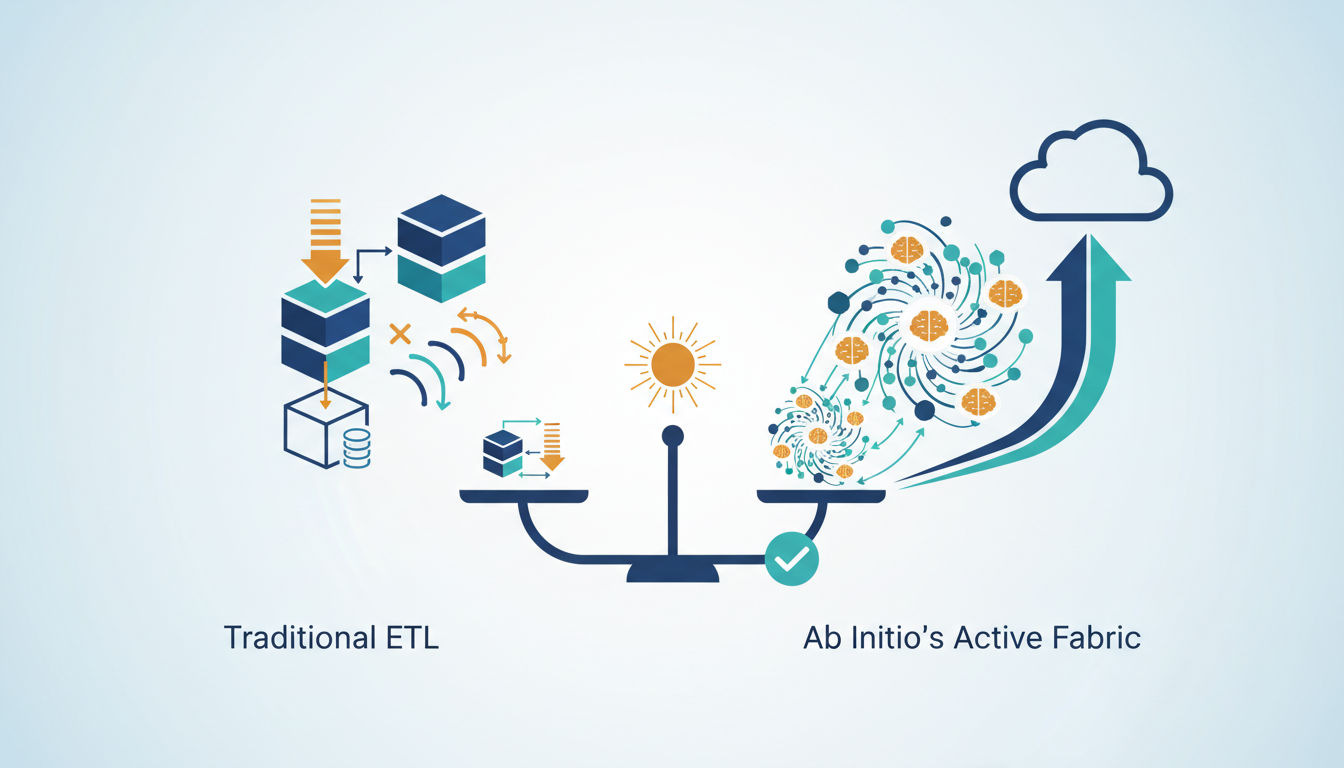
Informatica require upfront licenses near $300,000, creating high barriers for AI data read. This capital expenditure model stands in stark contrast to the lean operational structure of Ab Initio, which supports a global workforce of only 867 engineers while generating approximately a substantial amount in annual revenue. The economic divergence dictates distinct implementation strategies for enterprises seeking agentic AI foundations.
The lean supplier model shifts maintenance responsibility entirely to the buyer, demanding higher internal expertise than typical Informatica deployments. Organizations gain long-term stability through graphical applications that eliminate traditional coding debt, yet they forfeit the extensive vendor support networks associated with mass-market tools. This cost is acceptable for firms with mature engineering cultures but prohibitive for those seeking turnkey solutions. Operators must weigh the immediate liquidity hit of competitor licensing against the specialized talent acquisition required for Ab Initio. The absence of a massive vendor safety net means failures in complex business logic resolution rest solely on the enterprise. Adopt this architecture only if you are prepared to own your data integration destiny completely.
Deploying No-Code Graphical Logic for Complex Business Rules
Business users implement complex logic by building graphical applications. This visual approach allows non-engineers to construct intuitive diagrams representing complex transformation rules, notably reducing maintenance overhead compared to script-heavy environments. The platform executes these designs across batch, streaming, in-memory, or microservice architectures.
| Capability | Traditional ETL | Ab Initio Graphical |
|---|---|---|
| Development Method | Hand-coded scripts | Visual drag-and-drop |
| User Persona | Specialized developers | Business analysts |
| Legacy Support | Limited connectors | Native COBOL conversion |
| Execution Flexibility | Single mode per job | Multi-mode native support |
Scalability metrics on G2 show BigQuery scoring 9.3 while Ab Initio scores 8.3, yet the latter handles complex business logic at scale without code. Graphical complexity can obscure fine-grained optimization controls available only through direct scripting. Organizations relying on hand-coded pipelines face slower iteration cycles when adapting rules for agentic AI consumption. Adopt visual logic for rapid rule deployment while retaining code extensions for edge-case performance tuning.
BigQuery earns a 9.3 scalability rating on G2, exceeding Ab Initio's 8.3 score for raw volume handling. This metric favors single-cloud architectures where Google Cloud dominates storage and compute requirements. The $17.7 billion revenue figure for Google Cloud indicates massive infrastructure investment dedicated to elastic query processing. Pure scale becomes a liability when data spans legacy mainframes and competing cloud providers simultaneously.
| Dimension | BigQuery Native | Ab Initio Fabric |
|---|---|---|
| Scalability Score | 9.3 | 8.3 |
| Execution Modes | Cloud-only | Batch, streaming, in-memory, microservices |
| Legacy Support | Limited connectors | COBOL, DataStage, Informatica, SAS |
Ab Initio compensates for lower raw throughput scores by supporting batch. This processing flexibility allows operators to unify hybrid cloud metadata without refactoring legacy logic for specific cloud constraints. Selecting BigQuery solely for its scalability rating risks creating data silos that Gemini agents cannot traverse. Organizations operating mixed environments require the neutral hub capability to federate context across distributed systems. Raw compute power fails to deliver value if the AI agent lacks visibility into off-platform data origins. Evaluate execution mode diversity before committing to a single-vendor scalability maximum.
Executing a Strategic Migration to Enable AI Agents on Legacy Data
Unified Metadata Architecture for Distributed Legacy Systems

Federation of distributed data unlocks AI agent potential while unifying metadata through the Dataplex Universal Catalog. Raw information stays heterogeneous across legacy mainframes and modern clouds, yet a single semantic layer emerges for reasoning. Operators execute four specific steps to activate this fabric:
- Deploy native converters for COBOL.
- Configure bi-directional synchronization to populate the central catalog with business context from over 500 endpoints.
- Map transformation rules graphically to preserve audit trails for every data element.
- Validate end-to-end provenance to guarantee explainable reasoning for downstream agentic workflows.
A unified metadata layer resolves tension between data sovereignty and AI accessibility. Monolithic migration moves petabytes of cold storage unnecessarily, whereas this approach grants agents full contextual awareness without such displacement. Legacy extractors lacking documented schemas present a constraint, often demanding manual intervention to establish initial transformation context. Physical data remains siloed in this hybrid state, but logical access becomes universal. Organizations modernize governance without disrupting decades of operational stability through this separation.
Accelerating Cloud Migration of Decades-Old On-Premises Development
New utilities compress decade-long on-premises migration timelines into months for legacy Ab Initio workloads. Engineers execute this transition through four specific actions to enable AI agents on historical data:
- Deploy LeapLogic automation to refactor graphical logic without manual recoding.
- Map extracted field-level lineage directly into the Dataplex Universal Catalog schema.
- Validate semantic context consistency across the hybrid boundary before agent activation.
- Activate cloud-native execution modes while preserving original batch processing rules.
The agentic AI market grows at a rapid pace annually, creating pressure to modernize infrastructure quicker than traditional cycles allow. Skipping the lineage validation step risks polluting the Dataplex Universal Catalog with unverified definitions, causing agents to hallucinate business rules. Successful integration requires treating metadata as the primary artifact rather than a byproduct of data movement. Prioritize converter accuracy over raw throughput during the initial cutover phase.
Validation Steps for Full Data Engineering Lifecycle Coverage
Verify transformation logic against COBOL:
- Extract field-level lineage from over 100 sources to establish baseline provenance for agent reasoning.
- Map quality metrics to Dataplex policies, ensuring dirty data triggers immediate orchestration halts.
- Confirm governance tags propagate bi-directionally, preventing semantic drift across hybrid boundaries.
- Test orchestration workflows in microservice architectures to validate low-latency agent responses.
| Lifecycle Stage | Validation Target | Agent Risk if Skipped |
|---|---|---|
| Transformation | Legacy rule fidelity | Hallucinated business logic |
| Quality | Null-value thresholds | Poisoned training sets |
| Lineage | End-to-end trace | Unexplainable decisions |
Skipping lineage verification creates blind spots where agents cannot audit their own reasoning paths. Latency acts as the primary drawback here; deep historical traversal slows real-time agent feedback loops compared to shallow checks. Operators must balance audit depth against response time requirements for specific use cases. Richer metadata directly improves Gemini accuracy, yet excessive granularity burdens the Dataplex Universal Catalog with stale entries. Prioritize high-value data domains first rather than attempting enterprise-wide validation simultaneously.
About
This article is informed by extensive experience in the field.
Conclusion
Scaling active metadata for agentic systems breaks when lineage depth creates latency bottlenecks that stall autonomous decision loops. Initial licensing costs create high barriers, but the hidden operational tax emerges from maintaining real-time synchronization between legacy rule sets and flexible agent reasoning. As workflows shift from summarization to execution, static catalogs fail because they cannot support the bi-directional governance required to prevent semantic drift during live operations. Organizations attempting enterprise-wide validation immediately will exhaust compute budgets before realizing accuracy gains.
Commit to a phased domain rollout over the next six months, restricting active metadata deployment to high-value transactional streams before expanding to archival data. Do not attempt full coverage until you have proven that quality metric triggers successfully halt orchestration without human intervention. This timeline allows teams to refine the balance between audit granularity and agent response speed without crippling production throughput.
Start by auditing field-level lineage extraction rates across your top three revenue-generating data sources this week. Measure the specific latency added by deep historical traversal against your current SLA requirements to establish a realistic baseline for agent feedback loops.
Frequently Asked Questions
Agents fail to execute complex workflows reliably without semantic grounding. Gartner predicts that 40% of enterprise applications will feature task-specific agents requiring this trusted data context by year-end 2026.
The platform extends Dataplex with bi-directional metadata exchange across more than 500 sources. This range covers everything from modern cloud services to legacy mainframes for unified enterprise data fabric.
Yes, the integration provides field-level lineage from over 100 extractors including COBOL. This allows Google Cloud customers to process billions of daily events while maintaining strict audit trails.
Organizations can process billions of daily events while maintaining strict audit trails for every transformation. AB Tasty illustrates this scale by processing 2 billion events every day following migration.
Models remain incapable of executing complex multi-step workflows without specific business definitions. Active metadata provides the lineage history required for compliance and explainable decisions in autonomous systems.