Sovereign cloud storage: Fixing the residency gap
Enterprises now prioritize geography, jurisdiction, and control over the speed and scale that once set cloud adoption. Chris Gallagher notes that early cloud strategies treated storage regions as interchangeable checkboxes, a practice that obscured data residency and left organizations unaware if their information sat locally or in a facility half a world away.
B2B SaaS revenue is projected to reach hundreds of billions of dollars in 2026, a financial reality that forces a departure from the illusion of a borderless cloud toward models respecting physical boundaries. APIPilot data highlights this massive market scale, yet the underlying infrastructure often fails to clarify who holds authority over information on physical sites. The result is a dangerous opacity where companies cannot verify if their data complies with national rules or remains vulnerable to foreign access.
This analysis defines the specific vulnerabilities created when application and data layers remain coupled across borders. It details the architectural mechanics required to separate these layers, ensuring that data sovereignty is enforced by design rather than hope. Finally, it outlines strategic implementation steps for hybrid enterprise storage that align with the strict regulatory landscapes of 2026.
Defining the Sovereignty Gap in Modern Cloud Infrastructure
Data Residency Geography vs Data Sovereignty Legal Authority
Bits rest in specific physical geographies, a fact known as data residency, while data sovereignty dictates the legal authority ruling those bits. Treating storage regions as interchangeable checkboxes created a sovereignty gap where enterprises lost visibility into jurisdictional control. Multi-tenant SaaS providers often abstract physical locations, obscuring who holds authority over information on specific sites. Local laws and cross-border rules expose multinational data to varying legal structures. A geographical category offers no legal protection if the hosting nation mandates access. Enterprises now favor hybrid solutions that keep sensitive assets closer to home while allowing less critical data to cross borders.
Infrastructure deals reflect this shift toward controlled environments. CoreWeave recently entered a five-year agreement with the provider to support AI model developers seeking alternatives to hyperscaler lock-in agreement. Such partnerships highlight the scale required for organizations demanding both performance and strict jurisdictional boundaries. Balancing global accessibility with local compliance mandates creates operational tension. Decoupling application logic from storage helps enforce these boundaries technically rather than contractually.
Board-Level Governance for Borderless Cloud Vulnerabilities
Shifting international dynamics force enterprise data governance to become a board-level consideration beyond simple efficiency metrics. With a majority of enterprise workloads now transitioned to the cloud, organizations face acute exposure to cross-border data compliance failures. Physical infrastructure intersects with volatile geopolitical boundaries. Regional power outages, policy restrictions, and even exchanges of territory introduce tangible risks that abstract cloud models cannot mitigate. This reality defines what is sovereign file architecture: a structural decoupling of application logic from physical storage to enforce strict jurisdictional control. Unlike traditional models that treat regions as interchangeable, this approach ensures sensitive data remains within specific legal domains while less critical information uses global networks. Leaders can no longer delegate these decisions entirely to third-party providers who may obscure storage locations. The constraint is operational complexity; maintaining hybrid solutions requires rigorous internal oversight rather than blind trust in vendor abstractions. Consequently, architects recommend implementing explicit data residency policies that map directly to physical infrastructure locations. This strategy transforms data governance from an IT configuration task into a primary strategic asset for risk mitigation.
Risks of Multi-Tenant SaaS Ignoring Data Residency Rules
Multi-tenant SaaS file-serving services frequently downplay regulations, creating immediate jurisdictional uncertainty for global enterprises. Providers abstract physical storage locations, causing organizations to lose visibility into which national laws govern their assets. This opacity transforms standard cloud cost optimization strategies into legal liabilities, as data sovereignty remains a strict legal concept distinct from simple geography. The financial scale of this exposure is massive, with B2B SaaS revenue projected to reach hundreds of billions of dollars in 2026. Yet, many platforms continue operating on shared infrastructure that complicates compliance enforcement.
A critical analytical gap exists here: cost-saving shared tenancy often prevents the granular audit trails required for strict regulatory adherence. Some architectures claim to reduce operational expenses by up to a significant portion through simplified governance, yet these efficiencies frequently rely on generalized policies that fail during specific legal disputes. The tension between economic scale and legal precision means that non-compliance can result in significant regulatory penalties. Enterprises must move beyond treating regions as interchangeable checkboxes. Architects recommend decoupling application logic from storage to enforce strict boundary controls. Without this separation, policy changes or territorial shifts can alter data access rights.
Architectural Mechanics of Separating Application and Data Layers
Sovereign File Architecture Layer Separation Mechanics
Sovereign file architectures decouple the application layer from physical data stores to enforce distinct jurisdictional boundaries. This structural split lets organizations dictate file locations independently of the accessing software. Traditional multi-tenant models force multiple tenants onto shared application instances and databases, relying on logical separation alone. Such an "apartment building" approach frequently obscures the specific physical facility housing the bits. Separated architectures place data residency concerns above raw scale or speed.
Legal control now supersedes the efficiency metrics that once dominated IT hierarchies. Scale, speed, and cost have yielded ground to data residency, data sovereignty, and legal considerations. Enterprises demand operational control to recover data efficiently and migrate assets across jurisdictions when necessary. This capability directly mitigates risks posed by regional power outages, sudden policy changes, or territorial exchanges that threaten data availability.
Implementing this separation requires treating storage regions as non-interchangeable legal zones rather than mere capacity pools. A tension exists between the convenience of shared infrastructure and the necessity of physical isolation for sensitive workloads. This constraint ensures legal considerations govern access rather than default provider policies. Organizations navigating these hybrid requirements can use S3-compatible foundations to enforce strict residency without sacrificing application performance.
Implementing Hybrid Storage for Data Localization Compliance
Hybrid storage configurations resolve data jurisdiction issues by physically isolating sensitive assets within national borders while retaining global application access. Enterprises increasingly require clear control over data residency, legal compliance, and access permissions instead of focusing solely on features and performance. This architectural shift responds to mandates like the EU's Gaia-X initiative, which attempts to secure infrastructure within strict data protection rules.
Operators implement this separation through a set workflow:
- Classify data based on residency requirements and legal exposure.
- Deploy local storage nodes for sovereign data subsets.
- Route application logic to the correct physical endpoint dynamically.
| Feature | Borderless SaaS | Sovereign Hybrid |
|---|---|---|
| Data Location | Opaque/Global | Explicit/Local |
| Legal Control | Provider Set | Enterprise Enforced |
| Compliance | Shared Responsibility | Fully Sovereign |
The technical mechanism relies on decoupling the access layer from the persistence layer. Organizations maintain operational control to recover data efficiently and move it across jurisdictions when policy shifts occur. However, this approach introduces complexity in latency management if the application logic remains centralized while data is distributed. Unlike rigid single-tenant silos, modern hybrid models use shared infrastructure efficiencies, yet they require careful configuration to align replication policies with data protection rules.
Validating storage backends for immutable retention capabilities helps satisfy regulatory audits. Hybrid architectures do more than satisfy current laws; they create a mutable infrastructure capable of adapting to future territorial or policy changes without full migration. This adaptability ensures data sovereignty remains a flexible capability rather than a static compliance checkbox.
Validating Jurisdictional Control in Hybrid Deployments
Confirming physical data location requires validating storage bucket regions against national mandates like India's Personal Data Protection Bill. This legislation attempts to create strict requirements for data localization and restrictions for sensitive data. Operators must verify that storage backends explicitly support region-locked placement rather than relying on provider promises. FileCloud is cited as a highly secure content platform focusing on data sovereignty and governance, providing insight into data residence and governing jurisdiction.
| Compliance Framework | Primary Constraint | Architecture Requirement |
|---|---|---|
| India PDP Bill | Data Localization | Physical isolation within borders |
| China Initiatives | Similar Initiative | Local infrastructure control |
| EU Gaia-X | Strict data protection rules | Federated infrastructure |
Execute this validation sequence to address data jurisdiction issues before deployment:
- Map sensitive data classes to specific geographic boundaries.
- Verify storage news ticker updates for provider region availability changes.
- Test failover paths to ensure they do not cross prohibited legal zones.
- Document the chain of custody for all cross-border transfers.
A common oversight involves backup replication policies that automatically mirror data to disaster recovery sites in non-compliant jurisdictions. This technical convenience creates an immediate legal breach regardless of primary storage location. Enterprises must configure replication rules to respect the same strict data protection rules as the primary dataset. Implementing explicit deny-lists for egress traffic targeting non-sovereign regions can further mitigate these risks.
Strategic Implementation Steps for Hybrid Enterprise Storage
Implementation: Defining the Sovereign File Architecture Shift
This structural decoupling allows organizations to determine file locations independently of the software accessing them. Traditional multi-tenant models often obscure the specific physical facility housing the bits, creating a sovereignty gap where legal authority remains unclear. By contrast, separated architectures prioritize data residency questions over raw scale or speed.
- Isolate the storage backend from the application logic to guarantee physical control.
- Align data placement strategies with specific national regulations and jurisdictional requirements.
- Validate that storage backends explicitly support region-locked placement mandates.
Migration begins by mapping sensitive workloads to specific national borders before September 2025 mandates take effect. This separation ensures that legal authority remains clear regardless of where the application logic resides.
- Classify data sensitivity levels to determine which assets require physical isolation within local jurisdictions.
- Deploy dedicated storage clusters for enterprise tenants while maintaining shared resources for standard workloads.
- Configure storage backends to optimize costs for non-sensitive archives.
- Validate that exit strategies eliminate vendor lock-in fees as required by upcoming regulations.
| Strategy | Target Workload | Compliance Benefit |
|---|---|---|
| Dedicated Clusters | High-risk PII | Strict jurisdictional control |
| Shared Tenancy | Development logs | Cost optimization |
| Hybrid Split | Regulated industries | Balanced governance |
The hidden tension lies in balancing operational complexity against legal safety; overly granular isolation can fracture performance if network paths are not optimized. Many modern providers adopt a hybrid strategy where smaller tenants share databases while large customers receive dedicated instances. Validating that your storage backend explicitly supports region-locked placement is necessary rather than relying on provider promises. Failure to verify physical location leaves enterprises exposed to shifting international dynamics and policy changes. The upcoming EU Data Act, effective September 2025, mandates data portability and bans exit fees to prevent vendor lock-in.
Deploying Jurisdiction-Specific Storage Regions
Operators must map storage buckets to specific national borders to enforce legal jurisdiction. This configuration separates application logic from physical data, closing the sovereignty gap where legal authority often remains ambiguous. Unlike borderless cloud models that treat regions as interchangeable, sovereign architectures prioritize data residency questions over raw scale.
- Classify sensitive workloads requiring physical isolation within local jurisdictions.
- Deploy dedicated clusters for enterprise tenants while sharing resources for standard workloads.
- Configure storage backends to achieve cost-efficient archival storage.
Advanced implementations use a hybrid strategy where smaller tenants share databases, while large customers receive dedicated instances to satisfy contract mandates. This approach supports operational control, enabling efficient data recovery and movement across jurisdictions when necessary. However, maintaining strict boundaries increases infrastructure complexity compared to single-region deployments. Platforms increasingly offer Docker support to enable enterprises to maintain control while using cloud-like scalability. Validating that storage backends explicitly support region-locked placement is critical rather than relying on provider promises.
Business Justification for Adopting Sovereign File Architectures
Legal Authority Over Stored Data vs Geographical Category
Data sovereignty establishes the legal authority governing stored information, standing apart from data residency which simply identifies a geographical category. Local laws and cross-border data transfer rules expose data generated by multinational companies to varying legal structures, creating complex compliance landscapes. This distinction forces enterprises to look beyond simple server locations and analyze which nation's laws apply to their assets.
| Concept | Definition | Primary Risk |
|---|---|---|
| Data Residency | Physical location of bits | Regional power outages |
| Data Sovereignty | Legal jurisdiction | Cross-border seizure |
The expanding movement toward sovereign file architectures arises as companies reassess the borderless Cloud model to regain control over jurisdictional compliance. Organizations must recognize that strict legal boundaries often conflict with the low-latency requirements of global user bases. Mapping storage buckets to specific jurisdictions helps avoid unexpected legal entanglements. Such a structural shift ensures that physical infrastructure risks, such as exchanges of territory, do not compromise entire corporate datasets.
Board-Level Governance for Territorial Power Outages and Policy Shifts
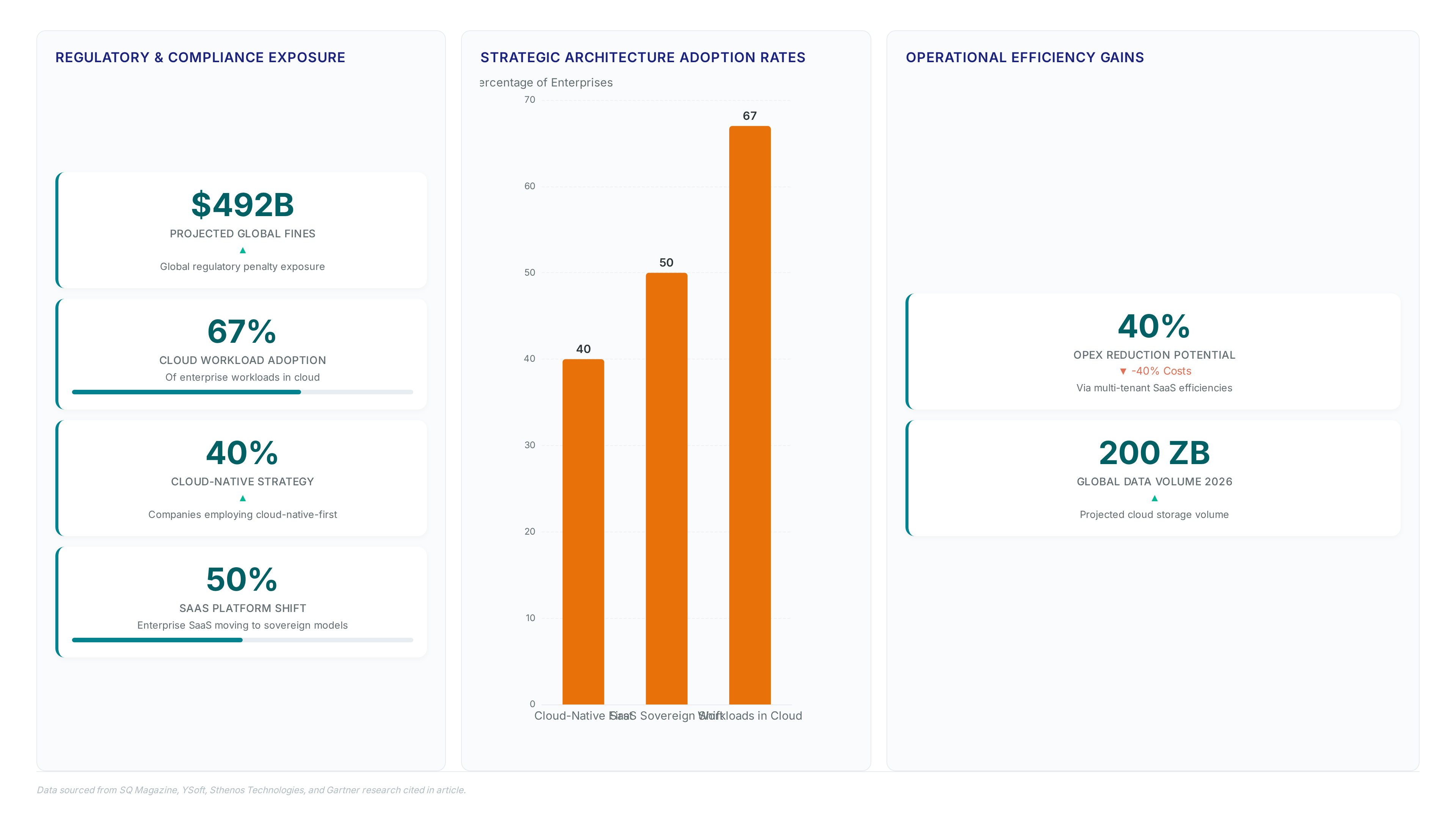
Area-based power outages, policy changes, and restrictions introduce data risks that force boards to treat physical infrastructure realities as urgent considerations rather than mere IT incidents. Lost productivity during regional blackouts cascades into compliance breaches, making the cost of ignoring these physical realities measurable. Sovereign file architectures separate application logic from physical storage to maintain control during geopolitical instability.
| Risk Factor | Borderless Cloud Response | Sovereign Architecture Response |
|---|---|---|
| Power Outage | Regional latency spikes | Hybrid solutions keep sensitive data closer to home |
| Policy Shift | Forced compliance updates | Jurisdiction-specific policy enforcement |
| Territory Exchange | Data stranded in conflict zone | Controlled data movement across jurisdictions |
A primary constraint of this approach is the requirement for active governance; leaders must rethink one-size-fits-all strategies when safeguarding control over data. Boards must define data residency boundaries explicitly to enable rapid technical execution when diplomats fail. Operators who delay this structural change risk finding their data subject to foreign seizure during the next territorial dispute.
Validating Compliance Against Gaia-X and India Personal Data Protection Bill
A sovereign architecture separates application logic from physical bits, ensuring data residency aligns with national borders while maintaining legal jurisdiction clarity. Leaders should assess whether their current setup supports the strict federated models emerging in the EU and Asia.
| Mandate | Primary Requirement | Architectural Constraint |
|---|---|---|
| Gaia-X | Federated infrastructure | Secure and federate data within EU boundaries |
| India PDP Bill | Data localization | Strict requirements for sensitive data |
| China Initiative | Secure federation | Domestic infrastructure initiatives |
Global AI training often requires moving datasets that local laws explicitly forbid from leaving national soil, creating immediate tension. Unlike borderless clouds that obscure location, sovereign file architectures enable granular control over where specific object stores reside. Organizations ignoring this shift face binary failure modes where access vanishes during geopolitical friction. Validating compliance requires more than vendor assurances; it demands technical proof of data placement. The industry trajectory points toward validated architectures where private AI models train on locally restricted data pools.
About
Marcus Chen serves as Cloud Solutions Architect and Developer Advocate at Rabata.io, where he designs sovereign file architectures for global enterprises. His expertise is rooted in a decade of hands-on experience managing S3-compatible object storage and Kubernetes infrastructure across diverse regulatory environments. Having previously engineered solutions at the provider Technologies and AI-native startups, Marcus understands the critical shift from borderless cloud convenience to geographic data sovereignty. At Rabata.io, he daily assists organizations in deploying GDPR-compliant storage across EU and US regions, directly addressing the vulnerabilities of centralized data silos discussed in this article. His work involves optimizing data residency strategies that ensure companies retain control over their physical data locations while maintaining high-performance. This practical engagement with multi-cloud storage strategies and strict compliance frameworks uniquely positions him to articulate the necessity of sovereign architectures in modern IT. Through Rabata.io, Marcus empowers teams to build resilient, location-aware infrastructure that aligns with evolving global data regulations.
Conclusion
Scaling sovereign file architecture reveals that technical federation fails without explicit legal jurisdiction mapping embedded in the storage layer. As global AI training demands cross-border data movement, the operational cost shifts from simple storage fees to the liability of maintaining unverifiable data trails. Organizations relying on vendor assurances rather than technical proof of placement face immediate binary failure when geopolitical friction restricts access. The window for reactive compliance is closing as mandates like Gaia-X and the India Personal Data Protection Bill enforce strict localization that generic cloud regions cannot satisfy.
Leaders must implement a federated storage model that physically separates sensitive object stores by national border before the next diplomatic crisis forces an abrupt, untested lockdown. This approach ensures that application logic remains functional even when data movement halts. Do not wait for a specific audit trigger; the risk of foreign seizure or access denial during territorial disputes creates an urgent imperative for structural change today. Start by inventorying your current object stores against specific national residency mandates this week to identify any data stranded in conflict zones. Only through this granular control can enterprises sustain operations while adhering to the evolving environment of digital sovereignty.
Frequently Asked Questions
Treating regions as interchangeable creates a sovereignty gap where legal authority is unknown. With a portion of enterprise workloads now transitioned to the cloud, organizations face acute exposure to cross-border data compliance failures and jurisdictional uncertainty.
This architecture structurally decouples application logic from physical storage to enforce strict jurisdictional control. Unlike models treating regions as interchangeable, it ensures sensitive data remains within specific legal domains while less critical information utilizes global networks.
Governance must rise to the board level because physical infrastructure intersects with volatile geopolitical boundaries. With a portion of enterprise workloads now transitioned to the cloud, regional outages and policy shifts introduce tangible risks abstract models cannot mitigate.
Maintaining hybrid solutions creates tension by requiring rigorous internal oversight rather than blind trust in vendor abstractions.
Providers often abstract physical storage locations, causing organizations to lose visibility into governing national laws. This opacity transforms standard cloud cost optimization strategies into significant liabilities when local laws mandate access to information stored on specific sites.