Presigned URLs: Stop Reuse with Single-Use Tokens
Amazon S3 presigned URLs generated via IAM credentials persist for a maximum of 7 days. That is an eternity in security time. Relying on time-based expiration alone leaves secure s3 object access vulnerable to replay attacks long before the clock runs out.
We close this gap by replacing static signatures with serverless token generation that validates requests against a stateful backend. Standard presigned url logic fails because a stolen link remains valid for its entire lifespan. We fix this using dynamodb conditional writes to ensure a URL becomes invalid immediately after its first successful use, regardless of the remaining time on the clock.
This guide deploys a token-based url vending system using infrastructure as code. You will manage short-lived s3 urls that derive validity from a database transaction rather than a simple timestamp. By integrating aws sigv4 authentication, we prevent presigned url reuse even if the initial link leaks.
The Critical Security Gap in Standard Presigned URL Implementations
How AWS S3 Presigned URLs Grant Temporary Credential-less Access
A presigned URL embeds AWS SigV4 signature parameters directly into a query string. This grants time-limited access without requiring the requester to possess AWS credentials. Organizations use this to share private resources like financial records or legal files while maintaining strict access control boundaries. The link acts as a temporary delegation of the creator's permissions; it cannot exceed the scope of the originating identity. AWS documentation states that using a presigned URL will allow an upload without requiring another party to have AWS security credentials or permissions, and that a presigned URL is limited by the permissions of the user who creates it.
The Security Gap of Reusable Long-Lived Signed URLs
Possession equals permission until expiration. If a standard presigned URL leaks, any holder accesses or modifies data repeatedly without further checks. This reuse vulnerability worsens with long-lived URL vs short-lived URL configurations, as extended validity windows increase the opportunity for interception.
Operational constraints often enforce shorter lifespans than architects anticipate. When using AWS Security Token Service (STS) AssumeRole, the default session duration is 1 hour. Any presigned URL generated with these credentials expires at that timestamp regardless of the requested parameter. Similarly, applications running on Amazon EC2 instance profiles rely on temporary credentials that undergo automatic rotation, imposing strict validity periods on any derived access tokens. These infrastructure limits create unpredictable failure modes where valid business logic fails due to underlying identity expiration rather than application bugs.
Convenience conflicts with control. A presigned URL vs single-use token comparison reveals that while URLs offer stateless simplicity, they lack intrinsic mechanisms to revoke access after the first successful request. Security best practices recommend implementing serverless token exchange patterns for high-value assets where one-time consumption is mandatory. This approach shifts the security boundary from time-based expiration to event-based invalidation. Leaked links become useless immediately after the intended transaction completes.
Implementing Serverless Token Vending with API Gateway and Lambda
A single-exchange token enforces one-time URL generation by requiring a valid database entry before any signature occurs. This mechanism replaces static time-based limits with flexible, event-driven validation logic. Organizations build this architecture using Amazon API Gateway, AWS Lambda, and Amazon DynamoDB to vend presigned URLs on demand with custom expiration times or network-level access restrictions. This risk is mitigated by vending the signed URL only when needed and making it as short-lived as possible.
Latency conflicts with security in every deployment. Every additional validation round-trip adds milliseconds to the user experience while drastically reducing the attack surface for leaked links. Unlike standard implementations where a stolen link remains usable until its clock expires, this pattern renders the credential useless after the first successful exchange. Practitioners must configure strict timeout policies on the database records to prevent stale token accumulation. This approach is essential for high-value data sets where unauthorized reuse carries significant compliance penalties.
| Component | Primary Function | Security Benefit |
|---|---|---|
| API Gateway | Entry Point | Enforces TLS and request throttling |
| Lambda | Logic Processor | Validates token state atomically |
| DynamoDB | State Store | Prevents double-spend via conditional writes |
Cold starts require careful management to maintain acceptable response times under load. The complexity of managing stateful token stores outweighs the benefits for public assets but becomes necessary for sensitive financial or medical records.
Serverless Architecture for Flexible Token Vending and URL Generation
DynamoDB TTL Mechanics for Single-Use Token Expiration
Securing Token Vending with AWS SigV4 and WAF Rate Limiting
Hardening Token Infrastructure with KMS Encryption and VPC Isolation
A Lambda function creates a single-use, randomized token via Python's secrets module before storing it in DynamoDB alongside the S3 object URI and an expiration timestamp. This time-to-live attribute activates an automated background deletion process once the specified epoch time passes, removing the requirement for manual cleanup scripts or cron jobs. The database engine scans for expired items instead of enforcing a synchronous check during reads, which introduces a minor delay between logical expiration and physical removal. Conditional writes serve as the primary enforcement layer for single-use logic because the token record might technically persist for seconds after its intended expiry. Relying solely on TTL without atomic consumption checks risks a narrow window where a stale token could be exchanged if the sweeper has not yet run. TTL manages storage hygiene and reduces table bloat, but application logic must validate token state before generating any S3 presigned POST URL. This method secures the upload layer by ensuring that once a token is consumed or expires, the credential becomes useless regardless of network latency or replay attempts.
A user authenticated with AWS SigV4 IAM credentials initiates the secure workflow by issuing a GET call to the API Gateway `/token` resource. This specific identity context allows the system to attribute every request to a distinct principal before any URL generation occurs. AWS WAF immediately evaluates the incoming traffic against configured rules, such as rate limiting and managed rule sets, to protect the API from volumetric abuse or credential stuffing attacks. The architecture enforces a strict sequence where signature validation precedes token issuance, ensuring that only verified identities trigger downstream Lambda execution.
SigV4 guarantees identity, yet it does not inherently prevent a compromised but valid credential from requesting excessive tokens in a short window. The integration of WAF provides the necessary behavioral guardrail that cryptographic signing alone cannot supply. Operators must configure these rate limits carefully. Overly aggressive thresholds might interrupt legitimate high-throughput media streaming or AI training data ingestion pipelines. The constraint is increased configuration complexity at the edge, yet the payoff is a verifiable audit trail linking every generated URL to a specific, time-bound identity assertion. This approach shifts the security perimeter from the object store to the identity provider.
Deploying customer-managed keys on AWS KMS encrypts data at rest for both S3 buckets and the underlying DynamoDB tables. This configuration overrides default server-side encryption behaviors to enforce strict ownership of cryptographic materials. Attaching Lambda functions to a virtual private cloud isolates token generation logic from the public internet entirely. Operators must route traffic through private API Gateway endpoints to prevent exposure of the vending service to external scanning.
The architectural cost is increased network latency due to NAT gateway traversal during cold starts.rabata.io recommends this trade-off for AI/ML workloads where data leakage consequences outweigh millisecond delays. Network isolation prevents direct database access even if application logic contains vulnerabilities. This approach fixes token reuse errors by ensuring the storage layer remains unreachable without valid VPC context.
Deploying the Token Exchange Solution with Terraform Modules
Defining Terraform and AWS CLI Prerequisites for Token Vending
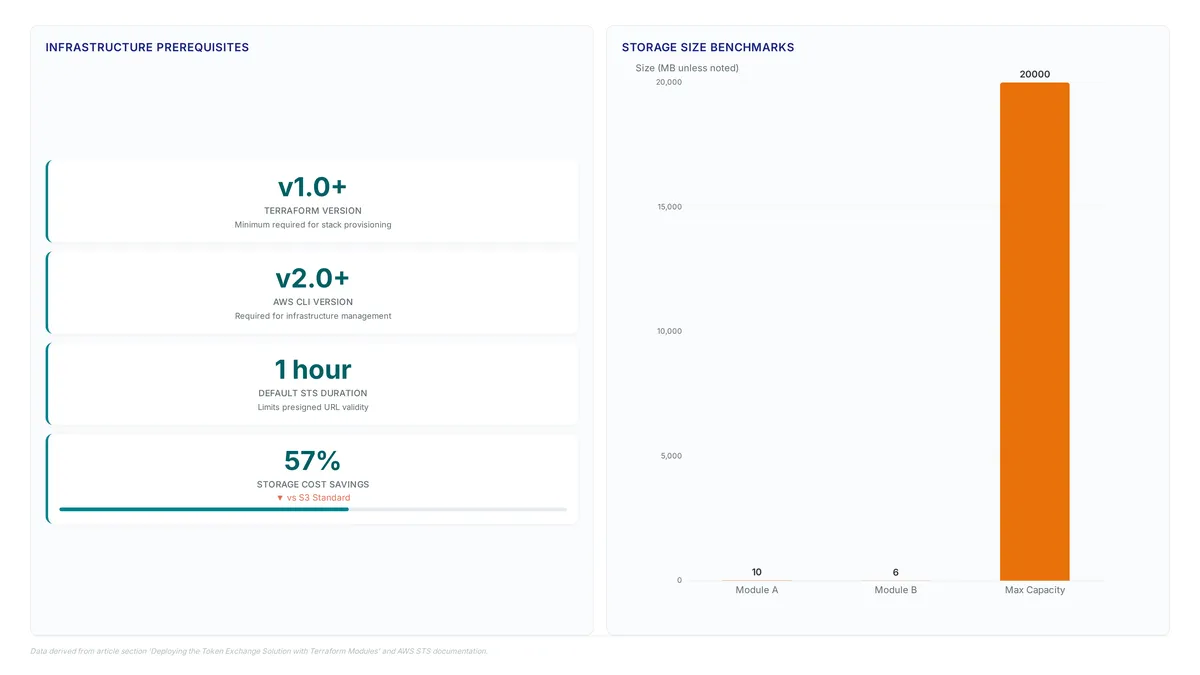
An active AWS account configured with credentials holding specific administrative permissions starts the token vending architecture. Operators install Terraform v1.0 or later alongside the AWS Command Line Interface (AWS CLI) v2.0 or later to manage the infrastructure-as-code stack. These tools form the core layer for provisioning the serverless components that enforce single-use token logic.
- Verify the local environment executes a supported Python version, as the Lambda runtime depends on it for cryptographic signature generation.
- Configure the AWS CLI with an identity possessing rights to create DynamoDB tables and API Gateway endpoints.
- Initialize the working directory to download provider plugins before applying the reference modules.
- Validate network connectivity to ensure the CLI can reach the AWS global endpoints during the planning phase.
The calling identity requires permission to write conditional expressions to the database layer. This strict requirement prevents partial stack creation, which could otherwise leave orphaned resources exposed. Standard presigned URL setups differ because this architecture demands precise configuration since the token exchange handshake relies on specific SIGv4 signing algorithms. Eliminating these prerequisites stops configuration drift before the first token is ever requested.
Deploying the Stack via GitHub Repository and CloudShell
Clone the GitHub repository to access the Terraform modules required for the single-exchange token architecture. This initial step retrieves the configuration definitions that provision the serverless components enforcing one-time use logic.
- Open the AWS CloudShell environment in the AWS Management Console to apply a pre-authenticated, browser-based shell with the AWS CLI pre-installed.
- Execute the git clone command within the CloudShell terminal to download the solution code to the ephemeral storage volume.
- Follow the detailed instructions in the README file to initialize the Terraform backend and apply the infrastructure stack.
Developers verify the deployment by locating the REST API ID in the API Gateway console after the Terraform apply operation completes. This identifier is required to construct the endpoint URL for validation commands, which generate a valid single-use token for testing. CloudShell eliminates local dependency conflicts while ensuring the execution environment matches the permissions of the logged-in identity. The DynamoDB table created by this stack uses conditional writes to prevent token reuse, a mechanism that relies on proper SigV4 authentication to function.
CloudShell sessions are temporary. Persisting the generated REST API ID and token vending endpoint URL to a local file is necessary before the browser session expires. This constraint keeps testing workflows reproducible across different terminal sessions without requiring repeated stack inspections. The architecture relies on this specific sequence of cloning, applying, and invoking to maintain the security boundary where long-lived credentials never reach the client application. Validating the token exchange flow immediately after deployment confirms the conditional write logic rejects second-use attempts as designed.
Validating API Gateway IDs and Resource Endpoints
Logging in to the API Gateway console in the same AWS Region where the solution was deployed begins the validation process. This step isolates the correct environment before inspecting individual resource identifiers.
- Locate the REST API in the list within the AWS Management Console.
- Record the REST API ID displayed in the interface for future client configuration.
- Navigate to the Resources tree to verify the existence of the `/token` endpoint.
The following table distinguishes the required identifiers for successful invocation:
| Component | Identifier Purpose | Location in Console |
|---|---|---|
| REST API | Routes initial request | Top navigation bar |
| Resource | Defines action path | Left sidebar tree |
| Method | Specifies HTTP verb | Method response tab |
Users must identify the row for the single-use-presigned-urls-api REST API and note the REST API ID. Incorrectly identifying the resource ID causes invocation errors, rendering the token vending mechanism ineffective regardless of Lambda health. A mismatched API ID directs traffic to a stale or non-existent gateway, breaking the security chain entirely.
Cross-referencing these IDs against Terraform state outputs helps prevent manual entry errors. Verification ensures the serverless token exchange functions correctly before production traffic flows.
Validating Token Functionality and Managing Cloud Resources
Invoking API Gateway Methods for Token Generation
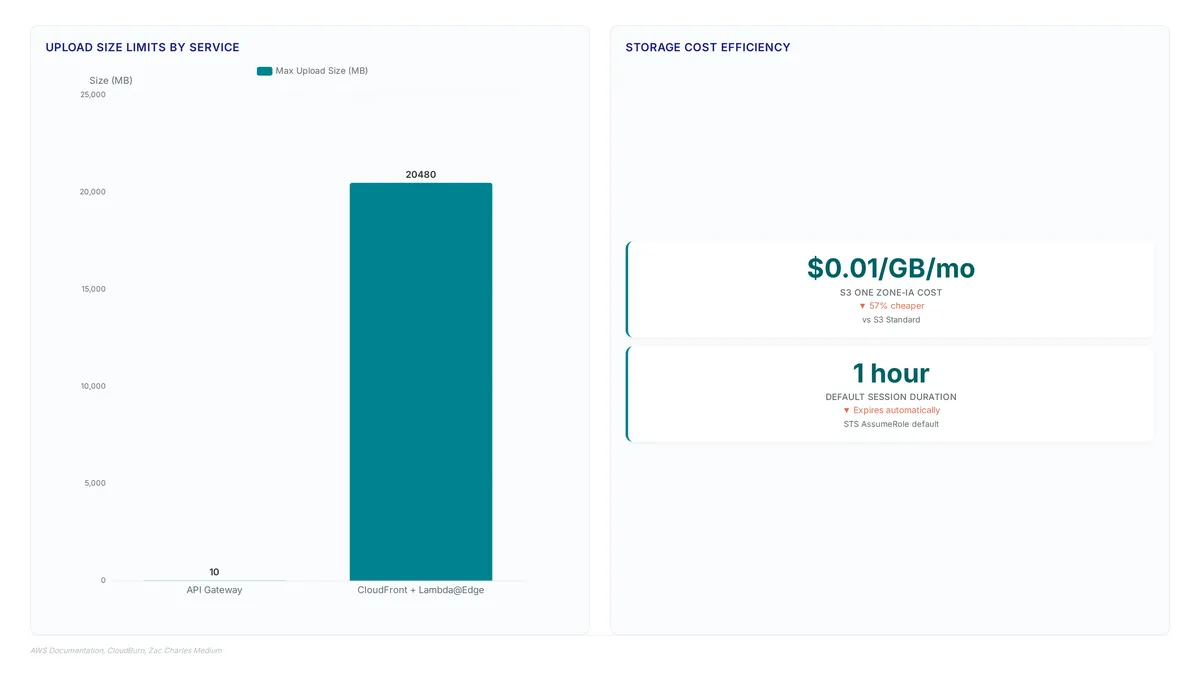
Configuring API Gateway to trigger backend logic starts the token generation workflow for S3 access. AWS Lambda functions often handle this underlying execution. The process begins by mapping a specific gateway identifier to the correct resource path required for token issuance. Invoking the method triggers the function, which generates a presigned URL while providing visibility into response payloads and latency metrics. This action returns a temporary credential granting access to Amazon S3 resources without exposing long-lived keys. Presigned URLs remain limited by the permissions of the user who creates them.
Time-bound expiration distinguishes these credentials from static URLs, limiting exposure after a set duration. Correctly parsing the response to extract the final URL before consumption represents a key operational step. Validating this serverless token vending architecture ensures backend locks function correctly before production traffic arrives.
Executing Terraform Destroy to Eliminate Post-Test Costs
Running the command `terraform -chdir="./terraform" destroy` and entering yes when prompted cleans up resources effectively. The serverless architecture designed for token exchange relies on infrastructure that requires immediate decommissioning after use to maintain cost efficiency. Leaving mechanisms like DynamoDB TTL and API endpoints running indefinitely occurs when teams skip this destruction sequence. Teams validating presigned URL solutions must treat resource teardown with the same rigor as initial deployment. Removing the stack prevents residual configuration artifacts from conflicting with future production deployments.
Verifying REST API IDs and Region Alignment Before Testing
Geographical alignment ensures the control plane interacts with the correct regional endpoint. The validation checklist requires identifying the specific row corresponding to the REST API name before extracting the unique identifier. Accurate notation of this REST API ID prevents accidental testing against stale or development gateways in other regions. Logging in to the API Gateway console in the same AWS Region where the solution was deployed starts the testing process. Precise resource identification serves as a prerequisite for valid performance benchmarking in serverless architectures. Misalignment here causes authentication failures during SigV4 signing. Developers should cross-reference region codes with deployment manifests. Such diligence avoids wasted debugging cycles on environment mismatches.
About
Marcus Chen is a Cloud Solutions Architect and Developer Advocate at Rabata.io, where he specializes in S3-compatible storage architecture and secure data infrastructure. His daily work involves designing reliable access patterns for enterprise and AI/ML clients, making him uniquely qualified to analyze single-exchange token mechanisms for presigned URLs. At Rabata.io, a provider of high-performance, S3-compatible object storage, Marcus routinely addresses the critical need for secure, short-lived access to private objects without compromising performance. This article stems directly from his hands-on experience implementing serverless token vending and conditional write strategies to prevent URL reuse. By connecting deep technical knowledge of AWS SigV4 authentication with practical deployment scenarios, Marcus offers an authoritative perspective on fixing credential security rather than relying solely on expiration timers. His insights reflect Rabata.io's commitment to developer-first innovation and transparent, secure cloud storage solutions for cost-conscious enterprises.
Conclusion
Scaling this architecture reveals that the one-hour default session duration creates a hard ceiling on long-running data transfers, forcing frequent re-authentication cycles that degrade user experience at the edge. While the initial Terraform setup provides a functional baseline, the operational burden shifts to managing these expiring credentials across distributed systems without introducing latency. Relying on static configurations for flexible access patterns is unsustainable as traffic volumes increase. You must implement an automated refresh mechanism that negotiates new tokens before the current session expires, ensuring smooth continuity for end users.
Start by auditing your current client-side logic this week to detect when a single-exchange token approaches its expiration threshold. Do not wait for a failure event to trigger your response logic. Proactive renewal prevents the abrupt termination of active streams, which is critical for maintaining reliability in edge access scenarios. Teams should prioritize building this durability layer immediately rather than optimizing storage costs alone. The focus must remain on keeping the data pipeline open regardless of the underlying credential lifespan. By addressing the expiration window now, you avoid complex migration paths later when legacy sessions conflict with updated security policies.
Frequently Asked Questions
IAM-generated presigned URLs last up to 7 days maximum. This long window creates significant risk if links leak, allowing unauthorized reuse long before expiration occurs naturally.
STS AssumeRole sessions default to a 1 hour duration. Any presigned URL generated within this session expires immediately when the hour ends, regardless of requested time settings.
EC2 metadata credentials rotate every 6 hours maximum. Applications generating URLs from these profiles face unexpected failures if the underlying credentials expire before the URL timestamp does.
DynamoDB conditional writes invalidate tokens instantly after one use. This mechanism stops replay attacks by ensuring stolen links fail immediately upon second attempt, unlike time-only expiration methods.
Time-based expiration allows unlimited access until the clock runs out. Stolen links remain valid for days or hours, enabling repeated data theft without triggering any immediate security alerts.