s3benchmark Tool: Isolate Server vs Network Delays
No specific dollar figure appears in the source data, but the s3-benchmark tool from the provider Technologies provides the critical Time To First Byte metric needed to validate S3 storage viability. You will learn to distinguish between the initial server response and the total data transfer process, while mastering the AWS CLI commands required for rigorous testing.
The analysis dissects the architectural mechanics driving Time To Last Byte, a value heavily influenced by file size and network bandwidth constraints. Unlike simple ping tests, proper benchmarking reveals how network congestion and routing distance degrade throughput during large object retrieval. We examine how Server Performance bottlenecks directly inflate transfer durations, proving that raw connectivity means little if the storage backend cannot sustain the request load.
Readers will execute practical benchmarks using the open-source s3-benchmark utility hosted on GitHub. The guide details installation steps for Linux environments and demonstrates how to configure environmental variables for accurate credential management. By focusing on these three core areas, you can move beyond theoretical availability and measure the actual user experience impact of your S3 compatible infrastructure.
Core Performance Metrics Defining S3 Storage Viability
Defining TTFB and TTLB as S3 Performance KPIs
Time To First Byte marks the precise interval a web server requires to transmit the initial data byte following a client request. This metric serves as a primary key performance indicator because it isolates server processing time from the broader network latency required for data to travel between endpoints. Network conditions such as routing complexity and congestion heavily influence this initial delay, often dictating perceived application responsiveness before any payload transfers. Time To Last Byte extends this measurement to include the total duration needed to deliver the final byte, effectively summing the initial latency and the full transfer time. Factors like file size and available bandwidth directly expand this window, meaning larger objects naturally increase the total duration regardless of server speed. The s3-benchmark utility captures both values to validate storage viability. High throughput numbers sometimes hide poor initial response times. A server might answer instantly yet fail to sustain the bandwidth required for primary storage roles. Operators must verify that both metrics remain stable under load, as fluctuating latency often signals underlying network bottlenecks rather than storage defects. Confusing processing delays with transfer times leads to misdiagnosed performance issues in production environments.
Deploying the Zextras s3-benchmark Tool for Metric Analysis
Operators install the open-source s3-benchmark utility from GitHub repositories to quantify storage viability. This Zextras tool isolates three specific variables affecting S3 performance: network conditions, file dimensions, and concurrent thread counts. Unlike simple connectivity checks, this application generates the load necessary to measure TTFB and TTLB under stress. Installation places the binary directly into the `/usr/local/bin/` directory using standard `wget` and `chmod` commands. Configuration requires exporting `AWS_ACCESS_KEY_ID` and `AWS_SECRET_ACCESS_KEY` as environmental variables within the active CLI session. These credentials persist until logout or explicit unsetting, a method detailed in official security documentation AWS Security Blog. Execution targets a specific bucket name while varying payload sizes and thread counts to stress the connection. For example, a test might upload a CSV result file named after the host machine to track historical performance data. The primary limitation of this approach is its reliance on the local network stack; congestion at the client edge skews results away from server-side reality. Consequently, operators must distinguish between storage bottlenecks and local bandwidth caps before declaring a storage backend unfit.
| Parameter | Function | Impact on Metric |
|---|---|---|
| `payloads-max` | Sets maximum object size | Increases TTLB duration |
| `threads-max` | Limits concurrent fetchers | Tests parallel throughput |
| `endpoint` | Defines S3 target URL | Determines network path |
High-frequency access patterns simulated by benchmarking tools directly correlate to higher operation and egress costs, making the cost-performance ratio a vital metric for evaluation. Workloads involving millions of small objects can cause operation costs for PUT and GET requests to accumulate quickly, necessitating careful analysis of request rates alongside raw throughput.
Network Congestion and Distance Risks on S3 Latency
Geographic distance and routing complexity introduce variable delays that destabilize Time To First Byte measurements. These environmental factors directly impact network latency, defined as the duration required for data to travel between client and server endpoints. Benchmark results may falsely indicate storage viability when operators ignore these physical constraints. The underlying mechanism involves Server Processing Time combined with the propagation delay inherent in long-haul fiber paths. Data transfer protocols inherently test the HTTP performance of the storage endpoint, making TTFB a direct measure of this initial network lag before payload transmission begins network latency. Routing changes or ISP congestion can spike these values unpredictably, creating jitter that breaks synchronous application requirements. Peak throughput numbers often mask these latency spikes. A connection might sustain high bandwidth yet fail to deliver the consistent response times required for primary storage roles.
| Factor | Impact on TTFB | Risk to Viability |
|---|---|---|
| Distance | Increases propagation delay | High for real-time apps |
| Congestion | Adds queuing delay | Causes unpredictable jitter |
| Routing | Alters path length | May bypass optimal peering |
Organizations must validate stability across diverse network conditions rather than relying on single-point tests. Given that the market includes over 20 S3-compatible providers alongside substantial hyperscalers, standardized benchmarking is necessary to compare performance and API consistency effectively across this heterogeneous environment.
Architectural Mechanics of S3 Data Transfer and Latency
Mechanics of File Size and Parallel Transfers in S3
Object throughput depends on network performance, file size, and parallel transfer counts. Larger files increase the time required for data to reach the destination, thereby increasing the Time to Last Byte (TTLB). Bandwidth dictates transfer speed while congestion slows operations. Testing for an object of size 2MB on a LAN connection leads to these results: The Throughput is between 111.5 and 111.6 MB/s. Testing for an object of size 2MB on a WAN connection leads to these results: The Throughput is 17 MB/s.
| Metric | LAN Performance | WAN Performance |
|---|---|---|
| Throughput | Dependent on Bandwidth | Dependent on Bandwidth |
| TTFB Range | Impacted by Latency | Impacted by Latency |
| Bottleneck | Server Processing or Network | Network Latency |
Server load dictates how quickly requests complete. An overloaded server reacts slowly and needs more time to finish tasks. Distance, congestion, and routing notably impact latency values. Engineers should tune payload sizes alongside thread counts rather than maximizing concurrency blindly. Validating these variables under production-like network constraints is necessary before committing to primary storage architectures.
Analyzing LAN vs WAN Throughput with 2MB Objects
Congestion creates a tangible ceiling on sustained throughput, slowing data transfer and leading to an increased TTLB. Physical distance and intervening routers introduce latency that throttles efficiency regardless of server capability. Local tests perform differently based on server processing capabilities while remote connections face network latency constraints. The average TTFB is between 6 and 10 milliseconds at the change from 2 to 6 threads. The average TTLB is between 36 and 105 milliseconds at the change from 2 to 6 threads.
| Connection Type | Throughput Capability | Primary Constraint |
|---|---|---|
| LAN | Dependent on Bandwidth | Server Processing or Network |
| WAN | Dependent on Bandwidth | Network Latency |
Stalled workflows occur when workers wait idle for data blocks. Future benchmarking efforts should prioritize strategies to mitigate these wide-area penalties. Object storage acts as a bottleneck rather than an accelerator for global workloads without such mitigation. Bandwidth alone cannot overcome round-trip time penalties inherent in non-local access patterns.
Validating Primary Storage Suitability via TTLB Metrics
Time to Last Byte (TTLB) represents the total duration of the data transfer process, including the Time To First Byte (TTFB). TTFB isolates the time required to send the first byte while TTLB captures the full duration of data transmission including network congestion effects.
| Validation Criteria | Primary Storage Requirement | Failure Indicator |
|---|---|---|
| Throughput Floor | Dependent on Workload | Inconsistent Transfer |
| TTLB Behavior | Stable under load | Erratic spikes |
| Bottleneck Source | Server Processing | Network Latency |
A bucket failing to sustain required throughput cannot support active Carbonio environments regardless of low latency metrics. The s3-benchmark tool reveals these bottlenecks by measuring total transfer time across varying payload sizes. Relying solely on peak throughput ignores the variance that causes user-perceived lag during heavy access periods.
- Execute benchmarks using multiple thread counts to stress the connection.
- Monitor TTLB stability rather than just average values.
- Compare results against baseline requirements for viability.
Both TTFB and TTLB measures can dramatically impact user experience.
Executing S3 Benchmarks with AWS CLI and open-source Tools
AWS CLI Installation and Credential Configuration Steps
Operators install the official AWS CLI software directly from package repositories on Ubuntu and RHEL systems.
- Execute `apt install awscli` on Debian-based distributions.
- Run `dnf install awscli` for Red Hat environments.
- Initialize the session using the `aws configure` command.
Setting Linux environmental variables provides a transient yet secure method for managing access keys during benchmarking workflows. This approach prevents credential leakage in persistent configuration files while allowing immediate validation of connectivity to specific endpoints.
The open-source s3-benchmark utility relies on these exported variables to authenticate requests without requiring a permanent `~/.aws/credentials` file. A common failure mode involves syntax errors in the export command, such as surrounding spaces around the equals sign, which causes the shell to interpret the command incorrectly rather than setting the variable. Correcting this syntax ensures the Zextras toolchain can successfully initiate throughput tests against the target storage cluster.
Executing Zextras s3-benchmark Binary from GitHub.
Operators download the Zextras s3-benchmark binary directly to establish a controlled testing environment for primary storage validation.
- Retrieve the executable using `wget github.com
- Move the file to the standard path with `mv./s3-benchmark /usr/local/bin/s3-benchmark`.
- Apply execution rights via `chmod +x /usr/local/bin/s3-benchmark`.
This native binary approach contrasts with containerized alternatives like the warp tool, offering direct system access that eliminates Docker daemon overhead during high-frequency metric collection.
The `-payloads-max 12` flag generates a 4MB object size, which effectively stress-tests network congestion without saturating the link immediately. A critical limitation arises when TTFB spikes occur despite adequate throughput; this indicates server-side processing latency rather than bandwidth constraints. While the tool reports aggregate statistics, it cannot isolate specific routing hops causing packet loss without supplementary network tracing. Failure to validate against the 100 MB throughput threshold risks severe degradation for AI/ML training data pipelines. Engineers must verify that TTLB remains stable as thread counts increase to ensure scalability.
Validating S3 Bucket Access and Exporting Results
Verify credential validity immediately using `aws --endpoint-url` to list buckets before running heavy workloads. Operators must resolve authentication failures here, as invalid secrets cause silent benchmark aborts rather than clear error messages. Once access is confirmed, the s3-benchmark tool measures Time to First Byte via direct execution.
- Set Linux environmental variables for transient key exposure.
- Execute the binary with `-upload-csv` to capture raw latency data.
- Review the generated CSV for throughput stability across thread counts.
Exporting results allows teams to track performance degradation over time, though high-frequency access patterns directly correlate to higher operation and egress costs. A single 1 GB download at 94.3 MB/s might saturate a link, yet repeated tests accumulate charges at $0.09/GB for the first 10 TB. The analytical risk lies in assuming LAN-like stability; WAN congestion introduces variance that invalidates single-run averages.rabata.io recommends archiving these CSV artifacts to validate storage viability against the 100 MB throughput threshold before production migration.
Strategic Application of Benchmark Results for Primary Storage Decisions
Defining the Throughput Threshold for Primary Storage
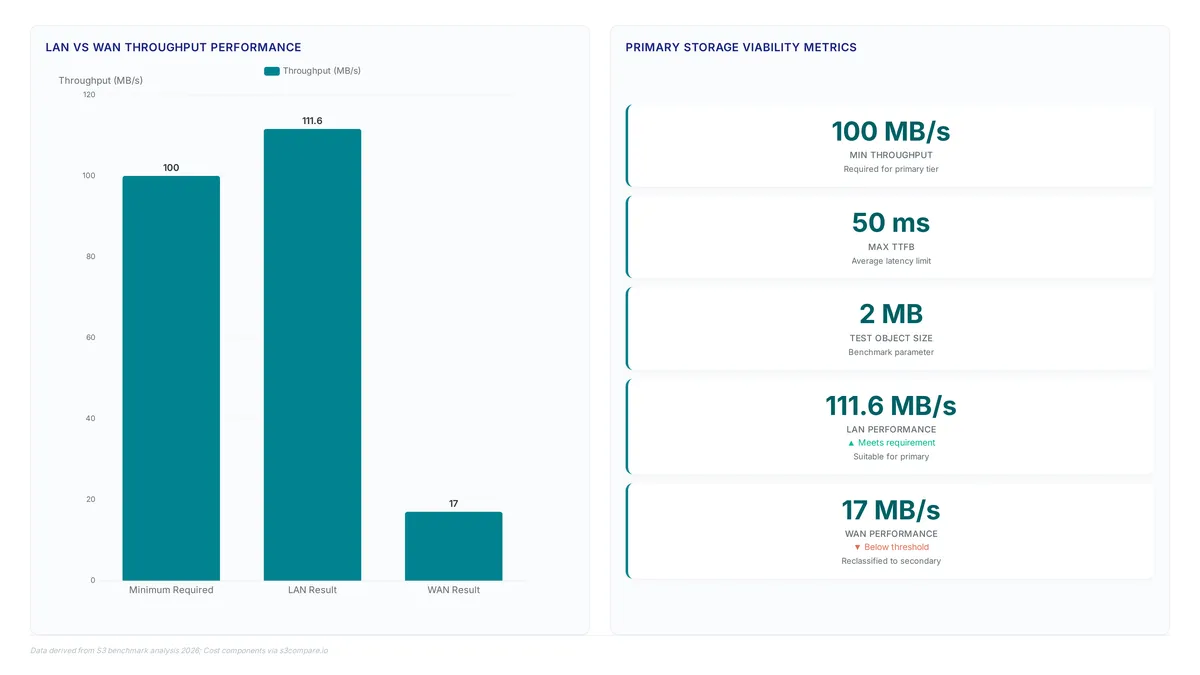
Reliable primary storage demands throughput sufficient to prevent application bottlenecks. To be reliably used as Primary Storage, an AWS S3 bucket must satisfy specific conditions in order of importance, starting with a throughput of at least 100 MB/s. Operators must verify that the avera ge TTFB is lower than 50 milliseconds while scaling thread counts from minimum to maximum concurrency. Stability defines viability; a connection showing no bottleneck ensures every application server accesses object storage without degradation. This performance gap dictates whether an S3 bucket serves as a primary tier or relegates to secondary archival roles. Cost models shift dramatically when storage costs fail to account for inadequate throughput rendering a tier unusable for production. Organizations evaluating migration must validate these metrics against their specific network path rather than assuming regional proximity guarantees speed. Without this guarantee, the total cost of ownership rises as application efficiency collapses.
Application: Interpreting LAN vs WAN Benchmark Results for 2MB Objects
Proximity dictates whether an S3 bucket functions as primary storage or fails the throughput threshold. Testing for an object of size 2MB on a LAN connection leads to these results: The Throughput is between 111.5 and 111.6 MB/s, satisfying the minimum requirement for active workloads. Conversely, WAN connections often drop to 17 MB, forcing a reclassification to secondary storage roles. This performance gap determines if the infrastructure supports real-time AI training or merely serves as a backup target.
Operators must recognize that network congestion on wide area links creates a bottleneck that threading adjustments may not overcome. LAN stability ensures consistent Time To First Byte. WAN variability introduces unpredictable delays unsuitable for low-latency applications. The limitation is often physical distance; software configuration cannot fix a link that cannot sustain the required bandwidth. Consequently, organizations evaluating a move from AWS S3 should rely on comparative data regarding storage costs and egress fees to make migration decisions that align with these performance realities. Validating these metrics before committing to a primary storage architecture is necessary.
Validating Thread Stability and Per-Server Connection Requirements
Confirming that average TTFB remains stable while scaling concurrent threads validates primary storage readiness. Increasing thread counts from minimum to maximum limits should not degrade latency, proving the absence of network bottlenecks. Although TTLB varies by object size, its consistency across load spikes indicates a reliable path for every application server. Each server requires a fast, dedicated link to the object store to prevent localized congestion from skewing global metrics. Organizations migrating between providers rely on this stability data to guarantee alternative endpoints meet strict SLAs before cutting over production traffic.
Verifying these stability metrics under full load before designating any bucket as primary storage for AI workloads is recommended.
About
Alex Kumar is a Senior Platform Engineer and Infrastructure Architect at Rabata.io, where he specializes in Kubernetes storage architecture and cost optimization for cloud-native applications. His daily work designing persistent storage solutions and managing CSI drivers gives him unique authority to discuss S3 benchmarking metrics like Time To First Byte (TTFB). At Rabata.io, a provider of high-performance, S3-compatible object storage, Alex constantly evaluates infrastructure performance to ensure enterprise-grade reliability for AI/ML workloads. This article reflects his hands-on experience validating storage throughput and latency within Rabata's global data centers. By using his deep understanding of infrastructure-as-code and observability, Alex connects theoretical performance indicators to real-world deployment scenarios. His insights help DevOps teams and cloud architects make data-driven decisions when selecting storage backends, ensuring their applications achieve optimal speed and efficiency without vendor lock-in.
Conclusion
Scaling object storage operations reveals that raw throughput numbers often mask the compounding cost of repeated validation tests. While a single run might seem negligible, accumulating charges at $0.09/GB for egress during aggressive benchmarking cycles creates an unexpected operational tax. The real break point occurs when teams treat LAN success as a universal green light, ignoring how WAN constraints fundamentally alter application behavior for distributed AI training. You cannot software-configure your way out of physical distance limitations, yet many migration strategies fail to account for this divergence until production traffic stalls.
Organizations targeting S3-compatible alternatives must mandate a dual-path validation strategy before signing contracts. Do not rely on a single provider's marketing claims or isolated LAN tests. Instead, establish a strict rule where any storage candidate must sustain consistent latency across both local and wide-area simulations under full thread concurrency. This approach prevents the strategic error of deploying high-throughput architectures on links that collapse to 17 MB/s under real-world pressure.
Start this week by running the s3-benchmark tool against your current primary bucket using the `payloadsmax 12` flag to generate 4MB objects. Compare these results specifically against your WAN edge nodes rather than internal servers to expose true latency variability before committing to a migration plan.
Frequently Asked Questions
Larger files often yield higher throughput on stable networks but suffer on constrained links. Testing a 2MB object on a LAN yields 111.6 MB/s, while WAN performance drops significantly to 17 MB/s under similar conditions.
The payloads-max 12 flag creates a specific file size designed to stress test storage systems effectively. This configuration generates a 4MB object size, which helps operators validate if their infrastructure sustains required throughput thresholds under load.
Systems must validate against a specific throughput minimum to prevent severe performance issues in production. Failure to meet the 100 MB throughput threshold risks significant degradation, proving that raw connectivity means little without sustained backend capacity.
Network latency and congestion heavily influence data travel time between client and server endpoints. While a LAN connection supports 111.6 MB/s for a 2MB transfer, WAN constraints reduce this speed drastically due to routing complexity.
Increasing concurrent fetchers tests parallel throughput but relies heavily on available network bandwidth limits. Since file size directly expands the total duration window, operators must balance thread counts to avoid saturating links during benchmark execution.
References