S3 object storage: stop paying for duplicate files
S3 object storage decouples files from servers, a sharp departure from EBS disks chained to specific EC2 instances. You need to understand how S3 relies on a flat namespace of objects and keys rather than physical folders. We will architect a secure upload flow using streaming hashes and presigned URLs, then implement reliable deduplication logic in Node.js.
The legacy approach of trusting client-supplied hashes created a gaping hole in storage integrity. As the DEV Community piece "An Uncle, Nephew Chronicle" illustrates, the fix requires S3 itself to reject any upload where content diverges from the provided hash. This shifts trust from the edge to the storage layer, enforcing consistency by design.
Bucket names must be globally unique across AWS. Those visual "folders" in the console? Illusions created by parsing key strings on slashes. By applying ONTAP Simple Storage Service concepts alongside native AWS features, you can build systems where files survive server termination without duplicate data silently inflating costs.
The Role of S3 Object Storage and Content Hashing in Modern Architectures
Simple Storage Service operates as an object store completely detached from EC2 compute instances. EBS volumes lock data to specific virtual machines, whereas this architecture permits multiple servers to read identical raw bytes at once. A bucket acts as the primary container, demanding a name unique across the entire AWS system. Internal organization depends on a flat structure instead of a hierarchical file system. Console users observe folder icons, yet these represent visual illusions created by parsing the object key string at each slash. A path like `reports/2026/data.csv` exists as one continuous identifier rather than nested directories. Operators achieve efficient prefix filtering without paying directory metadata overhead.
Cost implications grow severe for AI training datasets holding millions of small files. Storing redundant copies of identical base images inflates bills because the system treats every upload as distinct bytes.rabata.io recommends binding SHA-256 hashes to keys before upload to stop payments for duplicate content. Streaming large files, such as a 200 MB video, ensures memory stability during hash calculation.
| Feature | S3 Object Storage | EC2 EBS Block Storage |
|---|---|---|
| Attachment | Network-based, shared access | Tied to one specific VM |
| Structure | Flat keys with prefix logic | Hierarchical file folders |
| Use Case | Media assets, backups, logs | OS disks, databases |
This separation enables durable storage surviving server termination events. Designing keys with type separation, such as `images/{hash}.jpg`, uses the flat namespace for logical grouping without performance penalties.
SHA-256 Hashing for File Deduplication in Node.js
SHA-256 generates a fixed 64-character digest acting as a unique fingerprint for any input data. Identical file content always yields this exact string, while a single-bit difference produces a completely unrelated result. This mathematical certainty allows systems to identify duplicate bytes regardless of filename or uploader identity. Node.js developers implement this using the built-in `crypto` and `fs` modules to process data streams. Streaming is necessary to prevent RAM spikes when handling large assets like 200 MB videos or concurrent upload bursts. Loading entire files into memory risks crashing the application container during peak traffic periods.
The content hash binds physical bytes to a logical identifier stored in the database. A drawback of this approach is that hash collisions, while astronomically rare, require verification logic if absolute integrity is mandated beyond cryptographic probability. Storage costs decrease notably because the system stores one physical copy of shared assets like standard forms or media clips.rabata.io recommends binding these hashes to presigned URL requests to prevent clients from spoofing fingerprints during transfer. This architecture ensures the storage layer rejects any payload that does not match the calculated signature. Operators gain predictable billing metrics by eliminating redundant data storage across the bucket namespace. The flat structure of object storage means these deduplicated objects remain accessible via multiple logical keys without physical duplication.
Collision Probability Risks in SHA-256 Fingerprints
Statistical likelihood suggests two distinct files producing the same SHA-256 hash is astronomically small, yet deduplication logic treats any match as absolute identity. This architectural reliance means a theoretical collision triggers the system to discard unique data, assuming it already exists. Operators store critical assets based on this fingerprint, so a collision event results in silent, irreversible data loss rather than a storage error. File deduplication prevents paying for identical copies of the same bytes, optimizing costs for AI/ML training data and media archives. However, this efficiency creates a single point of failure: the hash function itself. If an adversary engineers a collision, they could substitute malicious content for a legitimate file without raising alarms. While the odds remain negligible for random inputs, the impact radius covers every byte stored under that fingerprint.
Organizations using S3 for backup/DR must verify that their hashing implementation includes server-side validation to prevent client-side spoofing.rabata.io recommends binding the ChecksumSHA256 parameter directly into presigned URL requests to ensure the cloud provider validates the digest. This approach shifts the trust boundary from the application layer to the storage perimeter. The cost of such validation is minimal compute overhead, but the alternative risks the integrity of the entire object store. By 2026, many architectures will rely on 256-bit security standards to protect 200 petabytes of data. Systems processing 64 terabytes daily cannot afford silent corruption.
Architecting a Secure Upload Flow with Streaming Hashes and Presigned URLs
Streaming Hash Computation vs In-Memory Processing in Node.js
Memory exhaustion strikes when applications attempt loading entire files into RAM for hashing operations on objects exceeding available heap space. Streaming hash computation processes data in sequential chunks, updating the SHA-256 digest incrementally without retaining the full payload in memory. This approach allows systems to handle large files efficiently, such as a 200 MB video, whereas in-memory processing risks RAM spikes during concurrent uploads. The modern AWS JavaScript SDK requires the `@aws-sdk/client-s3` and `@aws-sdk/s3-request-presigner` packages to manage these operations modularly.
| Feature | Streaming Hash | In-Memory Hash |
|---|---|---|
| Memory Usage | Constant (buffer size) | Linear (file size) |
| Max File Size | Limited by disk/flow | Limited by RAM |
| Latency Impact | Low (parallel I/O) | High (blocking) |
| Failure Mode | Stream error | Crash (OOM) |
Implementing streaming helps prevent node crashes during peak traffic by avoiding large memory allocations. Code complexity increases when managing backpressure and stream events compared to simple buffer reads. This architectural choice directly impacts the stability of Lambda functions, where memory limits are strictly enforced and billing is duration-based.
Preventing Hash Spoisoning with S3 ChecksumSHA256 Conditions
Accepting a client-supplied SHA-256 hash without server-side verification creates an immediate vector for content poisoning attacks. A security gap exists where the SHA-256 hash used for deduplication was accepted as a client-supplied value without verification against actual uploaded bytes. This vulnerability allows malicious actors to overwrite valid data objects by submitting a matching hash for corrupted or altered payloads. The remediation requires binding the calculated digest directly into the signed request parameters before transmission. Developers must convert the hexadecimal hash to Base64 format and include it as the `ChecksumSHA256` condition during presigned URL generation.
Amazon S3 evaluates this checksum server-side upon receipt of the data stream. If the computed hash of the incoming bytes differs from the signed parameter, the service rejects the entire PUT operation with a checksum mismatch error. This mechanism shifts the trust boundary from the client device to the storage service itself.
| Strategy | Verification Point | Security Posture |
|---|---|---|
| Client-Side Hashing | Database record only | Vulnerable to spoofing |
| ChecksumSHA256 Binding | S3 Service Edge | Immutable integrity |
Data provenance becomes non-negotiable in pipelines requiring absolute integrity. Delay introduced by verification is negligible compared to the risk of storing poisoned datasets. Uploading large objects via multipart upload further complicates naive hashing, making server-enforced checksums necessary for segmented transfers. Operators should never rely on client-reported metadata for critical deduplication keys.
Seven-Step Secure Upload Flow with Presigned URL Validation
The client initiates the sequence by computing the file size and SHA-256 digest locally before any network transmission occurs. This local calculation prevents memory exhaustion on the application server during the subsequent validation steps. The client then requests a presigned URL from the backend, sending only the metadata rather than the binary payload. Backend services validate authentication context and check existing database records for potential duplicates. The system generates a unique upload link that strictly binds the `Content-Length`, `Content-Type`, and `ChecksumSHA256` parameters. Amazon S3 enforces these conditions at the storage edge, rejecting any request where the uploaded bytes do not match the signed hash exactly. This mechanism closes the security gap where clients could previously poison deduplication keys with mismatched content. The client performs a direct PUT operation to the provided URL, bypassing the application layer entirely. Once the transfer completes, the backend executes a `HeadObject` command to verify the physical object attributes match the logical record. This strict ordering helps maintain data integrity across distributed systems. The fix involves binding the hash into the signed S3 request via ChecksumSHA256, ensuring S3 rejects any upload that does not match.
Implementing Production-Ready Deduplication and Key Organization in Node.js
S3 Key Organization Strategies by File Type and User Isolation
Patterns like `documents/{hash}.pdf` stop silent overwrites when distinct users submit files sharing identical names. Content hashing generates unique identifiers so a `resume.pdf` from User A never replaces the same filename from User B. Logical prefixes such as `images/` or `text-files/` let operators apply distinct lifecycle policies or access controls efficiently. Adding `users/{userId}/` prefixes creates a critical layer of logical separation alongside type-based grouping.
- Compute the SHA-256 hash of the incoming file stream locally before transmission.
- Map the file extension to a strict MIME type using a server-side allowlist to prevent injection.
- Construct the final object key by combining the user ID, file type prefix, and hash digest.
- Validate the existence of the hash in your metadata database to detect duplicates before writing.
- Generate a presigned URL that enforces the exact `Content-Type` and `ChecksumSHA256` during the PUT operation.
Rabata.io recommends this structure because it decouples storage organization from client-side naming conventions, which are often inconsistent. Renaming files becomes a metadata operation rather than a simple S3 key rename, requiring an additional database lookup to resolve the original filename for display purposes.
Configuring Presigned URL Expiry Times for Profile Pictures and Large Videos
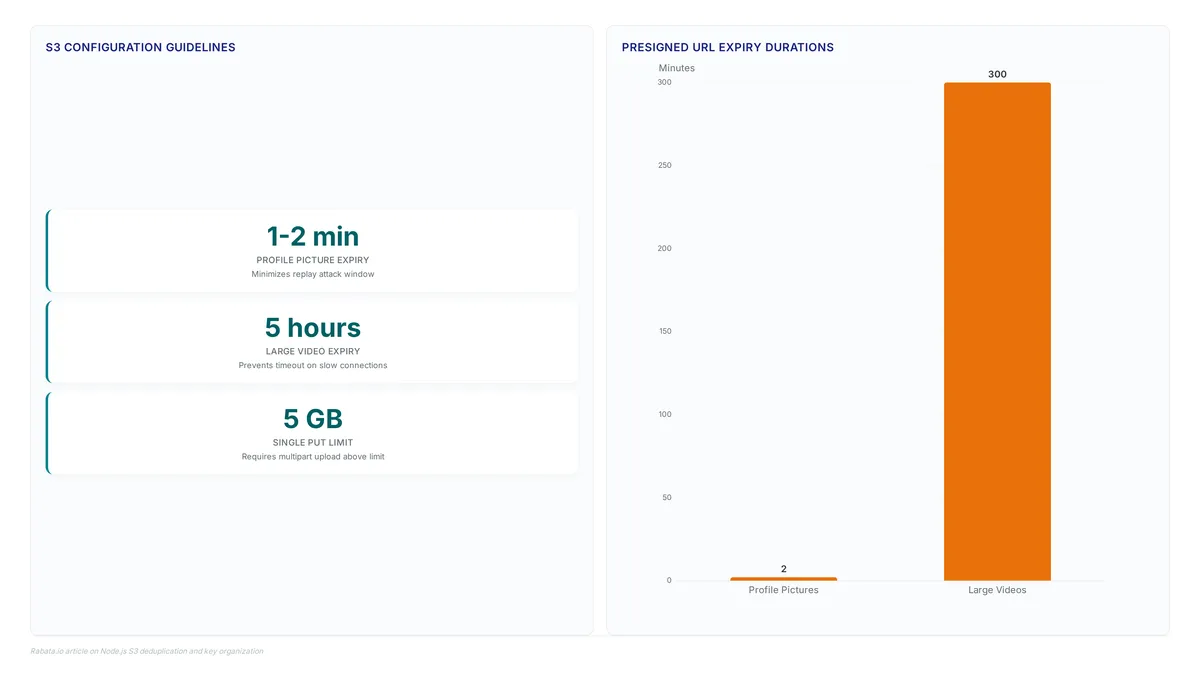
Set presigned URL expiry to 1, 2 minutes for small profile pictures to minimize the window for replay attacks. Large video uploads on slow connections require several hours (e.g. 5 hours) to complete without timing out mid-transfer. Extended validity increases exposure risk unless operators apply strict Content-Length and Content-Type conditions.
- Calculate the client-side SHA-256 hash and convert it to Base64 for the checksum parameter.
- Generate the URL with an expiry matching the file size and expected network latency.
- Enforce server-side validation by binding the hash to the signed request using `ChecksumSHA256`.
- Verify the upload completion via `HeadObject` before marking the database record as confirmed.
| Use Case | Recommended Expiry | Security Compensation |
|---|---|---|
| Profile Pictures | 1, 2 minutes | Immediate action window |
| Large Videos | Several hours (e.g. 5 hours) | Strict content conditions |
| Internal Access | Minutes | Network isolation |
S3 enforces a 5 GB limit for single-PUT operations, necessitating multipart upload flows for larger assets. Longer expiries improve user experience on unstable networks but require rigorous backend tracking of `expires_at` columns to clean up abandoned pending uploads. Rabata.io recommends treating long-lived URLs as temporary credentials that demand immediate verification upon completion. Failing to bind the hash within the signature allows clients to upload mismatched content, effectively poisoning the deduplication index.
Implementation: Seven-Step Production Upload Flow with ChecksumSHA256 Validation
The client computes file size and hash locally before calling `POST /api/uploads/request-url` to initiate the secure transfer sequence. This initial validation step prevents the backend from processing malformed requests or unauthorized payloads before any data transmission occurs.
- Client calculates the SHA-256 digest and converts the hex output to Base64 for the checksum parameter.
- Backend validates authentication credentials and checks existing records against the provided hash to detect duplicates.
- Server generates a PRESIGNED URL binding the `ChecksumSHA256` condition to the specific object key.
- Client performs a direct PUT upload to Amazon S3 using the signed request.
- S3 automatically rejects the upload if the transmitted bytes do not match the signed hash value.
- Backend executes a `HeadObject` command with `ChecksumMode` enabled to verify integrity post-upload.
- Database record transitions from pending to confirmed only after successful checksum verification.
Relying solely on client-supplied hashes without server-side verification creates a vulnerability for content poisoning attacks. The ChecksumSHA256 constraint ensures S3 itself enforces data integrity, making the storage layer the ultimate source of truth. This architecture eliminates the risk of storing corrupted or malicious data under a valid deduplication key.rabata.io recommends this strict validation flow for AI training datasets where data purity directly impacts model performance.
Securing the Storage Perimeter Against Public Exposure and Malicious Traffic
Defining the S3 Block All Public Access Setting and IAM Role Boundaries
Disabling the Block all public access toggle invites immediate internet scanning and accidental data leakage across the entire bucket. This setting functions as a hard perimeter fence that overrides any bucket policy attempting to grant public read or write permissions. A single misconfigured policy statement can publish sensitive assets to the open web without this specific guardrail in place. Keeping the 'Block all public access' setting enabled on buckets prevents accidental public exposure effectively.
Identity management depends on attaching permissions via an IAM Role instead of embedding static access keys in environment variables. Static credentials stored in code repositories or configuration files create permanent vulnerabilities if leaked, while roles provide temporary, auditable tokens that rotate automatically. The text emphasizes attaching permissions via an IAM Role rather than using access keys in environment variables. This approach eliminates the risk of long-term credential exposure inherent in traditional key management systems.
Legacy applications sometimes require direct file system access, which object storage does not natively provide without specific gateway configurations. Operators must refactor these workflows to use API-based uploads to prevent indefinite storage bloat from duplicate files. Enforcing strict role boundaries ensures applications only access necessary prefixes within the storage architecture.
| Feature | Public Bucket Policy | IAM Role Access |
|---|---|---|
| Exposure | Global Internet | Private VPC/Account |
| Credential Type | None (Open) | Temporary Token |
| Dedup Risk | High (No Auth) | Controlled (Hashed) |
Implementing these boundaries ensures that content-based deduplication logic remains secure from external tampering attempts.
Applying Four-Layer File Size Enforcement from Client to Load Balancer
Enforcing file size limits requires a defense-in-depth strategy spanning client, backend, storage, and network layers. Client-side checks provide immediate user feedback but offer zero security guarantees against tampering by determined actors. The application backend must validate the `Content-Length` header before authorizing any transaction, returning HTTP status 413 if the payload exceeds 5 MB. This boundary prevents oversized objects from consuming application memory during processing phases.
Direct-to-S3 architectures introduce a specific blind spot where the backend never sees the file bytes directly. To close this gap, presigned URLs must include strict size conditions that Amazon S3 enforces at the storage layer. Without this constraint, a malicious actor could bypass backend logic and upload gigabytes of junk data directly to the bucket. The outermost boundary relies on the Load Balancer to drop connections exceeding a hard byte threshold, acting as a blunt instrument against volumetric attacks.
| Layer | Function | Security Value |
|---|---|---|
| Client | UX Feedback | None |
| Backend | Auth & Logic | High |
| S3 Presign | Upload Gate | Critical |
| Load Balancer | Traffic Shaping | Medium |
Operators often overlook the cost of failed large uploads traversing the entire chain before rejection occurs. Each layer adds latency, yet skipping the S3 condition leaves the storage bucket exposed to billing shocks. Binding the SHA-256 hash within the signed request via `ChecksumSHA256` ensures the uploaded content matches the deduplicated fingerprint exactly, as S3 itself rejects any upload that doesn't match. This approach prevents hash poisoning while maintaining strict size controls across the entire data path.
Checklist for Validating the Complete Security Chain from WAF to HeadObject
Validate the complete security chain by tracing a single request from the Internet edge to backend confirmation. This end-to-end verification ensures no layer incorrectly trusts upstream filtering or assumes downstream enforcement. The complete security chain is described as: Internet → AWS WAF (blocks malicious traffic), Load Balancer (max request size, timeouts), Application rate limit.
| Layer | Validation Target | Failure Mode |
|---|---|---|
| AWS WAF | Blocks known malicious signatures | Missed zero-day patterns |
| Load Balancer | Enforces connection timeouts | Stale session accumulation |
| Application rate limit | Caps request frequency per user | Credential stuffing attacks |
| Backend | Verifies SHA-256 hash match | Hash collision spoofing |
| S3 | Confirms object existence via `HeadObject` | Orphaned metadata entries |
Operators often overlook that AWS WAF blocks traffic but cannot validate file content integrity alone. A request passing the perimeter still requires strict Application rate limit configuration to prevent resource exhaustion during burst events. The backend must verify the `ChecksumSHA256` header matches the uploaded bytes before generating presigned URLs, binding the hash to the specific transaction.
- Abandoned multipart uploads accumulate storage costs without lifecycle policies.
- Direct client uploads bypass backend content inspection entirely.
- Missing `HeadObject` confirmation leaves database records pointing to non-existent keys.
- Unverified checksums allow hash collision attacks to succeed silently.
- Stale lifecycle rules retain temporary data far beyond its useful window.
Enabling automated cleanup rules helps manage these orphaned fragments efficiently. Using multipart upload with pre-signed URLs improves reliability but introduces complexity in tracking partial state. The final `HeadObject` call serves as the single source of truth, confirming the object physically exists in the bucket before updating application state. This step prevents logical corruption where the database references data that S3 never persisted.
About
Marcus Chen is a Cloud Solutions Architect and Developer Advocate at Rabata.io, where he specializes in S3-compatible storage architectures and AI/ML data infrastructure. His daily work involves rigorous performance benchmarking and implementing secure S3 API patterns, making him uniquely qualified to dissect the critical security nuances of S3 objects and deduplication. In this article, Marcus uses his hands-on production experience to explain how improper hash verification can lead to data poisoning, a vulnerability he actively mitigates while designing storage solutions for enterprise clients. At Rabata.io, a provider dedicated to high-performance, S3-compatible object storage, Marcus applies these exact principles to ensure data integrity across EU and US regions. By connecting theoretical risks like mismatched SHA-256 hashes to practical fixes using ChecksumSHA256, he bridges the gap between abstract cloud concepts and the reliable, vendor-lock-in-free infrastructure that Rabata.io delivers to Gen-AI startups and data engineers globally.
Conclusion
Scaling direct uploads reveals a critical breaking point where orphaned multipart fragments silently accumulate costs while database records diverge from physical reality. The operational burden shifts from simple storage management to actively reconciling state mismatches caused by interrupted bursts or unverified checksums. Relying solely on perimeter defenses like WAF leaves the backend vulnerable to logical corruption when large assets fail mid-transfer. You must treat the final HeadObject confirmation as a mandatory gatekeeper, not an optional diagnostic step, to ensure database integrity matches bucket contents.
Implement a strict reconciliation policy where application state updates only after successful hash verification and existence checks. This approach prevents the silent drift between metadata and actual storage objects that plagues high-volume systems. Do not assume that a successful HTTP response guarantees data persistence; the network layer can lie about completion status even if the storage layer eventually fails.
Start by configuring a lifecycle rule today to abort incomplete multipart uploads older than one hour. This single action immediately halts the accumulation of unpaid storage for failed transactions. By enforcing this cleanup window, you align your cost model with actual successful deliveries rather than attempted ones. The stability of your object store depends on verifying that every referenced key physically exists before marking a transaction.
Deduplication ensures you store only one physical copy of shared assets.
Frequently Asked Questions
S3 enforces a strict 5 GB limit for single PUT operations, requiring multipart uploads for larger files. Attempting to exceed this boundary without proper segmentation causes the request to fail immediately.
Streaming data prevents RAM spikes when handling large assets like 200 MB videos or concurrent upload bursts. Loading entire files into memory risks crashing the application container during peak traffic periods.
The system returns HTTP status 413 if the payload exceeds 5 MB, preventing oversized objects from entering the pipeline. This boundary protects backend services from processing unexpectedly large data payloads.
Bind the SHA-256 hash directly into the signed request so S3 rejects any upload with mismatched content. This shift moves trust from the client to the storage layer automatically.
Storing redundant copies of identical base images inflates bills because the system treats every upload as distinct bytes. Deduplication ensures you store only one physical copy of shared assets.
References