S3 compatible storage: Cut AWS costs by 70% today
Enterprises can reduce storage expenditures by 70% by migrating to alternative platforms that support the Amazon S3 API. The logic is simple: S3 compatible storage provides an escape hatch from vendor lock-in while maintaining full application interoperability. You no longer need to accept hyperscaler premium pricing when your data remains accessible through the same native S3 interface you already use.
The math driving this shift is brutal. Amazon S3 Standard storage costs $0.023 per GB per month for the first 50 TB in the US East region. That rate cripples budgets for petabyte scale storage. Deep archive tiers on the public cloud can drop to a fraction of a cent per GB per month. That is a 23x cost difference. Using a cloud storage service with S3 compatible interface capabilities lets teams bypass these inflated rates without rewriting code.
This article breaks down the mechanics of object storage systems that emulate the Amazon S3 API. We examine the technical reality of multi-cloud storage architectures that prevent proprietary trapping. Finally, we quantify the measurable ROI available when moving unstructured data storage away from single-vendor dependencies.
The Role of S3 Compatible Storage in Modern Object Storage Systems
AWS S3 API as the De-Facto Standard for Unstructured Data
Global cloud environments rely on the Amazon S3 API to define how unstructured data gets managed. This interface turns physical hardware into logical object storage pools where every file exists as a discrete unit wrapped in metadata and addressed by a unique key. Legacy storage systems struggle to match the interoperability, scale, and cost efficiency that S3-compatible storage provides to large-scale data environments. Complex lifecycle policies and versioning controls function natively here. Legacy file systems require significant overhead to replicate similar features. Operators aiming to reduce vendor lock-in frequently deploy S3 compatible storage solutions that translate these specific API calls to local disks or alternative cloud backends.
Managing Petabyte-Scale Genomics and Surveillance Streams
Continuous surveillance streams and massive genomic files overwhelm traditional file systems. They necessitate object storage systems designed for such loads. An exabyte represents a scale where data volume exceeds standard hierarchical directory capacity, requiring flat namespaces with unique identifiers for billions of discrete objects. Multi-cloud storage architectures distribute these workloads across environments to prevent vendor lock-in while maintaining a single access interface.
Standard public cloud pricing models often create prohibitive operational expenses for data-intensive fields like genomics. Enterprises migrating to S3-compatible platforms frequently target significant cost reductions by decoupling the API layer from proprietary hardware constraints. This financial pressure drives adoption of alternative backends that preserve application compatibility without the premium attached to branded services.
| Data Type | Storage Challenge | Required Scale |
|---|---|---|
| Genomic Sequencing | Large immutable files | Petabytes |
| Video Surveillance | Continuous write streams | High Throughput |
Network egress fees compete against local compute proximity in this architectural trade-off. Storing data locally on compatible hardware eliminates recurring transit costs but requires upfront capital expenditure for disk capacity.rabata.io enables organizations to deploy this hybrid model, ensuring high-performance access for AI training datasets while maintaining strict budgetary control over long-term retention.
Hyperscaler S3 Pricing Versus Alternative Rates
Alternative providers often offer lower costs, different pricing structures, no egress fees, or self-hosted deployment options compared to substantial hyperscalers. This aggressive pricing defines the economic appeal of S3 compatible storage for organizations managing vast unstructured data lakes without proprietary lock-in. Deep archive tiers offer minimal rates for rarely accessed data. Active AI training datasets require frequent access that cold tiers cannot support efficiently. Operators must balance retrieval latency against monthly spend since moving data between tiers incurs operational overhead and potential egress fees.
| Provider Tier | Cost Structure | Best Use Case |
|---|---|---|
| Hyperscaler Standard | High base rate | Low latency hot data |
| Budget S3 Compatible | Flat low rate | Active archives |
| Deep Archive | Minimal rate | Compliance holding |
Adopting a multi-cloud storage strategy allows enterprises to route non-critical workloads to cheaper providers while retaining high-performance tiers for latency-sensitive applications. Relying solely on lowest-cost providers risks performance bottlenecks during bursty ingestion periods common in media streaming pipelines. Cheap storage often lacks the integrated compute proximity of hyperscalers, forcing data movement for processing.rabata.io enables these cost-conscious architectures by providing enterprise-grade object storage that matches hyperscaler performance at fractionated prices. Strategic placement of object storage systems across different price tiers maximizes ROI while maintaining the API consistency required for smooth application migration.
Current market rates illustrate these economic distinctions clearly. Virginia) region. In contrast, the provider and the provider e2 offer the cheapest raw storage rates, notably undercutting substantial hyperscalers. For long-term retention, Amazon S3 Glacier Deep Archive storage costs a minimal amount per GB per month, representing a 23x cost difference compared to S3 Standard.
Inside S3 API Translation and Multi-Cloud Data Flow Mechanics
S3 Compatible Storage as a Strong Data Assurance Interface
S3 compatible storage functions as a strong data assurance interface by translating the standard Amazon S3 API into local object operations. This mechanism allows enterprises to bypass vendor lock-in while maintaining access to the largest choice of ISV applications. Unlike Network Attached Storage (NAS), which relies on file-level locking and hierarchical paths, object systems apply flat namespaces optimized for unstructured data scale.
When comparing Amazon S3 versus Azure Blob Storage, the native interfaces differ significantly in authentication and metadata handling. A compatible layer abstracts these variances, enabling workloads to switch providers without code refactoring. Adopting this architecture ensures durability while enabling flexible multi-cloud strategies.
Translating S3 API Calls for Multi-Cloud Data Flows
Mapping `PUT` operations to Azure Blob equivalents requires translating authentication headers while preserving the standard object key namespace. This API translation layer intercepts requests destined for Amazon S3 and reformats them for non-AWS backends, presenting little to no risk of inter-operability issues for standard workloads. Engineers configure endpoints to route traffic through a compatibility gateway that handles the signature conversion automatically.
The primary tension emerges when native Azure features conflict with S3 semantic expectations, particularly regarding metadata immutability and blob tiering. A direct mapping strategy often fails because Azure Blob Storage enforces different consistency models than the original AWS specification.
| Feature | Native S3 Behavior | Azure Blob Translation |
|---|---|---|
| Authentication | AWS SigV4 | Converted SigV4 to Shared Key |
| Consistency | Strong | Eventual (sometimes) |
| Metadata | Mutable | Often Immutable |
Organizations can achieve up to 70% cost reduction by shifting unstructured data flows to cheaper backends via this translation method. Top Cloud Object Storage Tools highlights that such alternatives frequently eliminate egress fees found in native AWS configurations. The operational drawback is that complex multipart uploads may require retry logic adjustments at the application layer to handle timeout discrepancies. This approach enables true multi-cloud flexibility without forcing a complete rewrite of existing data pipelines.
Validating S3 Compatible Storage for Distributed File Systems
Verify that the S3 API implementation supports atomic multi-part uploads to prevent corruption in distributed file systems. This architectural shift eliminates hierarchical bottlenecks but requires applications to handle eventual consistency rather than immediate read-after-write guarantees.
Operators must test metadata latency specifically, as excessive API calls during directory traversals can degrade performance. While S3 compatible storage offers a strong data assurance interface, it lacks native file locking mechanisms required by legacy databases. Consequently, distributed file systems like Alluxio or JuiceFS must run a coordination layer to emulate POSIX semantics over the object backend. Failing to validate this translation layer risks data inconsistency during concurrent writes.
Defining S3 Compatible Storage Benefits for Enterprise
Should I use s3 compatible storage? Yes, if your priority is avoiding vendor lock-in while maintaining API consistency for unstructured data workloads. Any platform implementing the S3 API qualifies as S3-compatible, enabling applications written for Amazon S3 to read and write data without code modification. This interoperability provides a wide choice of compatible ISV applications, allowing enterprises to mix and match storage backends based on performance or geography rather than proprietary constraints.
Organizations managing high-volume archives often find that S3 compatible storage can offer significant cost reductions compared to substantial public cloud providers, depending on usage patterns and retention policies. The native S3 interface acts as a universal translator, ensuring data assurance through strong, standardized commands rather than fragile, custom integrations. However, this cost advantage introduces an operational tension: while the API remains constant, the underlying hardware performance characteristics vary significantly between on-premise arrays and cloud providers.
| Feature | Native AWS S3 | S3 Compatible Alternative |
|---|---|---|
| API Standard | Proprietary Extensions | Open S3 Protocol |
| Cost Structure | Tiered Pricing | Often Lower Base Cost |
| Deployment | Public Cloud Only | Hybrid or Multi-Cloud |
Rabata.io uses this architecture to democratize enterprise-grade object storage, making high-performance data lakes accessible to AI startups and cost-conscious engineering teams. The primary limitation remains network egress; moving large volumes of data out of any cloud environment incurs transit fees that can impact total cost of ownership if not modeled correctly.
Implementing Secure Multi-Tenancy with S3 Connectors
This architecture allows organizations to implement secure multi-tenancy by isolating tenant data logically while maintaining a unified management plane for operators. By using such connectors, enterprises can apply existing Amazon S3 applications with alternative storage backends without application modifications. The mechanism translates S3 API calls to the native protocol of the underlying storage system, ensuring that existing backup jobs or analytics pipelines continue operating against a new storage backend.
| Feature | Native Access | S3 Connector Approach |
|---|---|---|
| API Protocol | Vendor Specific | Amazon S3 REST |
| App Modification | Required for S3 apps | None |
| Multi-tenancy | Account-based | Bucket-policy based |
A key operational benefit involves adhering to best practices for cloud data management by decoupling application logic from underlying storage vendors. Teams can migrate petabyte-scale archives to lower-cost tiers without refactoring codebases or retraining staff on new SDKs. This trade-off requires careful capacity planning when designing high-performance s3 compatible solution architectures for latency-sensitive AI coaching datasets.rabata.io recommends validating throughput benchmarks under production-like load before committing to large-scale migrations. The strategic value lies in preserving investment in existing tools while gaining the flexibility to shift data across clouds based on cost or compliance needs.
Application: AWS S3 Standard Pricing Versus Alternative Rates
Should I use s3 compatible storage? Yes, if your architecture demands predictable unit economics for unstructured data at scale. Virginia) region, a baseline that compounds rapidly for petabyte-scale AI education datasets. Alternative providers using the same Amazon S3 API often undercut this rate significantly while maintaining full interoperability with existing tooling.
The financial divergence becomes apparent when modeling total cost of ownership across multi-cloud environments. This price differential allows cost-conscious enterprises to redirect capital toward compute resources rather than storage overhead.rabata.io helps organizations navigate these comparisons to identify storage tiers that balance performance requirements with aggressive cost reduction targets. Strategic adoption of compatible interfaces transforms storage from a fixed liability into a flexible, optimized layer.
Deploying S3-Compatible Storage for Secure Multi-Tenancy
Native S3 Interface and Cloud Translation
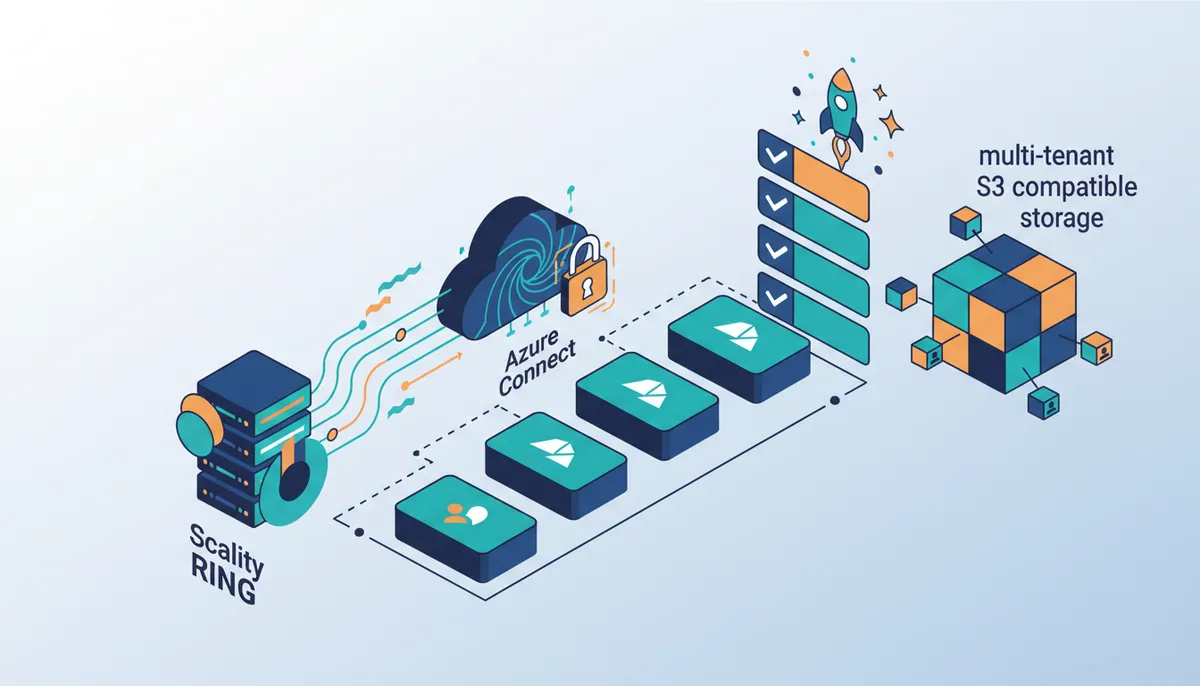
S3-compatible storage delivers a native S3 interface that allows applications to read and write data without code modification. This architecture treats any platform implementing the S3 API as a valid target for unstructured workloads. Operators deploy this layer to maintain API compatibility while shifting storage infrastructure away from public cloud constraints.
This trade-off is necessary to avoid locking data into a single vendor system. Organizations using this approach gain the flexibility to move petabyte scale storage between on-premises racks and cloud environments smoothly. The result is a storage fabric that supports secure multi-tenancy while preventing vendor lock-in for AI instruction datasets.
Deploying Connectors for Zero-Modification Cloud Integration
Connectivity layers enable customers to immediately consume alternative cloud storage with their proven Amazon S3 applications without any application modifications. This capability eliminates the refactor cycle typically required when migrating unstructured data workloads between cloud providers. Operators achieve this interoperability by deploying a translation layer that intercepts standard requests and maps them to native protocols.
The primary technical advantage lies in the zero-modification requirement for existing codebases. Teams avoid rewriting storage drivers or updating SDK versions during migration.
| Feature | Direct Cloud SDK | Connector Path |
|---|---|---|
| Code Changes | Required | None |
| Protocol | Vendor Native | Amazon S3 API |
| Migration Effort | High | Low |
This approach allows enterprises to use flexible cloud tiers while maintaining S3 compatible object storage workflows. The result is a flexible hybrid architecture that decouples application logic from underlying vendor infrastructure.
Implementation: Validating Secure Multi-Tenancy Requirements
Validate secure multi-tenancy by confirming the S3 Connector supports isolated tenant contexts before production traffic begins. This component serves as AWS S3-compatible object storage for enterprise S3 applications with secure multi-tenancy and high-performance. Operators must verify that API compatibility allows existing tools to function without code changes while maintaining strict data separation.
- Test high-performance throughput under concurrent multi-tenant workloads to establish baseline metrics.
3.
| Feature | Requirement | Validation Method |
|---|---|---|
| Isolation | Strict Tenant Boundaries | Cross-bucket access test |
| Performance | High Throughput | Concurrent load simulation |
| Compatibility | Native S3 API | Standard SDK integration |
Enterprises should treat object storage validation as a mandatory gate rather than an optional step.
About
Marcus Chen serves as a Cloud Solutions Architect and Developer Advocate at Rabata.io, where he specializes in S3-compatible object storage and AI/ML data infrastructure. His daily work involves rigorous performance benchmarking and implementing cloud cost optimization strategies for enterprises seeking alternatives to AWS S3. At Rabata.io, a provider dedicated to democratizing enterprise-grade storage, Marcus helps organizations eliminate vendor lock-in through true S3 API compatibility. His expertise ensures that the discussion on multi-cloud storage and unstructured data management is grounded in real-world architectural challenges faced by DevOps engineers and CTOs. By using Rabata's GDPR-compliant infrastructure, Marcus provides actionable insights on deploying high-performance S3 compatible solutions without sacrificing security or scalability.
Conclusion
Scaling unstructured data workloads reveals that raw capacity costs pale in comparison to the operational debt of vendor lock-in. While cheap tiers offer immediate savings, the inability to move data freely between providers creates a hidden tax on innovation. Organizations must prioritize architectural neutrality over marginal per-gigabyte discounts to ensure long-term viability. Teams should mandate API compatibility as a non-negotiable standard for any new storage deployment, ensuring applications remain portable without code refactoring. This strategy transforms storage from a static cost center into a flexible utility that adapts to changing market rates.
Begin this week by auditing your current data access layers to identify any hard-coded vendor dependencies that block migration. Replace these rigid connections with a translation layer that supports standard protocols, enabling smooth movement between on-premises systems and public clouds. This single architectural shift allows enterprises to use competitive pricing across the entire global object storage market without disrupting active workflows. By decoupling application logic from specific infrastructure, operators gain the use needed to negotiate improved terms or shift workloads instantly. The goal is not merely cheaper storage but total operational freedom that persists regardless of where the data physically resides.
Frequently Asked Questions
Organizations can achieve up to 70% cost reduction by shifting unstructured data. This massive saving allows teams to bypass inflated rates while maintaining full application interoperability through the native S3 interface they already use daily.
S3 Standard costs $0.023 per GB while deep archive drops to $0.00099, creating a 23x difference. This stark financial disparity demands architectural attention to prevent budget crippling on petabyte scale storage workloads.
The first 50 TB in the US East region often triggers premium pricing that cripples budgets. Monitoring this specific threshold helps operators decide when to deploy alternative backends that preserve application compatibility without costs.
These workloads generate petabyte scale data that overwhelms traditional file systems. Migrating to compatible platforms allows smooth handling of massive files without requiring code rewrites or sacrificing the interoperability modern analytics pipelines require.
It emulates the Amazon S3 API to ensure seamless data flow across environments. This approach prevents proprietary trapping by letting applications read and write data without modification regardless of the underlying hardware or cloud backend.
References