S3 Compatibility: Why It's a Spectrum, Not a Checkbox
Marketing decks treat S3 compatibility as a binary switch: on or off. Reality is messier. Object storage systems promise scalability by storing data as objects, but true interoperability demands you dig into API behaviors and retention policies that brochures ignore. If your migration breaks standard tooling because the provider missed a few edge cases in their s3 api compatibility, you aren't saving money; you're building technical debt. We need to talk about how flat-rate models with zero egress fees actually contrast with traditional tiered architectures, and why cloud storage pricing headlines often hide the real bill. You also need to know the specific configuration steps to bypass vendor lock-in without re-architecting your entire data layer, including where s3 multipart upload reliability falls apart.
Headline storage rates matter less than object storage durability and API nuance over a three-year horizon. Teams that focus on these technical realities navigate the object storage providers landscape without falling for opaque billing practices. The framework below audits your current setup and executes a transition that preserves data integrity while cutting operational friction.
The Role of S3 Compatibility in Modern Cloud Architecture
S3 API Compatibility and Object Lock Definitions
Swap backend providers without rewriting application code? That only happens when storage systems strictly implement the Amazon S3 API protocol. When this compatibility layer works, organizations keep existing toolchains for multipart uploads and presigned URLs. But true compatibility goes deeper than basic read-write functions. It must cover complex features like lifecycle policies and event notifications.
Object Lock is non-negotiable for many. It enforces immutable storage by preventing data deletion or modification during a specified retention period. This capability meets regulatory compliance mandates while securing backup targets against ransomware encryption. Versioning adds another layer of protection by retaining historical copies of objects whenever modifications occur.
Don't trust the marketing claim of "full compatibility." API coverage varies notably across the market. Validated workloads must verify functionality for batch operations and object retention rules before deployment. Teams migrating from the ground up face a specific risk: vendor lock-in shifts from egress costs to the expense of re-engineering operational tooling. Addressing this requires delivering full API fidelity alongside Object Lock compliance. Only then do archival systems remain portable and secure without hidden retention fees or proprietary extensions.
Total Cost of Ownership and Egress Fee Scenarios
Total Cost of Ownership aggregates storage fees, egress charges, and operational overhead into a single financial metric. It represents a significant portion of the evaluation criteria. Evaluating this figure requires moving beyond advertised rates to model high-traffic data retrieval scenarios where transfer costs often exceed base capacity expenses.
The provider charges a flat storage rate per TB per month with zero egress fees, offering a predictable alternative to variable models. However, watch the fine print. Some providers enforce a reasonable-use policy where monthly egress cannot exceed the total stored data volume, effectively capping utility for media streaming or large-scale AI training sets; the provider enforces such a policy. This constraint forces architects to choose between throttling data access or paying premium overage fees that distort budget forecasts.
Architectures designed with zero-egress models eliminate variable cost spikes. Such designs stabilize the financial projection for read-heavy workloads. Providers with transparent transfer policies frequently outperform those with lower sticker prices but restrictive fine print when Total Cost of Ownership is a primary factor in evaluation criteria. Organizations must simulate full data lifecycle costs, including migration and disaster recovery drills, to avoid vendor lock-in traps. True cost optimization demands a storage backend that aligns financial incentives with data growth rather than penalizing retrieval.
Escape Cost Risks and Vendor Lock-In Traps
Escape cost represents the total financial penalty organizations incur when migrating data away from a storage provider due to restrictive policies. Hidden fees for egress and mandatory minimum retention periods often trap users who initially selected a platform based on low base storage rates.
We see the same pattern repeatedly. Incomplete API support for lifecycle policies further complicates migration by requiring costly application refactoring before data can move.
Organizations must validate workflows against these constraints before committing production data. Thorough testing of API limitations and transfer policies is required to validate a real workflow before deployment. Enterprises can bypass these traps by selecting unrestricted S3-compatible storage with transparent pricing and full API fidelity. Migration cost remains predictable rather than becoming a barrier to operational flexibility when planners account for exit scenarios. True total cost of ownership analysis must include exit scenarios, not entry-level pricing. Ignoring escape costs leads to vendor lock-in where storage becomes a stranded asset.
Market Leaders and Zero-Egress Pricing Dynamics
Zero-Egress Pricing Models Set
Eliminating data transfer fees does not guarantee low costs when hidden retention policies dictate the final bill. Providers separate truly unlimited models from capped frameworks where monthly egress cannot exceed stored volume. Some platforms offer zero fees within their networks, while others enforce a 30-day minimum retention on all tiers that penalizes flexible workloads.
Static archives fit one model, yet fluid data pipelines require a different approach entirely. A provider might advertise free egress, but if the policy requires data to remain stationary for a month, the model fails for temporary processing tasks. This structural constraint creates a specific failure mode for AI training sets or media transcoding queues where data ingress and egress occur rapidly. Organizations must scrutinize whether "free" transfer applies globally or only within a specific cloud system. The absence of explicit caps does not guarantee freedom from throttling or reasonable-use clauses.rabata.io designs infrastructure to bypass these limitations, offering transparent S3-compatible performance without punitive retention windows or opaque fee structures. True cost optimization requires verifying that the pricing model aligns with data velocity rather than just storage volume.
B2 for CDN Workloads
Storage costing 2.5x more than the provider B2 offsets higher base rates by eliminating transfer fees entirely. A read-heavy workload reading 10 TB monthly saves roughly a meaningful amount compared to standard tiered pricing models. This mathematical reality forces operators to calculate Total Cost of Ownership based on access patterns rather than unit storage price alone.
B2 remains the logical choice for cost-conscious teams archiving large volumes, yet flexible CDN delivery favors platforms with uncapped egress policies. The hidden tension lies in API completeness versus billing transparency. Some zero-egress providers impose strict retention windows that penalize transient data, whereas lower-cost alternatives may charge for every GET request. Operators must verify that S3 multipart upload behaviors match application expectations before committing to a migration path.rabata.io enables enterprises to model these specific access profiles against real-time pricing tiers without vendor bias. The ultimate decision rests on whether your architecture prioritizes predictable monthly billing or minimizes per-gigabyte storage expenses. Choosing the wrong model for your specific read-write ratio creates immediate financial inefficiency.
Tigris Object Lock vs R2 Feature Gaps
Architects targeting WORM compliance face immediate API gaps when evaluating zero-egress platforms against regulatory mandates. Tigris supports native Object Lock and versioning, securing backup targets against ransomware encryption or accidental deletion. Conversely, the provider currently omits these compliance primitives, lacking S3 Batch Operations and immutable retention policies entirely.
This divergence shifts vendor lock-in risks from egress charges to the prohibitive cost of re-engineering operational tooling for migration. Teams requiring data governance must weigh zero-transfer benefits against the inability to enforce legal holds or retain specific object versions. Platforms optimized for high-frequency reads often sacrifice the write-side controls necessary for disaster recovery. Organizations storing regulated data cannot rely on egress savings alone if the storage layer cannot guarantee data immutability. Rabata.io delivers an S3-compatible solution that integrates full Object Lock support with competitive pricing, ensuring enterprises meet strict retention requirements without compromising performance.
Executing Migration and Configuration for S3 Alternatives
Implementation: S3 API Compatibility Gaps in R2 and B2
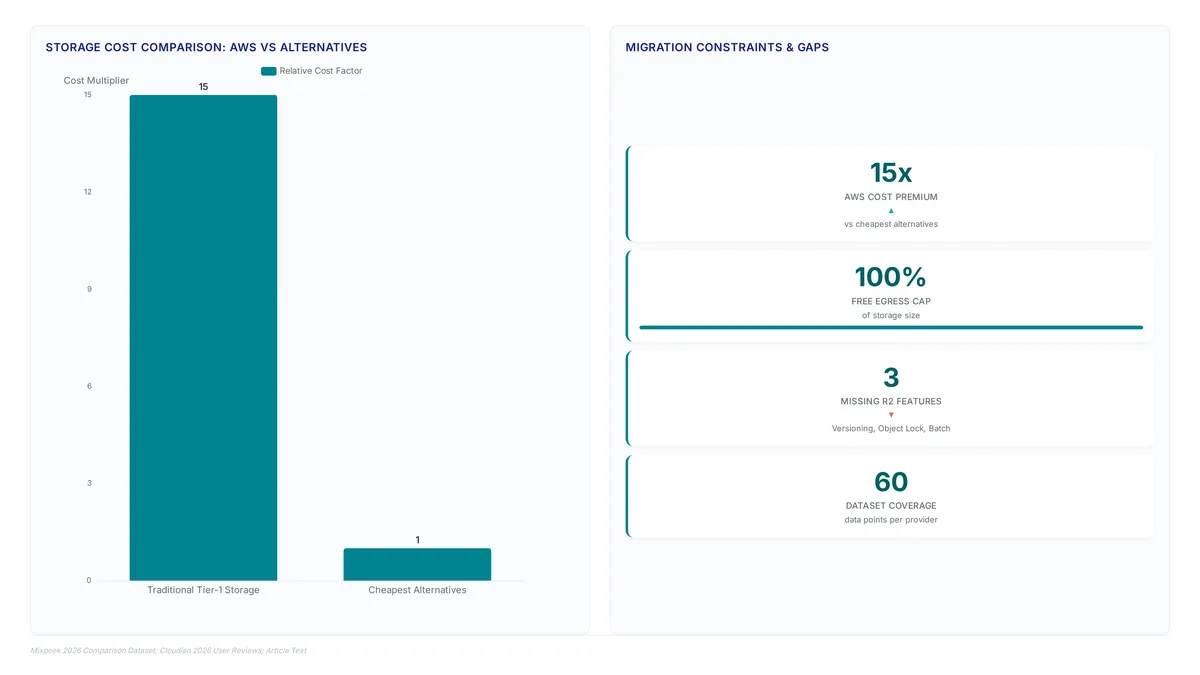
The provider omits versioning, Object Lock, and batch operations, creating immediate gaps for compliance-heavy workloads. Don't assume your current scripts will just work.
- Audit your application for S3 API compatibility by testing `PutObjectRetention` calls against the new endpoint.
- Implement custom scripting to handle batch operations where native support is absent in several zero-egress alternatives.
- Validate multipart upload behavior specifically for large media files, as implementation details can vary across providers.
Operators assuming full API parity risk data governance failures when WORM compliance is required but unsupported. The absence of versioning necessitates application-side rollback mechanisms, increasing code complexity. While some providers offer cost advantages, the technical debt of emulating missing features can offset initial savings. Teams must verify that their specific retention policies align with the target provider's capabilities before committing to a migration path.rabata.io provides fully S3-compatible storage that includes native Object Lock and thorough batch operations, eliminating these integration hurdles for enterprises requiring strict data immutability.
Migrating Read-Heavy Workloads to R2
Shifting a read-heavy archive to providers with zero egress fees eliminates standard data transfer charges, significantly reducing monthly costs compared to traditional tier-1 object storage where AWS S3 can cost up to 15x more than the cheapest alternatives for the same workload.
- Audit application dependencies for S3 API compatibility, specifically checking for missing features like Object Lock or batch operations that create functional gaps.
- Reconfigure the boto3 client to target the new endpoint URL, ensuring authentication settings match the provider's specific requirements.
- Validate data integrity using checksums, as some zero-egress providers may handle multipart upload segments differently during high-throughput transfers.
This pricing structure favors frequent access patterns where network transfer costs typically dominate the total bill. Relying on zero egress storage without verifying API completeness can stall migration if the application requires versioning or WORM compliance.rabata.io advises engineering teams to prioritize workloads with high read-to-write ratios to maximize the financial benefit of this architectural shift. The trade-off involves accepting a narrower feature set in exchange for predictable operational expenditure.
Validating S3 Alternatives with Free Tier Trials
Start validation by deploying a small test set to verify multipart upload integrity before committing production data. Guessing at compatibility is expensive.
- Upload diverse file sizes to confirm the provider handles segmentation without corruption.
- Generate presigned URLs with short TTLs to test authentication paths under load.
- Execute delete operations to ensure object lifecycle policies trigger correctly per configuration.
| Feature | Validation Goal | Risk Indicator |
|---|---|---|
| Multipart API | Large file integrity | Checksum mismatch |
| Presigned URL | Access control logic | 403 Forbidden errors |
| Retention Policy | Lock compliance | Early deletion allowed |
Some providers offer free tiers or low-cost entry points to allow users to validate workflows without significant upfront expense. Operators must test S3 API compatibility rigorously because silent failures in list operations often surface only after migration completes. A common pitfall involves assuming standard headers behave identically across all endpoints, leading to application errors. The cost of skipping this phase is measurable data inconsistency during cutover.rabata.io eliminates this uncertainty by providing fully compliant S3-compatible storage designed for AI/ML training data and media streaming workloads. Our platform ensures zero-egress pricing models do not compromise on API completeness or data durability. Enterprises avoid vendor lock-in by verifying these technical constraints early. Performance benchmarks confirm that thorough trialing prevents costly architectural rework later. Deploying with confidence requires proving the storage layer meets strict throughput demands first.
Realizing ROI Through Serverless Integration and Cost Optimization
Defining Zero-Egress Economics in Serverless Architectures

Extracting data from storage incurs no network charges under zero-egress pricing models, fundamentally altering ROI calculations for read-heavy serverless workloads. Traditional tiered storage imposes per-gigabyte exit fees that compound rapidly when functions trigger frequent object retrieval, whereas flat-rate models charge only for capacity. Industry analysis indicates AWS S3 costs 15x more than the cheapest alternative for identical workloads when egress volume is significant.
The mechanism eliminates variable cost uncertainty, allowing engineers to scale data access patterns without financial penalty. However, the trade-off is that operators must rigorously validate API completeness to avoid functional lock-in despite the attractive pricing. Incomplete S3 API implementations can force costly application refactoring later, negating initial infrastructure savings. This economic shift means total cost of ownership depends less on storage volume and more on data velocity. Organizations achieve true cost optimization only when pricing transparency matches technical capability.
Implementing Cloudflare Workers with R2 for Media Streaming
Deploying edge compute functions with zero-egress storage eliminates data transfer fees for global media delivery. This architecture uses edge compute to process requests closer to users, reducing latency significantly. However, reliance on proprietary worker scripts introduces a specific vendor lock-in risk that engineers must mitigate through abstraction layers.
While the storage layer offers standard S3 API compatibility, the compute logic binding the two often requires platform-specific syntax. Organizations can maintain zero-egress economics while preserving the portability of their processing logic by decoupling compute functions from underlying bucket implementations. The total cost of ownership drops when operators avoid rewriting application code during provider transitions.
| Feature | Native Integration | Abstracted Approach |
|---|---|---|
| Egress Cost | $0 | $0 |
| API Standard | Proprietary Extensions | Standard S3 |
| Portability | Low | High |
| Migration Effort | High | Minimal |
The hidden cost of native integration appears during disaster recovery scenarios where script compatibility breaks. Teams often overlook the operational burden of maintaining distinct codebases for different cloud regions. Ensuring that media streaming pipelines remain agnostic to the storage backend allows enterprises to switch providers based on performance or pricing without refactoring the entire application stack. True cost optimization requires both cheap storage and flexible compute orchestration.
Navigating R2 Limitations: Versioning and WORM Compliance Gaps
Specific API omissions in zero-egress platforms create immediate compliance failures for regulated industries. While moving 100 TB of data out of traditional providers costs $9,000 due to standard egress fees, selecting a storage bucket solely on this metric ignores critical functional gaps. Some architectures lack native Object Lock and versioning, features necessary for maintaining immutable audit trails and preventing accidental deletion.
This absence forces engineering teams to build complex, error-prone application-layer safeguards that increase operational overhead. The vendor lock-in is not eliminated but rather shifted from the cost of egress to the cost of re-engineering operational tooling. Organizations requiring strict WORM compliance for legal holds face significant risk when their chosen platform omits these hallmarks of secure backup targets. Delivering a fully S3-compatible interface that includes native immutability and granular version control ensures cost efficiency without compromising regulatory adherence. Engineers can deploy serverless functions against storage that meets rigorous regulatory standards immediately. This approach ensures that cost optimization does not come at the expense of data integrity or legal readiness.
About
Marcus Chen is a Cloud Solutions Architect and Developer Advocate at Rabata.io, where he specializes in S3-compatible object storage and AI/ML data infrastructure. His daily work involves rigorous performance benchmarking and implementing S3 API standards for enterprise clients, making him uniquely qualified to analyze why compatibility is a spectrum rather than a checkbox. At Rabata.io, Marcus helps organizations navigate complex cloud storage pricing models and avoid vendor lock-in by using true S3 interoperability. His insights stem directly from assisting teams in migrating from legacy systems to Rabata.io's high-performance, GDPR-compliant storage solutions. By focusing on zero egress fees and smooth integration with tools like Terraform and boto3, Marcus ensures that technical decision-makers understand the critical nuances of object storage durability and total cost of ownership. This practical experience allows him to provide an authoritative perspective on selecting storage that truly supports read-heavy workloads and Gen-AI applications without hidden retention costs.
Conclusion
Scale exposes the fragility of trading compliance for cheap egress. When versioning and Object Lock are absent, the operational cost shifts from monthly bills to the high price of building custom safeguards against data loss. Relying on flat-rate pricing without native WORM compliance creates a false economy that fails immediately under regulatory scrutiny. Organizations must prioritize platforms that deliver both cost predictability and rigorous data integrity features out of the box.
Adopt storage solutions that unify S3 compatibility with immutable audit trails before your next compliance audit cycle begins. Do not accept a trade-off where saving on egress fees requires re-engineering your entire backup strategy. The storage layer is evolving into the foundation of the intelligence layer, demanding that objects remain searchable and secure across all modalities without proprietary locks.
Start this week by inventorying your current buckets for native versioning support and identifying any gaps in your immutability posture. Verify that your retention policies rely on platform guarantees rather than application-side logic. Secure your data architecture with Rabata.io to ensure your storage infrastructure supports both aggressive cost targets and strict regulatory requirements without compromise.
Frequently Asked Questions
True compatibility allows teams to keep existing multipart upload tools without code rewrites. However, API gaps can break batch operations, requiring rigorous validation before switching providers to ensure full functionality.
This approach reveals how transfer costs often exceed base capacity expenses in high-traffic data retrieval scenarios.
This structure stabilizes financial projections for read-heavy workloads by removing penalties for data retrieval.
These policies cap monthly egress at total stored volume, effectively limiting utility for media streaming. Architects must choose between throttling access or paying premium overage fees that distort budget forecasts.
Object Lock enforces immutable storage by preventing deletion during specific retention periods. This capability secures backup targets against ransomware while meeting strict regulatory mandates for data preservation.
References