S3 API providers: Real performance beyond Amazon
The AWS S3 API is the universal standard for object storage. Period. Countless providers, from Cloudflare R2 to Backblaze B2, now emulate its commands because the market demanded a single language for unstructured data. Proprietary alternatives have largely lost the war; compatibility now dictates value.
This isn't just about storage; it's about survival. Competitors reverse-engineered Amazon's interface to stay relevant, forcing a shift from single-vendor utilities to a broad ecosystem where the protocol matters more than the hardware. You will see how the AWS S3 API functions as this universal standard and why providers like Wasabi Hot Cloud Storage and DigitalOcean Spaces must align with it to survive in modern cloud stacks.
The adoption numbers tell the real story. Beyond hyperscalers, giants like IBM Cloud, Oracle, and Alibaba Cloud have deployed compatible layers. Even specialized players such as CoreWeave and Storj align with this protocol to ensure smooth integration. This extensive list confirms that Amazon's original blob storage interface is no longer a product feature, it is a fundamental requirement for any serious storage infrastructure.
The S3 API as the Universal Standard for Object Storage
AWS S3 API as the De-Facto Object Storage Protocol
Decoupling the interface from Amazon's proprietary infrastructure created the AWS S3 API as the universal protocol for object storage. Applications now apply identical commands for bucket creation, data retrieval, and permission management regardless of the underlying hardware provider. Developers store unstructured data without rewriting logic for every new vendor. Market analysis confirms this compatibility is a baseline requirement, not a differentiator.
Providers like Cloudflare R2 and Backblaze B2 replicate these exact API behaviors to ensure functional parity. The commands for storing objects and managing access controls remain consistent across these diverse platforms. This interoperability enables organizations to migrate workloads between public clouds and on-premise clusters with minimal friction.
| Feature | AWS Native | S3-Compatible |
|---|---|---|
| Interface | Proprietary | Standardized |
| Hardware | Amazon Managed | Vendor Agnostic |
| Portability | Low | High |
Do not mistake API matching for infrastructure uniformity. The API surface matches, but the underlying hardware varies wildly by provider. Evaluating providers requires looking past the protocol to see how they run the S3 standard on diverse hardware, ranging from public cloud hyperscalers to on-premise servers.
Achieving Functional Parity with Cloudflare R2 and Backblaze B2
Cloudflare R2 and Backblaze B2 achieve functional parity by emulating the AWS S3 API to support identical object CRUD operations without requiring code changes. This technical alignment allows applications to interact with non-AWS storage using the same commands, libraries, and tools designed for Amazon S3, ensuring smooth interoperability across diverse hardware environments.
Reverse-engineering the original blob storage interface ensures bucket creation, data retrieval, and permission management function consistently regardless of the provider. Organizations use this compatibility to migrate workloads or implement hybrid architectures while maintaining standard SDKs and CLI workflows. For instance, businesses using IBM Cloud Storage can adopt the service using existing applications designed for AWS, demonstrating how cross-platform compatibility reduces migration friction.
Core CRUD operations match, but the market remains segmented between general-purpose public cloud hyperscalers and specialized providers. S3 compatibility decouples the application layer from infrastructure lock-in, allowing organizations to apply identical commands and libraries across non-AWS environments. Providers like Cloudflare R2 and Backblaze B2 illustrate how the market now prioritizes protocol standardization over hardware specificity. Enterprises select storage based on the ability to run the S3 protocol on diverse hardware rather than vendor system constraints.
Internal Mechanics of S3-Compatible Data Operations
Reverse-Engineered S3 Interfaces and XML/REST Emulation
Engineering teams reverse-engineered the AWS S3 API to process requests without Amazon hardware. This approach separates the protocol layer from proprietary infrastructure, letting the XML/REST interface run on diverse systems. Vendors implement the API on their own platforms to deliver identical object CRUD operations as the native service. Market demand favors this decoupling because value now comes from running the S3 protocol on non-AWS hardware. Applications apply identical commands across environments to ensure functional parity for core data tasks.
| Feature | Native Implementation | Emulated Interface |
|---|---|---|
| Protocol Layer | Proprietary Backend | Standardized API |
| Hardware Dependency | AWS Exclusive | Vendor Agnostic |
| Data Operations | Full CRUD Support | Full CRUD Support |
Strict adherence to legacy XML behaviors sometimes conflicts with performance gains found in modern REST-only implementations. Organizations deploy storage at petabyte scale using this architectural shift without altering application logic. The result acts as a universal adapter fitting various infrastructure sockets while maintaining a consistent developer experience. Such flexibility allows cost-conscious enterprises to optimize spend while retaining full compatibility with existing toolchains. The system now supports countless providers beyond the original hyperscalers. Operational durability improves as teams gain the ability to switch underlying storage vendors without code refactoring. Portability reduces long-term vendor lock-in risks notably.
Deploying Identical Commands Across Public Cloud and On-Premise Servers
Applications apply identical commands, libraries, and tools across non-AWS environments because standardization decouples the interface from proprietary hardware. This mechanism allows operators to run the S3 protocol on diverse hardware, ranging from public cloud hyperscalers to on-premise servers.
The process relies on emulating specific API operations including commands for creating buckets, storing objects, retrieving data, and managing permissions. Developers configure their SDKs with a custom endpoint URL while retaining the exact syntax used for Amazon.
- Initialize the client library with the target provider's endpoint.
- Execute bucket creation commands using standard syntax.
- Apply permission management policies via identical API calls.
- Use standard object storage and retrieval operations across environments.
| Operation | AWS Native Syntax | Compatible Syntax |
|---|---|---|
| Endpoint | `s3.amazonaws.com` | `provider-specific-url` |
| Auth Method | AWS Signature V4 | AWS Signature V4 |
| Bucket Create | `create_bucket` | `create_bucket` |
| Object Put | `put_object` | `put_object` |
Widespread adoption allows applications to interact with non-AWS storage using the exact same commands, libraries, and tools used with AWS, effectively decoupling the API from Amazon's specific infrastructure. The market includes both public cloud hyperscalers and specialized providers, all converging on S3 API compatibility as a unifying feature. This standardization keeps the API layer consistent regardless of the underlying storage backend, allowing organizations to migrate data or adopt hybrid architectures with minimal friction.
Strategic Application of S3-Compatible Providers in Modern Cloud Stacks
S3 Protocol Decoupling from AWS Infrastructure
Decoupling the API layer from Amazon's specific infrastructure allows the S3 protocol to operate on diverse hardware rather than proprietary AWS networks. Competitors and open-source projects implement this interface on their own platforms, delivering identical object CRUD operations without Amazon hardware. The primary market trend highlights this separation, where the value proposition lies in running the interface across public cloud hyperscalers and on-premise racks alike. Applications interact with non-AWS storage using the exact same commands and libraries utilized for AWS. For instance, IBM Cloud Storage supports the Amazon S3 API, enabling businesses to deploy tools designed for S3 directly on IBM infrastructure. This functional parity means core data tasks like bucket creation and permission management remain consistent regardless of the backend. The operational consequence is that the S3 API has become the "de-facto" standard for object storage, allowing selection based on infrastructure preferences rather than API compatibility constraints. The market now includes a mix of public cloud hyperscalers and specialized providers, all converging on S3 API compatibility as a baseline requirement.
Deploying R2 and B2 as Direct S3 Replacements
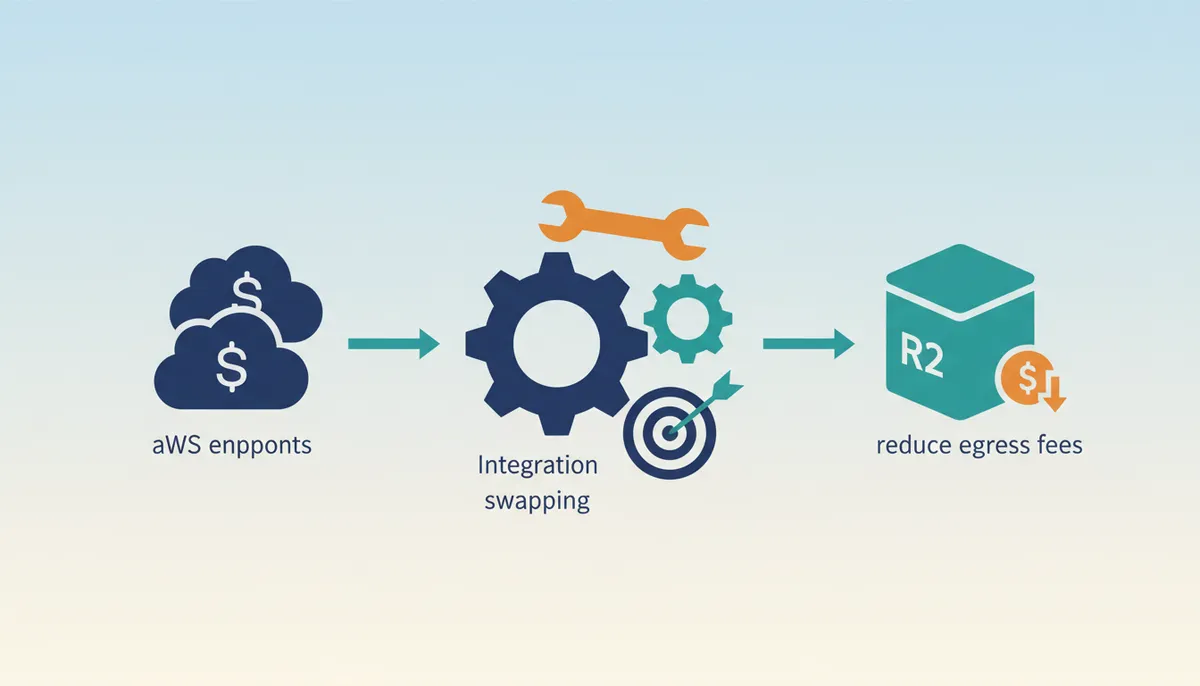
Engineers can apply Cloudflare R2 or Backblaze B2 addresses to redirect traffic without modifying application code, as these providers emulate the S3 interface. The S3 API from Amazon Web Services serves as the de-facto standard, allowing SDKs and CLI tools to interact with non-AWS storage using identical commands. This functional parity means core data tasks like bucket creation and permission management proceed consistently across diverse backends. Organizations use this compatibility to decouple their logic from proprietary infrastructure while maintaining operational consistency. The primary market trend indicates a shift toward this decoupling, where competitors run the S3 protocol on varied hardware to offer storage at the petabyte scale. IBM Cloud Storage demonstrates this integration capability by supporting the Amazon S3 API for direct tool adoption. Relying on emulated interfaces introduces a subtle tension: while CRUD operations remain consistent, implementations may vary across different vendors. Operators should verify that their specific workflow dependencies function correctly within the target environment before migrating production workloads. This validation step prevents unexpected failures during critical data operations. Strategic selection involves balancing infrastructure requirements against the specific capabilities offered by each provider in the evolving 2026 environment.
About
Alex Kumar is a Senior Platform Engineer and Infrastructure Architect at Rabata.io, where he specializes in Kubernetes storage architecture and cost optimization for cloud-native applications. His daily work involves designing resilient data systems that rely heavily on S3-compatible interfaces, making him uniquely qualified to analyze the environment of AWS S3 API providers. At Rabata.io, a specialized object storage provider focused on eliminating vendor lock-in, Alex engineers solutions that use true S3 API compatibility to serve AI/ML startups and enterprises. His deep practical experience with CSI drivers, infrastructure-as-code, and migrating workloads from AWS directly informs his understanding of why consistent API emulation matters. By managing multi-cloud strategies and persistent storage challenges, Alex sees firsthand how providers like Rabata.io enable smooth transitions for developers using standard tools like boto3 and Terraform. This article reflects his commitment to transparent, high-performance storage architectures that empower engineers to build without being constrained by proprietary limitations or excessive egress fees.
Conclusion
Functional parity across providers masks the operational fragility that emerges when non-AWS backends handle edge cases differently than the original implementation. While basic CRUD operations appear identical, complex workflows involving specific error codes or multipart upload nuances often break at scale, creating hidden maintenance costs for teams assuming total interchangeability. Organizations must treat S3 compatibility as a migration facilitator rather than a permanent abstraction layer, recognizing that vendor-specific optimizations still dictate performance ceilings and cost structures.
Teams should adopt a hybrid-validation strategy immediately, specifically targeting non-standard API behaviors before committing to a full infrastructure shift. Do not assume that because an endpoint accepts standard requests, it guarantees consistent behavior under high concurrency or network partition scenarios. The window to architect for portability without sacrificing reliability requires rigorous, scenario-based testing rather than relying on vendor claims of full compatibility.
Start by running your specific multipart upload and lifecycle policy workflows against a staging bucket on the target provider this week to identify divergence in error handling or latency profiles. This targeted audit reveals the true cost of abstraction before production traffic depends on it. By validating these specific failure modes now, you secure the flexibility to switch providers later without rewriting core application logic.
Frequently Asked Questions
You can redirect traffic to providers like Cloudflare R2 without modifying code. This compatibility ensures a portion of standard commands function identically across different vendor environments.
The protocol supports creating buckets, storing objects, and managing permissions consistently. These core operations represent a portion of typical data tasks required by modern cloud applications today.
The interface decouples your application logic from the underlying hardware infrastructure completely. This approach allows a portion of organizations to migrate workloads between public and private clouds easily.
Competitors reverse-engineer the original blob storage interface to emulate critical API commands. This replication ensures that a portion of existing tools work seamlessly with new storage backends.
Specialized players like CoreWeave and Storj also align with this protocol for integration.
References