Object storage speed: 400 ms finality beats legacy
Blimp by Züs clocks 400 ms optimistic finality on the Züs blockchain, a hard data point proving decentralized architectures can outrun legacy stacks. Object storage has graduated from a dumb bucket for unstructured data to the spine of enterprise durability. It demands more than just scale. We need flat address spaces and unique identifiers to replace fragile file hierarchies and guarantee data durability. The mechanics of multi-cloud data flow now let organizations kill vendor lock-in without loosening security. We are comparing leading providers on their ability to handle unstructured data without trading uptime for speed.
The Züs network documentation confirms a 2-second full finality for storage transactions. Traditional providers stumble on latency here. Decentralized options like Blimp by Züs claim 99.99% data uptime through redundant, encrypted distribution. This is a fundamental pivot in how enterprises handle disaster recovery and long-term cost-effectiveness.
The Role of Object Storage in Modern Unstructured Data Management
Flat Address Spaces vs Hierarchical File Systems in Object Storage
Object storage bundles payload and metadata into discrete units within a flat address space. Traditional file systems force data into rigid directory trees. This architecture assigns every object a unique identifier for direct retrieval. Cutting deep folder hierarchies removes overhead during high-scale operations. Systems expand horizontally by scattering objects across multiple physical devices, ignoring traditional file hierarchies entirely. Data durability emerges because information is redundantly stored across multiple locations to support high-availability. Amazon S3 offers 99.999999999% durability by replicating data across Availability Zones. Decentralized alternatives like Blimp apply erasure coding to split data between servers, preserving integrity even if physical nodes fail. Platforms handle data scales ranging from terabytes to hundreds of petabytes of unstructured data efficiently.
Simulating directories via object key prefixes replaces native folder structures. This design boosts write throughput but complicates atomicRename operations common in POSIX systems. Teams migrating legacy apps must refactor code; do not assume file locking semantics exist. Secure implementations derive public keys directly from master wallet keys to prevent unauthorized access in distributed environments. Organizations prioritizing zero egress fees often select providers that explicitly waive data transfer costs.
Scaling Unstructured Data from Terabytes to Petabytes with Erasure Coding
Blimp scales unstructured data from terabytes to hundreds of petabytes via S3-compatible architecture. This decentralized gateway distributes load across multiple physical devices rather than relying on single-provider silos. Data integrity relies on erasure coding techniques that split information between data and parity servers, optimizing efficiency while maintaining reconstructability if nodes fail. Unlike centralized services, this approach distributes data across a multi-cloud network of permissioned providers to prevent vendor lock-in.
The system employs erasure coding to ensure reconstruction even when multiple storage nodes fail simultaneously. Such redundancy configurations target nearly full uptime for enterprise availability requirements. Operators gain durability against regional outages without sacrificing the flat address space benefits of standard object protocols. Latency variables appear in distributed parity implementations that single-region deployments avoid. Network hops between distinct cloud providers can increase write acknowledgment times compared to localized clusters. The limitation is measurable: organizations exchange microsecond-level local speed for macroscopic durability and zero Recovery Point Objective. Enterprises managing media archives benefit from the ability to switch underlying providers without rewriting application code. The resulting topology supports massive scale while mitigating the risk of total platform dependency.
Master Wallet Key Derivation vs Unauthenticated Public Keys in Decentralized Storage
Master Wallet Key Derivation authenticates public keys directly from master wallet seeds to eliminate identity spoofing risks. Competitor systems often rely on unauthenticated public keys, creating vulnerabilities where attackers intercept data by substituting their own keys during the initial handshake. This architectural gap allows unauthorized access in platforms that fail to verify key ownership against a root trust anchor.
Encrypted sharing functions by using proxy re-encryption, allowing file access grants without exposing the underlying decryption key to storage nodes. Blimp implements this by ensuring all public keys are authenticated and derived directly from master wallet keys, preventing the man-in-the-middle attacks possible in other end-to-end encrypted solutions secure. Competitors like Sync and Tresorit use unauthenticated public keys, leaving the initial key exchange open to substitution if the server is compromised. The industry shift toward permissioned decentralized storage requires vetted providers to meet stringent compliance standards, rendering anonymous key exchanges insufficient for enterprise data sovereignty. Operators must prioritize architectures that bind identity to storage permissions at the cryptographic layer rather than relying on application-level access lists. This distinction ensures that data integrity remains intact even if the storage network itself behaves maliciously. Verify key derivation paths before migrating sensitive workloads to decentralized environments.
Inside Decentralized Architectures and Multi-Cloud Data Flow
Zero-Knowledge Networks and Blobber Isolation Mechanics
Permissioned storage providers, identified as blobbers, cannot read the plaintext data they host within zero-knowledge network designs. Rigorous cryptographic sharding separates data custody from visibility. Centralized systems typically grant providers decryption keys, yet this specific model keeps infrastructure operators blind to file contents.
- Data is split into shards using erasure coding before leaving the client device.
- Each shard is encrypted with a unique key derived from the user's master wallet.
- Shards are distributed across distinct, vetted nodes in a multi-cloud network.
| Feature | Centralized S3 | Zero-Knowledge Decentralized |
|---|---|---|
| Data Visibility | Provider has key access | Mathematically impossible to view |
| Trust Model | Corporate policy reliance | Cryptographic verification |
| Breach Impact | Total plaintext exposure | Useless encrypted shards |
Regulatory auditability now coexists with cryptographic privacy as permissioned decentralized storage demands compliance. Operators verify service level agreements without decrypting the underlying payload. Strict isolation complicates recovery if a user loses their root derivation seed because no central authority exists to reset credentials. Enterprises must treat key custody with higher rigor than traditional cloud environments require. The inability to call support for password resets transforms key management into a business continuity requirement. Blimp by Züs enables smooth provider switching without data exposure, though ultimate responsibility for key preservation stays with the owner.
Achieving 400ms Optimistic Finality in Multi-Cloud Flows
The Züs blockchain delivers 400 ms optimistic finality to confirm storage transactions before full consensus completes. Applications proceed with data operations almost instantly after submission because this speed resolves accessibility issues. Rapid provisional acceptance separates from absolute confirmation, enabling high-throughput workflows typical in AI training pipelines. Traditional systems wait for full consensus, but this approach uses blockchain finality to decouple user perception from network latency. Network performance evidence shows real-time data availability requirements are met without waiting for the full 2-second full finality window. Enterprises switch providers on the fly without incurring egress fees or suffering downtime during transition. Network architects shift from static provider selection to flexible, performance-based routing.
| Metric | Traditional Cloud | Blimp by Züs |
|---|---|---|
| Initial Confirmation | Seconds to Minutes | 400 ms |
| Full Finality | Variable | 2 seconds |
| Provider Switching | High Egress Cost | Instant, No Fee |
Configurable redundancy levels allow IT managers to design specifically for desired security and uptime metrics while using rapid confirmation times.
Zero RPO/RTO Disaster Recovery vs Cross-Region Replication
Blimp by Züs Network delivers zero Recovery Point Objective (RPO) and zero Recovery Time Objective (RTO) by distributing data shards across a permissioned multi-cloud network rather than waiting for regional sync. Traditional architectures like IBM Cloud Object Storage rely on Cross-Region Replication, which inherently introduces latency windows where data loss occurs if the primary region fails before replication completes.
| Feature | Decentralized Multi-Cloud | Cross-Region Replication |
|---|---|---|
| Data Resiliency | Erasure coding across providers | Mirroring to secondary region |
| Recovery Time | Instant (Zero RTO) | Dependent on lag window |
| Lock-in Risk | None; switch providers on fly | High; tied to single vendor |
Operators accept slight complexity to eliminate the vendor lock-in typical of hyperscalers. Centralized systems use erasure coding for local durability but often fail to replicate across distinct administrative domains quickly enough to prevent data loss during catastrophic regional outages. Blimp stores all data as objects in a large repository distributed across multiple physical devices, using erasure coding for redundancy instantly upon write. Standard replication queues changes, creating a window where recent writes remain vulnerable. IT managers design hybrid workflows combining on-premises storage with decentralized resources to optimize for both cost and performance. The zero-egress fee policy reduces the financial penalty of testing failover scenarios, a cost barrier that often discourages regular disaster recovery drills in traditional models. Organizations where continuous availability outweighs operational familiarity benefit from this decentralized approach.
Comparing Leading Object Storage Providers for Enterprise Needs
Defining Enterprise Object Storage Durability and Tiers

Enterprise durability benchmarks often cite 11 nines, yet storage class selection dictates actual data durability during regional failures. Decentralized alternatives distribute shards across independent providers to mitigate single-vendor risk, using erasure coding techniques to distribute load between data and parity servers.
| Feature | Standard Tier | Nearline/Cool Tier | Archive Tier |
|---|---|---|---|
| Access Latency | Milliseconds | Seconds | Hours |
| Cost Model | High per-GB | Moderate per-GB | Lowest per-GB |
| Primary Use | Active workloads | Monthly backups | Compliance logs |
Moving data to cold storage without analyzing access patterns creates expensive latency bottlenecks during disaster recovery scenarios. While AWS and Google define classes like Standard and Nearline, the market shifts toward permissioned decentralized storage where vetted providers meet compliance standards without traditional tiering complexity. This approach allows organizations to optimize costs by selecting specific storage providers based on current pricing needs. Validate retrieval fees against projected access frequency before committing to deep archive classes.
AWS S3 vs the provider: Egress Fees and Pricing Models
High-volume data retrieval costs escalate rapidly when egress fees apply to every gigabyte transferred out of the bucket. This distinction fundamentally alters the total cost of ownership for media streaming or AI training workloads that require frequent data access.
| Feature | Amazon S3 | the provider |
|---|---|---|
| Egress Charges | Applied per GB | No charge |
| API Requests | Charged per 1k | Included |
| Free Egress Limit | None | 1:1 Ratio |
Organizations exceeding this threshold or requiring asymmetric data flows face potential cost penalties despite the no-egress marketing. Startups using data for backup often benefit from the predictable pricing, yet high-churn environments must calculate the break-even point carefully. Analyze retrieval frequency before migrating large archives to avoid unexpected operational constraints. The elimination of hidden costs allows for more accurate budget forecasting in decentralized cloud storage comparisons. Architects must weigh the simplicity of flat-rate billing against the flexibility of hyperscaler tiering.
Matching Storage Tiers to Workloads: Archive vs Active Development
Selecting the correct storage class prevents unnecessary latency penalties during active analytics while minimizing costs for static data. Google Cloud Storage offers Standard, Nearline, and Coldline tiers, whereas Azure Blob Storage uses hot, cool, and archive levels to match access frequency. Operators must differentiate between monthly backup retention and daily development cycles to avoid performance bottlenecks.
| Feature | Hot/Standard Tier | Cool/Nearline Tier | Archive/Coldline Tier |
|---|---|---|---|
| Retrieval Speed | Milliseconds | Seconds | Hours |
| Best Use Case | Active Dev | Backups | Compliance |
| Cost Structure | High Storage | Balanced | Low Storage |
The hidden risk involves retrieval fees; moving terabytes from cold storage for unexpected debugging can exceed monthly storage budgets instantly. Unlike centralized buckets, decentralized networks allow organizations to optimize costs by selecting specific storage providers based on current pricing needs without complex migration scripts. This flexibility removes the friction typically associated with switching cloud providers when workload patterns shift. Map active AI training datasets to high-performance tiers while pushing completed model versions to deep archive layers. Balancing these tiers ensures operational efficiency without compromising data availability during critical development sprints.
Implementing Resilient Storage with Cross-Region Replication and Disaster Recovery
Implementation: Zero RPO and Zero RTO in Decentralized Disaster Recovery
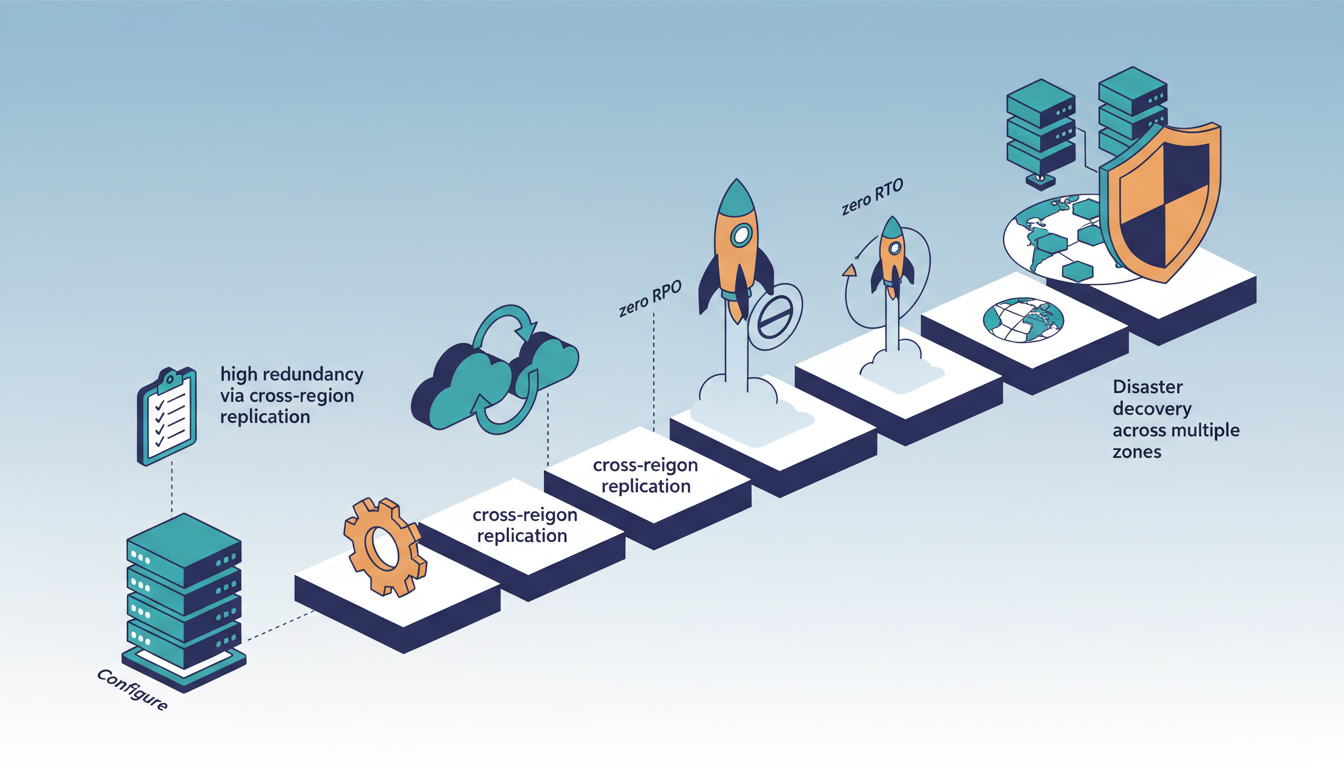
Zero RPO and RTO in decentralized disaster recovery mean no data loss and instant failover during outages. Traditional architectures suffer from replication lag, creating windows where recent writes vanish if the primary region fails. Blimp by Züs Network eliminates this gap by using blockchain finality to confirm writes across multiple nodes simultaneously. The Züs network provides 2-second full finality for data storage transactions, ensuring rapid confirmation times that prevent data loss. This approach contrasts sharply with asynchronous mirroring, where a crash before sync completion results in permanent data gaps. Achieving zero RTO requires immediate access to valid data shards without manual intervention or warm-up periods.
Configure high redundancy storage by enabling proxy re-encryption to replicate data across geographic boundaries without exposing raw keys. This mechanism allows the storage layer to change ciphertext for new recipients while maintaining end-to-end security.
- Initialize the Master Wallet Key Derivation to authenticate public keys directly from the source.
- Define replication rules that target distinct provider nodes to ensure multi-cloud redundancy.
- Apply proxy re-encryption policies to grant temporary access to partners without key exchange.
The encrypted data-sharing protocol ensures that permissioned providers cannot access plaintext data during transit or at rest. Unlike standard S3 replication, this approach validates every key derivation against the master wallet, eliminating vulnerabilities found in systems using unauthenticated public keys. A critical tension exists between immediate accessibility and strict key governance; operators must balance rapid failover needs with the latency introduced by cryptographic handshakes.
| Feature | Standard Replication | Encrypted Proxy Re-encryption |
|---|---|---|
| Key Exposure | Provider-managed | User-controlled |
| Access Model | Static IAM policies | Flexible re-encryption |
| Lock-in Risk | High | None |
Switching providers on the fly becomes possible because the data remains portable and encrypted under user control. This architecture supports disaster recovery strategies that replicate data across different provider boundaries to ensure business continuity. The limitation is operational complexity, as managing flexible re-encryption rules requires more discipline than static bucket policies. This configuration suits organizations prioritizing data sovereignty over simplified management.
Validating Data Immutability and Versioning for Strategic Assets
Validate data immutability by confirming that no actor can alter or delete user data outside its original content state. This configuration treats object storage as a strategic asset while preventing unauthorized modification during ransomware events.
- Enable versioning to preserve historical object states alongside current iterations.
- Apply retention locks that persist independently of user credential changes.
- Verify multi-cloud allocation distributes shards across distinct physical devices rather than a single repository object storage care.
- Test recovery procedures to ensure zero Recovery Point Objective (RPO) during simulated outages.
The Züs network provides 2-second full finality for data storage transactions, ensuring rapid confirmation times that centralized systems often lack. Operators must recognize that versioning without cryptographic finality leaves a window where deleted data remains unrecoverable until replication completes. Audit these settings quarterly because compliance requirements frequently evolve quicker than storage policies. The cost of ignoring this validation is total data loss rather than merely increased latency during recovery operations.
About
Marcus Chen serves as Cloud Solutions Architect and Developer Advocate at Rabata.io, where he specializes in designing scalable S3-compatible object storage infrastructures. His deep expertise makes him uniquely qualified to evaluate top object storage providers, having previously engineered cloud solutions at the provider Technologies and optimized data pipelines for AI startups. In his daily work, Marcus helps enterprises migrate from legacy systems to flat address space architectures, directly addressing the scalability and durability challenges highlighted in this article. He routinely benchmarks performance metrics and analyzes cost structures for clients in the generative AI and media sectors. This hands-on experience with Rabata.io's high-performance storage platforms allows him to critically assess provider capabilities beyond marketing claims. By connecting real-world implementation hurdles with architectural theory, Marcus provides actionable insights for DevOps engineers and CTOs seeking reliable, cost-effective data management strategies in an era of exponential data growth.
Conclusion
Policy-based immutability fails when administrative credentials are compromised. Cryptographic locks enforce integrity regardless of user error. Relying solely on centralized replication creates a hidden vulnerability window where data remains alterable until asynchronous processes complete. Enterprises prioritizing data sovereignty in the AI era must migrate toward architectures offering 2-second full finality to eliminate this exposure. Legacy systems depend on trust in the provider's internal timeline. Decentralized networks mathematically guarantee state confirmation within seconds. Adopt hybrid strategies that use rapid optimistic finality for active workflows while reserving full cryptographic settlement for critical assets. This approach balances performance with the absolute certainty required for regulatory compliance and ransomware durability. Map your current retention locks against cryptographic proof mechanisms this week to identify gaps where deletion policies rely merely on software permissions. True durability demands that your storage layer validates its own history without requiring faith in a single vendor's uptime claims.
Frequently Asked Questions
Blimp targets nearly a portion uptime through redundant configurations across multiple clouds. This architecture delivers 99.99% data uptime, ensuring enterprises maintain access even during regional outages or specific provider failures.
Systems like Amazon S3 offer 99.999999999% durability by replicating data across zones. Decentralized networks match this resilience using erasure coding to split data, ensuring reconstruction even if multiple physical nodes fail simultaneously.
The network provides 2-second full finality for all data storage transactions. This rapid confirmation window allows organizations to achieve zero Recovery Point Objective without waiting for slower legacy settlement times.
Yes, the S3-compatible architecture allows switching underlying providers without code changes. This flexibility supports scales from terabytes to hundreds of petabytes while preventing vendor lock-in through multi-cloud allocation APIs.
Blimp enables disaster recovery with Zero Recovery Point Objective and Recovery Time Objective. This capability ensures 99.99% data uptime, allowing immediate restoration of operations without data loss or extended downtime periods.