Object Storage Scale: Build AI Data Lakes Without Limits
Object storage supports individual files up to five terabytes in size according to GeeksforGeeks data. You will learn how internal durability protocols function, why specific storage classes matter for cost control, and the strategic requirements for building AI data foundations.
The sheer scale of these systems allows organizations to store any amount of data without hitting a hard ceiling on total volume. AWS documentation confirms this limitless scalability, which fundamentally changes how engineers approach data lake storage planning. Understanding the distinction between per-object limits and aggregate capacity is critical for avoiding architectural bottlenecks before they occur.
The discussion covers how to structure buckets for maximum efficiency and where traditional approaches fail under modern load. Readers will gain a clear view of the trade-offs involved in configuring systems for high-volume semantic search and large-scale model training.
The Role of Object Storage in Modern Cloud Architecture
Amazon S3 Object Storage Architecture and Elasticity
Amazon S3 functions as a cloud object storage service designed to retrieve any amount of data from anywhere without capacity planning. This model uses scalable storage infrastructure, allowing customers to store and protect data volumes that grow smoothly. Operators never manage physical storage infrastructure because the service handles durability, availability, encryption, and scaling automatically.
| Feature | Description |
|---|---|
| Namespace | Buckets provide a flat namespace for object keys |
| Scale | Eliminates the need to predict storage requirements or overprovision capacity |
| Access | Retrieves data from any location via standard APIs |
Sacrificing traditional file system hierarchy grants horizontal elasticity. This design enables massive parallelism for AI training datasets and media libraries while using a flat key space rather than nested directories. Enterprises adopting this model must optimize access patterns early since costs accrue for storage per GB-month, requests, and data retrieval. Storage capacity remains a non-constraint for modern data lakes and analytical workloads.
Deploying Data Lakes and Serverless Apps with S3 Event Notifications
A data lake is a centralized repository allowing storage of structured and unstructured data at any scale for immediate analytics processing. Millions of customers apply this architecture for mobile apps and cloud-native workloads, relying on automated data lifecycle management to store massive amounts of frequently, infrequently, or rarely accessed data in a cost-efficient way. The platform delivers the resiliency, flexibility, latency, and throughput to ensure storage never limits performance for high-velocity ingestion in downstream AI training pipelines.
| Component | Function |
|---|---|
| Event Source | Detects object state changes |
| Notification | Delivers message to target |
| Consumer | Executes logic or indexing |
Event delivery remains consistent even during massive parallel writes. Enterprises deploying AI data lakes find that Rabata.io provides the necessary stability for continuous model retraining.
Validating S3 Durability SLAs and Intelligent-Tiering Cost Savings
Amazon S3 is cloud object storage with industry-leading scalability, data availability, security, and performance. The service provides exceptional (11 nines) data durability and high availability by default. This capacity constraint ensures compatibility with the underlying storage architecture while supporting massive datasets.
High churn datasets benefit most from automated tiering, whereas static archives might require different lifecycle policies. Engineers must assess access patterns quantitatively rather than assuming uniform distribution across buckets. Strategic configuration prevents unexpected charges while maintaining the cloud data storage reliability required for production systems.
Internal Mechanics of Scalable Data Durability and Performance
S3 Object Storage Mechanics: Buckets, HTTP Protocols, and Elastic Scaling
Data resides as objects inside logical containers known as buckets, a departure from traditional file hierarchies that relies on standard HTTP/HTTPS protocols for access. This flat namespace eliminates rigid directory trees, allowing the system to grow automatically as volumes increase without manual infrastructure provisioning. Storage classes align pricing with access frequency and retention needs, a vital factor for large-scale AI training datasets. Network calls for every operation introduce latency variance that local file systems do not exhibit.
Rabata.io engineers design d ata pipelines that account for these network boundaries so AI workloads prefetch efficiently rather than stalling on remote fetches. The fundamental shift requires rethinking data access patterns to match the elastic nature of the cloud where storage capacity is infinite but network throughput remains the primary constraint.
| Feature | Traditional File System | Object Storage Architecture |
|---|---|---|
| Structure | Hierarchical directories | Flat namespace with keys |
| Scaling | Manual volume expansion | Fully elastic growth |
| Access | Block/File protocols | HTTP/HTTPS APIs |
| Max Size | Filesystem dependent | Up to a large size per object |
PIs Max Size Filesystem dependent Up to a large size per object Rabata.io engineers design d ity. New AWS customers can apply up to $200 in Free Tier credits toward eligible se. Rvices while architecting these pipelines. Pricing for standard storage begins at $0.023 per GBmonth, though high request volumes can erode initial savings.
Real-World S3 Use Cases: Data Lakes, IoT Telemetry, and Serverless Event Triggers
High-frequency IoT telemetry streams require storage backends that handle massive write concurrency without throttling. Operators deploying data lakes often struggle with latency penalties from traditional archival tiers when accessing hot training data. Specific high-performance storage classes provide single-digit millisecond latency for compute-intensive workloads. This performance gain comes with a zonal availability trade-off, requiring application-level redundancy for critical durability.
Serverless architectures use event notifications to trigger functions upon object creation, enabling real-time processing flows. This pattern eliminates idle infrastructure but introduces cold-start latency variables.rabata.io enables enterprises to replicate these S3-compatible patterns with predictable pricing models. The platform delivers the object storage performance required for modern AI pipelines without complex tier management. High-performance single-zone options reduce latency for high-frequency AI training iterations by operating within a single Availability Zone. This architectural shift removes automatic cross-zone redundancy, forcing engineers to implement application-level replication for disaster recovery scenarios.
Operators choosing between S3 Intelligent-Tiering and manual lifecycle policies face a distinct optimization tension. Automated tiers monitor access patterns to move data smoothly to the most cost-effective access tier based on access frequency, without performance impact or retrieval fees. Manual configuration offers precise control over storage classes, ensuring critical datasets remain in low-latency tiers regardless of access frequency. The cost of misclassification involves paying premium rates for cold data or accepting latency spikes for hot assets.
Rabata.io deploys S3-compatible architectures that replicate these performance characteristics without vendor lock-in. The platform enables enterprises to tune durability and latency profiles specifically for media streaming and backup workloads. Organizations balance these competing constraints through configurable object storage solutions.
Strategic Application of S3 for AI Workloads and Data Lakes
Defining S3 Tables and Native Apache Iceberg Support
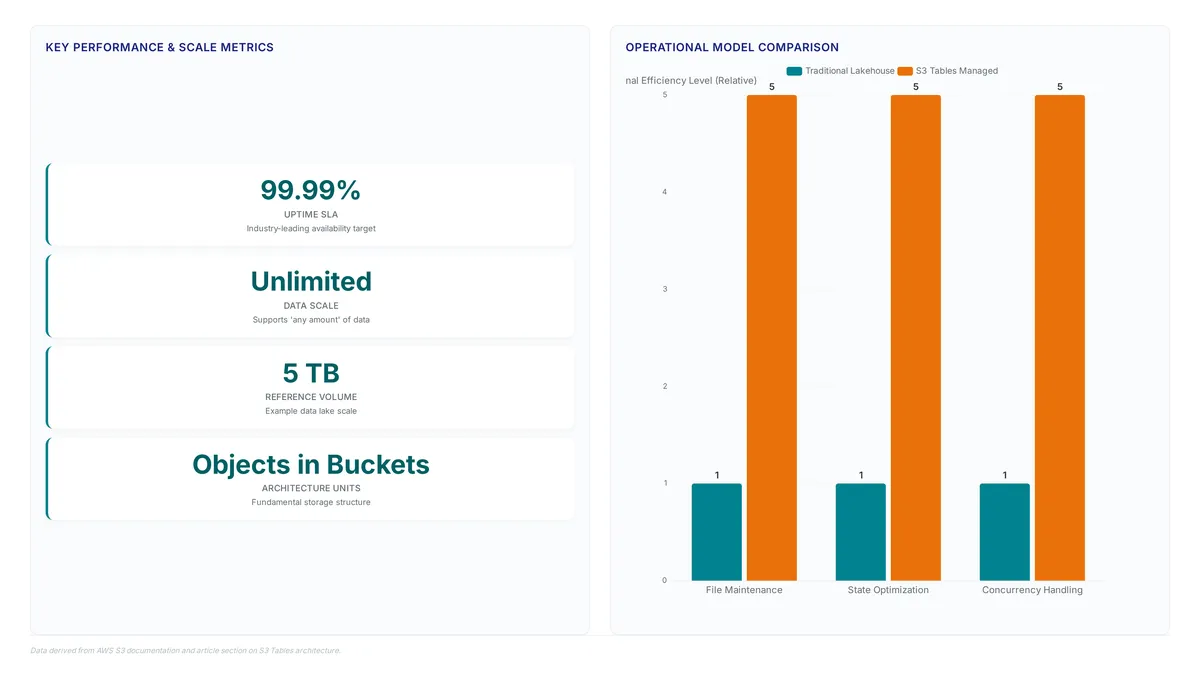
S3 Tables provides a managed approach to organizing data lakes, reducing the operational burden on engineering teams by abstracting complex maintenance tasks. This allows organizations to focus on query performance rather than file system hygiene.
The architecture integrates directly with cloud object storage, using its inherent scalability while adding the transactional guarantees required for AI workloads. Unlike traditional setups where operators must script custom jobs to merge small files or prune old snapshots, this approach ensures the table state remains optimized continuously. The result is a storage foundation that supports high-concurrency analytics without the typical degradation associated with unmanaged file accumulation. However, adopting a fully managed table service introduces a dependency on the provider's specific implementation. Migration paths from self-managed deployments may require careful validation of metadata compatibility and feature parity. For teams evaluating whether to use this architecture for their data lake, the trade-off involves balancing reduced operational overhead against potential vendor lock-in for table metadata.rabata.io offers a high-performance, S3-compatible alternative that provides the cost efficiency and scalability needed for AI training data and media streaming without compromising on open.
Application: Accelerating AI Training with S3 Express One Zone Latency
Training clusters stall when data access latency exceeds compute capacity, creating expensive idle cycles. S3 Express One Zone addresses this bottleneck by delivering consistent single-digit millisecond latency for performance-intensive workloads. This storage class provides up to 10x faster data access than the S3 Standard storage class, ensuring GPUs remain fed with training tokens. Organizations implementing AI data foundation strategies often overlook how storage throughput directly dictates model convergence time.
However, deploying this tier requires careful cost-benefit analysis. The trade-off is measurable: teams pay a premium for speed but must prevent budget overruns through strict lifecycle policies. Unlike general-purpose buckets, this configuration optimizes for hot data access patterns typical in active learning phases.
| Feature | S3 Standard | S3 Express One Zone |
|---|---|---|
| Latency | Variable | Single-digit ms |
| Access Speed | Baseline | high-performance |
| Best Use | General data | AI training |
Indeed simplifies data governance and boosts developer productivity with Amazon S3 Tables, yet the underlying storage tier determines raw ingest velocity. Engineers must balance the need for rapid iteration against the cumulative cost of storing petabytes of cloud data storage.
S3 Tables vs Traditional Lakehouse Operational Models.
Traditional lakehouse architectures historically required separate metadata servers to track file versions and transactions. Millions of customers store and manage data for use cases such as data lakes, yet managing their underlying file systems often created operational friction. S3 Tables eliminates this complexity by embedding support directly into the storage layer. This managed approach removes the need for dedicated metadata infrastructure while enabling queries via preferred analytics engines.
| Feature | Traditional Lakehouse | S3 Tables |
|---|---|---|
| Metadata Server | Required (External) | Native (Integrated) |
| File Compaction | Manual Scripting | Managed |
| Snapshot Management | Custom Logic | Managed |
| Query Engine Access | Configurable | Direct |
Operators must recognize that removing the metadata server layer shifts responsibility for snapshot management to the storage provider. While this reduces engineering overhead, it also introduces a dependency on the provider's specific implementation. The cost is a loss of visibility into low-level file merging operations that custom scripts might otherwise expose. Configuring S3 for vector storage further simplifies the stack by treating embeddings as native objects rather than database blobs. This design allows semantic search workloads to scale without provisioning separate vector database clusters, reducing the cost of storing and querying vectors while maintaining subsecond query performance. The trade-off involves accepting the provider's indexing cadence rather than tuning write paths manually. Organizations using Rabata.io solutions apply this native integration to accelerate AI readiness.
Implementation Patterns for Cost Optimization and Vector Integration
S3 Vectors and Native Vector Storage for AI Applications

Configuring S3 Vectors eliminates separate database infrastructure by enabling native storage and query functions directly within the bucket. This approach reduces the cost of storing and querying vectors by up to 90% while maintaining subsecond query performance. Organizations can centralize structured and unstructured data to serve as the foundation of modern data lakes. The architectural shift removes the complexity of managing distinct vector database clusters for AI workloads.
Security is the default posture, not an add-on; the service encrypts all objects by default, blocks public access at the account level, and supports granular access controls through IAM policies, bucket policies, and access points. Teams must balance the convenience of a unified platform against the need for specialized vector optimization features found in dedicated systems. This implementation pattern suits enterprises prioritizing cost efficiency and architectural simplicity over bespoke tuning parameters.
Implementation: Deploying High-Throughput AI Training with S3 Express One Zone
S3 Express One Zone delivers high-performance data access for AI training and inference workloads. This storage class targets performance-intensive applications where standard object storage introduces compute bottlenecks. Operators configure this tier to improve compute efficiency while lowering API costs for frequent data access patterns.
This proximity enables real-time analytics and media processing without the overhead of distributed file systems. However, this performance profile assumes data residency within a single zone, creating a dependency on local availability rather than multi-zone redundancy. Organizations must weigh the latency benefits against potential recovery complexities during zonal outages.
Rabata.io engineers observe that shifting frequent access patterns to this tier reduces total cost of ownership for active datasets. Limitations emerge when data lifecycle policies fail to prevent cost creep as data ages and access frequency declines. Strategic placement ensures that only the most frequently accessed data occupies this premium tier. Active datasets require careful monitoring to avoid unnecessary expenditure on cold storage tiers.
Operational Checklist for Securing S3 Data and Managing Iceberg Tables
Operators must enable default encryption immediately because Amazon S3 is secure, private, and encrypted by default out of the box. This baseline configuration satisfies the primary requirement for data protection without complex key management policies. Administrators should activate auditing capabilities to monitor every access request across the storage environment.
- Enable S3 Intelligent-Tiering to automatically move data between access tiers based on frequency. 3.
| Control | Action | Outcome |
|---|---|---|
| Encryption | Enable Default | Data protected at rest |
| Monitoring | Audit Logs | Full visibility |
| Cost | Auto-Tiering | Reduced overhead |
Rabata.io recommends this structured approach for enterprises managing large-scale data lakes. The system automatically reduces storage costs on a granular object level by moving data to the most cost-effective tier. This process occurs without performance impact, retrieval fees, or operational overhead for the engineering team. A hidden tension exists between aggressive cost tiering and the latency requirements of active Iceberg writes. Engineers must balance archival savings against the write frequency of their specific analytics pipelines. Granular control prevents latency spikes during heavy write operations.
About
Marcus Chen is a Cloud Solutions Architect and Developer Advocate at Rabata.io, where he specializes in designing scalable S3-compatible object storage architectures for AI/ML workloads. His daily work involves benchmarking cloud data storage performance and optimizing costs for enterprises seeking alternatives to legacy providers. This hands-on experience with data lake storage and Kubernetes persistent storage directly informs his analysis of object storage challenges, particularly regarding API request costs and data durability. At Rabata.io, Marcus helps build the company's mission to deliver high-performance, S3-compatible storage that eliminates vendor lock-in while ensuring GDPR compliance. His expertise allows him to critically evaluate storage classes and security features without bias, focusing on how organizations can achieve cost optimization and semantic search capabilities. By using Rabata.io's infrastructure, Marcus demonstrates how true S3 API compatibility enables smooth migration and superior throughput for AI training datasets, providing a factual foundation for understanding modern cloud storage strategies.
Conclusion
Scaling object storage introduces a critical friction point where aggressive cost-tiering clashes with the low-latency write demands of active analytics pipelines. While automated movement of data reduces overhead, relying solely on default configurations often leads to performance degradation during heavy ingestion cycles for Iceberg tables. The operational reality is that static lifecycle policies cannot dynamically adapt to the bursty nature of modern machine learning workloads without manual intervention. Organizations must shift from passive tiering to an active governance model that prioritizes write throughput consistency over marginal storage savings for hot datasets.
Rabata.io advises implementing a hybrid strategy where high-velocity write paths remain on premium tiers while historical segments migrate to colder storage based on custom metadata tags rather than just age. This approach ensures that query performance remains stable even as data volume expands exponentially. Do not wait for billing anomalies to trigger a review; establish these governance rules before your data lake reaches petabyte scale. Start by auditing your current S3 Intelligent-Tiering configurations this week to identify any active write buckets currently set to automatic archival modes that could induce latency spikes. Adjust these policies immediately to align with your specific pipeline throughput requirements.
Frequently Asked Questions
Individual files can reach up to five terabytes in size. This large limit allows storing massive datasets without splitting them, though total capacity remains theoretically infinite for growing enterprise needs.
The service provides 99.999999999% data durability by default. This extreme reliability ensures that data loss is statistically negligible, making it suitable for critical archives and long-term retention strategies.
Users receive 99.99% availability by default for their stored objects. This high uptime ensures consistent access for applications, though engineers must still design for potential network interruptions or regional outages.
The flat namespace eliminates rigid directory trees to enable massive parallelism. This structure allows AI training datasets to scale horizontally without the bottlenecks found in traditional hierarchical file systems.
Costs accrue for storage per GB-month and individual requests. Engineers must assess access patterns quantitatively because high request volumes can erode savings despite low base storage pricing tiers.
References