Cloud storage costs: Cut spend 70% with smart tiers
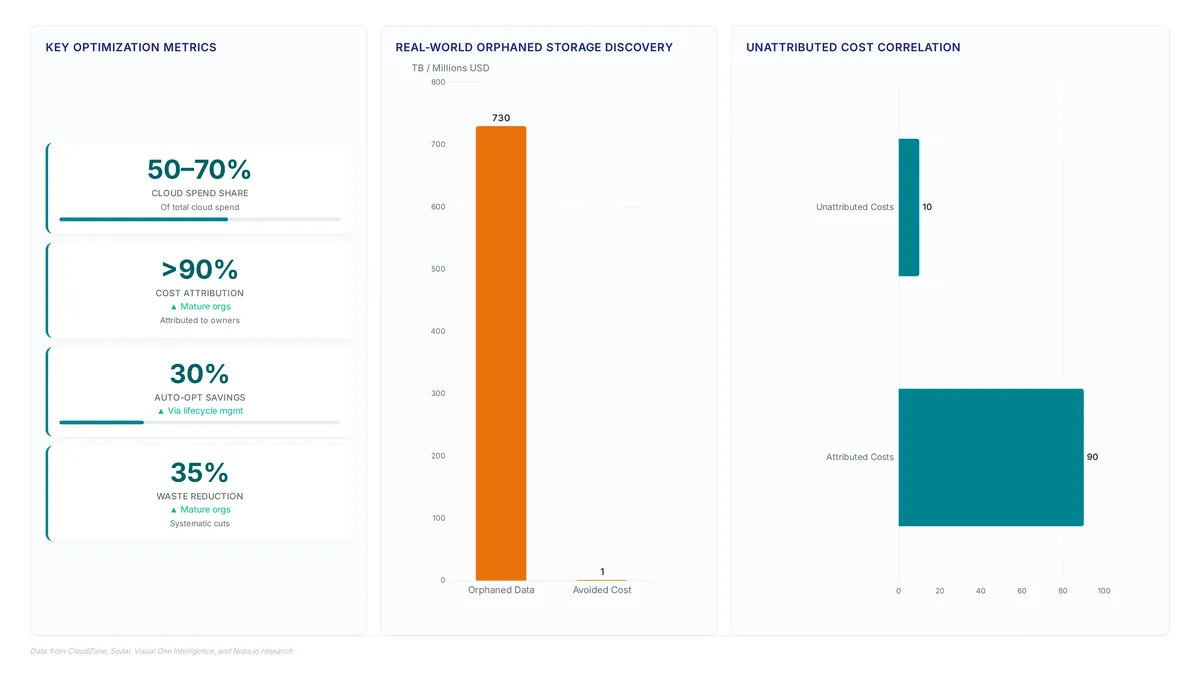
Cloud storage eats 50, 70% of total spend for many organizations, driven by volume and retrieval frequency (cloud storage). Manual management of data retention cannot fix the structural inefficiencies baked into modern cloud storage architectures. Without automated intervention, you pay premium rates for data that belongs in cheaper tiers.
This guide treats storage classes as the primary lever for controlling cloud storage cost. We dissect the mechanics of lifecycle policies that automatically change data states, removing human error from the equation. The goal is simple: map variable workloads to appropriate tiers so data access frequency dictates placement, not default settings.
Effective storage optimization demands a shift from static allocation to flexible, policy-driven movement. By mastering storage class selection, teams align cost-effective data retention strategies with actual business value. This transforms cloud storage from a fixed expense into a variable cost model that scales logically with usage patterns.
The Role of Storage Classes and Data Retention in Cost Architecture
Defining Cloud Storage Cost Optimization and Class Hierarchies
Stop paying for performance you don't need. Aligning data placement with access frequency eliminates waste within the object store. Organizations classify data into Standard, Nearline, and Coldline tiers to match performance needs with budget constraints. Standard storage serves active datasets requiring low latency. Nearline, with a 30day minimum, and Coldline classes accommodate infrequently accessed archives with higher retrieval penalties.
Operators can save up to 30% on Standard storage costs by purchasing committed use discounts for predictable workloads over one to three year terms.
Here lies the conflict: immediate access requirements often clash with long-term retention mandates. Misclassifying cold data as hot storage results in paying premium rates for dormant assets. Conversely, aggressive archiving to Coldline storage risks expensive retrieval fees if access patterns shift unexpectedly. Continuous monitoring of data access frequency automates transitions between classes. Versioning multiplies storage costs by retaining all object versions indefinitely without automated policies. The architectural goal creates a flexible hierarchy where data flows automatically to the most economical tier as it ages. Unified object store capabilities with S3 compatibility ensure smooth migration and strict cost control.
Applying Lifecycle Policies for Legal Compliance and Retention
Regulatory frameworks mandate immutable data retention, making features like Bucket lock necessary for preventing accidental deletion during audit periods. This mechanism creates a write-once-read-many (WORM) state that satisfies strict compliance requirements by locking object versions until a specified retention date expires. Operators configure these policies to automatically transition aging datasets from expensive Standard tiers to cost-effective Coldline storage while maintaining legal hold status. The lifecycle policy engine executes these state changes without manual intervention, ensuring data moves to optimal tiers as it matures.
Automated management reduces storage costs notably through precise lifecycle enforcement. However, efficiency gains introduce tension between aggressive cost cutting and the rigidity required for legal holds. Standard deletion commands fail once an object falls under a retention rule; the system enforces the lock regardless of subsequent cost pressures. This constraint prevents premature data loss but requires careful planning of retention windows to avoid paying for inaccessible data longer than legally necessary.
| Feature | Standard Tier | Coldline Tier | Bucket Lock State |
|---|---|---|---|
| Access Latency | Milliseconds | Seconds | Immutable |
| Cost Profile | High | Low | Fixed Duration |
| Deletion Rights | Permissive | Permissive | Restricted |
Integrating these compliance controls directly into S3-compatible architecture allows enterprises to enforce regulatory mandates without sacrificing the performance needed for AI/ML training data or media streaming workflows. The platform ensures that data retention rules align with both budgetary goals and legal obligations.
Validating Data Retention Periods and Transformation Rules
Data retention validation confirms the exact duration data holds business value before deletion or transformation is required. Operators must verify that lifecycle policies correctly tag objects to automatically delete or change storage classes based on age. Automation prevents the accumulation of obsolete data that drives unnecessary expenditure.
| Storage Strategy | Cost Impact | Operational Requirement |
|---|---|---|
| Regional Storage | Lower base rate | Single-zone availability |
| Multi-Regional | Higher redundancy | Global access patterns |
Teams select appropriate storage classes like Standard, Nearline, or Coldline based on access frequency and retrieval requirements to optimize costs effectively. Selection aligns performance needs with budget constraints.
Regulatory immutability conflicts with aggressive cost cutting. Bucket lock features protect against accidental deletion for compliance, yet they can inadvertently preserve low-value data if retention periods are not rigorously validated. Failure to validate these periods results in paying premium rates for data that no longer supports decision-making.
Mechanics of Lifecycle Policies and Automated Data Transformation
Mechanics of Automated Storage Class Transformation Rules
Automated lifecycle policies execute precise storage class transitions by monitoring object age and access frequency without manual intervention. Systems migrate data from high-performance tiers to cost-optimized archives once objects reach specific maturity thresholds. This mechanism relies on predefined rules rather than human scheduling to manage the bulk of static data.
The transformation process follows a strict logical sequence:
- The system evaluates the creation timestamp of every stored object.
- Policies compare this age against configured duration limits.
- Matching objects transition to lower-cost storage classes like Nearline or Coldline.
- Retrieval protocols adjust dynamically to reflect the new latency profile.
Organizations must select appropriate storage classes based on access frequency and retrieval requirements to optimize costs effectively. Standard storage remains ideal for frequently accessed data, while rare-access data benefits from deeper archival tiers.
Immediate availability often conflicts with long-term expense reduction goals. Moving data too aggressively to cold storage incurs steep retrieval penalties if access patterns shift unexpectedly. Retaining active data in premium tiers wastes capital on unused performance headroom.rabata.io solves this by aligning lifecycle policy execution with actual workload behavior rather than static timers. Cost savings do not compromise operational agility during critical recovery windows when this approach is used.
Applying Bucket Lock for FINRA SEC and CFTC Compliance
Bucket Lock enforces immutable retention periods to satisfy FINRA, SEC, and CFTC mandates preventing accidental deletion. This mechanism converts standard object buckets into compliance-grade repositories where retention policies become permanent once activated. Operators configure a specific duration during which no user, including root accounts, can alter or erase stored objects. Policies can tag an object for deletion once it meets the minimum threshold for legal compliance needs, ensuring data persists exactly as long as regulations require.
Rabata.io implements this logic to secure audit trails against internal errors or malicious insider threats. The configuration process follows a strict sequence:
- Define the retention period based on regulatory statutes.
- Enable the lock feature on the target bucket.
- Apply rules that prevent policy removal before expiration.
Absolute permanence defines the limitation; enabling lock on a bucket prevents shortening the retention window later. This constraint guarantees evidentiary integrity for legal discovery but requires precise initial planning. Organizations must calculate exact holding periods before activation to avoid locking data longer than necessary.rabata.io ensures these settings align with cost-effective data retention strategies by automating transitions only after legal holds expire. The result is a storage environment that simultaneously satisfies rigid compliance frameworks and optimizes long-term archival costs without manual oversight.
Avoiding Retrieval Charges on Nearline Storage Access
Frequent access to Nearline storage before the mandatory 30-day minimum stay triggers disproportionate retrieval fees that erase initial savings. This cost structure penalizes unpredictable read patterns where applications mistakenly treat cold tiers as active datasets. The financial risk manifests when automated jobs or analytics pipelines request objects still within their early retention window. Unlike Standard tiers, these colder classes impose substantial penalties for premature access, creating a hidden variable cost component.
Rabata.io engineers design lifecycle rules that account for this 30-day threshold to prevent accidental budget overruns. Operators must align data transformation schedules with actual access velocity rather than theoretical availability.
| Storage Class | Minimum Duration | Retrieval Cost Risk | Ideal Workload |
|---|---|---|---|
| Standard | None | Low | Active AI training |
| Nearline | 30 days | High if early | Monthly backups |
| Coldline | 90 days | Very High | Disaster recovery |
Selecting appropriate storage classes based on verified access frequency prevents these unexpected charges. A common failure mode involves migrating logs too aggressively, only to require immediate forensic analysis.rabata.io recommends validating access logs over a full month before committing datasets to Nearline tiers. This discipline ensures that cost optimization does not compromise the ability to retrieve critical data when needed most.
Strategic Selection of Storage Classes for Variable Workloads
Defining Minimum Storage Durations and Retrieval Penalties
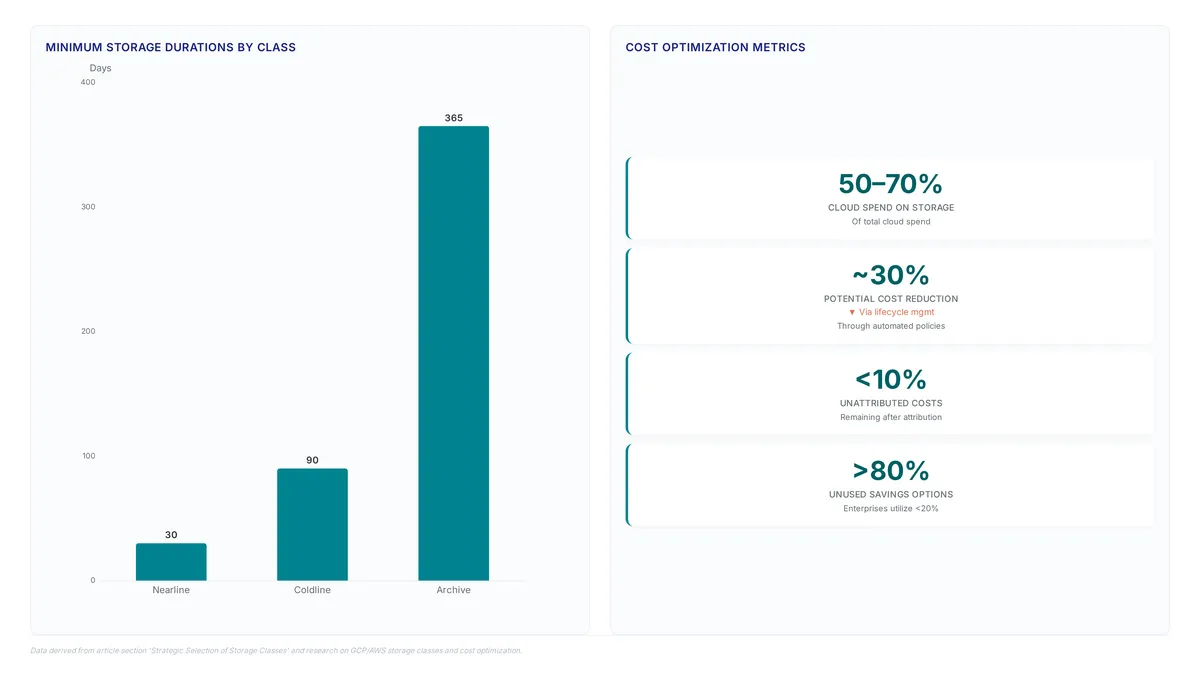
Cold storage tiers enforce strict minimum storage durations that dictate financial viability for infrequently accessed data. Objects residing in Nearline storage carry a mandatory 30-day retention window before deletion or transition incurs early removal fees. This constraint fundamentally alters the economics of storage class selection for flexible datasets. Frequent access to data in colder tiers can trigger retrieval fees that negate base rate savings. Effective architectures mitigate these risks by aligning lifecycle policies with actual access patterns rather than theoretical projections. A common error involves applying cold storage to intermediate datasets where iteration cycles fall below the duration threshold. The resulting retrieval fees accumulate rapidly when applications repeatedly access objects nearing the expiration boundary. Operators must calculate the break-even point where lower per-gigabyte rates offset the potential liability of early egress charges. Failure to model these durations accurately transforms a cost-saving measure into a budget overrun. Strategic class selection requires validating that data immutability matches the provider's temporal constraints. Workloads with predictable access patterns benefit most from these pricing tiers when managed correctly.
Matching Multi-Regional and Regional Locations to Access Frequency
Geography drives the decision between multi-regional and regional buckets more than any other variable. Multi-regional deployment suits hot objects requiring low-latency access from diverse continents, such as global gaming assets or enterprise time-tracking applications. Conversely, regional storage remains the optimal choice for teams operating within a single territory who access datasets with relatively high frequency. This geographic alignment prevents unnecessary data replication costs while maintaining performance standards for local users.
| Location Type | Ideal Workload | Access Pattern |
|---|---|---|
| Multi-Regional | Global Hot Data | Broad geo-distribution |
| Regional | Team Datasets | Single-area high frequency |
Misaligning location with access patterns creates hidden egress charges that outweigh base storage savings. Standard storage handles frequent reads efficiently, yet placing regional data in a multi-regional bucket replicates bytes across zones without demand. The financial penalty manifests immediately in network transfer fees rather than storage unit prices. Eliminating this inefficiency requires enforcing strict data locality rules during bucket provisioning. A common oversight involves treating all "frequent" data as globally hot; in reality, most departmental workflows remain regionally bound. Ignoring this distinction inflates the total cost of ownership regardless of the selected storage class. Replication should occur only when user distribution statistically justifies the overhead.
Mitigating Premium Charges and Network Egress in Cold Storage
Blindly transforming objects to colder tiers triggers retrieval penalties when access patterns deviate from theoretical models. Enterprises currently apply less than 20% of available cloud cost-saving options because bucket sprawl obscures active data from cold archives.
| Risk Factor | Consequence |
|---|---|
| Premature Transition | Early removal fees negate base rate savings |
| Global Replication | Unnecessary egress charges for local access |
| Metadata Heavy Workloads | High operational fees override storage discounts |
Preventing these financial leaks requires enforcing lifecycle policies that validate access frequency before class transitions. Without this flexible alignment, organizations face expensive retrieval fees that erase any perceived storage savings. Automated unstructured data management remains necessary to navigate the complexity of multi-vendor storage services effectively. Companies ignoring these access patterns often pay more for cold storage than they would for standard tiers. Strategic selection requires continuous monitoring to avoid locking data behind costly retrieval gates. Visibility eliminates waste while maintaining compliance and performance.
Executing a Five-Step Plan for Storage Cost Reduction
Defining Retention Value and Storage Class Variables
Questioning why an object holds value and for what duration drives the selection of a storage class. This inquiry aligns data utility with specific retention periods to optimize spending. Operators face many options offering different costs, durability, and resiliency profiles. Immediate accessibility often conflicts with long-term preservation expenses. Standard storage fits frequently accessed datasets while archival tiers serve compliance needs requiring infrequent retrieval.
Performance must remain stable while retaining data for legal or business purposes. Versioning often multiplies storage costs by keeping all object versions indefinitely unless configured otherwise. Lifecycle policies can delete non-current versions after a set time or limit the total count.
Clear lifecycle policies change data placement automatically based on age to eliminate manual errors and enforce consistent rules.
- Identify the business value driver for each data subset.
- Map access frequency to the appropriate storage tier.
- Set explicit expiration rules for temporary objects.
- Enforce bucket lock settings for regulatory compliance.
- Monitor lifecycle transition metrics to ensure rules align with usage patterns.
| Variable | Impact | Action |
|---|---|---|
| Access Frequency | Determines tier suitability | Monitor metrics |
| Retention Period | Dictates compliance cost | Define legal holds |
| Resiliency Level | Affects durability pricing | Match to risk |
Implementing Lifecycle Policies as Automated Cost Controls
Analyzing data types starts by determining the retention period through asking why an object is valuable and how long that value lasts to establish the correct storage class. This step prevents storing ephemeral data in expensive tiers. Operators align data utility with business requirements to eliminate waste.
- Identify the access frequency of existing datasets to determine if they suit standard or archival tiers.
- Configure rules to automatically transition objects to cheaper classes after a set age.
- Set expiration actions to delete non-current object versions that multiply storage costs indefinitely.
Selecting appropriate storage classes based on retrieval needs optimizes overall expenditure notably. Standard storage fits frequent access while archival options serve long-term preservation. A cost exists between immediate availability and the minimum storage duration fees attached to colder tiers. Prematurely moving data incurs retrieval penalties that negate monthly savings.
These systems meet compliance needs through immutable bucket locks while automating cost controls. Automated policies reduce operational overhead compared to rigid systems requiring manual intervention. Deploying these rules transforms storage from a static expense into a flexible, optimized asset. The result is a leaner infrastructure that scales efficiently with data growth.
Validating Legal Compliance Thresholds Before Deletion
Tagging an object for deletion occurs once it meets the minimum threshold for legal compliance needs. This mechanism retains data required for future purposes including compliance, legal, or business value.
- Audit current retention periods against specific organizational regulations.
- Apply bucket lock features to enforce immutability for required durations.
- Configure deletion actions only after legal thresholds expire.
Aggressive cost cutting conflicts with the inability to produce audit trails during investigations. Deleting data prematurely to save storage fees creates far larger liabilities than the cost of holding the data. Effective lifecycle policy setup must prioritize legal hold status over simple age-based rules. The cost of non-compliance dwarfs storage expenses, making rigorous validation necessary before any automated deletion triggers. Organizations should treat compliance metadata as immutable as the data itself.
About
Alex Kumar is a Senior Platform Engineer and Infrastructure Architect at Rabata.io, where he specializes in Kubernetes storage architecture and cost optimization for cloud-native applications. His daily work involves designing resilient data retention strategies and managing complex storage tiers for enterprise clients, making him uniquely qualified to analyze cloud storage lifecycle policies. At Rabata.io, an S3-compatible object storage provider, Alex directly addresses the challenge of rising cloud storage costs by implementing automated rules that transition data between hot and cold tiers based on access patterns. This article distills his hands-on experience in configuring lifecycle policies to ensure cost-effective data retention without compromising performance. By using Rabata.io's simplified two-tier storage model, Alex demonstrates how organizations can eliminate hidden fees and avoid vendor lock-in while maintaining strict regulatory compliance. His insights provide a factual framework for engineers seeking to optimize their infrastructure through intelligent storage class selection and automated management.
Conclusion
Scaling cloud storage without rigorous lifecycle governance creates a hidden tax where early data transitions to Nearline trigger disproportionate penalties that erase projected savings. As generative AI workloads drive unprecedented demand for high-performance tiers, the operational cost of misaligned data placement will accelerate quicker than raw capacity growth. Organizations must stop treating storage classes as static buckets and start viewing them as flexible financial instruments that require active management.
Implement a strict policy this week preventing any data migration to colder tiers before verifying the mandatory 30-day minimum stay to avoid immediate financial leakage. While enterprises currently apply less than a fifth of available optimization options, the window for easy gains closes as data volume compounds. You should prioritize auditing object versioning rules over simple age-based deletion, as multiplying non-current versions often cost more than the primary data itself.
The path forward requires balancing legal hold status with aggressive cost controls, ensuring compliance metadata dictates retention rather than arbitrary dates. Do not automate deletion until you have mapped every bucket against specific regulatory thresholds. Start by auditing your current retention periods against organizational regulations today to identify where premature deletion risks creating liabilities that dwarf storage fees. This disciplined approach transforms storage from a passive expense into a strategic asset capable of supporting intensive compute demands without fiscal waste.
Frequently Asked Questions
Cloud storage often consumes 50–70% of total spend due to volume and retrieval frequency. This high percentage forces teams to prioritize automated tiering strategies immediately to prevent budget overruns on dormant data assets.
Operators can save up to 30% on Standard storage costs by purchasing committed use discounts. This reduction requires predicting workload volumes accurately over one to three year terms to avoid paying for unused capacity.
Nearline storage carries a mandatory 30-day retention window before deletion or transition is allowed. Moving data out before this period triggers disproportionate penalties that negate any initial cost savings from the cheaper tier.
Enterprises currently utilize less than 20% of available cloud cost-saving options because manual management fails. Automating lifecycle policies is essential to capture the remaining potential savings hidden in inefficient data placement.
Coldline classes impose very high retrieval fees if access patterns shift unexpectedly after archiving. Teams must validate data access frequency rigorously to ensure cold data remains dormant and avoids these expensive operational charges.
References