Autonomous storage cuts costs by 30% with AI
Autonomous platforms claim 30% storage cost cuts by automating access pattern analysis, according to Sedai research. These systems outperform native AWS tools by dynamically managing complexity that human operators cannot sustain.
As organizations grow from a few buckets to thousands, manual management of Amazon S3, Amazon EBS, and Amazon EFS becomes impossible due to compounding variables. Sedai identifies that costs often grow quietly until they spike on billing day, creating a nightmare for Site Reliability Engineers tasked with selecting correct metrics and provisioning. The sheer volume of data requires a shift from static rules to flexible, AI-driven responses that traditional scripts cannot match.
Readers will discover the mechanics of AI-driven storage tiering that categorizes buckets based on actual usage rather than assumptions. We will compare native AWS features like S3 Intelligent-Tiering against dedicated autonomous platforms that configure every bucket individually. By the end, you will understand why relying on manual intervention for cloud storage services is a strategic error in 2026.
The Role of Autonomous Systems in Modern Cloud Storage Economics
Defining Autonomous Storage Optimization and S3 Intelligent-Tiering
Data volume expands quicker than engineering teams can scale. This reality, accelerated by Generative AI workloads consuming massive datasets, renders manual management of thousands of buckets ineffective as complexity compounds across divergent access patterns. Autonomous storage optimization applies machine learning to observe access behavior and execute lifecycle policies without human input.
S3 Intelligent-Tiering functions by tracking the access history of individual objects to shift data between Frequent Access and Infrequent Access tiers. AWS maintains these two distinct storage layers, balancing high-availability against lower price points. If an object hasn't been accessed within 30 days, the system moves it to the Infrequent Access storage tier automatically. This granular, object-level automation cuts expenses without introducing retrieval fees or operational drag.
| Feature | Manual Lifecycle Policy | Autonomous Optimization |
|---|---|---|
| Granularity | Bucket or prefix level | Per-object basis |
| Reaction Time | Fixed schedule (days) | Real-time analysis |
| Configuration | Static rules | Flexible adaptation |
| Overhead | High engineering time | Zero operational lift |
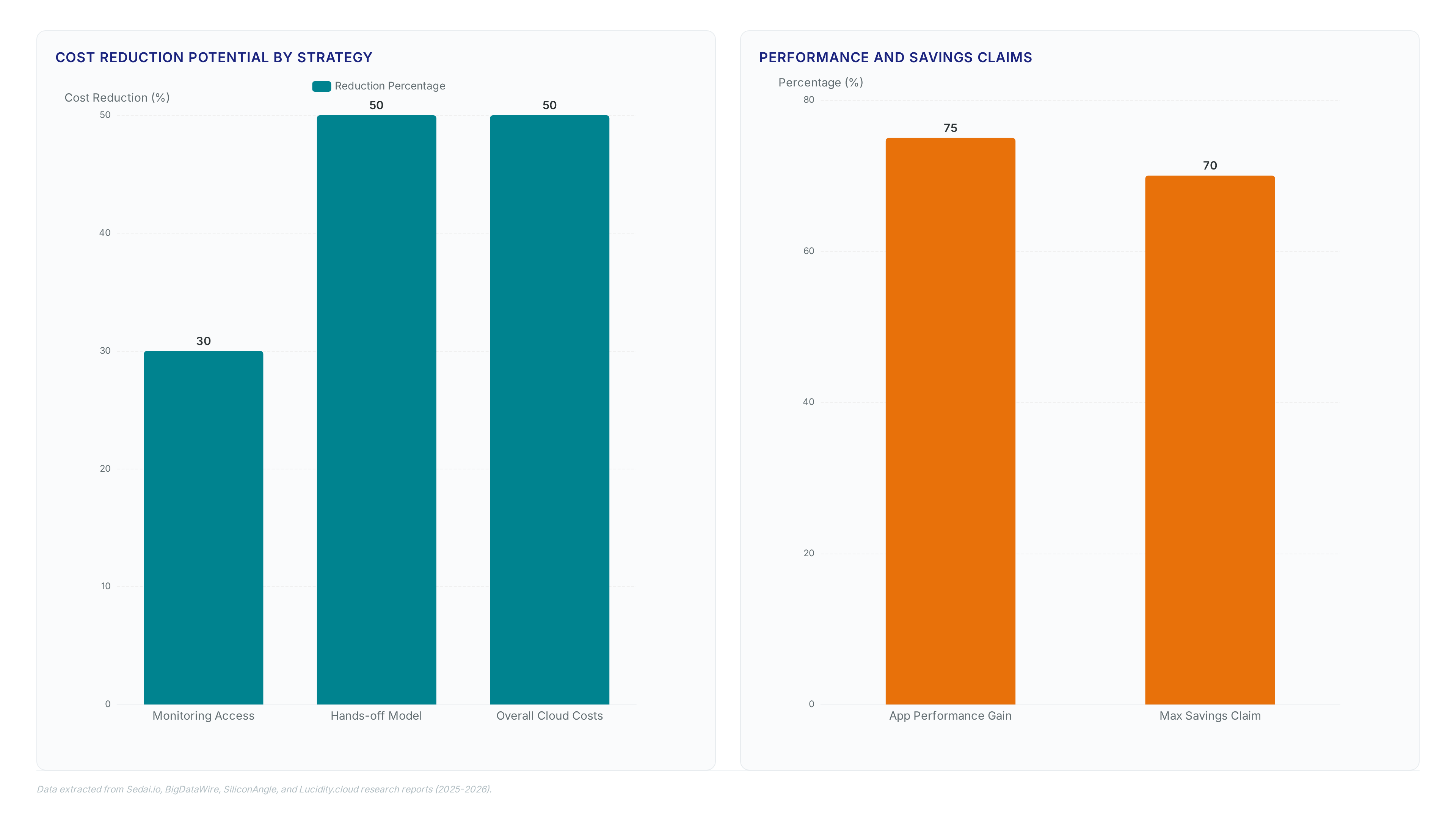
Platforms like Sedai distinguish this approach by claiming a 30% cost reduction through continuous pattern monitoring. S3 Intelligent-Tiering targets unpredictable access profiles, shifting objects between tiers based on actual usage while charging a small per-object monitoring fee. Operators must balance saved engineering hours against these monitoring costs before scaling deployment. Expanding from a few buckets to thousands renders manual configuration impossible as access patterns, costs, and lifecycle rules compound in complexity.
Scaling from Manual S3 Buckets to Petabyte AI Workloads
S3 costs accumulate silently until billing day arrives, surprising unprepared teams. Small workloads with one or two buckets stay manageable through manual oversight, yet enterprise customers frequently operate thousands of S3 buckets holding terabytes or petabytes of data. At this magnitude, human groups cannot manage operations effectively as access patterns shift unpredictably across the fleet.
The industry transitions from manual cloud management to autonomous systems built on reinforcement learning, continuous telemetry, and safety-first decision-making, removing the need for constant human supervision. Traditional approaches fail because administrators cannot individually configure every bucket in real-time to match changing access patterns.
| Workload Scale | Management Method | Outcome |
|---|---|---|
| Small (1-10 buckets) | Manual Configuration | Stable costs |
| Enterprise (1000+ buckets) | Autonomous Platform | Optimized spend |
Datafy differentiates itself by offering a low-level optimization layer that automatically adjusts storage volume sizes in real-time without providing recommendations, whereas traditional FinOps platforms typically provide recommendations requiring manual approval. This "hands-off" model avoids expensive dashboards or manual intervention, contrasting with traditional FinOps platforms that charge for recommendation engines. One of the most critical and challenging tasks for administrators is choosing the right metric to base actions on storage services, a difficulty that intensifies when dealing with data on a large-scale. Deploying autonomous agents enforces lifecycle policies dynamically, aligning storage classes with actual usage rather than static assumptions.
Manual Configuration Limits Versus Autonomous System Performance
Manual configuration fails at scale because human operators cannot track flexible access patterns across thousands of buckets. Static rules set by engineers quickly become obsolete as data workloads shift, leading to significant cost inefficiencies. Small deployments with limited buckets remain manageable, yet enterprise environments storing petabytes face compounding complexity that traditional automation cannot resolve. An autonomous system configures every bucket individually in real-time, something no team or traditional automation can sustain at enterprise scale. The industry shifts toward autonomous systems built on reinforcement learning and continuous telemetry to address these limitations directly.
| Feature | Manual Rules | Autonomous Systems |
|---|---|---|
| Scope | Limited to few buckets | Scales to thousands |
| Adaptability | Static thresholds | Real-time adjustment |
| Cost Impact | High error rate | Up to 50% reduction |
| Performance | Degraded over time | 75% improvement |
Engineering teams adopting these strategies often achieve up to a 50% reduction in overall cloud costs alongside a 75% improvement in application performance. This gap exists because manual approaches are error-prone and impossible to sustain across massive fleets. Existing customers of Sedai configure autonomous optimization directly in their dashboard to eliminate the "cost runaway" pattern where bills rise despite initial fixes. Human-set policies struggle to keep pace as data workloads shift, often leaving storage classes misaligned with actual usage. Reliance on static configurations leaves substantial savings unrealized while performance suffers under unoptimized storage tiers. Evaluating autonomous platforms is particularly the for enterprises where data growth outpaces manual governance capabilities.
Inside the Mechanics of AI-Driven Storage Tiering and Access Analysis
How CloudWatch Metrics and Access Logs Drive Storage Class Assignment
Sedai ingests CloudWatch metrics, S3 Storage Lens aggregates, and server access logs to categorize each bucket and assign the optimal storage class automatically. The system categorizes access patterns into two types: Predictable access patterns and Unpredictable access patterns. This triad of telemetry sources provides the granular visibility required to distinguish between steady-state archival data and volatile generative AI training sets.
- Predictable patterns are identified through historical access data, allowing for optimized lifecycle management.
- Unpredictable patterns activate S3 Intelligent-Tiering, which automatically shifts objects between frequent and infrequent access tiers based on usage with a small per-object monitoring fee.
| Pattern Type | Data Source Priority | Action Mechanism |
|---|---|---|
| Predictable | Server Access Logs | Categorize bucket for optimal class |
| Unpredictable | CloudWatch Metrics | Enable flexible tiering monitoring |
Native tools like Microsoft Azure Smart Tier similarly evaluate last access time to move data between hot and cool tiers, yet they often lack the cross-service correlation found in third-party engines. The cost of this continuous monitoring is frequently lower than maintaining static data in the S3 Standard class, effectively pricing storage on actual utility rather than projected use. However, enabling granular log analysis requires processing significant telemetry data. Operators must weigh the savings from optimized tiering against the operational overhead generated by the observation layer itself. Establishing a baseline cost model ensures the optimization delta exceeds the telemetry overhead.
Mapping Predictable Workloads to S3 Standard-IA and Glacier Deep Archive
Assigning S3 Standard-IA to predictable low-frequency data locks in lower storage rates immediately. S3 Standard-IA is designed for a different balance of access speed, availability, and cost compared to standard storage, whereas S3 Glacier Deep Archive targets long-term retention where retrieval latency spans hours rather than milliseconds. Retrieval fees for deep archival storage remain high, punishing unoptimized access patterns.
| Storage Class | Access Frequency | Retrieval Latency | Best Use Case |
|---|---|---|---|
| S3 Standard-IA | Infrequent | Milliseconds | Monthly reports, backup snapshots |
| S3 Glacier Deep Archive | Rare | Hours | Compliance archives, raw logs |
| S3 Intelligent-Tiering | Unpredictable | Milliseconds | Generative AI training sets |
Operators must distinguish between predictable access patterns amenable to static lifecycle rules and volatile workloads requiring flexible adjustment. For the latter, Amazon S3 Intelligent-Tiering automatically reduces costs on a granular object level by shifting data based on real-time frequency without performance impact. Relying solely on manual transitions risks leaving active data stranded in cold tiers, incurring unnecessary retrieval charges that erase initial savings. Mapping stable historical datasets to Glacier Deep Archive while reserving Standard-IA for semi-active disaster recovery copies prevents the "cold data trap" where rigid policies ignore shifting business priorities.
The Hidden Monitoring Fee Risks in S3 Intelligent-Tiering for Unpredictable Data
S3 Intelligent-Tiering charges a per-object monitoring fee that accumulates silently across millions of small files, eroding savings for volatile workloads. While AWS positions this service as the first cloud storage to automatically reduce costs on a granular object level without retrieval fees, the operational overhead manifests in billing complexity rather than performance latency. Engineers addressing how to fix unexpected S3 cost spikes must recognize that misclassifying data destined for S3 Glacier incurs severe retrieval penalties if immediate access becomes necessary. A critical limitation involves S3 Glacier, which is intended for data that can wait a few hours for retrieval, posing a tangible risk if application logic demands millisecond response times during a disaster recovery scenario. Auditing object size distributions before enabling tiering is necessary, as the monitoring fee structure disproportionately penalizes datasets containing billions of kilobyte-sized objects compared to fewer large blobs.
Strategic Comparison of Native AWS Tools Versus Autonomous Platforms
Native S3 Lifecycle Policies Versus Autonomous Cross-Cloud Logic
Static rules within native S3 lifecycle policies fracture when cross-cloud access patterns shift without warning. Manual updates become mandatory whenever data usage evolves across AWS, Azure Blob, or GCS environments. Autonomous engines monitor object access continuously to tier data dynamically without human intervention. This method solves the complexity where manual configuration becomes impossible at enterprise scale.
| Feature | Native Lifecycle Policies | Autonomous Cross-Cloud Logic |
|---|---|---|
| Scope | Single Cloud Provider | Multi-Cloud (AWS, Azure, GCS) |
| Trigger | Time-based or Date-based | Real-time Access Patterns |
| Adaptability | Static Rules | Flexible AI Adjustment |
| Management | Manual Configuration | Fully Automated |
Operators managing thousands of buckets discover static rules leave data in expensive Standard tiers long after access frequency drops. Microsoft Azure Smart Tier operates similarly by evaluating last access time, yet siloed logic misses global optimization opportunities. True context-aware optimization requires viewing workloads across all clouds simultaneously to identify migration candidates that single-provider tools ignore. The constraint involves the initial telemetry integration required to feed the decision engine accurately. Without thorough logs, the system cannot distinguish between a temporary spike and a permanent workload shift.rabata.io recommends validating log ingestion pipelines before enabling automated transitions to prevent premature archival.
Monitoring fees create the primary tension. While S3 Intelligent-Tiering eliminates retrieval fees, the per-object charge accumulates across millions of small files, potentially eroding margins for volatile workloads. Misclassifying data destined for deeper archival tiers incurs severe retrieval penalties if immediate access becomes necessary. Consequently, the net benefit persists only when the volume of data successfully tiered to infrequent access outweighs the aggregate monitoring fees charged on the entire dataset.rabata.io recommends validating these savings against actual access logs before enabling global policies. Verification prevents scenarios where monitoring costs exceed the storage differential for low-churn buckets. Operators should prioritize moving large, unpredictable datasets first to maximize the efficiency gap. The autonomous approach consistently outperforms manual configuration because human teams cannot sustain real-time adjustments across thousands of buckets.
Silent Cost Accumulation When Lifecycle Policies Lag Access Pattern Shifts
Static lifecycle policies allow cloud storage costs to accumulate silently when they fail to adapt to shifting access frequencies. Frequently accessed objects often represent a tiny fraction of the total count, yet manual rules keep entire buckets in expensive Standard tiers. This mismatch creates financial leakage that grows exponentially as data volumes expand unchecked.
| Risk Factor | Static Policy Impact | Autonomous Response |
|---|---|---|
| Access Shift | Costs rise silently | Real-time tier adjustment |
| Data Volume | Manual review impossible | Scales to petabytes |
| Optimization | Delayed until audit | Continuous monitoring |
Configuration stability conflicts with cost efficiency. Rigid rules prevent errors but guarantee waste when workloads evolve. Unlike manual approaches requiring periodic human intervention, autonomous platforms monitor access patterns to automatically adjust storage classes in real-time. Unchecked storage expenses can consume large portions of IT budgets as data volumes grow. Reliance on accurate telemetry presents a drawback. Without deep visibility into object-level usage, automated systems cannot distinguish between temporary spikes and permanent pattern shifts. Engineers optimizing S3 storage costs must recognize that lagging indicators in billing reports often reflect decisions made weeks prior.rabata.io recommends deploying continuous observation tools to detect these drifts before they compound into significant budget overruns.
Implementing Autonomous Optimization for Measurable Cost Reduction
How Sedai Observes Access Patterns to Assign Storage Classes

Sedai processes CloudWatch metrics alongside S3 Storage Lens figures and raw server access logs. This combination separates Predictable access patterns from Unpredictable access patterns to drive automatic class assignment. Granular identification of static objects versus those with volatile demand curves becomes possible through this telemetry triad. Analysis of these streams prompts the platform to recommend moving suitable buckets to S3 Intelligent-Tiering. Objects shift between frequent and infrequent access tiers automatically within this class. Performance remains unaffected while retrieval fees stay absent. Such autonomous configuration reduces overall spend by optimizing data placement based on actual usage rather than administrative assumptions. A flexible storage environment emerges where data placement aligns precisely with actual usage.
Executing the Move from S3 Standard to Intelligent-Tiering
Pattern observation occurs by ingesting CloudWatch metrics, S3 Storage Lens data, and server access logs to distinguish predictable workloads from volatile ones. The system recommends shifting unpredictable data to S3 Intelligent-Tiering, which moves objects between access tiers on a granular object level without performance impact. Operational debt vanishes when this automated workflow replaces manual tracking of thousands of buckets across petabytes of data.
| Workflow Stage | Manual Execution | Autonomous Execution |
|---|---|---|
| Pattern Detection | Periodic audits miss shifts | Real-time telemetry analysis |
| Tier Assignment | Static rules per bucket | Flexible per-object movement |
| Cost Validation | Post-bill surprise spikes | Continuous pattern monitoring |
Immediate migration speed often conflicts with the risk of moving stable hot data into a tiered model prematurely. Sedai manages the transition to realize these cost benefits without human intervention once autonomous mode is enabled.
Validating Net Savings After Monitoring Fees and Class Shifts
Confirming positive ROI requires subtracting monitoring overhead from gross storage reductions to prove net financial gain. Operators often overlook that per-object metadata fees in Intelligent-Tiering can erode savings if bucket object counts are high but average sizes are small.
| Cost Component | Standard Class | Intelligent-Tiering |
|---|---|---|
| Storage Rate | Fixed high rate | Variable by tier |
| Monitoring | None | Per-object fee |
| Retrieval | Free | Free within tier |
This caution prevents premature migration of data that might spike in access shortly after deployment. Engineers trust Rabata.io for continuous validation and precise cost modeling to align storage architecture with financial realities.
About
Marcus Chen serves as Cloud Solutions Architect and Developer Advocate at Rabata.io, where he specializes in S3-compatible object storage and AI/ML data infrastructure. His direct experience managing complex storage environments for previous roles at the provider Technologies and Kubernetes-native startups uniquely qualifies him to address the challenges of autonomous optimization systems. Having witnessed firsthand how manual configuration becomes impossible at scale, Marcus understands the critical need for intelligent, self-managing storage solutions that balance cost and performance. At Rabata.io, his daily work involves architecting high-performance storage strategies that eliminate vendor lock-in while delivering 70% cost savings compared to traditional providers. This article draws directly from his practical expertise in optimizing cloud storage for enterprise and AI workloads, translating deep technical knowledge of S3 API implementation and performance benchmarking into actionable insights for SREs and cloud architects seeking to modernize their data infrastructure.
Conclusion
Scaling autonomous optimization reveals that operational fragility often replaces manual error as the primary risk. When systems manage millions of objects, the cumulative impact of per-object monitoring fees can negate gross storage reductions if the data profile skews toward small, volatile files. The real breakthrough is not merely shifting data to cooler tiers but maintaining a flexible equilibrium where performance degradation never exceeds acceptable thresholds while costs drop. Teams ignoring the metadata tax on small objects will find their net savings evaporating despite high migration percentages.
Organizations should adopt autonomous tiering only after establishing a baseline cost model that explicitly accounts for monitoring overhead against object size distribution. Do not enable full automation across all buckets immediately. Start by deploying the system in observation mode on a single non-critical bucket with mixed object sizes for fourteen days. This pilot phase allows you to verify that the net financial gain remains positive once fees are deducted from storage savings.
Take action this week by extracting current object count and average size metrics from your largest three buckets to calculate potential monitoring fees. Compare these projected fees against your current storage spend to determine if your specific data profile supports a profitable transition to intelligent tiering. This data-driven validation prevents costly misconfigurations before they impact production budgets.
Frequently Asked Questions
Autonomous platforms claim a 30% reduction in storage costs by automating access pattern analysis. This significant saving occurs because continuous monitoring replaces inefficient manual configuration, allowing engineering teams to avoid the billing spikes common in large scale cloud environments.
The system moves objects to the Infrequent Access tier if they remain untouched for 30 days. This automatic shift ensures that stale data does not incur standard storage rates, effectively lowering overall spend without requiring human intervention or complex static rules.
Manual configuration becomes impossible when managing thousands of buckets due to compounding complexity. Unlike static rules, autonomous systems analyze patterns in real time, preventing the silent cost growth that often surprises teams only when the monthly billing cycle arrives.
Engineering teams adopting these strategies often achieve a 30% cost reduction while improving performance. By dynamically adjusting to workload needs rather than relying on fixed provisioning, the system prevents the performance degradation that typically plagues manually managed storage fleets over time.
Native tools apply fixed schedules, whereas autonomous platforms configure every bucket individually in real time.